研发设计

Search documents
扩大进口,七部门联合发布!
Jin Rong Shi Bao· 2026-02-26 09:26
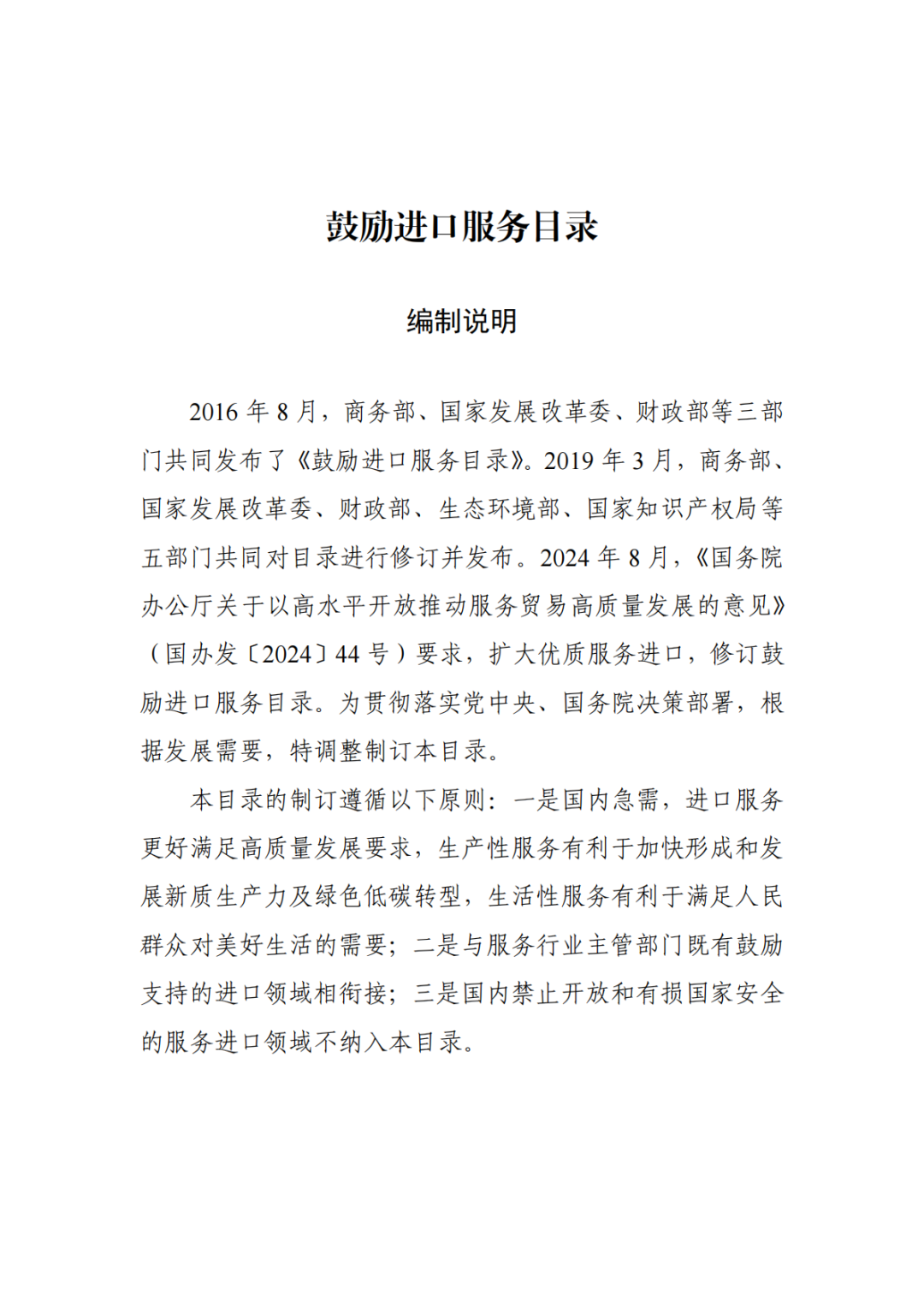
Core Viewpoint - The Ministry of Commerce and six other departments have jointly released a revised version of the "Encouragement of Import Services Directory," which aims to guide and support the innovative development of service trade, expand imports proactively, and achieve high-quality development in China [1][2]. Group 1: Directory Revision Overview - The revised directory is a response to the 2024 directive from the State Council to expand the import of quality services and is based on extensive research and feedback from local governments and service import enterprises [2][3]. - The new directory continues to support four existing categories: "Research and Design Services," "Energy Conservation and Environmental Protection Services," "Environmental Services," and "Consulting Services," while adding two new categories: "Other Professional Services" and "Medical and Health Services" [3][4]. Group 2: Specific Changes in the Directory - The new directory includes specific high-quality services that are urgently needed domestically, such as "Green Building and Other Low-Carbon Related Design, Assessment, or Certification Services" and "Supply Chain Management Services" under the "Other Professional Services" category [4][5]. - Adjustments have been made to optimize the content of encouraged import services, including updates to descriptions for "Digital Technology Development Services," "Technical Testing and Analysis Services," and "Water Pollution Control and Ecological Restoration Services" [4][5]. Group 3: Removal of Certain Services - Services that are no longer necessary to encourage for import, such as those solely focused on air pollution control, have been removed from the directory due to improvements in domestic service capabilities [5].

张一婷:有序扩大服务领域自主开放
Jing Ji Ri Bao· 2026-01-21 00:01
Core Viewpoint - The article emphasizes the importance of expanding the service sector's openness in China as a key characteristic of modernization, highlighting its role in economic growth and global competitiveness [1][2]. Group 1: Economic Impact - By 2025, the service sector's value added is expected to account for over 50% of China's GDP for 11 consecutive years, with foreign investment in this sector making up about 70% of the actual foreign capital utilized in the country [1]. - Expanding openness in the service sector can introduce advanced global technologies and high-quality services, enhancing the high-end development of productive services and the quality of life services [1][2]. Group 2: Policy and Strategy - The manufacturing sector has seen the removal of foreign investment restrictions, making the service sector the primary focus for expanding foreign openness [2]. - The article outlines a phased approach to opening the service sector, emphasizing the need for precise regulation and a balance between openness and security [2][3]. Group 3: Implementation and Challenges - Recent efforts have included easing foreign investment restrictions in the service sector and establishing a negative list management model for cross-border service trade, which has been promoted from Hainan Free Trade Port to other regions [3]. - Despite progress, challenges remain, such as the need for greater autonomy in certain regions and industries, and the necessity for improved coordination of entry and operational regulations [3]. Group 4: Future Directions - The article advocates for a proactive approach to institutional openness in the service sector, including reducing restrictions in telecommunications, healthcare, education, and culture, and exploring the removal of foreign ownership limits [4]. - It calls for enhancing pilot programs for service sector openness, focusing on high-end, digital, and green services, and leveraging the advantages of free trade zones [4][5]. Group 5: Risk Management - The establishment of a risk assessment and prevention mechanism for service sector openness is crucial, utilizing technologies like big data and AI to identify potential risks in finance, data, and network security [6].
1至11月全省签约652个重大项目
Xin Lang Cai Jing· 2025-12-24 18:49
Group 1: Investment Projects Overview - In the first 11 months of the year, Guizhou province has proposed 863 major investment projects with a total intended investment of 548.693 billion yuan [1] - A total of 652 projects have been signed, with 78 contracts exceeding 1 billion yuan and 2 contracts exceeding 10 billion yuan, amounting to a total contract value of 337.124 billion yuan [1] - 444 projects have commenced construction, with a total investment of 179.919 billion yuan [1] Group 2: Agricultural Investment Focus - Agricultural investment is a key area for Guizhou, with 323 agricultural projects proposed this year, totaling an investment of 46.79 billion yuan [1] - 263 agricultural projects have been signed, with a total investment of 40.08 billion yuan, and 234 projects have started construction, amounting to 30.73 billion yuan [1] - The signing rate for agricultural projects is 81.4%, and the construction rate for signed projects is 89% [1] Group 3: Cultural and Tourism Investment - Guizhou is accelerating its development as a world-class tourism destination, with 992 cultural and tourism projects established in the investment database [2] - As of the end of November, there are 108 key tourism projects in the database with a proposed investment of 27.559 billion yuan, and 84 projects have been signed with a contract investment of 21.909 billion yuan [2] - The annual target of exceeding 10 billion yuan in signed contracts has been surpassed [2] Group 4: Digital Industry Investment - The province has attracted 147 digital industry projects this year, with an investment exceeding 33.5 billion yuan [2] - This initiative aims to accelerate the establishment of a national digital industry cluster [2] Group 5: Productive Service Industry Investment - The province's development and reform commission has focused on productive service industry projects, with 69 major projects signed, totaling an investment of 22.522 billion yuan [3] - The focus areas include modern logistics, research and design, energy conservation, and human resources [3]
宏观经济周报:服务业与制造业的共赢逻辑-20251129
Guoxin Securities· 2025-11-29 11:53
Group 1: Economic Structure and Trends - The service and manufacturing sectors are not in opposition but rather have a symbiotic relationship, as evidenced by the increase of over 7 percentage points in the service sector's share of global GDP from 1980 to 1996, while manufacturing remained stable[1] - From 2002 to 2019, both sectors exhibited a synchronized trend of rise and fall, indicating their interdependence rather than a zero-sum game[1] - Manufacturing acts as an incubator for service industries, with many productive services like logistics and R&D initially emerging from within manufacturing firms[1] Group 2: Support and Demand Dynamics - The large service sector constitutes the core consumer base for manufacturing products, creating significant demand for items ranging from medical equipment to educational materials[2] - Services play a crucial role in enhancing human capital, which is essential for the quality of manufacturing inputs, thereby supporting innovation and breakthroughs in the manufacturing sector[2] - The current economic transition in China highlights the need for high-quality development in manufacturing to create more opportunities for productive services like R&D and digital services[2] Group 3: Current Economic Indicators - Fixed asset investment has decreased by 1.70% year-on-year, indicating a contraction in investment activities[4] - Retail sales have shown a modest increase of 2.90% year-on-year, reflecting some resilience in consumer spending[4] - Exports have declined by 1.10% year-on-year, suggesting pressure on external demand[4] - The M2 money supply has grown by 8.21%, indicating a continued expansionary monetary policy[4]
报告显示我国服务贸易规模和质量齐升 正向知识密集型转变
Zhong Guo Jing Ji Wang· 2025-09-15 08:19
Core Insights - The "Blue Book" highlights significant improvements in the scale and quality of China's service trade, driven by institutional openness, digital technology, and emerging service trade forms [1] Group 1: Transition to Knowledge-Intensive Services - China's service industry is shifting from labor-intensive to knowledge-intensive, optimizing industry structure and increasing the proportion of knowledge-intensive service trade [2] - Traditional service trade still holds a significant share, with tourism and transportation services accounting for about 50% of total service trade from 2019 to 2024 [2] - In 2023, tourism service trade exports reached $14.56 billion, with a projected 154.1% year-on-year growth in 2024, increasing to $37.0 billion [2] Group 2: Growth of Knowledge-Intensive Service Trade - In 2024, knowledge-intensive service trade is expected to reach 28,965.2 billion yuan, growing by 6.5%, with exports at 16,573.2 billion yuan, up 7.4% [3] - The fastest growth in knowledge-intensive service exports is seen in personal cultural and entertainment services, and telecommunications, with increases of 39.3% and 12.2% respectively [3] - Knowledge-intensive service trade surplus expanded to 4,181.2 billion yuan in 2024, an increase of 504.5 billion yuan from the previous year [3] Group 3: Service Outsourcing and Development - Service outsourcing has been growing, with an average annual growth rate of 14.47% from 2016 to 2024, and the total contract amount for service outsourcing contracts reaching 30,535 billion yuan in 2024 [3] - The execution amount for service outsourcing contracts was 22,197 billion yuan, reflecting a year-on-year growth of 13.3% [3] Group 4: High-Quality Development of Service Trade - The core of high-quality service trade development lies in releasing new productive forces in the service industry, focusing on high value-added and digital professional services [4] - There is a need to accelerate the development of knowledge-intensive productive services and support the establishment of digital service trade zones and export bases [4] - New service models such as virtual exhibitions and remote healthcare should be cultivated to enhance global market participation [4] Group 5: Impact of Digital Technology - Digital technology is reshaping the service trade model in entertainment, culture, and sports, driving industries towards intelligence, integration, and globalization [5] - Technologies like AI, 5G, and cloud computing are breaking traditional industry boundaries and accelerating the emergence of new business models [5][6] - The market for new service industries such as digital culture and smart tourism is expanding, with the sharing economy and platform economy thriving [6]
天津红桥:聚集资源提速项目建设
Zhong Guo Jing Ji Wang· 2025-08-19 03:57
Group 1 - China Coal Energy Group signed a cooperation agreement with the Beijing-Tianjin-Hebei National Technology Innovation Center for a key national R&D project focused on disruptive technology innovation in low-carbon energy [1] - The Energy Low-Carbon Innovation Center aims to transform disruptive green energy technologies and is rooted in Tianjin Hongqiao [1] - An investment fund for disruptive technology innovation in the low-carbon energy sector was established, and a national competition for disruptive technology innovation in low-carbon energy was launched [1] Group 2 - The Tianjin Hongqiao District has accelerated the construction of the Beijing-Tianjin-Hebei Integrated Business District, with significant progress on major projects over the past two years [2] - The integration of transportation modes ("subway + high-speed rail + airplane") at Tianjin West Station enhances the development of the business district [2] - The district's GDP grew by 6.1% year-on-year, fiscal revenue increased by 10.1%, fixed asset investment rose by 16.4%, and retail sales of consumer goods increased by 12.1% in the first half of the year [2]