经济学研究

Search documents
周其仁:问题比答案更重要︱21书评
2 1 Shi Ji Jing Ji Bao Dao· 2026-02-10 09:36
Group 1 - The core idea of the articles emphasizes the importance of asking good questions in the pursuit of knowledge, rather than merely seeking answers [2][6][7] - The experiences of influential scholars like Zhang Peigang and Ronald Coase illustrate how focusing on significant questions can lead to groundbreaking discoveries in economics [5][6][8] - Zhang Peigang's research on grain marketing during wartime highlights the critical role of transportation costs and market organization in agricultural economics, which aligns with the concept of transaction costs introduced by Coase [4][5] Group 2 - The discussion on artificial intelligence underscores that pivotal questions, such as Turing's inquiry about machine thinking, have driven scientific advancements and technological innovations [7][8] - The Wright brothers' approach to flight innovation demonstrates that identifying the right problem—ensuring stable flight—was key to their success, rather than merely achieving flight [8] - The development of the "Wicab" technology for the visually impaired showcases how a fundamental question about perception led to significant technological breakthroughs [8]

论争中的张维迎:一个古典自由主义者的自白|我们的四分之一世纪
经济观察报· 2025-12-27 05:04
Core Viewpoint - The past 25 years have been a significant learning process for understanding human nature, society, and the control of destiny [39] Group 1: Background and Context - In 2003, Zhang Weiying proposed a personnel reform plan at Peking University, which led to significant controversy and was perceived as a betrayal by some [8][9] - The year 2003 marked a pivotal moment in China's economic trajectory, coinciding with its entry into the WTO and a notable economic growth rate of 9.9% in the first quarter [11] - Zhang Weiying's early career included founding the China Center for Economic Research at Peking University, aiming to reform the education and research system in economics [12] Group 2: Reform and Controversy - The personnel reform plan aimed to eliminate nepotism and implement a "no promotion, no stay" policy, which sparked widespread debate and backlash [12][13] - Despite the criticism, Zhang Weiying believes the reform was successful in principle, as it laid the groundwork for future hiring standards at Peking University [14] - The reform process faced significant public scrutiny, leading to a perception of Zhang as a "traitor" within the university community [13] Group 3: Economic Debates and Perspectives - The "Lang-Gu" debate in 2004 highlighted the tensions surrounding state-owned enterprise reforms, with Zhang Weiying advocating for a nuanced understanding of economic reform [16][17] - Zhang Weiying emphasized the importance of individual contributions to economic growth, arguing that entrepreneurial spirit is crucial for progress [25] - The debate over economic paradigms continues, with Zhang Weiying and Lin Yifu representing differing views on the role of government intervention versus market forces [23][24] Group 4: Educational Initiatives and Philosophy - Zhang Weiying co-founded the Xinzhong Classroom to promote entrepreneurial spirit and humanistic values among students, emphasizing the importance of ideas and perspectives [28][31] - His academic work has consistently focused on the role of entrepreneurs in economic development, with a belief that understanding entrepreneurship is essential for societal progress [30][31] - Zhang Weiying's philosophy centers on the idea that human actions can shape the future, rejecting deterministic views of history and advocating for proactive engagement in societal change [36][39]

金刻羽最新演讲
Xin Lang Cai Jing· 2025-12-08 00:55
Core Insights - The lecture by Professor Jin Keyu emphasizes the shift from an era of "hyper-globalization" driven by economic development to a new phase where political forces are significantly shaping economic structures [3][9] - Geopolitical risks are increasingly influencing economic decisions, leading to inflation and capital market volatility, yet globalization shows unexpected resilience [4][10] - China's position in global supply chains is strengthening despite external pressures, with a notable decrease in reliance on imported intermediate goods, indicating enhanced supply chain autonomy [4][10] Geopolitical and Economic Dynamics - Geopolitical logic is deeply penetrating economic decision-making, with rising geopolitical risks reflected in economic phenomena such as inflation and market fluctuations [4][10] - Despite Western countries imposing technology blockades and protectionist measures against China, global dependence on China is increasing [4][10] - The importance of countries in trade networks is now more about their "hub" position in global production, trade, and knowledge networks rather than just their production scale [4][10] Role of Intermediate Countries - Middle-sized countries in a "non-aligned" or "intermediate" position are becoming crucial "connectors" in the global economy, facilitating trade and investment amidst weakening geopolitical group trade [5][11] - These countries are emerging as important buffers for maintaining global economic interactions, contributing to the resilience of globalization and indicating a complex multi-centered network rather than a simple bipolar world [5][11] Future Competition and Technological Dynamics - The core logic of future technological competition is shifting from pursuing "technological monopoly" to developing "technology diffusion and application capabilities" [5][12] - China is leveraging its advantages in large-scale manufacturing, cost innovation, and rapid application to drive technology diffusion and lower global costs [5][12] - Protectionism and technology blockades may backfire, potentially stimulating domestic innovation in targeted countries and accelerating the formation of alternative systems [5][12] Conclusion on Globalization - Globalization is undergoing profound restructuring and demonstrating remarkable resilience, with countries needing to enhance their hub and connectivity roles in global networks [5][12] - The emphasis on maintaining openness and cooperation is crucial for achieving sustainable growth and shared prosperity in the new geopolitical economic landscape [5][12]
诺贝尔经济学奖公布!获奖成果都在研究什么?
Sou Hu Cai Jing· 2025-10-13 15:58
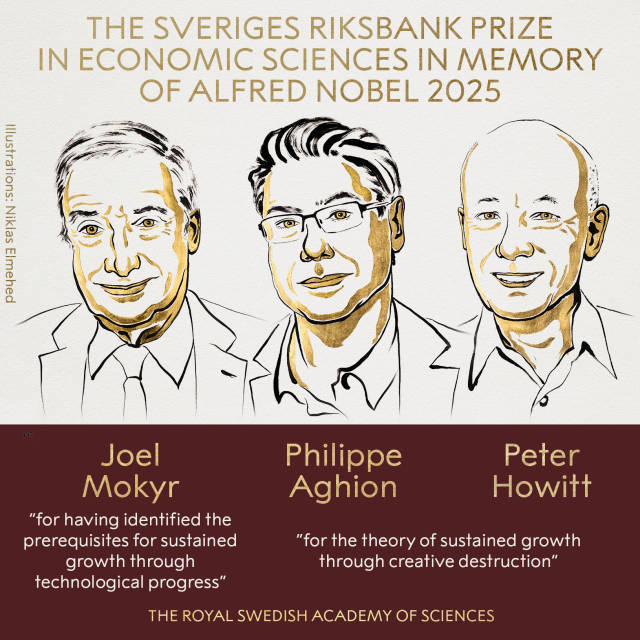
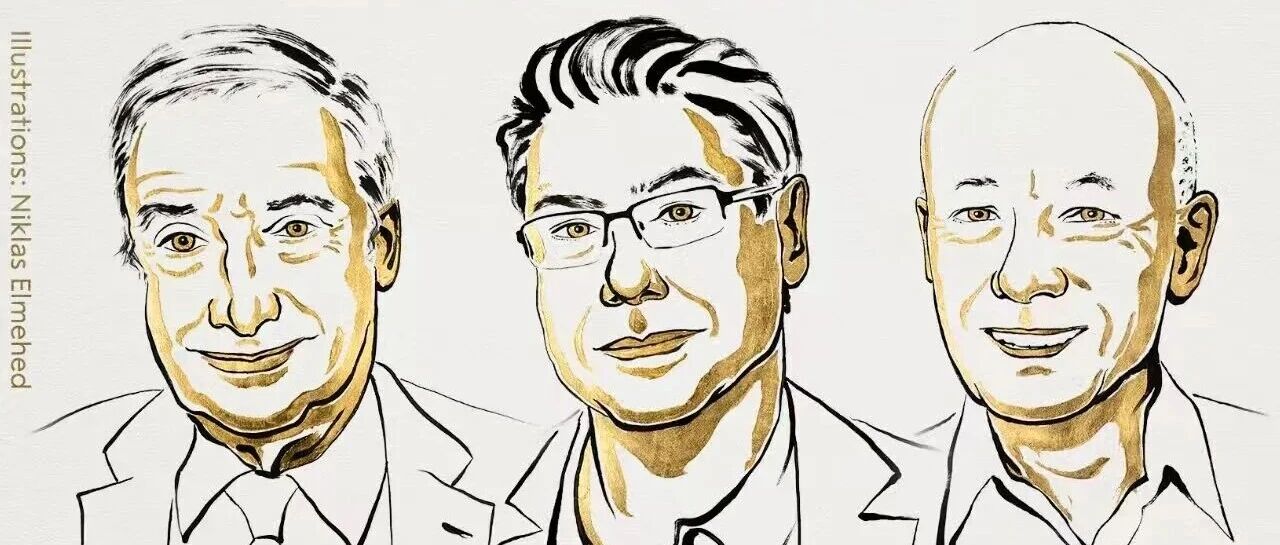
Core Insights - The 2025 Nobel Prize in Economic Sciences was awarded to economists Joel Mokyr, Philippe Aghion, and Peter Howitt for their contributions to understanding innovation-driven economic growth [1][2] - Mokyr received half of the prize for his work on the prerequisites for sustained growth through technological progress, while Aghion and Howitt shared the other half for their theory on sustained growth under creative destruction [1] Group 1: Mokyr's Contributions - Mokyr's research addresses why the Industrial Revolution occurred in 18th century Britain rather than in India, emphasizing the importance of "useful knowledge" accumulation, inclusive institutional environments, and cultural respect for experimental science [3][4] - His work highlights the role of platforms like the Royal Society in knowledge sharing, patent laws in protecting innovators, and societal attitudes towards science as critical factors for technological transformation into sustained productivity [3] Group 2: Aghion and Howitt's Theory - Aghion and Howitt's "creative destruction" model explains the dynamics of innovation, where competitive R&D leads to vertical innovation as the ultimate source of growth [7] - Their model illustrates that increased R&D activity can rapidly destroy existing innovations, thereby impacting current R&D incentives, and it provides a framework for understanding the transition from traditional fuel vehicles to electric vehicles [7][8] - The model also quantifies the effects of innovation on employment and industry structure, suggesting that while old industries may decline, the overall vitality of the economic ecosystem can improve [8] Group 3: Trends in Economic Research - Recent Nobel Prize selections reflect a shift in economic research from abstract theoretical modeling to addressing real-world issues, emphasizing dynamic processes over static analyses, and integrating interdisciplinary approaches [10] - This trend is particularly evident in new economic fields, where research must consider multiple dimensions such as technological feasibility, regulatory frameworks, and consumer behavior [10]
2025年诺奖得主莫克尔:启蒙经济视角下英国现代经济增长的起源
Sou Hu Cai Jing· 2025-10-13 14:33
Core Insights - The 2025 Nobel Prize in Economic Sciences was awarded to Joel Mokyr, Philippe Aghion, and Peter Howitt for their contributions to understanding innovation-driven economic growth [2][4] - The Nobel Committee emphasized the importance of managing creative destruction constructively to avoid hindering innovation by established companies and interest groups [4] Group 1: Economic Growth and Beliefs - Economic changes in any period heavily depend on people's beliefs, more so than most economists acknowledge [6][7] - Mokyr's work highlights that the Enlightenment era significantly influenced economic outcomes, suggesting that ideology and culture play crucial roles in economic results [6][8] Group 2: Historical Context of Economic Transformation - Between 1700 and 1850, the UK experienced profound economic changes, with the population more than doubling and urbanization increasing significantly [9][11] - By 1850, 45% of the population lived in towns, up from 18% in 1700, indicating a shift towards market dominance in daily economic activities [9][10] Group 3: The Role of Ideas and Intellectual Competition - The competition among intellectuals, scientists, and entrepreneurs during the Industrial Revolution was pivotal in shaping economic development [7][8] - The emergence of dominant ideas often depended on favorable environments, but historical uncertainty and timing also played critical roles in their success [8][9] Group 4: Industrial Revolution and Economic Leadership - The Industrial Revolution marked the beginning of modern economic growth, with the UK becoming the undisputed world economic leader by the time of the Crystal Palace Exhibition in 1851 [10][11] - The period saw a significant transformation in consumption patterns and living standards, with luxury goods becoming accessible to a broader segment of the population [9][10]
诺贝尔经济学奖获得者:发财不一定需要知识,但经济增长需要
Hu Xiu· 2025-10-13 13:22
Core Insights - The 2025 Nobel Prize in Economic Sciences was awarded to Joel Mokyr, Philippe Aghion, and Peter Howitt for their contributions to understanding how technological change drives sustained economic growth [1] Group 1: Contributions of Joel Mokyr - Mokyr's work focuses on the origins and evolution of modern economic growth through systematic research of economic history [1] - He emphasizes the role of knowledge in economic growth, arguing that modern growth is significantly more dependent on knowledge compared to pre-modern economies [6][12] - Mokyr attributes the rise of knowledge's importance to the Enlightenment, which reshaped knowledge systems and encouraged scientific inquiry [7][8] Group 2: Contributions of Philippe Aghion - Aghion's research centers on innovation economics, particularly the concept of "creative destruction," which explains how technological progress disrupts old structures to foster economic growth [15][16] - He, along with Peter Howitt, developed a model that incorporates the randomness of technological research and its interaction with economic cycles [17] - Aghion also investigates the microeconomic mechanisms and institutional factors behind innovation, such as ownership structures and financing environments [18]
诺贝尔经济学奖获得者:发财不一定需要知识,但经济增长需要
经济观察报· 2025-10-13 12:40
Group 1 - The 2025 Nobel Prize in Economic Sciences was awarded to Joel Mokyr, Philippe Aghion, and Peter Howitt for their contributions to understanding how technological change drives sustained economic growth [5] - Mokyr's work focuses on the historical origins and evolution of modern economic growth through systematic research of economic history [5][4] - Aghion and Howitt developed the "creative destruction" mechanism, explaining how technological innovation drives long-term growth in dynamic competition [5][4] Group 2 - Mokyr's research emphasizes the role of knowledge in economic growth, arguing that modern growth is significantly more dependent on knowledge compared to pre-modern economies [10][11] - The Enlightenment period is identified as a key factor in the rise of knowledge's importance in economic growth, reshaping knowledge systems and promoting scientific inquiry [10][11] - Mokyr's "Enlightenment Index" shows that regions like England and the Netherlands had higher knowledge dissemination compared to France, correlating with their economic development [12] Group 3 - Aghion, a prominent figure in innovation economics, integrates the concept of "creative destruction" into modern economic theory, highlighting both the benefits and potential downsides of innovation [15][16] - Aghion and Howitt's theory addresses the randomness of technological research and its interaction with economic cycles, providing insights into the conflicts arising from technological transitions [17] - Aghion has engaged with the Chinese academic community since the 1990s, contributing to discussions on economic reform and receiving accolades such as the Sun Yefang Economic Science Award [18]
诺贝尔经济学奖获得者阿吉翁曾说过什么?
Di Yi Cai Jing· 2025-10-13 11:37
Core Insights - The 2025 Nobel Prize in Economic Sciences was awarded to Joel Mokyr, Philippe Aghion, and Peter Howitt for their contributions to understanding innovation-driven economic growth [1] - Aghion's work, particularly the Aghion-Howitt model based on "creative destruction," has reintegrated Schumpeter's economic growth paradigm into mainstream macroeconomic theory [1] Group 1: Nobel Prize Winners - Joel Mokyr received half of the prize for identifying prerequisites for sustained growth through technological advancement [1] - Philippe Aghion and Peter Howitt jointly received the other half for their theoretical work on achieving sustained growth through creative destruction [1] - Aghion is recognized as a leading figure in economic growth theory and has been a strong candidate for the Nobel Prize for years [1] Group 2: Economic Theories and Policies - The concept of "creative destruction," originally proposed by economist Schumpeter, suggests that large-scale innovations replace outdated technologies and production systems [4] - Aghion emphasizes the importance of government support in helping employees and businesses adapt to new economic environments, particularly through education, training, and income insurance [4] - Aghion's analysis of the "Danish model" highlights how effective social protection can mitigate the negative impacts of job loss, contrasting it with the less supportive system in the U.S. [4] Group 3: U.S. Economic Measures - The Biden administration has attempted to address economic challenges through a series of relief measures, but the lack of a robust social safety net remains a significant issue [6] - Aghion notes that the U.S. needs to rethink its social system to better protect individuals from unemployment and economic crises [6] - There is a potential shift in American attitudes towards social welfare, especially following the pandemic, which may create opportunities for new social safety measures [7] Group 4: European Innovation Challenges - Aghion points out that Europe is underinvesting in innovation and needs to unite to promote large-scale projects [8] - He criticizes Europe's regulatory environment for being overly focused on preventing anti-competitive practices rather than fostering investment [8] - The current crisis has highlighted Europe's inefficiencies in innovation, indicating a need for a more proactive investment approach [8]

2025年诺贝尔经济学奖:创新、毁灭与增长
Jing Ji Guan Cha Bao· 2025-10-13 10:54
Core Insights - The 2025 Nobel Prize in Economic Sciences was awarded to Joel Mokyr, Philippe Aghion, and Peter Howitt for their contributions to understanding how technological change drives sustained economic growth [1] Group 1: Contributions of Joel Mokyr - Mokyr's research focuses on the origins and evolution of modern economic growth through systematic studies of economic history [1] - He emphasizes the role of knowledge in economic growth, arguing that modern growth is significantly more dependent on knowledge compared to pre-modern economies [5][6] - Mokyr attributes the rise of knowledge's importance in economic growth to the Enlightenment, which reshaped knowledge systems and encouraged scientific inquiry [6][7] Group 2: Contributions of Philippe Aghion and Peter Howitt - Aghion and Howitt introduced the concept of "creative destruction," explaining how technological progress disrupts old structures to promote economic growth [11][12] - Their work on endogenous growth theory highlights the dual effects of technological change: enhancing long-term growth potential while also causing disruptions to existing enterprises [12][13] - Aghion's research also delves into the micro-mechanisms and institutional factors behind innovation, including the impact of ownership structures and financing environments [13]
周末读史 | 中国传统经济思想的问题导向与丰富内涵
Sou Hu Cai Jing· 2025-10-11 10:48
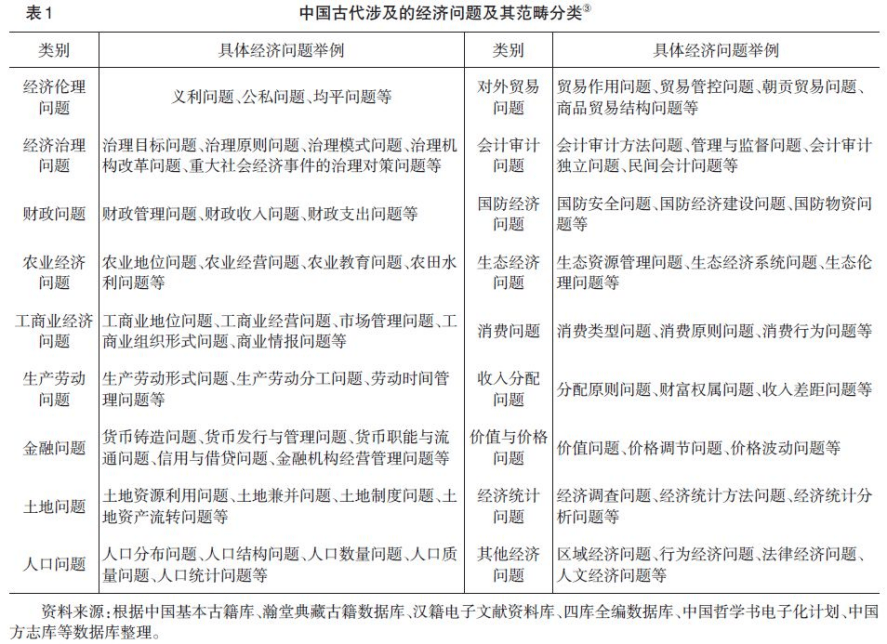
Core Insights - The article explores the richness and depth of traditional Chinese economic thought, identifying 18 major economic issues that have persisted throughout history [1][2] - It emphasizes the evolution of traditional economic thought into three layers: economic philosophy, economic propositions, and economic analysis [1][9] - The study highlights the importance of traditional economic thought in contemporary economic theory and its potential for creative transformation [1][12] Group 1: Classification of Economic Issues - Traditional Chinese economic thought is categorized based on 18 major economic issues, including economic ethics, governance, finance, agriculture, commerce, labor, finance, land, population, foreign trade, accounting, national defense, ecology, consumption, income distribution, value and price, economic statistics, and other economic issues [5][6][7] - The classification reflects the systematic and diverse nature of ancient economic problems, which directly influences the richness of economic thought [3][5] Group 2: Depth of Economic Thought - Traditional Chinese economic thought exhibits a layered structure, encompassing philosophical, political, and ethical elements that form the theoretical foundation for analyzing economic issues [9][10] - The depth of thought is characterized by a combination of macro and micro perspectives, leading to various insights, propositions, and policies for addressing economic problems [9][10] Group 3: Formation Mechanisms - The richness of traditional Chinese economic thought is attributed to the interplay of economic practice, cultural heritage, ideological traditions, diverse participants, and modes of exchange [12][13] - Agricultural practices and the development of commerce and foreign trade have significantly influenced the evolution of economic thought in ancient China [12][13] Group 4: Contemporary Relevance - The article suggests that understanding and leveraging traditional Chinese economic thought can contribute to the innovative development of a Chinese economic knowledge system [15] - It emphasizes the need to adopt a problem-oriented approach and integrate traditional wisdom into modern economic practices to enhance theoretical innovation [15]