
饲料生产

Search documents
鲁、豫生猪饲料市场调研报告
Guang Fa Qi Huo· 2026-03-17 10:58
1. Report Industry Investment Rating No information provided. 2. Core Viewpoints of the Report - The current pig industry is in a bottom - oscillating adjustment period, with the overall trend of "short - term stabilization and decline, medium - term slight recovery, and further pressure release in the second half of the year". Industry reshuffle is accelerating, and cost control and model innovation are the keys for enterprises to break through [16]. - The long - term industry losses will lead to a reshuffle, and enterprises with sufficient funds and good cost - control capabilities will stand out. The pig price is expected to struggle at the bottom for a long time, and it is recommended to mainly use reverse hedging operations in the futures market, and long - term allocation can focus on high - quality breeding stocks [20]. 3. Summary by Directory 3.1. Research Summary 3.1.1. Feed Link - Some feed enterprises face the pressure of declining sales. The core reasons are the recurrence of diseases in Shandong from mid - October to early November last year, which led to an early increase in pig slaughter volume, reducing feed demand. Coupled with the low pig price and rising feed price, the breeding end is cautious about restocking, further suppressing feed consumption. Enterprises expect feed sales to gradually recover after April [5]. - In terms of raw material procurement, affected by the mildew of North China corn, enterprises mainly purchase corn from the Northeast, with a transportation cost of 200 - 300 yuan/ton. To reduce the impact of toxins, enterprises implement refined proportioning. Piglet feed uses all Northeast corn, and medium and large pig feed uses a combination of Northeast and local corn. The overall inventory is relatively sufficient, and the current enthusiasm for restocking is limited [5]. - Affected by the increase in raw material prices after the Spring Festival, the feed price has been raised synchronously. The sales volume in March is expected to decline by 30% year - on - year, which is in line with the historical trend after the Spring Festival. However, the sales volume of teaching and protection feed is expected to improve slightly month - on - month, indicating that the inventory of piglets in the market is still at a high level [5]. - For raw material price prediction, enterprises believe that soybean meal is supported by the cost of US soybeans and international freight in the short term and has increased in price, but the overall supply is loose, so they do not blindly expect a high price. Corn still has room for price increase, and the subsequent price is expected to reach 2600 - 2700 yuan/ton [5]. 3.1.2. Breeding Link - The breeding end is currently facing multiple pressures such as low pig prices, increased costs, and high inventory. The enthusiasm for restocking is differentiated, and enterprises of different scales show different business situations. Although the industry is generally in a loss state, the adjustment of production capacity is very cautious [7]. - In terms of production capacity, the current industry production capacity is still at a high level. Although the data from the Ministry of Agriculture shows that the number of fertile sows in the country has decreased to 39.6 million, the absolute value is still high. The impact of losses and diseases at the end of last year on production capacity is relatively limited. Breeding enterprises have no obvious intention to actively reduce production capacity, only those with financial difficulties reduce production capacity passively. The reduction of production capacity by leading enterprises is mostly for capacity transfer, and the actual slaughter volume of sows has not increased significantly, and the price of culled sows is stable [7]. - In terms of restocking, the current enthusiasm for secondary fattening is not high. Affected by factors such as low pig prices, rising feed costs, and the inversion of standard and fat pig prices, secondary fattening households mostly adopt a wait - and - see attitude. Most stocking enterprises' pens are empty. It is expected that the enthusiasm for purchasing 15kg piglets is higher than that for 7kg piglets. Enterprises are optimistic about the price before the Zhongyuan Festival and believe that the decline space of piglet prices is limited because the restocking demand in Shandong from March to May is relatively high. In Henan, there is a situation of "high piglet prices and cautious restocking", and only a small number of secondary fattening households buy at the bottom [9]. - In terms of cost and profit, there are differences among enterprises. The current fattening cost of individual farmers in Shandong is about 5.5 yuan/jin, the fattening cycle is 5 - 5.5 months, and the daily weight gain is 1.6 jin. The daily weight gain of secondary fattening is about 2 jin. The slaughter cost of stocking enterprises is about 5.6 yuan/jin (excluding disease losses), and the cost after disease losses exceeds 6 yuan/jin. The current pig price is about 5 yuan/jin, and the industry is in a loss state. In addition, slaughterhouses have increased the deduction for large pigs, and the supply of pigs in the 125 - 150KG weight range is sufficient, and the price decline is greater than that in the 105 - 125KG range. Breeding enterprises have difficulties in selling and are forced to reduce prices, and the pressure of slaughtering large pigs is relatively large. Group enterprises are still further reducing costs and will further lower the target cost in 2026, achieving cost - control advantages through integrated layout [10]. - In terms of diseases and hedging, there are still sporadic epidemics, which increase the breeding cost and risk. The current full - industry loss state and the investment in disease prevention and control costs undoubtedly increase the burden on enterprises. If there is a high - incidence period of epidemics in the future, it may increase the risk of concentrated outbreaks of diseases at the breeding end. In terms of hedging, enterprises in Shandong and Henan have a high enthusiasm for hedging, and the model is mature. They are more enthusiastic about hedging in the piglet fattening link. The large - scale participation of the breeding end industry also has a profound impact on the futures market trend [13]. 3.1.3. Slaughter and Trade Link - In the slaughter link, it is currently facing problems such as weak demand, seasonal decline in sales volume, and financial pressure. Although the pig price is at a low level, the current enthusiasm for segmentation and warehousing is not high. However, some more radical enterprises believe that the risk of making frozen products at a pig price of about 5 yuan/jin is low and are gradually segmenting and warehousing. The weak performance of the consumer end is the core problem faced by slaughter enterprises. The current low pork price has an insignificant effect on stimulating consumption, and the willingness of terminal consumers to switch from beef and poultry to pork is not strong, which is in line with the situation where the decline in poultry prices affects the demand for pig products. At the same time, the industry has over - capacity and a long payment period, which further increases the pressure on slaughter enterprises. Therefore, the current overall warehousing rhythm is still relatively slow [14]. - In the trade link, single transportation businesses have mostly transformed due to financial pressure, and enterprises mostly adopt the "transportation + stocking" model. Slaughterhouses generally have a long payment period, and traders face prominent financial pressure. Large pigs in Shandong mainly flow to Anhui and Zhejiang, but affected by the sufficient supply of large pigs in the South, the number of large pigs transported from the North to the South has decreased, which is consistent with the current situation of the structural mismatch between the supply and demand of pigs in the North and the South. Although there is a gap in the main sales areas in the South, the current supply is sufficient, resulting in a decline in cross - regional transportation volume [15]. 3.1.4. Market Outlook - The current pig industry is in a bottom - oscillating adjustment period. Although there are differences in market predictions among all parties, the overall trend is "short - term stabilization and decline, medium - term slight recovery, and further pressure release in the second half of the year". At the same time, the industry reshuffle is accelerating, and cost control and model innovation are the keys for enterprises to break through [16]. - In terms of market prediction, most enterprises believe that March - April is the low - price range of pig prices in the first half of the year, and the probability of the price being lower than this level in the future is small and the duration is short. From May to June, the price is expected to rise with the decrease in supply. It is difficult to judge the annual high point, and it is expected that reaching 7 yuan/jin is already good. Regarding the market in the second half of the year, there are different views in the market. Some believe that it is expected to recover, but some enterprises believe that there is no substantial reduction in production capacity at present. Although the industry is in a loss state, the time and space of the loss are limited, the breeding end has sufficient funds, and it is difficult to reduce production capacity, so the expectations for the second half of the year have been lowered [16]. 3.2. Research Minutes 3.2.1. Shandong Enterprise A - The enterprise mainly engages in pig feed (with a small amount of ruminant feed). The designed production capacity of pig feed is 180,000 tons, and the current output is about 60,000 tons. It has 20,000 fattening pens, and the scale of the cooperative fattening pig enterprise reaches 100,000 heads. In terms of feed sales, the pig feed sales volume in February was about 3,000 tons, a significant halving month - on - month, and the sales volume from December to February continued to decline month - on - month. It is expected to start to recover in April, mainly because the recurrence of diseases in Shandong from mid - October to early November last year led to an increase in pig slaughter volume, resulting in an early decline in pig feed sales [21]. - In terms of restocking, the enthusiasm for secondary fattening in Linyi is not high. Affected by low pig prices, rising feed costs, and the inversion of standard and fat pig prices, secondary fattening households mostly adopt a wait - and - see attitude. The enterprise's 20,000 pens and most of its cooperative customers' pens are currently empty. It plans to purchase 15kg piglets recently and slaughter them before the Zhongyuan Festival on August 27 (with a slaughter weight of 270 - 280 jin). It is optimistic about the price before the festival and believes that the decline space of piglet prices is limited because the restocking demand in Shandong from March to May is relatively high [21]. - In terms of fattening cost, the enterprise indicates that the current cost from purchasing 15kg piglets (450 yuan/head) to slaughter is about 6 yuan/jin, and the fattening cost of individual farmers is about 5.5 yuan/jin. The fattening cycle is 5 - 5.5 months, and the daily weight gain is 1.6 jin. The daily weight gain of secondary fattening is about 2 jin [21]. - In terms of circulation, large pigs in Shandong mainly flow to Anhui and Zhejiang. Affected by the sufficient supply of large pigs in the South, the number of large pigs transported from the North to the South has decreased [22]. - In terms of hedging, it is recommended to use over - the - counter options for hedging, which can be combined with on - exchange hedging to reduce risks. Enterprises in Shandong have a high enthusiasm for hedging [22]. - In terms of feed raw materials, the enterprise's corn inventory is maintained for more than one month, with daily rotation in and out. Affected by the mildew of North China corn, it mainly purchases corn from the Northeast, with a transportation cost of 200 - 300 yuan/ton. It proportions corn for different pig feed stages to reduce toxins. Piglet feed uses all Northeast corn, and medium and large pig feed uses a combination of Northeast and local corn. The enterprise is optimistic about the domestic corn price and expects it to reach 2600 - 2700 yuan/ton [22]. - In the future, the enterprise will focus on promoting piglet procurement, hedging operations, and raw material procurement, strengthen market monitoring, and pay attention to the trends of pig prices and raw material prices. In terms of the market, the short - term pig price is expected to improve in April, stabilize in May, improve in June, and may decline in July, and the long - term upward space is limited [22]. 3.2.2. Shandong Enterprise B - The enterprise mainly engages in the sales of segmented products. The current daily slaughter volume is more than 5,000 heads, half of the peak of more than 10,000 heads before the Spring Festival. The average weight of purchased pigs is 100 - 110 kg, the same as the same period. The pig sources mainly come from local Shandong and northern Jiangsu. In terms of pig prices, the enterprise believes that March - April may be the low price of the year, and the probability of the price being lower than this level in the future is small and the duration is short. It is relatively optimistic about the pig price in the second half of the year. The short - term average price in March is 5.2 - 5.4 yuan/jin, slightly rising to about 5.6 yuan/jin in April. The supply is expected to decrease from May to June, and the price is expected to rise. It is difficult to judge the annual high point, and it is expected that reaching 7 yuan/jin is already good [23]. - In terms of enterprise operation, the fresh - sales rate is about 50%, down from 70 - 80% before the Spring Festival. Warehousing is mainly order - based, with 25% being customer orders and 25% being active + passive warehousing. In terms of product cost, the price of No. 4 meat is 15,500 - 16,000 yuan/ton, and the price of No. 2 meat is 15,000 - 15,500 yuan/ton. In the frozen - product storage cost, the daily rent per ton of goods is 1 yuan (30 yuan/ton per month). Coupled with handling and transfer fees, the monthly fixed cost is about 100 yuan/ton. The enterprise's designed frozen - product storage capacity is about 10,000 tons, and the current inventory is 3,000 - 4,000 tons (including customer orders and the amount of active segmentation and warehousing). It believes that the risk of making frozen products at a pig price of about 5 yuan/jin is low and is gradually segmenting and warehousing, planning to complete the target volume in about three months. At the same time, the enterprise pays attention to production refinement and channel construction, and some enterprises avoid payment - period risks [23]. - In terms of supply and demand, the decline in poultry prices affects the demand for pig products. The prices of frozen and fresh meat are close, and the discount situations are different for different uses. The industry has over - capacity, and there are differences in the management and production capacity of slaughterhouses in the North and the South. Some southern enterprises rely on contract slaughtering. The enterprise improves its competitiveness by optimizing production and sales and cooperating to stabilize customers [24]. - In terms of inventory, deep - processing enterprises increase inventory moderately as needed. In terms of funds, supply - chain finance provides support, and the enterprise uses funds carefully. Looking forward to the future, the short - term price will rise slowly, and the medium - term demand is expected to increase. The enterprise will optimize inventory, expand channels, and strictly control costs [25]. 3.2.3. Shandong Enterprise C - The enterprise is a large - scale pig trading enterprise in the local area, with business covering the whole country. The average daily trading volume is about 50 trucks, reaching 120 trucks at the peak before the Spring Festival. Each truck is 15 - 18 tons, and the weight of each truck of large - weight pigs exceeds 16 tons. The purchased pig sources are mainly from provinces in the Northwest and the South with low prices and price - difference advantages [26]. - Currently, the stocking volume in the Shandong region is large, and the local fattening supply is sufficient. The enterprise's own stocking volume is about 30,000 heads, which is relatively small among large - scale stocking enterprises in the local area. Shandong stocking enterprises had a long - term profit in the early stage and increased the volume rapidly last year. They have been in a loss state since September last year. The agency - raising fee is 200 - 240 yuan/head. Because the average weight per head is lower than that in the South, the agency - raising fee is lower than that in the South [26]. - At the breeding end, the slaughter cost of stocking enterprises is about 5.6 yuan/jin (excluding disease losses), and the cost after disease losses exceeds 6 yuan/jin. The current pig price is about 5 yuan/jin, and the industry is in a loss state. Shandong slaughterhouses have increased the deduction for large pigs, 80 - 100 yuan per head. The supply of pigs in the 125 - 150KG weight range is sufficient, and the price decline is greater than that in the 105 - 125KG range. Breeding enterprises have difficulties in selling and are forced to reduce prices [26]. - At the industry level, single transportation businesses have mostly transformed due to financial pressure, and enterprises mostly adopt the "transportation + stocking" model. Slaughterhouses generally have a long payment period, and traders face prominent financial pressure [26]. - The process of taking delivery in the futures market is cumbersome. In the North, 72 - hour disinfection is required in advance for delivery, and the intangible cost is high. Slaughterhouses have a low participation rate and are prone to losses [26]. - All parties believe that the current bottom - oscillating of pig prices has just started and is expected to last for about three months. Enterprises need to have sufficient funds and good cost - control capabilities to survive the difficult period [27]. 3.2.4. Henan Enterprise A - The
从“走出去”到“共发展”
Xin Lang Cai Jing· 2026-02-09 23:29
Core Viewpoint - The "Belt and Road" initiative is driving Chinese private enterprises to explore international markets, with Ghana emerging as a key destination for investment and industrial development [1]. Group 1: Company Development - The establishment of Greenhouse International Development (Ghana) Group by Gao Jian and his partner Zheng Xiangming in 2011 marked the beginning of their investment journey in Ghana, focusing on creating a sustainable industrial platform for Chinese enterprises [2]. - The company initially targeted urgent infrastructure and livelihood needs in Ghana, engaging in road and bridge construction and later expanding into agriculture and aquaculture [2][3]. - The company has developed the Guangming International Industrial Park, which has become a significant platform for Chinese enterprises to expand into the West African market, featuring comprehensive infrastructure and logistics [4]. Group 2: Industrial Park Features - Guangming International Industrial Park is designed for integrated development, combining industrial, commercial, and entertainment functions, and aims to attract over 70 Chinese enterprises by 2025 [5]. - The park is strategically located near Tema Port, enhancing its accessibility and potential to serve the broader West African economic zone [4]. Group 3: Local Engagement and Employment - The company emphasizes local employment, with over 90% of its workforce being local employees, and aims to create direct employment for 60,000 people and indirect employment for 200,000 upon full completion of the industrial park [8]. - The company provides systematic training and equal promotion opportunities for local employees, fostering skill development in engineering, manufacturing, and logistics [8]. Group 4: Social Responsibility - The company actively engages in social responsibility initiatives, contributing over 10 million RMB to various local community projects, including education and disaster relief [9]. - Gao Jian's commitment to community development reflects the company's philosophy of shared growth, emphasizing the importance of mutual development between the enterprise and local society [9].


阿尔及利亚强化畜牧与饲料保障
Shang Wu Bu Wang Zhan· 2026-02-06 06:32
Core Viewpoint - The Algerian government is committed to increasing support for livestock and feed production to ensure food security and stabilize the related industries [1] Group 1: Government Initiatives - The Minister of Agriculture, Rural Development, and Fisheries announced ongoing support for the livestock and feed production sectors during the opening of the third International Poultry and Feed and Veterinary Science Exhibition [1] - The government imported approximately 125,000 tons of corn from December to January to address temporary feed supply issues and established strategic reserves to stabilize market fluctuations [1] - There has been a noticeable increase in the number of local feed production companies, and the government plans to continue supporting these enterprises through policy and organizational measures [1] Group 2: Industry Development - The exhibition, themed "New Technologies in Poultry and Sheep and Goat Farming," attracted over 70 specialized institutions and companies from Algeria, China, Egypt, France, and other countries, showcasing the latest achievements in livestock farming, feed production, and veterinary technology [1] - The event serves as an important platform for promoting technological exchange, industry connections, and investment cooperation [1] - The Minister emphasized the need to strengthen institutional guarantees for livestock health and enhance the role of veterinarians in industry governance, aiming to establish a framework for the veterinary industry [1] Group 3: Sustainable Development - The government's initiatives reflect a systematic approach to promoting sustainable development in the livestock sector by ensuring feed supply, improving industry structure, and strengthening professional support [1]
东西部协作续写新故事——来自宁夏回族自治区的调查
Jing Ji Ri Bao· 2026-02-02 22:10
Core Viewpoint - The collaboration between Fujian and Ningxia has evolved over 30 years from one-way assistance to a mutually beneficial partnership, significantly contributing to poverty alleviation and rural revitalization efforts [1][2]. Group 1: Achievements of the Collaboration - The Fujian-Ningxia collaboration has transitioned from single-directional poverty alleviation to cooperative win-win outcomes, with a focus on consolidating and expanding poverty alleviation results and effectively connecting with rural revitalization during a five-year transition period [2]. - The collaboration has led to the establishment of various economic projects in Ningxia's rural areas, enhancing the foundation for rural industrial revitalization [3]. - By 2025, Ningxia plans to invest 650 million yuan in 129 projects aimed at enhancing characteristic industries, benefiting 278 administrative villages [4]. Group 2: Industrial Upgrading and Support - The collaboration has facilitated the establishment of a modern agricultural framework, with a total area of 14,900 acres dedicated to facility agriculture, supporting standardized planting and off-season supply of specialty crops [4]. - The introduction of technology and expert guidance from Fujian has been pivotal in enhancing agricultural productivity and quality, with initiatives like the "Fujian Specialty Plant Technology Cooperation Base" providing ongoing support [5][6]. - The establishment of the Ningxia Shanhai Feed Company, which focuses on local resource advantages and leverages Fujian's industrial experience, aims to enhance the local economy and reduce costs for livestock farmers [7]. Group 3: Labor and Employment Initiatives - The collaboration has shifted from merely encouraging labor migration to promoting stable employment opportunities within local communities, enhancing the skill levels of the workforce [10][11]. - Various labor brands have emerged, such as "Yuanzhou Weavers" and "Yongning Winemakers," which have successfully integrated traditional skills into modern economic activities, providing stable employment for thousands [12]. - By 2025, 63,000 rural laborers have been supported in stable employment through a comprehensive labor cooperation mechanism [12]. Group 4: Market Expansion and Sales Channels - The collaboration has focused on expanding market access for local agricultural products, with initiatives like the "Fujian Market + Ningxia Products" model facilitating broader market penetration [13][14]. - The establishment of e-commerce platforms and training programs has empowered local farmers to market their products effectively, leading to significant sales growth [14][15]. - By 2025, the collaboration is expected to achieve a consumption assistance amount of 7.692 billion yuan, reflecting an 8.6% year-on-year increase [13].
905万亩背后的鄂尔多斯担当:寒冬治沙战犹酣
Zhong Guo Xin Wen Wang· 2026-01-30 07:40
Core Viewpoint - The news highlights the ongoing ecological restoration efforts in Ordos City, Inner Mongolia, focusing on desertification control and sustainable development initiatives, particularly in the Kubuqi Desert and the Mu Us Sandy Land [1][2][3]. Group 1: Ecological Restoration Efforts - Ordos City has made significant progress in ecological restoration, completing 19.05 million acres of the "Three-North" project in 2025, with 8.6 million acres specifically for desertification control [1]. - The governance rates for the Kubuqi Desert and Mu Us Sandy Land have reached 50% and 85%, respectively, showcasing a commitment to ecological improvement [1]. - The city employs a systematic approach to build ecological defenses, including green belts and various engineering projects to combat desertification [2]. Group 2: Technological Innovation - Ordos is leveraging technological innovation as a key support for its ecological initiatives, implementing over 20 major technology projects aimed at advancing intelligent and mechanized desertification control [3]. - The mechanization rate for desertification control has reached 75%, resulting in a 30% reduction in labor costs and a fivefold increase in efficiency [3]. Group 3: Economic Benefits and Community Impact - The city is exploring pathways to convert ecological benefits into economic gains, with local companies employing automated processes to enhance efficiency and reduce costs for local farmers [4]. - By 2025, the area dedicated to the production of feed crops is expected to reach 15 million acres, contributing to a total forestry and grassland output value exceeding 8.5 billion yuan [4]. - Policies promoting local employment and cooperative projects have led to an average income increase of over 30,000 yuan per person for local farmers [4]. Group 4: Community Engagement and Recognition - The efforts in desertification control are supported by a strong community spirit, with local workers and volunteers actively participating in restoration projects [5]. - Recognition has been given to individuals and groups for their contributions to ecological restoration, reinforcing the commitment to sustainable practices and community involvement [5].

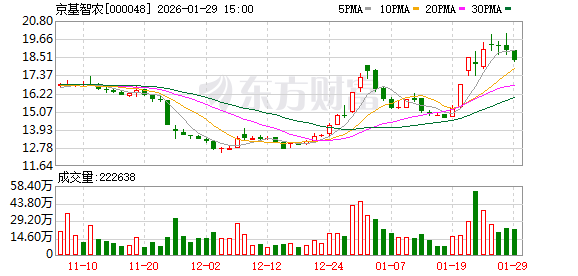
京基智农:2025年净利同比预降76.88%-82.49%
Zhong Guo Zheng Quan Bao· 2026-01-29 13:19
Company Performance - The company, Jingji Zhino (000048), forecasts a net profit attributable to shareholders for 2025 between 125 million to 165 million yuan, representing a year-on-year decline of 76.88% to 82.49% [4] - The expected non-net profit is projected to be between 120 million to 160 million yuan, indicating a year-on-year decrease of 79.63% to 84.72% [4] - The basic earnings per share are estimated to be between 0.2375 yuan and 0.3151 yuan [4] Valuation Metrics - As of January 29, the company's price-to-earnings (P/E) ratio (TTM) is approximately between 58.91 and 77.76 times, with a price-to-book (P/B) ratio (LF) of about 2.35 times and a price-to-sales (P/S) ratio (TTM) of around 1.93 times [4] Business Operations - The company primarily engages in pig farming and sales, feed production and sales, breeding and sales of chickens, real estate development, and trendy fashion art IP business [13] - In 2025, the company sold 2.3129 million pigs (including 324,200 piglets), reflecting a year-on-year growth of 7.77% compared to 2024 [13] - The company has optimized feed nutrition formulas to enhance pig health, leading to significant improvements in operational efficiency and cost control in pig farming [13] - However, due to industry cyclical fluctuations, the sales prices of pigs have decreased significantly year-on-year, adversely affecting the revenue and profit from pig farming [13] - The real estate business is in a late-stage sales phase, resulting in a year-on-year decline in sales revenue, which impacts the overall operating income and net profit for 2025 [13]

福建傲农生物科技集团股份有限公司股东减持股份计划公告
Shang Hai Zheng Quan Bao· 2026-01-27 20:10
Core Viewpoint - The announcement details a share reduction plan by major shareholders of Aonong Biological Technology Group Co., Ltd., indicating a potential decrease in shareholding and its implications for the company [1][2]. Shareholder Holdings - As of the announcement date, the shareholders include: - China Foreign Economic and Trade Trust Co., Ltd. - Foreign Trade Trust - Xuanwu No. 13 Collective Fund Trust Plan holds 65,000,000 shares, accounting for 2.4972% of the total share capital - Xiamen International Trust Co., Ltd. - Xiamen Trust - Aochuang Zhihe No. 1 Asset Service Trust holds 123,000,000 shares, accounting for 4.7254% - Beijing Yawen Chunya Technology Development Center (Limited Partnership) holds 20,000,000 shares, accounting for 0.7684% [1]. Reduction Plan Details - The reduction plan involves: - Foreign Trade Trust plans to reduce up to 15,665,973 shares - Xiamen Trust plans to reduce up to 5,543,344 shares - Beijing Yawen plans to reduce up to 4,820,299 shares - The total reduction will not exceed 1% of the company's total share capital [2][4]. Shareholder Agreement - The reducing shareholders have no concerted action parties - They signed a "Concerted Action Agreement" on December 25, 2024, to act in unison regarding shareholder rights for a period of 12 months, ending on December 27, 2025 [3]. Compliance with Regulations - The shareholders have committed to not transferring or entrusting their shares for 12 months following the acquisition of restructured investment shares - The planned reduction aligns with previously disclosed commitments [5][6]. Monitoring and Disclosure - The company will continue to monitor the progress of the reduction plan and fulfill its information disclosure obligations as required [7]. Announcement Date - The announcement was made on January 28, 2026 [8].

美农生物1月26日获融资买入472.60万元,融资余额4830.34万元
Xin Lang Cai Jing· 2026-01-27 01:33
Core Viewpoint - Meino Bio's stock performance shows a slight increase, with significant financing activity indicating a high level of investor interest and engagement in the company's shares [1][2]. Financing Summary - On January 26, Meino Bio's financing buy-in amounted to 4.726 million yuan, while financing repayment was 6.1917 million yuan, resulting in a net financing buy-in of -1.4656 million yuan [1]. - The total financing and securities balance for Meino Bio reached 48.3309 million yuan, representing 1.75% of its circulating market value, which is above the 50th percentile level over the past year, indicating a relatively high financing balance [1]. - The company had no short selling activity on January 26, with a short selling balance of 27,500 yuan and a remaining short selling volume of 1,400 shares, which is above the 90th percentile level over the past year, indicating a high level of short interest [1]. Business Performance - As of September 30, Meino Bio reported a total of 10,400 shareholders, a decrease of 17.92% from the previous period, while the average circulating shares per person increased by 21.83% to 7,161 shares [2]. - For the period from January to September 2025, Meino Bio achieved operating revenue of 390 million yuan, reflecting a year-on-year growth of 14.68%, and a net profit attributable to shareholders of 40.9182 million yuan, which is a 29.44% increase year-on-year [2]. Dividend and Shareholding - Since its A-share listing, Meino Bio has distributed a total of 168 million yuan in dividends [3]. - As of September 30, 2025, among the top ten circulating shareholders, the Guotai CSI Animal Husbandry ETF ranked as the sixth largest shareholder with 1.1559 million shares, an increase of 334,500 shares from the previous period [3]. - The Nuoan Multi-Strategy Mixed A fund entered as a new shareholder, holding 861,800 shares, while the Jianxin Flexible Allocation Mixed A fund also entered as a new shareholder with 448,700 shares [3].
山东邦基科技股份有限公司 2025年年度业绩预告
Zheng Quan Ri Bao· 2026-01-26 22:50
Core Viewpoint - The company expects significant growth in net profit for the year 2025, projecting an increase of 119.43% to 169.30% compared to the previous year [2][3]. Performance Forecast - The performance forecast period is from January 1, 2025, to December 31, 2025 [3]. - The estimated net profit attributable to the parent company is projected to be between 110 million and 135 million yuan, an increase of 59.87 million to 84.87 million yuan compared to the previous year [2][3]. - The estimated net profit after deducting non-recurring gains and losses is expected to be between 105 million and 130 million yuan, reflecting an increase of 54.47 million to 79.47 million yuan year-on-year [3]. Previous Year Performance - The net profit attributable to the parent company for the previous year was 50.13 million yuan [4]. - The net profit after deducting non-recurring gains and losses for the previous year was 50.53 million yuan [4]. - The earnings per share for the previous year was 0.2984 yuan [5]. Reasons for Performance Increase - The increase in profitability is primarily due to the growth in inventory levels at large-scale breeding enterprises through direct sales channel partnerships, which has driven an increase in product sales and revenue [6].

邦基科技:预计2025年净利润同比增119.43% - 169.30%
Xin Lang Cai Jing· 2026-01-26 08:16
Core Viewpoint - The company expects a significant increase in net profit for the year 2025, projecting a range of 110 million to 135 million yuan, which represents a year-on-year increase of 119.43% to 169.30% compared to the previous year's net profit of 50.1298 million yuan [1] Financial Performance - The projected net profit attributable to the parent company for 2025 is estimated to be between 110 million and 135 million yuan, an increase of 59.8702 million to 84.8702 million yuan from the previous year [1] - The expected non-recurring net profit is forecasted to be between 105 million and 130 million yuan, reflecting a year-on-year growth of 107.81% to 157.28% [1] Growth Drivers - The growth in performance is primarily attributed to the increase in inventory levels of large-scale breeding enterprises through direct sales channel partnerships, which has driven up product sales and revenue [1]