Non - Ferrous Metals

Search documents
有色套利早报-20260325
Yong An Qi Huo· 2026-03-25 02:35
1. Report Industry Investment Rating - No information provided 2. Core View of the Report - The report provides cross - market, cross - period, and cross - variety arbitrage tracking data for non - ferrous metals including copper, zinc, aluminum, nickel, and lead on March 25, 2026 [1][3][4] 3. Summary by Relevant Catalogs Cross - Market Arbitrage Tracking - **Copper**: Spot price in China is 94000, LME price is 11933, and the ratio is 7.71; for the three - month contract, the domestic price is 94020, LME price is 12025, and the ratio is 7.81. The equilibrium ratio for spot import is 7.83, with a profit of - 200.99 [1] - **Zinc**: Spot price in China is 22840, LME price is 3073, and the ratio is 7.43; for the three - month contract, the domestic price is 23000, LME price is 3073, and the ratio is 5.34. The equilibrium ratio for spot import is 8.24, with a profit of - 2488.57 [1] - **Aluminum**: Spot price in China is 23470, LME price is 3200, and the ratio is 7.33; for the three - month contract, the domestic price is 23685, LME price is 3200, and the ratio is 7.40. The equilibrium ratio for spot import is 8.36, with a profit of - 3272.66 [1] - **Nickel**: Spot price in China is 132750, LME price is 16915, and the ratio is 7.94. The equilibrium ratio for spot import is 7.97, with a profit of - 1868.46 [1] - **Lead**: Spot price in China is 16300, LME price is 1856, and the ratio is 8.77; for the three - month contract, the domestic price is 16430, LME price is 1891, and the ratio is 12.14. The equilibrium ratio for spot import is 8.50, with a profit of 494.78 [3] Cross - Period Arbitrage Tracking - **Copper**: The spreads of the next - month, three - month, four - month, and five - month contracts relative to the spot month are 1910, 1900, 1920, and 1880 respectively, while the theoretical spreads are 563, 1023, 1493, and 1962 [4] - **Zinc**: The spreads of the next - month, three - month, four - month, and five - month contracts relative to the spot month are 205, 230, 230, and 255 respectively, while the theoretical spreads are 217, 340, 463, and 585 [4] - **Aluminum**: The spreads of the next - month, three - month, four - month, and five - month contracts relative to the spot month are 125, 185, 235, and 250 respectively, while the theoretical spreads are 229, 358, 488, and 617 [4] - **Lead**: The spreads of the next - month, three - month, four - month, and five - month contracts relative to the spot month are 50, 60, 65, and 40 respectively, while the theoretical spreads are 207, 310, 413, and 515 [4] - **Nickel**: The spreads of the next - month, three - month, four - month, and five - month contracts relative to the spot month are 910, 1140, 1320, and 1480 respectively [4] - **Tin**: The spread of the 5 - 1 contract is 1240, and the theoretical spread is 7134 [4] Spot - Futures Arbitrage Tracking - **Copper**: The spreads of the current - month and next - month contracts relative to the spot are - 1825 and 85 respectively, while the theoretical spreads are 159 and 957 [4] - **Zinc**: The spreads of the current - month and next - month contracts relative to the spot are - 70 and 135 respectively, while the theoretical spreads are 178 and 311 [4] - **Lead**: The spreads of the current - month and next - month contracts relative to the spot are 70 and 120 respectively, while the theoretical spreads are 159 and 269 [5] Cross - Variety Arbitrage Tracking - The ratios of copper/zinc, copper/aluminum, copper/lead, aluminum/zinc, aluminum/lead, and lead/zinc for Shanghai (triple - continuous) are 4.09, 3.97, 5.72, 1.03, 1.44, and 0.71 respectively; for London (triple - continuous) are 3.98, 3.71, 6.39, 1.07, 1.72, and 0.62 respectively [5]
有色套利早报-20260324
Yong An Qi Huo· 2026-03-24 01:53
Report Industry Investment Rating - Not provided Core View - The report presents cross - market, cross - period, spot - futures, and cross - variety arbitrage tracking data for various non - ferrous metals on March 24, 2026, including copper, zinc, aluminum, nickel, lead, and tin [1][3] Summary by Directory Cross - Market Arbitrage Tracking - **Copper**: Spot price in China is 92800, LME price is 11657, and the ratio is 8.12; March price in China is 92070, LME price is 11743, and the ratio is 7.92. The equilibrium ratio for spot import is 7.83, with a profit of 759.87, and a loss of - 1920.23 for spot export [1] - **Zinc**: Spot price in China is 22660, LME price is 3029, and the ratio is 7.48; March price in China is 22830, LME price is 3050, and the ratio is 5.37. The equilibrium ratio for spot import is 8.24, with a loss of - 2308.83 [1] - **Aluminum**: Spot price in China is 23440, LME price is 3209, and the ratio is 7.30; March price in China is 23595, LME price is 3178, and the ratio is 7.43. The equilibrium ratio for spot import is 8.34, with a loss of - 3333.71 [1] - **Nickel**: Spot price in China is 134450, LME price is 16622, and the ratio is 8.09. The equilibrium ratio for spot import is 7.96, with a loss of - 327.20 [1] - **Lead**: Spot price in China is 16250, LME price is 1845, and the ratio is 8.82; March price in China is 16430, LME price is 1885, and the ratio is 12.08. The equilibrium ratio for spot import is 8.50, with a profit of 593.34 [3] Cross - Period Arbitrage Tracking - **Copper**: The spreads between the next - month, March, April, and May contracts and the spot - month contract are - 2680, - 2710, - 2700, and - 2740 respectively, while the theoretical spreads are 576, 1050, 1533, and 2016 [3] - **Zinc**: The spreads between the next - month, March, April, and May contracts and the spot - month contract are - 130, - 100, - 100, and - 105 respectively, while the theoretical spreads are 218, 341, 465, and 589 [3] - **Aluminum**: The spreads between the next - month, March, April, and May contracts and the spot - month contract are - 405, - 365, - 310, and - 290 respectively, while the theoretical spreads are 231, 363, 494, and 626 [3] - **Lead**: The spreads between the next - month, March, April, and May contracts and the spot - month contract are 140, 175, 195, and 145 respectively, while the theoretical spreads are 206, 309, 411, and 513 [3] - **Nickel**: The spreads between the next - month, March, April, and May contracts and the spot - month contract are 230, 420, 620, and 800 respectively [3] - **Tin**: The spread between the 5 - month and 1 - month contracts is - 2050, and the theoretical spread is 6790 [3] Spot - Futures Arbitrage Tracking - **Copper**: The spreads between the current - month and next - month contracts and the spot are 1990 and - 690 respectively, while the theoretical spreads are 734 and 856 [3] - **Zinc**: The spreads between the current - month and next - month contracts and the spot are 270 and 140 respectively, and the theoretical spreads are 183 and 315 (the data is repeated with different theoretical spreads 248 and 329) [3] - **Lead**: The spreads between the current - month and next - month contracts and the spot are 5 and 145 respectively, while the theoretical spreads are 153 and 262 [3] Cross - Variety Arbitrage Tracking - The ratios of copper/zinc, copper/aluminum, copper/lead, aluminum/zinc, aluminum/lead, and lead/zinc for Shanghai (three - continuous contracts) are 4.03, 3.90, 5.60, 1.03, 1.44, and 0.72 respectively; for LME (three - continuous contracts) are 3.95, 3.80, 6.41, 1.04, 1.68, and 0.62 respectively [3]
有色套利早报-20260313
Yong An Qi Huo· 2026-03-13 02:56
Report Summary 1. Report Industry Investment Rating - No investment rating information is provided in the report. 2. Report Core View - The report presents cross - market, cross - period, and cross - variety arbitrage tracking data for various non - ferrous metals including copper, zinc, aluminum, nickel, and lead on March 13, 2026, to help investors find potential arbitrage opportunities [1][3][6]. 3. Summary by Related Catalogs Cross - Market Arbitrage Tracking - **Copper**: On March 13, 2026, the domestic spot price was 100575, LME spot price was 12896, with a spot ratio of 7.81. The spot import equilibrium ratio was 7.81, and the profit was - 319.72. The three - month domestic price was 101160, LME price was 12998, with a ratio of 7.78 [1]. - **Zinc**: The domestic spot price was 24330, LME spot price was 3269, with a spot ratio of 7.44. The spot import equilibrium ratio was 8.21, and the profit was - 2510.67. The three - month domestic price was 24340, LME price was 3314, with a ratio of 5.02 [1]. - **Aluminum**: The domestic spot price was 25260, LME spot price was 3522, with a spot ratio of 7.17. The spot import equilibrium ratio was 8.25, and the profit was - 3772.67. The three - month domestic price was 25325, LME price was 3488, with a ratio of 7.29 [3]. - **Nickel**: The domestic spot price was 135650, LME spot price was 17372, with a spot ratio of 7.81. The spot import equilibrium ratio was 7.96, and the profit was - 1006.22 [3]. - **Lead**: The domestic spot price was 16450, LME spot price was 1890, with a spot ratio of 8.72. The spot import equilibrium ratio was 8.48, and the profit was 436.18. The three - month domestic price was 16655, LME price was 1938, with a ratio of 12.61 [5]. Cross - Period Arbitrage Tracking - **Copper**: The spreads between the next - month, three - month, four - month, and five - month contracts and the spot month were 230, 380, 410, and 390 respectively, while the theoretical spreads were 606, 1110, 1623, and 2136 [6]. - **Zinc**: The spreads were 10, 50, 95, and 105 respectively, and the theoretical spreads were 224, 355, 485, and 616 [6]. - **Aluminum**: The spreads were 75, 160, 215, and 240 respectively, and the theoretical spreads were 237, 375, 512, and 650 [6]. - **Lead**: The spreads were 0, 40, 90, and 125 respectively, and the theoretical spreads were 208, 312, 416, and 520 [6]. - **Nickel**: The spreads were 1120, 1600, 1860, and 2070 respectively [6]. - **Tin**: The 5 - 1 spread was 2900, and the theoretical spread was 8015 [6]. Spot - Futures Arbitrage Tracking - **Copper**: The spreads between the current - month and next - month contracts and the spot were 130 and 360 respectively, and the theoretical spreads were 157 and 745 [6]. - **Zinc**: The spreads were - 40 and - 30 respectively, and the theoretical spreads were 75 and 216 [6]. - **Lead**: The spreads were 165 and 165 respectively, and the theoretical spreads were 107 and 218 [7]. Cross - Variety Arbitrage Tracking - The ratios of copper/zinc, copper/aluminum, copper/lead, aluminum/zinc, aluminum/lead, and lead/zinc in Shanghai (three - continuous contracts) were 4.16, 3.99, 6.07, 1.04, 1.52, and 0.68 respectively, and in London (three - continuous contracts) were 3.94, 3.70, 6.70, 1.07, 1.81, and 0.59 respectively [7].
锌周报2026/2/27:低波动观察周-20260302
Zi Jin Tian Feng Qi Huo· 2026-03-02 08:43
Report Industry Investment Rating - Not provided in the content Core Viewpoints - The short - term fundamentals of zinc may lack drivers, and March is the time to verify the authenticity of the peak season [4]. - The Trump tariff issue is basically priced in, the political uncertainty in the United States increases, and the logic of a "weak dollar" is strengthened. The path of the Fed's interest rate cuts is highly uncertain. China's Two Sessions are about to be held, and real - estate policies will be intensified to support the market [5]. - Overall, the zinc fundamentals lack clear short - term drivers, but the macro - level is expected to gradually shift to a risk - on situation in March. Therefore, the zinc price is expected to show a slightly stronger oscillating trend in the short term. Attention should be paid to the changes in inventory data next week [5]. Summary by Relevant Catalogs Market Focus - Capital Flow - After the festival, the funds in the domestic futures market showed significant structural differentiation, flowing around the three main lines of "game between strong expectations and weak reality, supply disturbance drive, and policy preview of the Two Sessions" and avoiding sectors with high inventory and weak demand [9]. - The post - festival capital activity in the non - ferrous metal sector has not fully recovered, and the volatility of non - ferrous metals has a downward trend. As of February 27, the open interest of SHFE zinc was still less than 186,000 lots, with an increase of less than 7,000 lots after the Spring Festival, far lower than the market activity after the Spring Festival last year [9]. - The VIX volatility index of SHFE zinc shows a downward trend [10]. Market Focus - Real Estate - Policy - side: After the Spring Festival, core cities represented by Shanghai took the lead in introducing new policies, including reducing the purchase - restriction threshold, increasing the provident fund quota, and optimizing the property tax, to activate market trading. Local Two Sessions clearly stated the orientation of "stabilizing the real - estate market, reducing inventory, and optimizing supply" [14]. - Market - side: As of February 25, the resumption rate of 10,692 construction sites across the country was 8.9% (slightly increased year - on - year in the lunar calendar), the labor attendance rate was 15.5% (slightly increased year - on - year in the lunar calendar), and the fund arrival rate was 29% (slightly increased year - on - year in the lunar calendar). The start of resumption of work and labor attendance was slightly earlier than last year, especially in East China [14]. - The expectation of a stabilized real - estate market has an important role in boosting the demand expectation for zinc. In 2026, the drag on real - estate demand is expected to narrow significantly, and the marginal increase in demand from the new economy can fully make up for the reduction in the real - estate sector [14]. Weekly Fundamental Situation - Main Industry News - Inner Mongolia plans to promote the upgrading of the non - ferrous metal industry in 2026, aiming to improve the deep - processing level of non - ferrous metals such as zinc [18]. - Newmont's zinc concentrate production in Q4 2025 was 46,000 tons, a 22% decrease from the previous quarter. Its total zinc concentrate production in 2025 was 231,000 tons, a 10% decrease year - on - year, and the production guidance for 2026 is 220,000 tons [18]. - New Century's zinc concentrate production in Q4 2025 was 30,000 tons, basically unchanged from the previous quarter. Its total salable zinc production in 2025 was 101,000 tons, a 22% increase year - on - year. The production guidance for 2026 is 86,300 - 98,300 tons [18]. Weekly Fundamental Situation - Zinc Concentrate Production and Processing Fees - In January 2026, China's zinc concentrate production was 294,300 metal tons, a 2.26% increase from the previous month and a 17.20% increase year - on - year. The production in February is expected to be 222,700 tons, a 7.13% decrease year - on - year [21]. - The domestic zinc concentrate TC stopped falling and stabilized at 1,500 yuan/metal ton in late December. This week, the average price rebounded to 1,550 yuan/ton, a 50 - yuan increase from the previous week. It is expected that TC will continue to rebound from March to April, but the overall space is limited [22]. - This week, the import zinc concentrate processing fee index was 23.75 US dollars/dry ton, a decrease of 0.60 US dollars/dry ton from the previous week. As the import TC continues to decline, the loss of zinc concentrate imports has expanded. As of February 26, 2026, the import profit and loss of zinc concentrate was - 889 yuan/ton [22]. Weekly Fundamental Situation - Downstream Enterprises' Production and Inventory - This week, the weighted average operating rate of domestic zinc downstream primary processing enterprises was 7.62%, a 6.70 - percentage - point increase from the previous week, but still in the Spring Festival shutdown state. The average holiday days of downstream enterprises this year were 22 days, an increase of 1 day from last year. Enterprises will resume work from late February to early March [24]. - As of February 26, the total weekly raw material inventory of zinc downstream enterprises in China was 23,890 tons, a decrease of 1,014 tons from before the festival. The inventory pressure is not large, especially for die - cast zinc alloy and zinc oxide enterprises [24]. - On February 26, the weekly operating rate of galvanizing enterprises was 6.84%, a 6.2 - percentage - point increase from the previous week. The raw material inventory of galvanizing enterprises decreased slightly after the festival, and the finished - product inventory of 23 cities' galvanized sheets increased significantly during the Spring Festival. The average holiday days of 34 galvanizing sample enterprises were about 20 days, an increase of 1 day from last year. Enterprises are expected to resume production from late February to early March [30]. - On February 26, the weekly operating rate of die - cast zinc alloy enterprises was 8.73%, an 8.34 - percentage - point increase from the previous week. Before the festival, die - cast zinc alloy enterprises slowed down their purchases due to high prices, resulting in a decline in raw material inventory and a seasonal increase in finished - product inventory. The average holiday days of 20 die - cast zinc alloy sample enterprises were 23.1 days, an increase of 1.1 days from last year. The resumption time is concentrated around the eighth day of the first lunar month or the Lantern Festival [36]. - On February 26, the weekly operating rate of zinc oxide enterprises was 19.76%, a 12.3 - percentage - point increase from the previous week. The raw material inventory continued to decline to the lowest level in the same period in history, and the finished - product inventory remained at a high level in the same period in history. The industry shows obvious differentiation in holiday arrangements. The downstream orders of zinc oxide also show structural differences [42]. Weekly Fundamental Situation - LME Inventory - LME inventory has been gradually decreasing since reaching a recent peak of 112,300 tons on January 19. As of February 26, it dropped below 100,000 tons to 98,400 tons, a decrease of 3,775 tons from before the festival. The overall cancellation warrant ratio dropped to a low level, with only 7,500 tons of cancellation warrants remaining [45]. - This week, the global visible inventory reached 311,000 tons, a 47,000 - ton increase from the previous week, showing seasonal inventory accumulation [45]. Structure & Arbitrage - SHFE Zinc Spread Structure - Since late January, the domestic spot price has been at a slight discount to the SHFE zinc main contract. On Thursday this week, the average price in Shanghai was at a 105 - yuan discount to the 2604 contract, and the discount widened [49]. - Recently, the Contango structure of SHFE zinc has strengthened again. It is recommended to pay attention to the subsequent opportunity to enter the inter - period positive arbitrage, as it is expected to show a rapid inventory - reduction state after the Spring Festival this year [49]. Structure & Arbitrage - LME Zinc Structure Curve - The outer market has returned to the Contango structure since mid - December, and the discount range has recently shown a narrowing trend. As of February 27, the LME zinc 0 - 3 discount was 16.97 US dollars/ton [52]. - With the continuous inventory reduction overseas, the LME market has shown an abnormal convex structure recently. It is advisable to consider holding a positive arbitrage [52]. Structure & Arbitrage - LME Reports - The FuturesBandingReport of LME shows that the long and short forces are relatively balanced, but the short - position concentration in the far - month contracts has increased, possibly due to the seasonal short - position concentration caused by the long - term zinc ore shipment [54]. - The CashReport and WarrantBandingReport show that the market concentration decreased after the February delivery [54].
永安期货有色早报-20260302
Yong An Qi Huo· 2026-03-02 01:55
1. Report Industry Investment Rating No relevant information provided. 2. Core Viewpoints of the Report - Copper: The report maintains a medium - term bullish view on copper. Although the downstream consumption is weak in the short - term, copper is a metal with increasing demand and limited supply, and it can be bought and held in the medium - term [1]. - Aluminum: Due to the intensification of the Middle East situation, there are rumors of production interruptions in Iranian electrolytic aluminum. Aluminum prices may rise in the short - term. Attention should be paid to the post - holiday destocking amplitude [1]. - Zinc: The domestic fundamentals of zinc are average, but long - term capital investment is limited and there are supply disturbances from Iran. It is expected that zinc prices will still be supported in the short - term [2]. - Nickel: The short - term fundamentals of nickel are weak, but there are many supply - side policy interventions. Nickel prices are expected to fluctuate within a range [4]. - Stainless Steel: The fundamentals of stainless steel are weak, and it is expected to follow nickel prices and fluctuate within a range [8]. - Lead: Lead prices are expected to maintain a weak and volatile trend under the influence of overseas inventory and scrap lead profit support [11]. - Tin: Tin prices are expected to be strong, but there is also a risk of correction. Key factors such as supply recovery and AI - related consumption need to be monitored [14]. - Industrial Silicon: The supply and demand of industrial silicon are close to balance, and prices are expected to fluctuate with costs. In the long - term, prices will fluctuate at the cycle bottom [18]. - Lithium Carbonate: In the short - term, the fundamentals of lithium carbonate are strong, and there is a large space for positive spreads between months after the intermediate inventory is further reduced [20]. 3. Summary by Related Catalogs Copper - Price and Inventory: From February 13 to 27, 2026, the spot import profit decreased by $694.39, and the LME inventory increased by 100 tons [1]. - Market Situation: The copper price fluctuated in the first half of the week and rose slightly with increased positions in the second half. The downstream point - pricing was weak, and the LME cash - 3m structure was suppressed. Attention should be paid to downstream resumption and post - holiday destocking [1]. Aluminum - Price and Inventory: From February 13 to 27, 2026, the Shanghai aluminum ingot price decreased by $80, and the domestic social inventory increased by 58,646 tons [1]. - Market Situation: Due to the Middle East situation, there are rumors of production interruptions in Iran. Aluminum prices may rise in the short - term. Attention should be paid to the post - holiday destocking amplitude [1]. Zinc - Price and Inventory: From February 13 to 27, 2026, the Shanghai zinc ingot price decreased by $10, and the domestic exchange inventory increased by 39,027 tons [2]. - Market Situation: The supply is expected to be tight in the medium - term, and the downstream resumption is slow. The long - term capital investment is limited and there are supply disturbances, which support the short - term zinc price [2]. Nickel - Price and Inventory: From February 13 to 27, 2026, the 1.5 - grade Philippine nickel ore price remained unchanged, and the LME inventory decreased by 1,530 tons [3]. - Market Situation: The short - term fundamentals are weak, but there are many supply - side policy interventions. Nickel prices are expected to fluctuate within a range [3][4]. Stainless Steel - Price and Inventory: From February 13 to 27, 2026, the prices of 304 cold - rolled coils, 304 hot - rolled coils, 201 cold - rolled coils, and 430 cold - rolled coils remained unchanged, and the waste stainless steel price increased by $250 [8]. - Market Situation: The supply and demand are weak, and it is expected to follow nickel prices and fluctuate within a range [8]. Lead - Price and Inventory: From February 13 to 27, 2026, the domestic exchange inventory increased by 8,128 tons, and the LME inventory decreased by 200 tons [10]. - Market Situation: The supply is increasing, the demand is weak, and lead prices are expected to maintain a weak and volatile trend [11]. Tin - Price and Inventory: From February 13 to 27, 2026, the tin price rose significantly, the LME inventory decreased by 25 tons, and the position increased by 23,492 [14]. - Market Situation: The supply is expected to recover, and the demand is relatively flat. Tin prices are expected to be strong, but there is a risk of correction [14]. Industrial Silicon - Price and Inventory: From February 13 to 27, 2026, the 421 Yunnan basis decreased by $60, and the 553 East China basis decreased by $160 [18]. - Market Situation: The supply and demand are close to balance, and prices are expected to fluctuate with costs. In the long - term, prices will fluctuate at the cycle bottom [18]. Lithium Carbonate - Price and Inventory: From February 13 to 27, 2026, the SMM electric - grade lithium carbonate price increased by $28,250, and the SMM industrial - grade lithium carbonate price increased by $28,250 [20]. - Market Situation: In the short - term, the fundamentals are strong, and there is a large space for positive spreads between months after the intermediate inventory is further reduced [20].
午评:创业板指半日跌超1% 算力租赁、有色板块逆势走强
Zhong Guo Jin Rong Xin Xi Wang· 2026-02-27 04:05
Market Overview - A-shares experienced fluctuations on February 27, with the Shanghai Composite Index turning negative again and the ChiNext Index dropping over 1% [1] - The total trading volume in the Shanghai and Shenzhen markets reached 1.59 trillion yuan, a decrease of 53 billion yuan compared to the previous trading day [1] - The Shanghai Composite Index closed at 4139.53 points, down 0.17%, with a trading volume of 674.3 billion yuan; the Shenzhen Component Index closed at 14405.75 points, down 0.68%, with a trading volume of 910.8 billion yuan; the ChiNext Index closed at 3296.23 points, down 1.46%, with a trading volume of 431.4 billion yuan [1] Sector Performance - The computing power leasing concept showed strength against the trend, with stocks like Chengdi Xiangjiang and Yunsai Zhili hitting the daily limit [1] - The Huawei supply chain was active, with stocks such as Tuowei Information and Huasheng Tiancai also hitting the daily limit [1] - The non-ferrous metals sector was notably active, with stocks like Zhangyuan Tungsten and Xianglu Tungsten hitting the daily limit [1] - Conversely, the fiberglass concept stocks declined, with Honghe Technology hitting the daily limit down, and International Composite Materials dropping over 10% [1][2] Institutional Insights - CITIC Securities highlighted opportunities in heavy asset industries due to rising inflation expectations, continuous recovery of PPI, and rising commodity prices, which benefit the balance sheets of heavy asset enterprises [3] - The report emphasized the recovery potential in industries like chemicals and building materials, driven by capacity clearing and policies to stabilize prices [3] - Everbright Securities noted the transition from energy consumption dual control to carbon emission dual control in China, suggesting that assets with low or negative carbon attributes will gain green premiums [3] Technology Developments - CITIC Securities reported that the AI computing power network is undergoing a critical transition towards full optical interconnection, with NPO technology emerging as a balanced solution for bandwidth physical bottlenecks [4] - Major tech companies like Alibaba and Tencent are accelerating the implementation and standardization of NPO architecture, indicating that this technology is entering a phase of large-scale commercialization [4] - The transformation in underlying hardware is expected to significantly restructure the optical communication industry chain, benefiting domestic optical module leaders [4] Regulatory News - The People's Bank of China announced a reduction in the foreign exchange risk reserve ratio for forward foreign exchange sales from 20% to 0%, effective March 2, 2026, to support the development of the foreign exchange market [5] Product Launches - Alibaba's personal AI assistant "Qianwen" is set to enter the AI hardware market, with plans to launch various AI hardware products globally, including the first AI glasses at the 2026 Mobile World Congress [6]

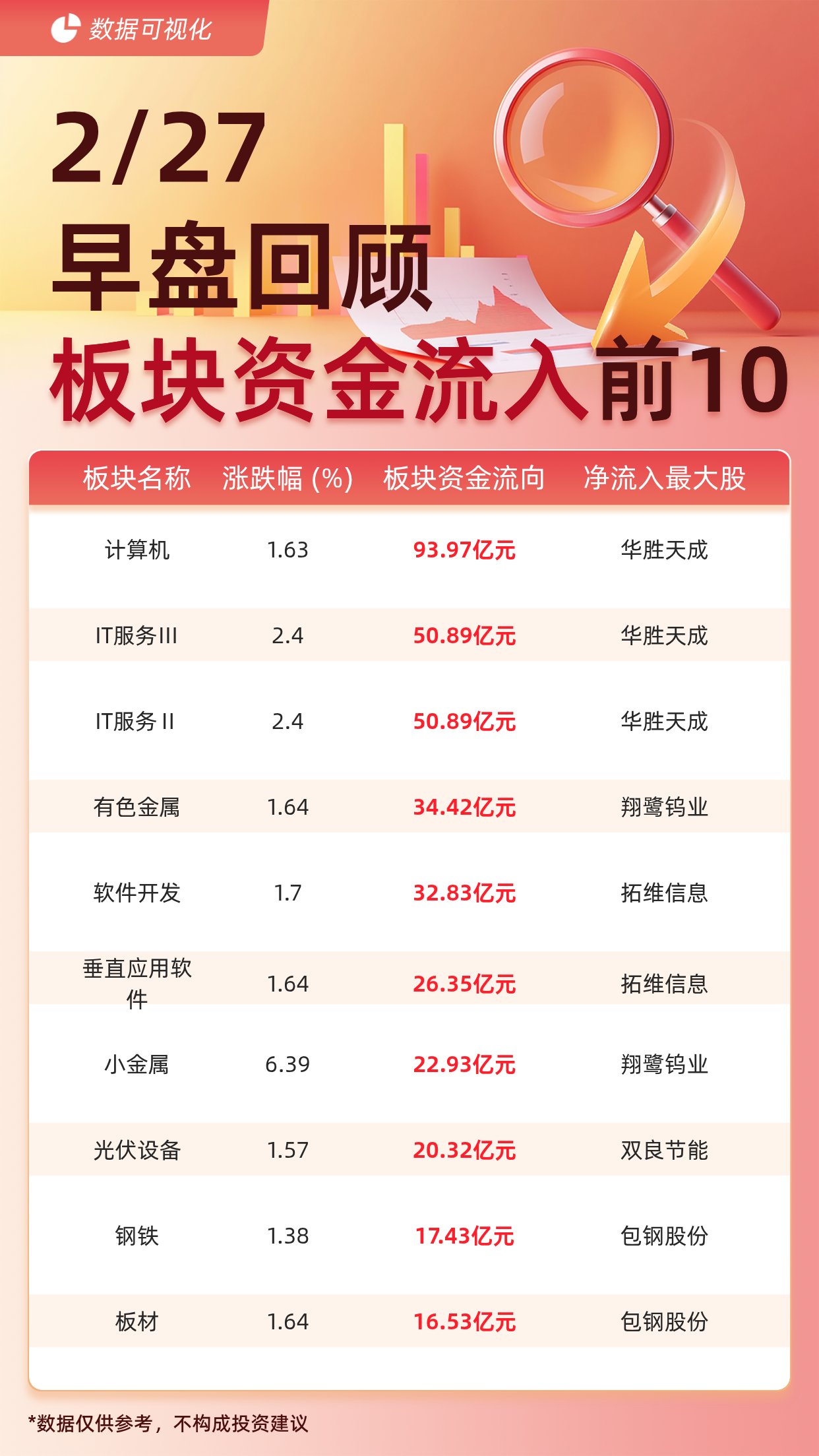
主力板块资金流入前10:计算机流入93.97亿元、IT服务Ⅲ流入50.89亿元
Jin Rong Jie· 2026-02-27 03:52
Group 1 - The main market experienced a net outflow of 29.449 billion yuan in principal funds as of February 27 [1] - The top ten sectors with inflows of principal funds included: Computer (9.397 billion yuan), IT Services III (5.089 billion yuan), IT Services II (5.089 billion yuan), Non-ferrous Metals (3.442 billion yuan), Software Development (3.283 billion yuan), Vertical Application Software (2.635 billion yuan), Minor Metals (2.293 billion yuan), Photovoltaic Equipment (2.032 billion yuan), Steel (1.743 billion yuan), and Plates (1.653 billion yuan) [1] Group 2 - The Computer sector saw a price increase of 1.63% with a net inflow of 9.397 billion yuan, led by Huasheng Tiancai [2] - IT Services III and IT Services II both recorded a price increase of 2.4% with net inflows of 5.089 billion yuan, also led by Huasheng Tiancai [2] - The Non-ferrous Metals sector had a price increase of 1.64% with a net inflow of 3.442 billion yuan, led by Xianglu Tungsten Industry [2] - The Software Development sector increased by 1.7% with a net inflow of 3.283 billion yuan, led by Tuo Wei Information [2] - The Minor Metals sector experienced a significant price increase of 6.39% with a net inflow of 2.293 billion yuan, led by Xianglu Tungsten Industry [3] - The Photovoltaic Equipment sector had a price increase of 1.57% with a net inflow of 2.032 billion yuan, led by Shuangliang Energy Saving [3] - The Steel sector increased by 1.38% with a net inflow of 1.743 billion yuan, led by Baogang Co. [3] - The Plates sector recorded a price increase of 1.64% with a net inflow of 1.653 billion yuan, also led by Baogang Co. [3]

18天15板!000711,停牌核查
Shang Hai Zheng Quan Bao· 2026-02-26 23:00
Core Viewpoint - ST Jinglan (000711) announced a suspension of trading for stock verification starting February 27, 2026, after experiencing a significant price surge over 18 days with 15 trading limits reached, indicating abnormal trading fluctuations [1][2]. Group 1: Stock Performance and Trading Suspension - ST Jinglan's stock price closed at 3.64 yuan per share on February 26, 2026, with a cumulative price increase of 116.67% from January 23 to February 26, 2026 [2][3]. - The company’s stock price deviation exceeded 13.13% over three consecutive trading days, prompting the suspension for verification in accordance with Shenzhen Stock Exchange regulations [1][2]. Group 2: Business Transformation and Strategic Changes - The company plans to change its name to Indium Target New Material Technology Co., Ltd., reflecting its strategic shift towards indium-based rare metal extraction and hazardous waste resource utilization [2]. - ST Jinglan's new controlling shareholder has led a comprehensive business transformation since completing bankruptcy restructuring at the end of 2023, establishing a strong position in the indium market [2]. Group 3: Risks and Future Outlook - The company anticipates a significant decline in operating performance for 2025, with a projected net loss of 220 million to 150 million yuan, indicating a worsening financial outlook compared to 2024 [4]. - ST Jinglan has limited cash resources of 9.1263 million yuan as of the end of Q3 2025, which may hinder project funding and affect the overall strategic transformation [4]. - The company faces challenges in entering the high-density ITO target manufacturing sector, with uncertainties regarding market acceptance and a lengthy customer verification period of 6 to 12 months [5].


镁/铝价比创历史新低,镁合金多行业应用持续开拓 | 投研报告
Zhong Guo Neng Yuan Wang· 2026-02-13 02:38
Core Insights - The overall magnesium price increased in January 2026, with magnesium ingot (1) averaging 18,127.50 yuan/ton, reflecting a year-on-year increase of 1.50% and a month-on-month increase of 5.24% [1] - The magnesium/aluminum price ratio continued to decline, reaching a historical low of 0.75, primarily due to a significant increase in aluminum prices driven by demand from emerging industries [2] - The magnesium alloy sector showed resilience with a 4.51% year-on-year increase in exports, despite an overall decline in magnesium product exports [2] Price Tracking - In January 2026, the average price of aluminum (A00) was 24,085.50 yuan/ton, up 20.24% year-on-year and 9.77% month-on-month [1] - The magnesium market supply was relatively balanced, with stable prices supported by supply and steady demand from essential needs, leading to a positive market outlook [1] Industry Dynamics - The Shenzhou 20 return capsule utilized a magnesium-lithium alloy operation platform, significantly reducing weight and achieving new breakthroughs in aerospace applications [3] - A strategic cooperation was established between Bole Intelligent and Anhui Liheng for the supply of 37 large magnesium alloy semi-solid injection molding machines, indicating rapid expansion into large integrated structural components for electric vehicles [3] - Three key magnesium industry standards will be implemented starting February 1, 2026, marking a new phase in energy conservation and environmental governance in the magnesium smelting industry [4] Important Company Announcements - Baowu Magnesium Industry forecasted a net loss of 10-20 million yuan for 2025, primarily due to declining magnesium prices impacting profitability [6] - Yian Technology projected a net loss of 13-18 million yuan for 2025, attributed to increased investments in new sectors and currency appreciation affecting export profits [6] Investment Recommendations - Companies with full industry chain layouts such as Baowu Magnesium Industry are recommended for attention [7] - Companies with high magnesium alloy business ratios and strong elasticity like Xingyuan Zhuomei are also highlighted [7] - Equipment manufacturers benefiting from increased capital expenditures in component enterprises, such as Yizhiming, are suggested for consideration [7]
A股午评:创业板指涨超1% 电网设备概念全线走强
2 1 Shi Ji Jing Ji Bao Dao· 2026-02-12 04:31
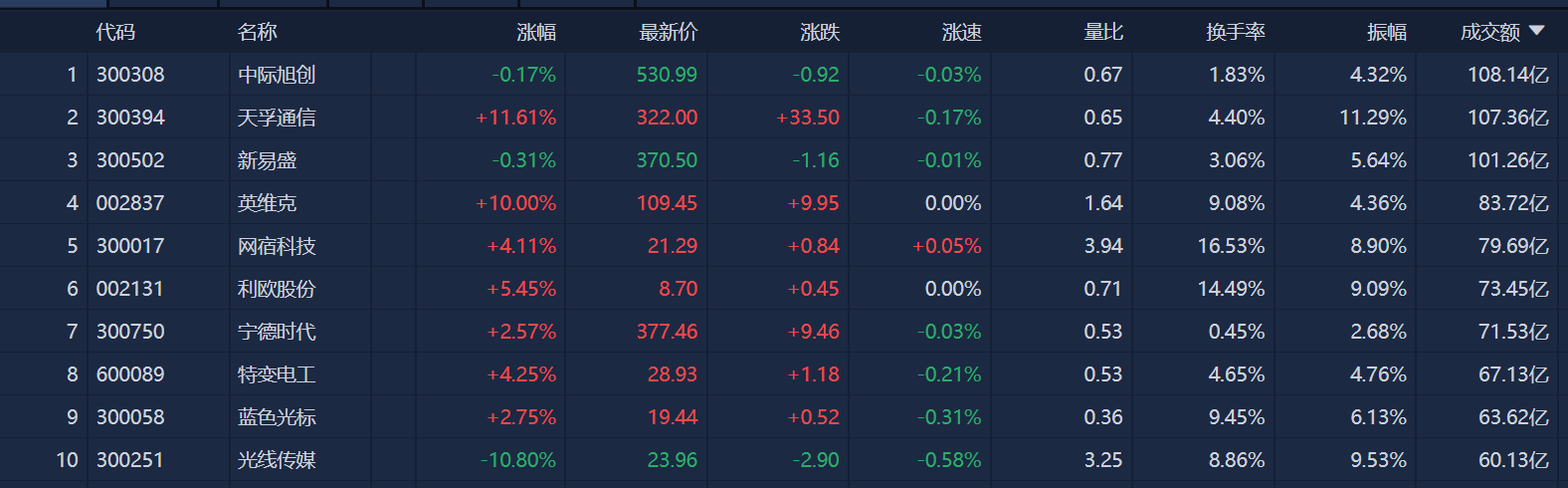
Market Overview - The Shanghai Composite Index experienced a slight increase of 0.12%, while the Shenzhen Component Index rose by 0.81%, and the ChiNext Index increased by 1.18% at the close of trading [1] - Over 2,700 stocks in the market saw gains, indicating a broad-based rally [1] Sector Performance - The electric grid equipment sector showed strong performance, with companies like Siyi Electric and Sifang Co. reaching new highs, and stocks such as Wangbian Electric and Shun Sodium Co. hitting the daily limit [2] - The non-ferrous metals sector was active, with Xianglu Tungsten Industry achieving three consecutive daily limits in five days, and Zhangyuan Tungsten Industry securing two consecutive daily limits [2] - The CPO concept also gained momentum, with Tianfu Communication rising over 10% to set a new historical high [2] - The gas turbine sector saw a surge, with companies like Yingliu Co. and Changbao Co. hitting the daily limit [3] Declines - The film and cinema sector faced significant declines, with companies such as Huanrui Century, Hengdian Film, and Bona Film all hitting the daily limit down [4] Individual Stock Highlights - Zhongji Xuchuang had a trading volume exceeding 10.8 billion yuan, leading the market, while Tianfu Communication, Xinyi Sheng, and Yingwei Ke also had high trading volumes [5] - Notable stock performances included: - Tianfu Communication: +11.61% to 322.00 yuan [5] - Yingwei Ke: +10.00% to 109.45 yuan [5] - Zhongji Xuchuang: -0.17% to 530.99 yuan [5] - Guangxian Media: -10.80% to 23.96 yuan [5]