
乐奇AI眼镜

Search documents
Rokid火得太晚了
远川研究所· 2026-03-19 13:06
Core Viewpoint - The article discusses the resurgence of AI glasses in the consumer electronics market, highlighting the significant growth potential and the success of Rokid as a leading brand in this space, particularly in the context of technological advancements and market dynamics [6][21]. Group 1: Market Overview - According to Omdia, global AI glasses shipments are expected to reach 8.7 million units by 2025, representing a year-on-year increase of 322%. China is projected to account for nearly 1 million units, making it the second-largest market after the United States [6]. - Meta leads the market with 7.4 million units shipped, but less than 100,000 of these are display-enabled models. In contrast, Rokid has emerged as the top-selling brand in the AI+AR glasses category [6][7]. Group 2: Technological Innovations - Rokid's AI glasses utilize a dual-chip architecture to address performance and battery life, with one chip handling high-load tasks and the other managing low-power scenarios. This design allows for a lightweight product weighing only 49 grams [15][16]. - The glasses employ a dual diffraction waveguide display technology, achieving over 80% light transmittance while significantly reducing module size, which is crucial for lightweight design [15]. Group 3: Competitive Landscape - The article notes that many large companies have struggled in the smart glasses market, often incurring significant strategic losses. In contrast, Rokid, as a startup, has been able to innovate and adapt more flexibly [22][23]. - Rokid's success is attributed to its long-term investment in its proprietary Yoda OS, which has allowed it to build a robust software ecosystem that complements its hardware offerings [22][23]. Group 4: Future Outlook - The industry is expected to see rapid growth, with the integration of advanced technologies and a decrease in production costs, potentially leading to shipments exceeding 10 million units [26]. - Rokid anticipates that in three to five years, smart glasses will become the primary interface for interaction, with smartphones serving as communication and storage terminals [27].


全球首款智能眼镜购物应用落地!看一眼、说一句即可完成购物
Zhong Jin Zai Xian· 2026-01-26 09:11
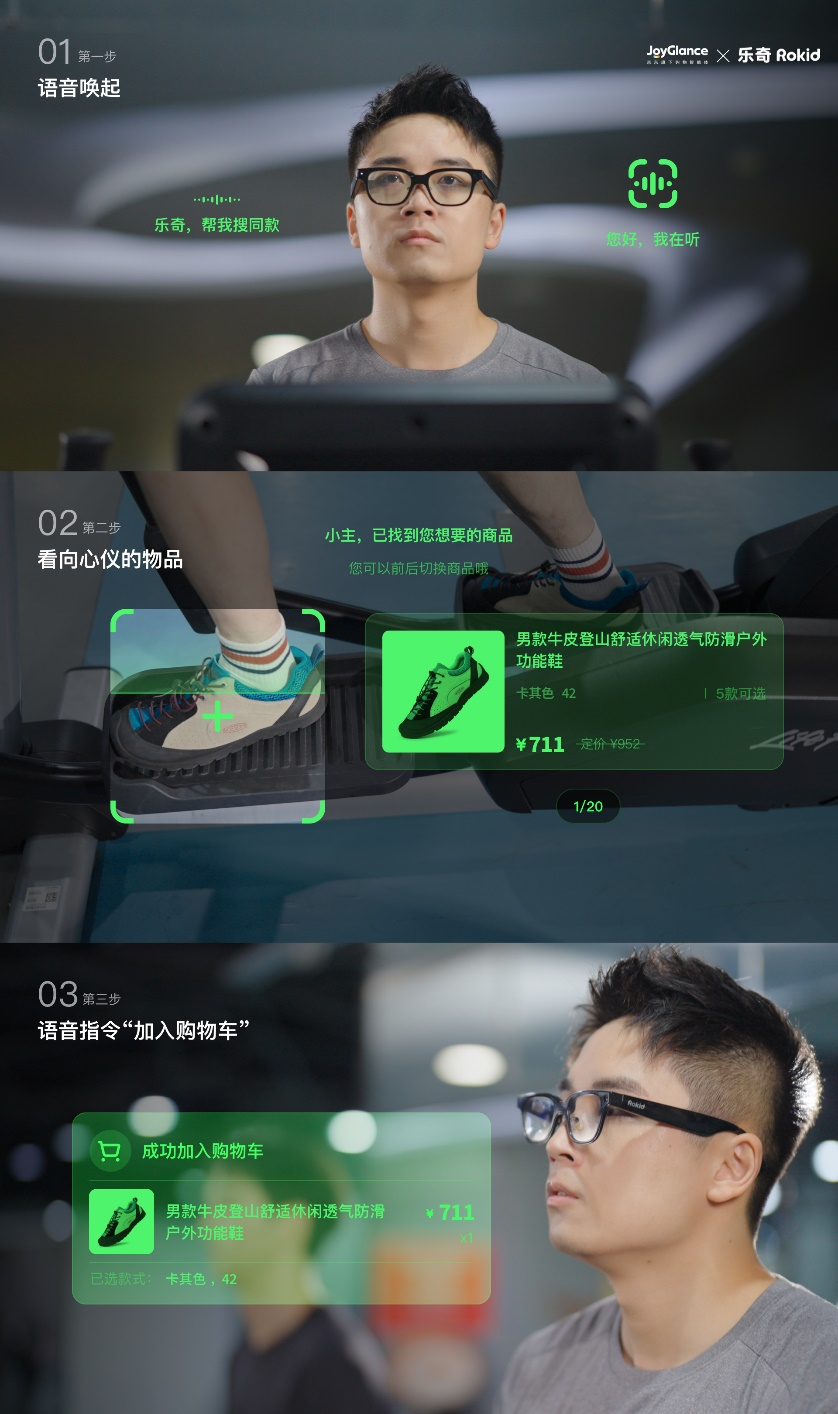
Group 1 - The core concept of the news is the launch of JoyGlance, an AI shopping application integrated into Rokid's smart glasses, enabling users to shop by simply looking at items and speaking commands [1][3] - JoyGlance combines intent recognition, intelligent product search, and voiceprint payment with Rokid's optical waveguide display and voice interaction capabilities, transforming smart glasses into an AI shopping interface [3] - The shopping process has been simplified from multiple steps to just "look, say, and pay," allowing users to search for products and complete purchases through voice commands [3] Group 2 - JoyGlance employs a financial-grade security solution using voice and voiceprint recognition to prevent recording attacks and voiceprint synthesis risks, ensuring secure transactions during natural interactions [3] - In 2026, smart glasses will be included in the national subsidy program, with current promotions offering a 15% subsidy in certain regions, along with additional discounts from JD.com [3] - The integration of shopping capabilities into wearable devices signifies a shift in consumer interaction, making shopping more intuitive through visual and verbal commands [3]

终于上桌吃饭,AI眼镜分野于CES:独立重要,智能体更重要
3 6 Ke· 2026-01-12 03:05
Core Insights - CES 2026 showcased a significant shift in the AI landscape, with AI not just as a feature but as a means to redefine user interaction with information [1][6] - AI glasses emerged as a prominent category, indicating a growing consumer interest and potential market viability [5][18] Group 1: AI Glasses Development - AI glasses are evolving from mere concepts to practical devices, with a focus on usability and experience rather than just technological gimmicks [5][18] - The differentiation among AI glasses continues, with AI audio glasses showing disadvantages compared to AI display and multifunctional glasses like Rokid's offerings [5][18] - The introduction of independent operation capabilities in AI glasses, such as the Thunder X3 Pro with eSIM, marks a significant trend towards detaching from smartphones [10][12] Group 2: Market Trends and Consumer Engagement - Consumer interest in AI glasses is high, with significant foot traffic at Rokid's booth during CES, indicating a positive reception for products like the Rokid AI Glasses Style [3][5] - Companies are focusing on making AI glasses practical for daily use, with various manufacturers exploring different approaches to enhance user experience and encourage purchases [18][22] - The emergence of smart agent stores is crucial for the AI glasses industry, allowing developers to define functionalities, similar to how the App Store transformed the smartphone market [28][31] Group 3: Technical Innovations and Challenges - Innovations in connectivity, such as Qualcomm's efforts to achieve low-power WiFi connections, are essential for the independent operation of AI glasses [12][33] - Battery life and ease of recharging are critical factors for the independence of AI glasses, with various designs being tested to improve these aspects [13][33] - The balance between lightweight design and essential functionalities, such as first-person photography and video recording, remains a challenge for manufacturers [32][33]

港科大教授实测AI眼镜“作弊”:30分钟碾压95%的学生,把传统教学评估体系整破防了
3 6 Ke· 2026-01-06 11:20
Core Insights - The article discusses an experiment conducted at Hong Kong University of Science and Technology where an AI-powered smart glasses, equipped with the ChatGPT-5.2 model, participated in a final exam for a computer networking course, achieving a score of 92.5, placing it in the top 5 among over 100 human students [1][3][4]. Group 1: Experiment Overview - The experiment aimed to test the capabilities of AI in a real exam setting, specifically targeting a challenging course known for its complexity [4][6]. - The AI glasses were selected after evaluating 12 commercial smart glasses, with Rokid's model chosen for its superior SDK and development flexibility [7][8][10]. - The AI glasses processed exam questions by capturing images, sending them to the cloud for analysis, and displaying answers back to the user [12]. Group 2: Performance Metrics - The AI achieved full marks in multiple-choice and single-page short answer questions, and scored 45.5 out of 53 in multi-page short answer questions, demonstrating strong reasoning capabilities [13]. - The AI's performance highlighted its ability to maintain coherence in reasoning, even when faced with complex, context-dependent questions [15]. Group 3: Implications for Education - The experiment raises questions about the validity of traditional educational assessments, as the AI's performance suggests that current evaluation methods may not effectively measure true understanding and reasoning skills [15][26]. - The reliance on standardized testing may overlook critical skills such as creativity, critical thinking, and problem-solving, which are essential in real-world scenarios [25][29]. - The article suggests a shift in educational assessment focus from merely providing correct answers to evaluating the reasoning process and understanding behind those answers [30][31].

“百镜大战”白热化产业链上市公司加速创新
Zheng Quan Ri Bao Zhi Sheng· 2025-11-14 16:09
Core Insights - Baidu officially launched the Xiaodu AI Glasses PRO, marking its entry into the competitive AI glasses market, which is referred to as the "Hundred Glasses War" [1] - The AI glasses market is experiencing rapid growth, with Tmall reporting a 2500% year-on-year increase in sales during the "Double 11" shopping festival, and JD.com reporting a 346% increase in AI glasses sales [1] - The AI glasses industry is still in its early exploration stage, with significant market potential as a future human-computer interaction interface [2] Market Growth - The AI glasses market is witnessing substantial sales growth, with various brands like Xiaomi, Baidu, and Lenovo entering the space, indicating a highly competitive environment [1] - IDC forecasts that global smart glasses shipments will reach 12.8 million units by 2025, with China's market expected to exceed 2.75 million units, reflecting a 107% year-on-year growth [2] Industry Innovation - Companies are innovating across the supply chain, with TCL showcasing a high-resolution MicroLED display for AI glasses, and Guangdong Green Precision providing comprehensive solutions for precision components [3] - Software advancements are also crucial, with companies like Hongsoft Technology enhancing user experience through visual algorithms that improve functionalities such as night scene recognition and video stabilization [3] Future Outlook - The next 1 to 2 years are critical for shaping the industry landscape, with collaborative innovation across the supply chain expected to enhance product functionality and user experience, potentially leading to market explosion [4]


国庆中秋假期市场观察丨尽享“中国游” 爱上“中国购”
Ren Min Ri Bao· 2025-10-09 02:36
Core Insights - China is committed to expanding high-level opening-up, aiming to leverage its vast market potential to create new opportunities for global economic growth [1] Group 1: Tax Refund Policy and Impact - The implementation of the departure tax refund policy has significantly enhanced the shopping and travel experience for international tourists, with over 10,000 tax refund stores established by the end of August [2][8] - The "immediate refund" feature allows tourists to receive tax refunds at the point of purchase, promoting further consumption and improving the overall shopping experience [5][6] - The tax refund service has been optimized, with processes streamlined to reduce customs verification time to approximately 3 minutes, enhancing the experience for international travelers [5] Group 2: Regional Highlights and Consumer Behavior - In cities like Shenzhen and Qingdao, international tourists are drawn to local specialties and high-tech products, with significant sales reported during the holiday periods [4][2] - The collaboration between tax authorities across provinces allows tourists to enjoy tax refunds and choose their departure points freely, enhancing travel flexibility and encouraging cross-province tourism [7] - Notable increases in sales have been reported, with a 707% year-on-year growth in transactions and a 435% increase in spending by international tourists at specific shopping centers [8]
尽享“中国游” 爱上“中国购” 离境退税持续激发入境旅客消费潜力
Ren Min Ri Bao· 2025-10-09 01:04
Core Insights - China is committed to expanding high-level opening-up, aiming to leverage its vast market to create new opportunities for other countries and inject more certainty into global economic growth [1] Group 1: Tax Refund Policy - The implementation of the departure tax refund policy has been expanded nationwide, enhancing the shopping and travel experience for foreign tourists [2][3] - As of the end of August this year, the number of departure tax refund stores in China has exceeded 10,000 [2] Group 2: Consumer Experience - Various cities like Shenzhen and Shanghai have become popular destinations for foreign tourists, offering a wide range of products eligible for tax refunds, including high-tech items and traditional crafts [4][5] - The "immediate refund" service allows tourists to receive tax refunds on-site, significantly improving the shopping experience and encouraging further consumption [5][6] Group 3: Cross-Province Recognition - New measures have been introduced for cross-province recognition of the "immediate refund" service, allowing tourists to choose from multiple departure airports after shopping in designated stores [7] - The implementation of these policies has led to a significant increase in sales, with some stores reporting a 707% increase in transaction numbers and a 435% increase in consumption amounts from foreign tourists [7]
离境退税持续激发入境旅客消费潜力 尽享“中国游” 爱上“中国购”(国庆中秋假期市场观察)
Ren Min Ri Bao· 2025-10-08 22:28
Core Insights - China is committed to expanding high-level opening-up, aiming to leverage its vast market to create new opportunities for other countries and inject more certainty into global economic growth [1] Group 1: Tax Refund Policy Impact - The implementation of the departure tax refund policy has significantly enhanced the shopping and travel experience for international tourists, with the number of tax refund stores exceeding 10,000 by the end of August this year [2][3] - The "immediate refund" feature allows tourists to receive tax refunds at the point of purchase, promoting further consumption and improving the overall shopping experience [5][7] Group 2: Regional Highlights - In cities like Qingdao, Chengdu, and Shenzhen, various local products and high-tech items are popular among international tourists, with specific stores offering a wide range of goods eligible for tax refunds [2][4] - The cross-province recognition of the departure tax refund service allows tourists to shop in one province and depart from another, enhancing travel flexibility and encouraging more cross-province tourism [6][7] Group 3: Consumer Behavior and Growth - The tax refund policy has led to a significant increase in consumer spending, with some stores reporting a 707% year-on-year increase in transactions and a 435% increase in the amount spent by international tourists [7]
尽享“中国游” 爱上“中国购”(国庆中秋假期市场观察)
Ren Min Ri Bao· 2025-10-08 22:11
Core Insights - China is committed to expanding high-level opening-up, aiming to leverage its vast market to create new opportunities for other countries and inject more certainty into global economic growth [1] Group 1: Tax Refund Policy Impact - The implementation of the departure tax refund policy has significantly enhanced the shopping and travel experience for international tourists, with the number of tax refund stores exceeding 10,000 by the end of August this year [2][3] - The "immediate refund" feature allows tourists to receive tax refunds at the point of purchase, promoting further consumption and improving the overall shopping experience [5][7] Group 2: Regional Highlights - In cities like Qingdao, Chengdu, and Shenzhen, various local products and high-tech items are popular among international tourists, with specific stores offering a wide range of goods eligible for tax refunds [2][4] - The collaboration between tax authorities across provinces facilitates a seamless shopping experience, allowing tourists to choose from multiple departure points for tax refund processing [6][7] Group 3: Consumer Behavior and Trends - The convenience of the tax refund process has led to a significant increase in sales, with some stores reporting a 707% year-on-year increase in transactions and a 435% increase in consumption amounts from international tourists [7]