云计算与大数据

Search documents
申万宏源策略一周回顾展望(25/11/17-25/11/22):调整是也只是怀疑牛市级别
Shenwan Hongyuan Securities· 2025-11-22 12:46
Core Viewpoints - The current adjustment is characterized as a "doubtful bull market level," indicating that the major trends in the AI industry chain have not ended, although there are short-term fluctuations and a temporary lack of cost-effectiveness in large trends. This situation resembles historical patterns observed in early 2014, early 2018, and early 2021 [1][3][5] - The "two-stage bull market theory" remains unchanged, suggesting that the transition from Bull Market 1.0 to 2.0 is a typical feature of the A-share bull market cycle. The transition period is expected to occur in the first half of 2026, with a full bull market potentially starting in the second half of 2026 [1][5][6] Summary by Sections Adjustment Phase - The adjustment phase is seen as a "doubtful bull market level," where the AI industry chain is experiencing a lack of cost-effectiveness, leading to a market correction. Historical experiences indicate that such adjustments are typical and often occur in quarterly cycles [3][4] - The current market conditions show that the implied equity risk premium (ERP) in sectors like telecommunications and electronics is still above historical lows, while the price-to-earnings (PE) ratios are at absolute historical highs [3][4] Spring Market Outlook - The spring market is expected to be more promising post-adjustment, with economic growth needing to maintain a high level to achieve the 2035 medium-developed country goal. The third quarter of 2025 showed weak economic performance, and December 2025 is seen as a critical window for laying out economic policies for 2026 [6][7] - The technology sector is anticipated to see a rapid improvement in cost-effectiveness, with institutional investors reducing their technology holdings in the short term. The micro-structural improvements in the technology sector are also expected to play a significant role in the spring market rotation [6][7] 2026 Industry Style and Rhythm Outlook - The transition from Bull Market 1.0 to 2.0 is expected to favor high-dividend defensive stocks. The actual improvement in economic sentiment will catalyze cyclical stocks to lead index breakthroughs, with technology trends and manufacturing global influence being the main themes of the bull market [8] - In the spring of 2026, the early validation of policy bottoms, cyclical price increases, and improved year-on-year PPI expectations will provide a foundation for cyclical assets. Key areas of focus include basic chemicals, industrial technology, innovative pharmaceuticals, and defense industries, with potential rebounds in AI computing power, storage, energy storage, and robotics [8]
银河证券:新质生产力相关产业有望在“十五五”期间迎来重大突破和高速成长
Zheng Quan Shi Bao Wang· 2025-10-29 00:24
Core Viewpoint - The development of new productive forces is a primary task during the 14th Five-Year Plan period, emphasizing the urgent need for technological self-reliance in the face of increasing external uncertainties [1] Group 1: Investment Opportunities - Investing in technology is equated with betting on national strategic security, making technology companies with genuine technological barriers a key investment theme under the 14th Five-Year Plan [1] - The deepening of capital market reforms is favorable for the revaluation of new productive forces, attracting more resources to this sector [1] Group 2: Economic Transformation - The focus on new productive forces is expected to drive the transformation and upgrading of the economic structure, leading to high-quality development [1] - With ample financial support, industries related to new productive forces are anticipated to achieve significant breakthroughs and rapid growth during the 14th Five-Year Plan [1] Group 3: Key Sectors to Watch - Attention should be given to specific sub-themes such as cloud computing and big data, computing power, 5G/6G, next-generation information networks, artificial intelligence, digital creative devices, integrated circuits, advanced new materials, core components, anti-cancer drugs, and new materials in non-ferrous metals [1]
“十五五”规划展望系列:前瞻布局新质生产力主题投资
Yin He Zheng Quan· 2025-10-09 02:42
Group 1 - The development of new quality productivity is a primary task for accelerating the transition from old to new driving forces during the 14th Five-Year Plan period, which is crucial for achieving the goals set for 2035 and completing the reform tasks outlined in the Third Plenary Session [4][6][11] - The concept of "new quality productivity" was first proposed during the 14th Five-Year Plan period, emphasizing the need to cultivate strategic emerging industries and future industries to enhance new driving forces [24][25] - The importance of new quality productivity has been highlighted in various policy meetings, indicating a strategic focus on innovation and the integration of technology and industry [23][24][25] Group 2 - The macro background for developing new quality productivity includes the need for high-quality economic growth, a shift from traditional factor-driven growth to innovation-driven growth, and addressing challenges posed by an aging population and declining investment rates in traditional sectors [12][14][20][22] - The policy framework is continuously strengthening, with multiple government meetings emphasizing the need to promote technological innovation and industry transformation to enhance new quality productivity [23][24][25] Group 3 - New quality productivity encompasses several industries, including strategic emerging industries such as new generation information technology, biotechnology, new energy, and advanced manufacturing, as well as future industries driven by cutting-edge technologies [4][25][31] - Traditional industries are also targeted for transformation and upgrading, focusing on areas like industrial internet, digital infrastructure, and artificial intelligence, which are essential for enhancing productivity [46][47] - The digital economy plays a significant role in the new quality productivity framework, with rapid growth projected in both digital industrialization and the digitalization of traditional industries [50][55] Group 4 - The investment outlook for new quality productivity themes suggests that technology companies with genuine technological barriers will be a key investment focus during the 14th Five-Year Plan period, with significant growth expected in related sectors [4][6] - The new quality productivity index has shown substantial performance, with a cumulative increase of 92.23% from September 2024 to September 2025, outperforming the overall A-share index [4][6] - Capital market reforms are expected to further enhance the valuation of new quality productivity themes, attracting more resources to this area and promoting structural transformation and high-quality development [4][6]
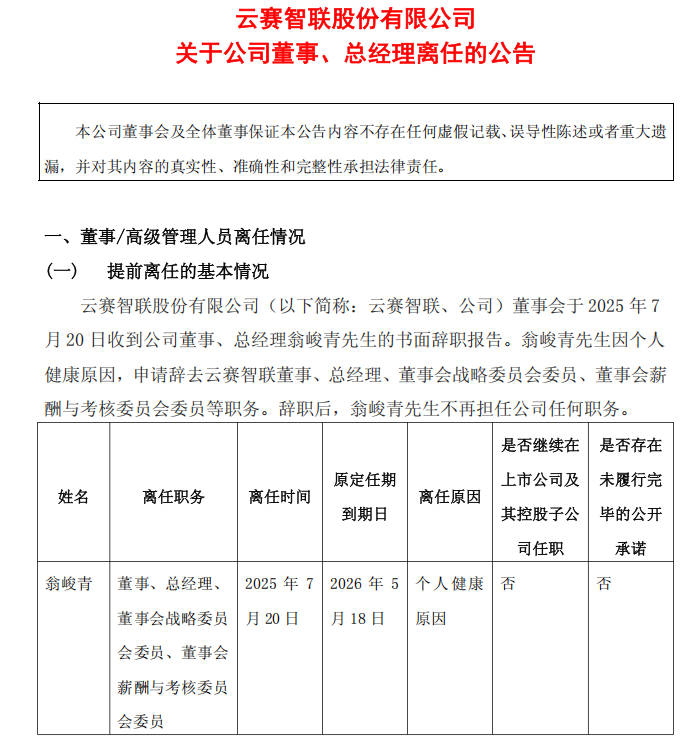
三百亿A股总经理,因健康问题离任
Zhong Guo Ji Jin Bao· 2025-07-21 14:25
Core Points - The general manager of YunSai ZhiLian, Weng Junqing, resigned due to health issues, effective July 20, 2024, after serving for ten years since July 23, 2015 [1][4][5] - The company expressed gratitude for Weng's contributions but did not disclose information regarding his successor or the timeline for the appointment [1][4] - Weng's resignation will not affect the board's minimum member count or the company's normal operations [4][5] Company Performance - In 2024, YunSai ZhiLian reported a revenue of 5.623 billion yuan, a year-on-year increase of 6.82%, and a net profit attributable to shareholders of 202 million yuan, up 4.92% [6] - The first quarter of 2025 saw a revenue of 1.410 billion yuan, a decrease of 2.07%, and a net profit of 42 million yuan, down 29.03% compared to the previous year [6] - As of July 21, 2024, the company's stock price was 22.28 yuan per share, reflecting a decline of 3.72%, with a total market capitalization of 30.47 billion yuan [7]