代理式AI

Search documents
未知机构:巴莱克银行实体AI正接近一个拐点有望在2035年前成长为万亿美元市场-20260224
未知机构· 2026-02-24 03:05
Summary of Key Points from the Conference Call Industry Overview - The report from Barclays Bank highlights the emergence of "Physical AI," which is expected to grow into a trillion-dollar market by 2035, with a projected market size ranging from $0.5 trillion to $1.4 trillion [1][3]. Core Insights and Arguments - Growth in the Physical AI market will be primarily driven by autonomous vehicles, followed by drones, industrial automation, and eventually humanoid robots [2][4]. - The ecosystem of Physical AI is categorized into four main pillars: - **Brain**: Semiconductors, software, and connectivity - **Muscle**: Actuators - **Battery**: Energy solutions - **Enablers**: Companies that build or deploy robotic systems [4]. - China currently leads in global deployment, expected to account for approximately 85% of humanoid robot installations by 2025 [4]. Investment Opportunities - From an investment perspective, enablers and existing companies deploying robots at scale in industrial, logistics, and retail sectors are poised to benefit the most from productivity enhancements and sustained growth [4]. Risks in High-Yield Software Sector - The rise of Agentic AI tools, such as Anthropic's Claude Code and Cowork, is reshaping the disruption risks in the high-yield software sector. Concerns about AI agents potentially replacing or reducing reliance on workflow software have led to significant sell-offs in high-yield software bonds, particularly for platforms lacking proprietary data or deep customer ties [4]. - The report categorizes disruption risks in the software sector, identifying defensive areas such as record systems, cybersecurity, core infrastructure software, and small to medium-sized enterprise network services, while event management and marketing intelligence software face the highest risks [4]. Long-term Pricing Pressures - Despite the potential for a gradual disruption process due to years of recurring revenue contracts, the seat-based pricing model is expected to face long-term pressure. Agentic AI may encourage large enterprises to develop software internally, but software vendors can partially mitigate risks by integrating AI capabilities and enhancing internal productivity [5].
2026年科技、传媒和电信行业预测报告2026
Deloitte· 2026-02-03 01:55
Investment Rating - The report does not explicitly provide an investment rating for the technology, media, and telecommunications (TMT) industry Core Insights - The gap between the ideal and reality in AI applications will narrow by 2026, driven by the solidification of foundational capabilities rather than flashy new models [3] - The TMT sector is expected to surpass all other industries in terms of scale, value, and economic growth contribution, as other sectors leverage TMT capabilities for their own innovation and efficiency [4] - Over half of the 13 key themes in the report focus on AI, emphasizing the importance of scaling AI applications and the need for practical groundwork such as data governance and compliance management [5] Summary by Sections AI-Driven Cross-Industry Transformation - The report predicts a shift from "software disrupting the world" to "AI, particularly agentic AI, disrupting the world" by 2026 [4] - AI data center spending is currently a significant contributor to GDP growth in the U.S., with TMT sector market capitalization nearing 53% of the S&P 500 [4] Generative AI and Agentic AI - Generative AI is expected to be one of the most influential technologies, with its integration into mainstream applications leading to a user base expansion that surpasses standalone applications [7][27] - By 2026, the daily usage of generative AI in embedded applications is projected to be three times higher than that of standalone tools [27] AI Computing Demand - By 2026, inference will account for two-thirds of all AI computing capacity, with a significant portion still relying on high-cost, high-power AI chips in data centers [8][53] - The market for inference-optimized chips is expected to exceed $50 billion by 2026, indicating a growing demand for specialized computing solutions [53] Autonomous AI Agents - The market for autonomous AI agents is projected to reach $8.5 billion by 2026, with potential growth to $45 billion by 2030 if companies effectively manage coordination challenges [9] Robotics and Drones - The cumulative installation of industrial robots is expected to reach 5.5 million units by 2026, with a potential doubling of annual shipments by 2030 driven by labor shortages and advancements in AI capabilities [10] SaaS and AI Integration - The integration of agentic AI into SaaS platforms is anticipated to fundamentally change how businesses procure and utilize software, leading to more intelligent and adaptive applications by 2026 [11] Semiconductor Supply Chain - The report highlights the increasing urgency for companies to enhance supply chain resilience amid trade restrictions affecting next-generation AI chip technologies [12] Short Video Content Evolution - The micro-drama format is reshaping global viewing habits, with revenue from in-app micro-dramas expected to double to $7.8 billion by 2026 [13] Podcasting Trends - Video podcasts are expected to generate approximately $5 billion in annual advertising revenue by 2026, reflecting a nearly 20% year-over-year growth [15] Sovereign Technology Initiatives - Countries are increasingly focused on building sovereign technology and AI infrastructure, which is expected to accelerate investments in cloud computing, semiconductors, and AI models over the next decade [16] Satellite Internet Developments - The report forecasts that spending on direct-to-device satellite network infrastructure will grow to between $6 billion and $8 billion by 2026, driven by the deployment of low Earth orbit satellites [20] Mobile User Trends - By 2026, the importance of mobile operators' reward programs may rival that of network performance in developed markets, indicating a shift in consumer priorities [21]
德勤:《2026科技、传媒和电信行业预测》报告
欧米伽未来研究所2025· 2026-01-26 02:02
Core Insights - The global technology industry is at a critical juncture, transitioning from the experimental phase of generative AI to a more pragmatic application by 2026, with a focus on foundational capabilities and cross-industry integration [1] - The TMT (Technology, Media, and Telecommunications) sector is becoming a fundamental driver of growth, efficiency, and innovation across all industries, surpassing the importance of chips and code [1] Group 1: Generative AI and SaaS - A significant trend is the shift from "active showcasing" to "passive service" in the use of generative AI, with embedded AI in mainstream applications expected to surpass standalone AI tools by 2026 [2] - The accessibility of passive generative AI will lead to a 300% higher usage rate in everyday applications like search engines compared to independent tools, making AI a background infrastructure in digital life [2] Group 2: Agent AI and SaaS Market Transformation - The rise of "Agent AI" will fundamentally change how enterprise software is procured and used, evolving SaaS applications into autonomous real-time workflow services [3] - Traditional subscription and per-seat licensing models may be replaced by hybrid models based on usage and outcomes, reflecting a shift from selling tools to selling results [3] Group 3: Market Size and Projections - The autonomous automation market is projected to reach $8.5 billion by 2026, with potential growth to $35 billion by 2030, contingent on addressing multi-agent orchestration challenges [4] Group 4: Computing Infrastructure and Energy Challenges - The focus of AI computation is shifting from model training to model inference, with predictions indicating that inference will account for two-thirds of all AI computation by 2026 [5] - The construction costs for AI data centers are expected to reach $400 billion by 2026, with annual costs potentially climbing to $1 trillion, posing significant energy challenges [7] Group 5: Geopolitical Influences and Technology Sovereignty - The complexity of the global geopolitical environment is driving nations to strengthen control over digital infrastructure, particularly in AI, leading to increased investments in cloud computing, semiconductors, and data centers [7] Group 6: Robotics and Physical AI - The global cumulative installation of robots is expected to reach 5.5 million units by 2026, with annual sales around 500,000 units, indicating a gradual but steady growth in the robotics sector [8] Group 7: Media and Entertainment Trends - The revenue from in-app micro-dramas is projected to double to $7.8 billion by 2026, reflecting a shift towards fragmented, mobile-first content consumption [9] - Video podcasts are expected to generate approximately $5 billion in annual advertising revenue by 2026, growing nearly 20% year-on-year [9] Group 8: Regulatory Concerns in Media - The rise of generative AI in media may trigger regulatory responses in the U.S. by 2026, addressing concerns over misinformation and copyright issues [10] Group 9: Conclusion on Industry Maturity - The overarching theme of the Deloitte report is that AI is moving away from myth and returning to the essence of industry, indicating a more mature and pragmatic phase for the TMT sector [11]


AI革命下的“失败者名单”:投行 Wedbush预警,这些巨头正被时代抛弃
Zhi Tong Cai Jing· 2025-12-08 13:49
Core Insights - Artificial intelligence is significantly transforming spending across various industries, benefiting companies like Nvidia and AMD, while negatively impacting others [1] Semiconductor and PC Industry - Wedbush Securities highlights that soaring demand for computer memory is squeezing companies linked to traditional PC and mobile sectors, adversely affecting Intel, HP, Synaptics, Qualcomm, Qorvo, and Cirrus Logic [1] - The report indicates that due to concentrated memory supply and AI-driven demand, DRAM contract prices are expected to rise over 30% by Q4 2025, with NAND flash prices potentially increasing by at least 20% [2] - Memory constitutes about 20% of the PC bill of materials, and a 27.5% average price increase in memory could lead to a 5.5% impact on sales costs, compressing gross margins for manufacturers like HP by 300-440 basis points [2] Autonomous Vehicles - The rise of autonomous vehicles is projected to negatively impact ride-hailing companies such as Uber and Lyft, as Tesla's first fleet of driverless cars is set to launch in Austin, Texas by the end of the year [2][3] - Autonomous fleets can transport people and goods without human labor, marking a significant shift in transportation economics since the introduction of ride-hailing services a decade ago [3] - As autonomous networks scale, value will shift towards platforms that own fleets, have data accumulation, and benefit from closed-loop economic advantages, undermining the asset-light models of Uber and Lyft [3] Advertising Sector - The emergence of agentic AI is causing a significant shift in advertising spending, with Wedbush downgrading Pinterest's rating and predicting negative impacts on The Trade Desk as advertisers move towards platforms with proven conversion rates, such as Amazon, Meta, Google, and AppLovin [2][3] - In an agentic AI landscape, advertising budgets are expected to flow towards platforms that offer rich first-party data, measurable conversion rates, and short feedback loops from signal to sale [3] Software as a Service (SaaS) Companies - Major SaaS companies like Adobe, Docusign, and Workday may face negative impacts as some firms pivot towards usage-based models, while high-cost product companies are likely to be more affected [3][4] - Historically, disruptors in enterprise software first succeed in niche applications before threatening established competitors, with Adobe, Docusign, and Workday facing the greatest risks [4] - Wedbush downgraded Nice Systems from "outperform" to "neutral," lowering the target price from $170 to $120 [4] Retail Sector - The impact of agentic AI is also disrupting various areas within the retail sector, including intermediary organizations like Instacart [4]



重磅发布:毕马威《2025年中国首席执行官展望》报告
Sou Hu Cai Jing· 2025-11-10 11:38
Core Insights - The report highlights the resilience and vitality of the Chinese economy amidst external risks and challenges, with 88% of Chinese CEOs expressing confidence in the country's economic development over the next three years, marking a recent high [8][18][20]. Group 1: Economic Outlook - Despite escalating external risks, Chinese CEOs show a rebound in confidence regarding short-term economic growth, with 54% expressing optimism for the next year, an increase of 9 percentage points from the previous year [9][11]. - The long-term economic outlook remains positive, with 58% of Chinese CEOs confident in global economic growth over the next three years, although this is a decrease of 13 percentage points from the previous year [18][20]. Group 2: Business Challenges - The report identifies "involution" competition as the primary challenge for businesses, with 51% of CEOs acknowledging intensified market competition as a significant impact on current business development [15]. - There is a notable decline in revenue growth expectations, with only 73% of CEOs anticipating positive revenue growth this year, down from 81% last year [11][12]. Group 3: Strategic Initiatives - 52% of Chinese CEOs prioritize research and innovation to develop new productivity as a key short-term strategy to combat "involution" competition [12][15]. - The focus on digital transformation and compliance investments is increasing, with a significant emphasis on enhancing supply chain security [12][15]. Group 4: Leadership and Management - 54% of Chinese CEOs believe their roles and responsibilities have significantly changed in the past five years, necessitating a multifaceted leadership approach that includes strategic foresight and adaptability [26]. - The importance of agility and rapid decision-making under pressure is emphasized, with 26% of CEOs identifying these as critical leadership capabilities [26]. Group 5: International Expansion - Chinese companies are shifting their overseas strategies from aggressive expansion to rational deepening, with 77% of CEOs citing strategic resource allocation as a primary driver for international ventures [29]. - The choice of overseas markets is increasingly focused on Southeast Asia and the Middle East, reflecting a strategic move to mitigate geopolitical risks [29][31]. Group 6: Technology and AI - The application of artificial intelligence (AI) is becoming more prevalent, with 86% of Chinese CEOs expecting a return on AI investments within three years, a significant increase from the previous year [33]. - Over 60% of CEOs view the competition for AI talent and skills enhancement as a key challenge for future development [36]. Group 7: ESG Investments - There is a growing proactive attitude towards Environmental, Social, and Governance (ESG) investments, with 76% of CEOs believing that ESG investments contribute to corporate transformation and demand enhancement [38]. - 49% of companies have initiated practices in low-carbon transformation, a notable increase from 35% the previous year [38].

麦肯锡《技术趋势展望》解读:技术革命与全球竞争新格局
Sou Hu Cai Jing· 2025-08-30 02:37
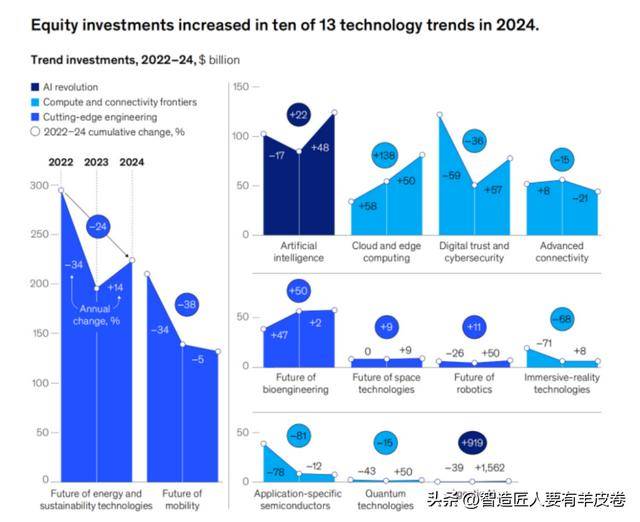
Group 1: Core Insights - The McKinsey report identifies 13 key technologies categorized into three main areas: Artificial Intelligence Revolution, Computing and Connectivity Frontiers, and Advanced Engineering [1] - In 2024, 10 out of the 13 technology trends saw an increase in equity investment, indicating sustained global interest in cutting-edge technologies [4] - The report highlights the rapid growth of agent-based AI, with investment reaching $1.1 billion in 2024 and a 985% increase in related job demand [4][6] Group 2: Artificial Intelligence Revolution - Agent-based AI is characterized by autonomous agents capable of planning and executing multi-step tasks, showing unique value in areas like intelligent customer service and code development [6] - General AI is evolving towards multi-modal interactions, with 78% of organizations deploying AI in at least one business function and 92% of executives planning to increase investments in the next three years [8] - In 2024, global AI equity investment reached $124.3 billion, with OpenAI raising a record $40 billion in a single funding round [8][11] Group 3: Computing and Connectivity Frontiers - The demand for AI-driven computing is growing exponentially, driving innovation in semiconductors, networking, and cloud computing [11] - Customized semiconductors are becoming essential for meeting the massive computational needs of AI, with global equity investment in this area reaching $7.5 billion in 2024 [12] - The report predicts that by 2030, approximately 70% of data center demand will be for AI workloads, with a 33% annual growth rate from 2023 to 2030 [16] Group 4: Advanced Engineering - The integration of AI and robotics is transforming robots from fixed-task executors to collaborative partners, with global investment in robotics expected to reach $7 billion in 2024 [25] - The robotics industry is projected to grow to $900 billion by 2040, driven by opportunities arising from labor shortages and rising production costs [25] - Notable applications include Boston Dynamics' ElectricAtlas for heavy lifting in industrial settings and FigureAI's Helix for complex tasks like grocery sorting [25]