元宝红包

Search documents
春节AI拉新卷疯了!一个“千问新人”最高卖到18元
第一财经· 2026-02-08 08:49
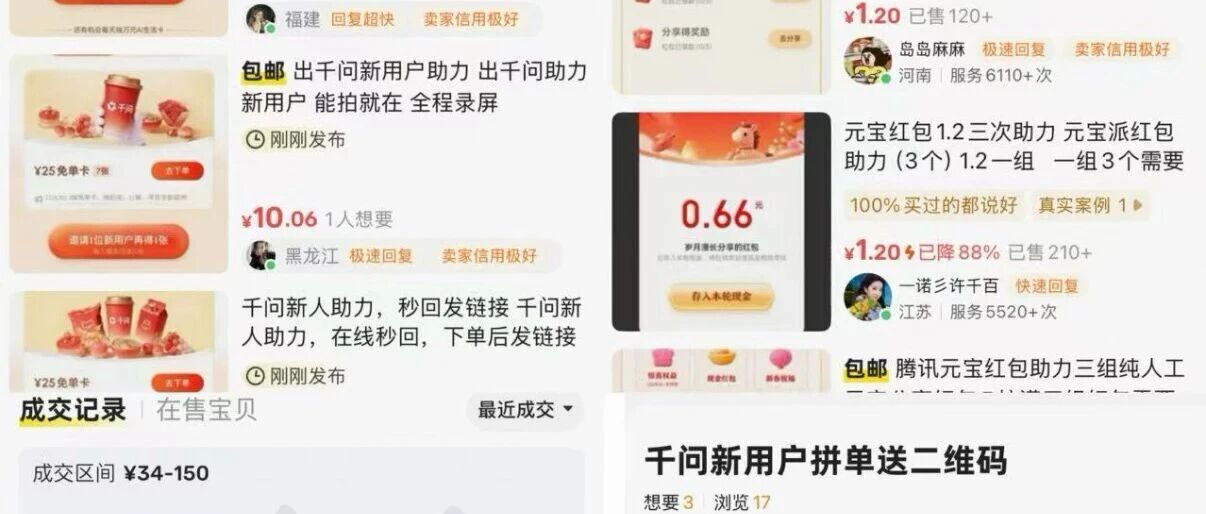
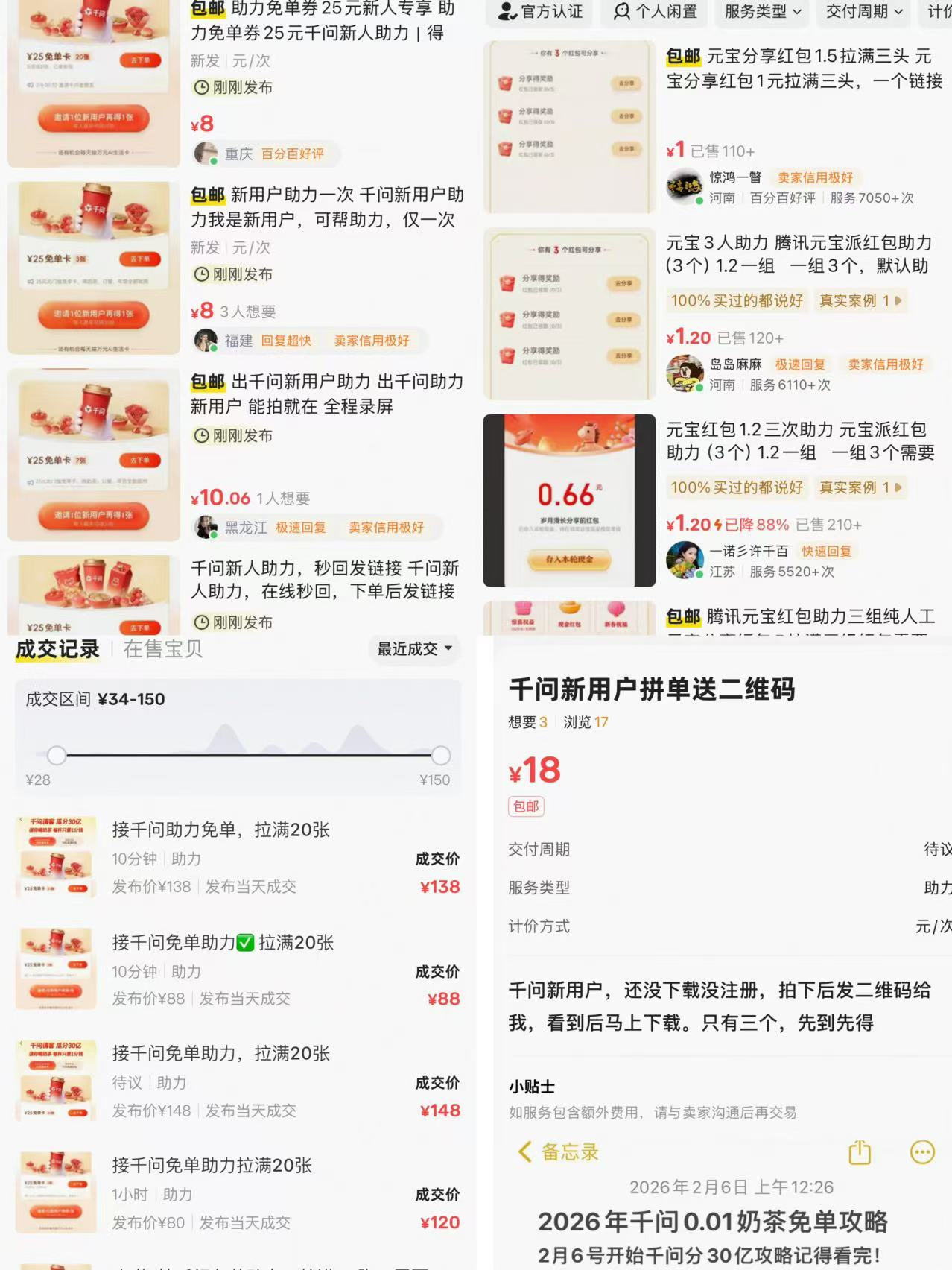
Core Viewpoint - The article discusses the emerging business of selling "AI newcomers" on platforms like Xianyu, driven by promotional activities from AI applications during the Spring Festival, particularly the "Qianwen" initiative which offers substantial incentives for user acquisition [3][5]. Group 1: AI Application Promotions - On February 6, Qianwen launched a 3 billion yuan "Spring Festival Treat" plan, offering new users a 25 yuan takeaway "free order card" for participating in the activity [3]. - Users can earn additional free order cards by successfully inviting new users, leading to a surge in demand for "Qianwen newcomers" on Xianyu [3][5]. - The promotion resulted in over 10 million orders within 9 hours of launch, showcasing the effectiveness of the marketing strategy [5]. Group 2: Market Dynamics on Xianyu - The price for "Qianwen newcomers" has increased significantly, with average transaction prices rising from 3-4 yuan on February 6 to 4-6 yuan by February 8, and some listings reaching up to 18 yuan [5]. - There are also numerous listings priced at 0.01 yuan or 1 yuan, indicating a mix of legitimate offers and potential scams, as some sellers do not fulfill orders [5]. - The competition among AI applications has led to a vibrant marketplace, with other promotions like "Yuanbao Red Packet Assistance" also gaining traction, further driving user engagement [5].

春节AI拉新卷疯了!一个“千问新人”最高卖到18元
Di Yi Cai Jing· 2026-02-08 08:14
Core Insights - The competition among AI applications during the Spring Festival is intensifying, with companies like Qianwen launching promotional campaigns to attract new users [1][4] - The practice of selling "AI newcomers" in bulk on platforms like Xianyu has emerged as a new business model, driven by incentives such as free meal vouchers [1][4] Group 1: Promotional Activities - Qianwen initiated a 30 billion yuan "Spring Festival Treat" campaign, offering new users a 25 yuan meal voucher for their first participation [1] - Users can earn additional vouchers by inviting new users, leading to a surge in demand for "Qianwen newcomers" on Xianyu [1][4] - The campaign saw over 10 million orders within 9 hours of launch, indicating strong user engagement [4] Group 2: Market Dynamics - The price of "Qianwen newcomers" has been increasing, with average transaction prices rising from 3-4 yuan to 4-6 yuan within two days, and some listings reaching up to 18 yuan [3][4] - There are also numerous listings priced at 0.01 yuan or 1 yuan, with reports of some sellers not delivering the promised services, highlighting potential consumer risks [4] - The competition among AI applications has led to fluctuating rankings in the Apple App Store, with Qianwen frequently occupying the top position [4]
微信已恢复!千问 + 元宝红包口令可以复制了
程序员的那些事· 2026-02-08 07:34
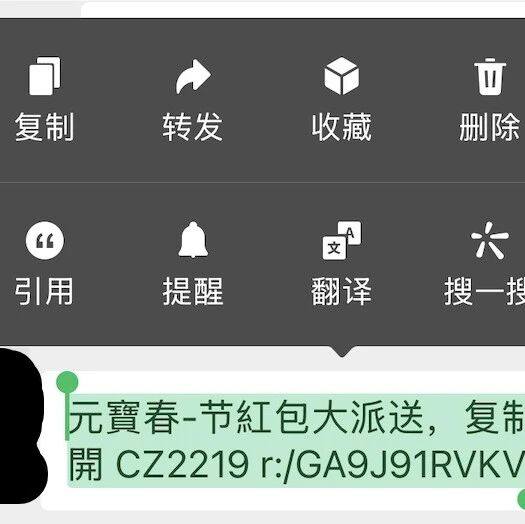
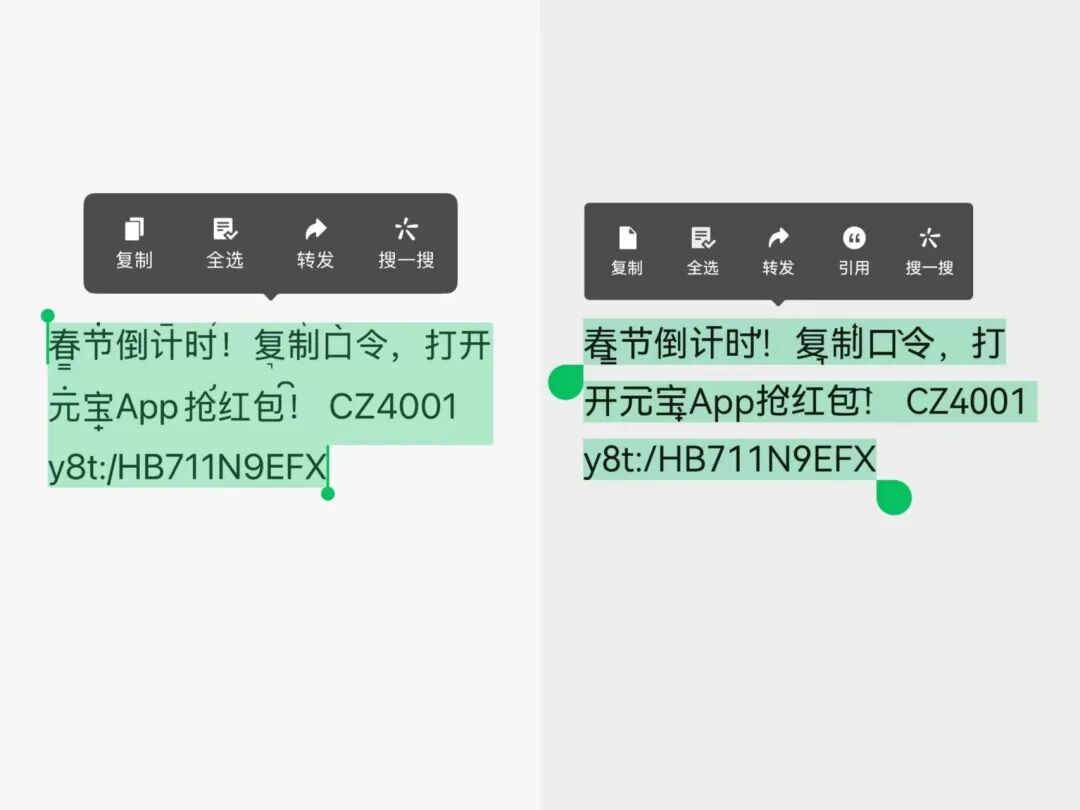
Group 1 - The "Qianwen + Yuanbao" red envelope command in WeChat was not copyable starting from noon on February 6 [1] - Reports indicated that the copy option for Yuanbao red envelopes was restored by the afternoon of February 8, as confirmed by testing [1]
元宝红包口令已能够在微信中复制!千问1分钱奶茶遭疯抢,二手平台惊现“千问奶茶”6元起售,回应:虚拟权益禁止倒卖和转让
新华网财经· 2026-02-08 02:33
Core Viewpoint - The article discusses the intensifying competition in the "red envelope war" driven by AI applications, particularly focusing on the changes in how users can share and access red envelope links during the Chinese New Year period [4]. Group 1: Red Envelope Sharing Mechanism - As of February 7, users can share Yuanbao red envelope links through Yuanbao Pai, and WeChat has enabled the copying of red envelope codes [1][3]. - Following WeChat's restriction on Yuanbao and Qianwen's red envelope links, both platforms shifted to a code-copying method for sharing [5]. - Starting from February 6, users were unable to copy the red envelope codes once sent to the WeChat chat interface [6]. Group 2: Qianwen's Promotional Activities - Qianwen's "Buy a Milk Tea" campaign has sparked a buying frenzy, with some users reportedly acquiring up to 21 free milk teas [12]. - On second-hand trading platforms, users are attempting to sell Qianwen's milk tea offers for prices ranging from 6 to 10 yuan, claiming to facilitate orders for customers [12]. - Qianwen's customer service clarified that the free milk tea offers are virtual discounts and cannot be transferred, resold, or monetized in any form [14].

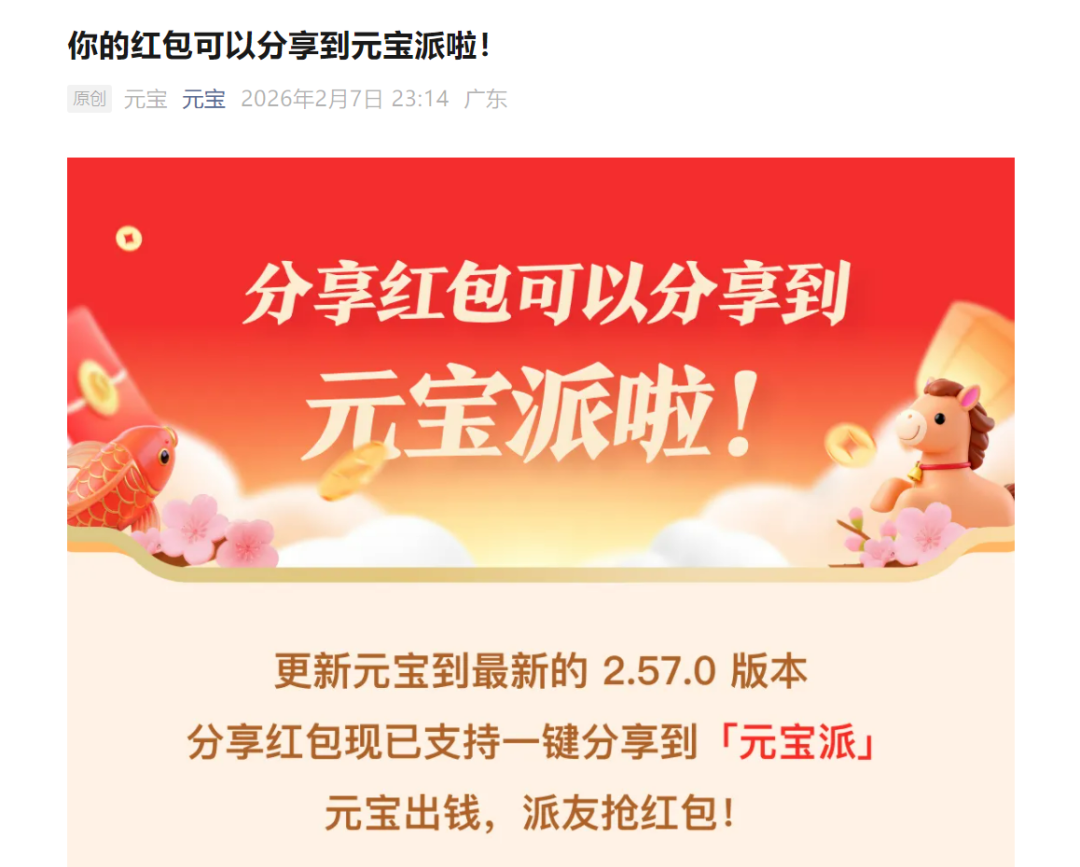
元宝深夜发布:红包可分享到元宝派!红包口令已能在微信中复制
Mei Ri Jing Ji Xin Wen· 2026-02-08 01:57
Core Viewpoint - Tencent's Yuanbao has updated to version 2.57.0, enabling users to share red envelope links directly to "Yuanbao Pai" with a single click [1]. Group 1 - On February 7, a reporter tested the new version on an iPhone and confirmed that the Yuanbao red envelope link can now be shared to Yuanbao Pai [5]. - Between 21:29 and 21:49 on February 7, tests on both iOS and Android devices showed that WeChat can now copy the Yuanbao red envelope password [7]. - Prior to this update, starting from the afternoon of February 6, users were unable to copy the password information after it was sent to the WeChat chat interface [7].

元宝红包口令已能够在微信中复制!千问1分钱奶茶遭疯抢,二手平台惊现“千问奶茶”6元起售,回应:虚拟权益禁止倒卖和转让
Mei Ri Jing Ji Xin Wen· 2026-02-07 16:27
Group 1 - The core point of the article highlights the intensifying competition in the "red envelope war" among AI applications, particularly between Yuanbao and Qianwen, as they adapt their strategies to share red envelope links through copying commands after WeChat blocked direct links [3][2]. - Yuanbao and Qianwen have shifted to a command-copying method for sharing red envelopes, which was tested successfully on both Apple and Android devices [2][3]. - The "please treat me to milk tea" promotion by Qianwen has sparked a buying frenzy, with users reportedly acquiring multiple free milk tea orders, leading to secondary market transactions [7][9]. Group 2 - Qianwen's customer service clarified that the free order rights are virtual discounts and cannot be transferred, sold, or monetized, with strict measures against reselling [9]. - Qianwen announced that the free order cards are valid until February 28, providing users with ample time to utilize them, especially during peak ordering times [9]. - The free order cards can be used for various purchases, including groceries and daily necessities, through the Qianwen app and other partnered platforms [9].
千问红包,被微信封禁
Sou Hu Cai Jing· 2026-02-06 06:59
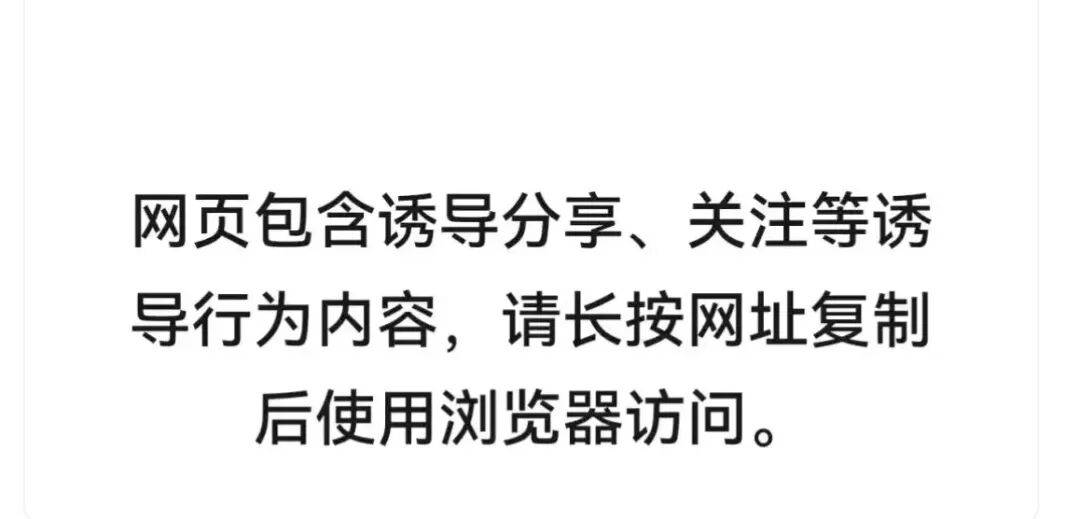
Group 1 - The "Spring Festival 3 Billion Free Order" campaign by Qianwen App launched on February 6, allowing users to order milk tea for free using AI-generated phrases, resulting in over 1 million orders within 3 hours [1] - Qianwen adjusted the default sharing method for red envelopes on WeChat to "password red envelopes" in response to platform restrictions [2] - WeChat has previously banned red envelopes during the Spring Festival marketing period, including those from its subsidiary Yuanbao, indicating a crackdown on excessive marketing and misleading sharing practices [4] Group 2 - On February 5, Baidu's Wenxin Assistant faced a similar ban on its red envelope sharing link by WeChat, which cited misleading content as the reason for the block [6] - Following the ban, Baidu also switched to a "password red envelope" format, requiring users to manually copy the password to participate in the activity, a common method to bypass platform restrictions [6]

腾讯“内讧”?微信封杀元宝红包
3 6 Ke· 2026-02-05 23:22
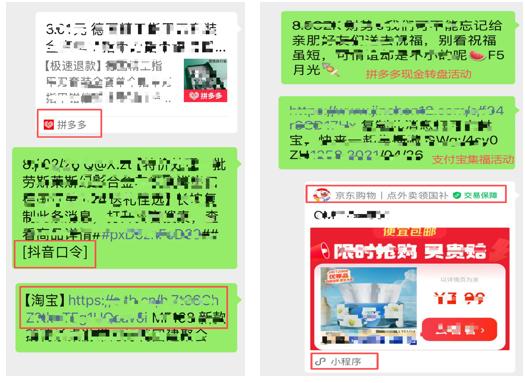
Core Viewpoint - Tencent's Spring Festival "Yuanbao" red envelope activity faced unexpected challenges when WeChat restricted access to its links, raising questions about the implications of this internal conflict and the strict external link management policies of WeChat [3][14][19]. Group 1: Event Overview - The Yuanbao red envelope activity launched on February 1 with a cash pool of 1 billion yuan, generating significant user engagement and discussions about potential "induced sharing" practices [1][12]. - The excitement surrounding the event was short-lived, as WeChat implemented restrictions on the Yuanbao links just three days later, citing risks associated with "induced sharing" [2][14]. Group 2: WeChat's Link Management - WeChat is known for its stringent external link management, having previously restricted links from platforms like Douyin, Taobao, and Alipay [4][5]. - The platform's history of "link wars" with competitors highlights its commitment to maintaining control over its ecosystem, with notable actions taken against various external links over the years [5][8]. Group 3: Internal Dynamics and User Reactions - Despite being a Tencent product, the Yuanbao activity faced scrutiny for its similarity to practices WeChat typically opposes, leading to accusations of double standards [12][14]. - User feedback indicated dissatisfaction with the decreasing value of red envelopes over time, compounding the criticism of the activity's structure and WeChat's handling of it [13][24]. Group 4: Strategic Implications - WeChat's decision to restrict its own product's links may serve to uphold its reputation for fairness and could provide a basis for future actions against competitors' promotions [18][24]. - The timing of WeChat's restrictions coincided with Alibaba's launch of its own Spring Festival marketing initiatives, suggesting a strategic maneuver to limit competition [18][19]. Group 5: Market Response and Future Outlook - The Yuanbao activity's failure to replicate the success of previous red envelope campaigns indicates challenges in user engagement and acceptance of its promotional model [23][24]. - The incident reflects broader trends in the competitive landscape of the internet industry, where understanding user sentiment and adhering to established rules are crucial for success [24].
微信,给元宝“纠偏”
Sou Hu Cai Jing· 2026-02-05 22:46
Core Viewpoint - WeChat's decision to restrict the "Yuanbao" red envelope feature has sparked significant discussion on social media, highlighting the platform's commitment to user experience and its evolving business strategy [1][3][9] Group 1: WeChat's Strategy - WeChat is undergoing a transformation from a "technology-driven" model to a "user-driven" model, emphasizing user experience as a core principle [7][8] - The platform's evolution includes the integration of various features such as public accounts, mini-programs, and video accounts, which have created a complex ecosystem [7] - The restriction on Yuanbao links may serve as a strategic move to maintain user engagement and prevent the dilution of user experience [9][10] Group 2: Market Dynamics - The competitive landscape suggests that simply investing heavily in marketing, as seen with various tech companies, does not guarantee user retention or loyalty [11][12] - Historical context indicates that WeChat's success with the red envelope feature was rooted in its already strong user engagement, rather than just financial incentives [13][14] - The platform's ability to connect with 1.4 billion global users positions it as a fertile ground for AI development, requiring patience and strategic focus [15][17] Group 3: Future Outlook - The potential for AI within WeChat's ecosystem is significant, but it necessitates a strong commitment to enhancing user experience and product quality [14][18] - The narrative suggests that once the Yuanbao feature is adequately prepared, the value of WeChat as an AI platform will be fully realized [18]

南财V快评:微信封杀自家元宝
2 1 Shi Ji Jing Ji Bao Dao· 2026-02-05 08:30
Group 1 - WeChat announced the restriction of its "Yuanbao Red Packet" feature due to marketing practices that induce sharing and disrupt platform ecology, causing user harassment [2] - The decision to restrict Yuanbao Red Packet serves multiple strategic purposes, including generating significant publicity without spending on advertising, as the news quickly became a trending topic [3] - By taking action against its own product, WeChat aims to reinforce its commitment to user experience, positioning itself as prioritizing users over internal affiliations, thus enhancing its public image [3] Group 2 - The timing of the restriction is strategic, as it coincides with competitors like Doubao and Qianwen preparing to launch their own red packet features, signaling to competitors that similar marketing tactics will not be tolerated on the WeChat platform [3][4] - The situation is framed not as internal conflict within Tencent but as a strategic move to clear the competitive landscape, emphasizing the straightforward nature of business warfare [4]