
全自动驾驶(FSD)

Search documents
财报前瞻 | 汽车业务承压,特斯拉(TSLA.US)高估值将由“AI与能源”叙事撑起?
智通财经网· 2026-01-26 08:27
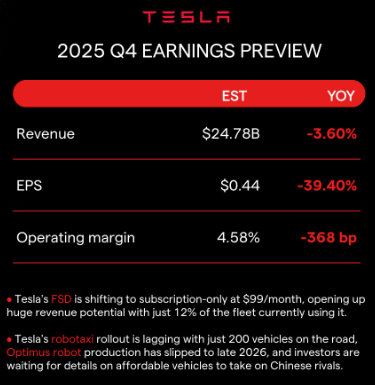
智通财经APP获悉,特斯拉(TSLA.US)将于北京时间周四晨间(美东时间周三美股盘后)公布最新季度业绩。该公司 持续引发激烈争论,仍然是市场上最具争议、最受关注的股票之一。投资者对特斯拉的看法几乎没有中间立场。 他们要么极度追捧,要么极度厌恶,一些人预期股价会大幅下跌,而另一些人则期待获得丰厚回报。 围绕特斯拉存在着诸多疑问。它究竟是一家汽车公司?还是一家科技公司?它在全自动驾驶(FSD)领域究竟拥有多大 的潜力?它会成为市场领导者,还是仅仅是众多竞争者之一?它的估值又如何呢?有人认为,这家公司的估值过高, 尤其如果将其视为一家汽车公司的话。 自2025年4月触底以来,特斯拉股价一直处于强劲上涨趋势。在近期回调之前,其股价已经上涨超过100%。 业绩回顾:第三季度营收创历史新高,但成本上升掩盖了其光芒 疲软的交付量可能对特斯拉的汽车业务收入和利润率造成压力。但该公司的能源发电和储能业务有望在一定程度 上抵消这种不利影响。得益于Megapack和Powerwall产品的强劲市场表现,特斯拉的能源业务表现良好。 特斯拉第四季度交付量为418,227辆,同比下降15.6%,低于分析师预期。2025财年全年交付量预 ...


Wedbush展望2026年AI黄金赛道:除英伟达外,这五大科技巨头将主导市场
美股IPO· 2025-12-30 04:48
Core Viewpoint - Wedbush identifies Microsoft, Palantir, Apple, Tesla, and CrowdStrike as the top five companies to invest in the AI sector by 2026, alongside Nvidia [1] Group 1: Microsoft - Analysts led by Dan Ives believe Wall Street has underestimated Azure's growth potential and the AI-driven transformation expected by 2026, making Microsoft a favored large-cap tech stock for the coming year [3] - The fiscal year 2026 is anticipated to be a pivotal year for Microsoft's AI growth as CIOs schedule deployment projects [3] Group 2: Palantir - Wedbush sees Palantir, under CEO Alex Karp, continuing to make significant progress in government and commercial sectors, with potential to reach a market valuation of $1 trillion [3] Group 3: CrowdStrike - CrowdStrike is expected to benefit from AI as its product suite expands in the enterprise market, with analysts believing Wall Street has underestimated its growth potential [4] Group 4: Tesla - Wedbush forecasts Tesla's market value could reach $2 trillion in the coming months, and potentially $3 trillion by the end of 2026 in a bullish scenario due to advancements in autonomous vehicles and robotics [4] - The process of transitioning to AI-driven valuation for Tesla is believed to have already begun, with full self-driving and autonomous driving penetration among existing users seen as key growth drivers [4] Group 5: Apple - Apple is expected to leverage its vast consumer base of over 2.4 billion iOS devices and 1.5 billion iPhones to profit from AI, with potential to increase its stock value by $75 to $100 per share in the coming years [5] - Tim Cook is anticipated to remain CEO until at least the end of 2027 to guide Apple through a critical AI technology transformation [5]


Wedbush展望2026年AI黄金赛道:除英伟达(NVDA.US)外,这五大科技巨头将主导市场
Zhi Tong Cai Jing· 2025-12-30 00:32
Group 1 - Wedbush identifies Microsoft, Palantir, Apple, Tesla, and CrowdStrike as the top five companies to invest in the AI sector by 2026, alongside Nvidia [1] - The analyst team led by Dan Ives believes that Wall Street has underestimated Azure's growth prospects and the AI-driven transformation that Microsoft will undergo by 2026, making it a favored large-cap tech stock for the coming year [1] - Palantir is expected to progress towards a $1 trillion market cap as it continues to achieve significant advancements in government and commercial sectors [1] Group 2 - CrowdStrike is anticipated to benefit from AI as its product suite expands in the enterprise market, with Ives noting that cybersecurity is a secondary beneficiary of the AI revolution [2] - Wedbush projects Tesla's market cap could reach $2 trillion in the coming months, and potentially $3 trillion by the end of 2026 due to advancements in autonomous vehicles and robotics [2] - Apple is expected to leverage its vast consumer base of over 2.4 billion iOS devices and 1.5 billion iPhones to profit from AI, with potential increases in share value of $75 to $100 in the coming years [2]


大摩:市场低估了xAI对特斯拉的意义,FSD 14.3或将成为自动驾驶的“蒸汽机时刻”
Hua Er Jie Jian Wen· 2025-11-11 02:48
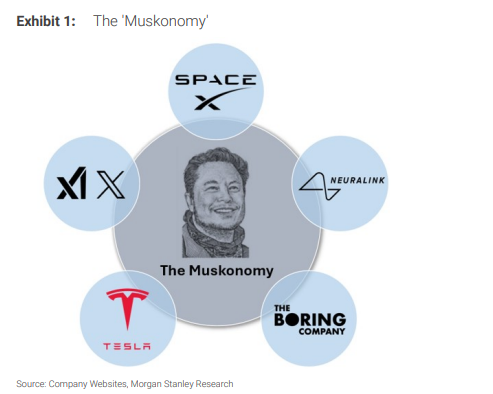
Core Insights - The market has focused on Elon Musk's high compensation, but Morgan Stanley emphasizes that the strategic points from Tesla's shareholder meeting are being overlooked [1] - Key signals that will profoundly impact Tesla's stock price in the next 6-12 months include the relationship with xAI, advancements in Full Self-Driving (FSD), vertical integration of chips, distributed inference cloud networks, space AI satellites, and revolutionary production methods for Cybercab [1] Group 1: Tesla and xAI Relationship - The relationship between Tesla and xAI is crucial for Tesla's long-term success, with both companies forming a recursive loop in data, hardware, and manufacturing [4] - Tesla may build a "gigantic chip factory" to support its ambitious plans for billions of robots, ensuring supply and innovation in reasoning chips [4] - The market has underestimated the significance of Musk's confidence in FSD V14.3, which will allow texting while driving [4] Group 2: Technological Breakthroughs - Transitioning driving responsibility from humans to pure visual algorithms represents a historic technological breakthrough in transportation [5] - Musk proposed a "massive" distributed inference cloud, offering $100 or $200 monthly to car owners for AI processing when their vehicles are idle, potentially creating an unprecedented edge computing network [5] Group 3: Future Innovations - The report highlights two future-oriented concepts: solar AI satellites and the production target for Cybercab [6] - The collaboration between Tesla and SpaceX in space computing is underscored by the potential of solar AI satellites, which could address human demands for computing and power [6] - Tesla aims for a production rate of "one vehicle every 10 seconds" for Cybercab, significantly faster than traditional automotive manufacturing, indicating a major leap in mass production methods [6]
预期VS现实:特斯拉(TSLA.US)万亿市值背后的豪赌,自动驾驶成唯一救赎?
智通财经网· 2025-08-27 06:28
Core Viewpoint - Tesla's stock price has risen over 35% since March, driven by optimistic expectations regarding robotaxi, AI advancements, and new product news, despite recent performance not showing significant improvement [1] Group 1: Current Focus of Tesla - Tesla maintains a market capitalization above $1 trillion, leveraging its strong brand, large operational fleet, and vertically integrated business model [2] - The management is currently focused on the rollout of robotaxi services, with a pilot program launched in Austin, and is reallocating engineers to full self-driving (FSD) and AI projects [2] - The company is also pushing for growth in its energy business, although its profits still heavily rely on automotive sales, which face pricing pressures and intense competition [2] Group 2: Current Electric Vehicle Market Landscape - The global electric vehicle market is entering a challenging phase, with growth slowing in regions like the US and Europe, and increased competition from companies like BYD and VinFast [3] - Regulatory scrutiny is intensifying due to incidents involving Autopilot, adding to industry challenges [3] - Tesla's competitive edge lies in its software development and data accumulation, but regulatory hurdles may impede progress [3] Group 3: Key Financial Data - In Q2, Tesla reported revenue of $22.5 billion, a 12% year-over-year decline, with automotive revenue dropping from $18.5 billion to $15.8 billion [4] - The gross margin was 17.2%, down from 18% year-over-year, and net profit was $1.2 billion, down from $1.4 billion in the same period last year [4] - The company has a strong balance sheet with $36.8 billion in cash and short-term investments against $13.1 billion in debt [4] Group 4: Market Valuation Logic - Tesla's valuation appears excessive, with a forward P/E ratio exceeding 200, and even with projected EPS of $3.25 by 2027, the P/E ratio remains above 100 [5] - Such valuation levels are only justified if Tesla achieves significant breakthroughs in robotaxi or AI software profitability [5] - If Tesla's valuation aligns with peers, the stock price could face a decline of 55%-75% [6] Group 5: Recent Key Developments - Recent news includes mixed signals: positive developments such as obtaining robotaxi licenses in Texas and ongoing energy and AI collaborations, alongside negative news like securities fraud lawsuits and investigations by NHTSA [7] - Investor sentiment is divided, with retail investors remaining enthusiastic while most institutions adopt a cautious stance, reflected in earnings forecast adjustments [7] Group 6: Future Outlook - Short-term revenue growth is expected to be weak, with profit margins under pressure; consensus predicts 2025 revenue of $92.7 billion, with potential recovery in subsequent years [10] - The core challenge lies in whether Tesla can enhance profitability while growing, with market expectations for significant contributions from robotaxi and AI being overly optimistic [10] - The performance will depend on three factors: preventing further margin declines, transforming the energy business into a profit engine, and managing costs without relying on new government subsidies [10] Group 7: Scenario Assumptions - Pessimistic scenario: Delays in robotaxi deployment and profit margin pressure lead to stagnant EPS around $2, with valuation dropping to a 100 P/E ratio [11] - Neutral scenario: Continued growth in energy and service sectors stabilizes automotive business, achieving EPS of $3.25 by 2027 with a P/E ratio above 90 [11] - Optimistic scenario: Successful commercialization of robotaxi by 2027 results in EPS exceeding $7, with investors assigning a 60-70 P/E ratio [11] Group 8: Final Conclusion - Tesla remains an attractive company, but its stock price trajectory is difficult to predict due to high valuations driven by expectations of breakthroughs in robotaxi and AI [13] - Current data shows declining automotive sales, weak margins, and moderate profit growth, challenging the sustainability of its $1 trillion market cap [13] - A neutral rating is maintained, suggesting long-term holding for existing investors while cautioning against new investments at current price levels due to unfavorable risk-reward ratios [13]
大摩评特斯拉(TSLA.US)解散Dojo团队:“DOGE式效率”革命启动 百亿AI开支有望重配机器人赛道
智通财经网· 2025-08-12 08:23
Core Viewpoint - Morgan Stanley maintains an "Overweight" rating on Tesla (TSLA.US) with a target price of $410, highlighting a strategic shift involving the dissolution of the in-house Dojo supercomputer team to optimize AI program cost-effectiveness [1] Group 1: Strategic Changes - Tesla is reportedly disbanding its Dojo supercomputer team, with team leader Peter Bannon leaving the company, although Tesla has not confirmed this news [1] - The Dojo supercomputer was designed to process vast amounts of data and video generated by Tesla vehicles for training Full Self-Driving (FSD) and Optimus machine learning models [1] - Elon Musk has ordered the termination of the Dojo project, with plans to increase collaboration with external tech partners like NVIDIA (NVDA.US) and AMD (AMD.US) for computational support [1] Group 2: Financial Implications - Analyst Adam Jonas suggests that this move reflects significant strategic and financial considerations, potentially part of Tesla's cost-cutting plan to reduce capital and operational expenditures associated with the Dojo project [2] - Tesla's Q2 report indicated that AI initiatives have increased operational expenses, with capital expenditures expected to exceed $9 billion in fiscal year 2025, primarily directed towards AI-related fields [2] Group 3: Focus on Robotics and Edge Computing - The strategic shift may benefit Musk's xAI company, which is taking on more responsibilities for developing Tesla's "AI brain" and utilizing data from social media and real-world vehicle operations [2] - Tesla appears to be refocusing on robotics technology and edge inference capabilities, with Musk emphasizing the potential strategic value of Tesla's global fleet as a distributed inference network [2] - As the commercialization of Optimus accelerates, analysts believe Tesla may redirect capital expenditures and R&D investments towards reducing robot production costs and optimizing manufacturing systems [2] Group 4: Market Context - The timing of Tesla's spending reduction is notable, as the GPU shortage that previously pressured the company to develop in-house computing resources has significantly eased [2] - Joe Moore from Morgan Stanley notes that developing ASIC chips that can outperform NVIDIA's offerings is becoming increasingly difficult due to NVIDIA's annual R&D spending exceeding $15 billion and the expanding scope of AI investments [3]
