化工50ETF

Search documents
最高涨近35%!同叫化工ETF,为何收益差这么多?
市值风云· 2026-03-20 10:16
Core Viewpoint - The article discusses the varying performance of chemical ETFs in 2023, highlighting that despite all being labeled as "chemical," their returns differ significantly due to underlying factors such as the indices they track and market conditions [4][6]. Group 1: ETF Performance - The best-performing chemical ETF has nearly achieved a 35% return this year, while others have returned less than 5% [4]. - The leading ETF, the Energy Chemical ETF by Jianxin (159981.SZ), has shown a significant increase in performance, attributed to its tracking of a commodity futures index rather than a traditional stock index [7][11]. - The majority of chemical ETFs are equity-based, tracking the performance of chemical companies, which can be influenced by broader market sentiments [14][13]. Group 2: Index Tracking Differences - Jianxin's ETF tracks the Yisheng Energy Chemical A index, which is linked to commodity prices like thermal coal and PTA, making it more sensitive to commodity market fluctuations [11][13]. - Other mainstream chemical ETFs follow a segmented chemical index, which includes top-performing companies in the chemical sector, such as Wanhua Chemical and Salt Lake Potash [15][17]. - The largest ETF by assets is the Penghua Chemical ETF (159870.SZ), with a combined scale exceeding 28 billion [19]. Group 3: Full Return Index vs. Price Index - The Guotai Chemical ETF (516220.SH) tracks a "full return" index, which includes dividends in its calculations, potentially leading to higher long-term returns compared to standard price indices [24][25]. - The full return index captures the benefits of reinvested dividends, which can enhance returns over time, especially in a cyclical industry like chemicals [25]. Group 4: Investment Strategies - For traders focused on short-term trends in commodities like PTA and methanol, the Energy Chemical ETF by Jianxin is more suitable due to its futures-based nature [26]. - For long-term investors interested in core chemical assets and industry leaders, ETFs tracking stocks of leading companies in the chemical sector may be more appropriate [26].



地缘冲突引爆资源行情,油气ETF单周吸金超206亿
第一财经· 2026-03-09 13:33
Core Viewpoint - The article discusses the significant shift in the A-share ETF market, driven by geopolitical conflicts, leading to a substantial inflow of funds into resource-related ETFs, particularly in oil and gas sectors, while core broad-based ETFs experienced notable outflows [3][4][11]. Fund Flows and Market Dynamics - As of March 6, nearly 400 billion yuan was withdrawn from core broad-based ETFs like the CSI 300 and CSI 500, while industry-themed ETFs saw a net inflow of 443.23 billion yuan, indicating a clear trend of funds moving from broad-based to thematic investments [4]. - Oil and gas ETFs emerged as the top performers, attracting over 206 billion yuan in a single week, with several products seeing their shares increase by over 300% [4][5]. - Specific oil and gas ETFs, such as the Guotai CSI Oil and Gas Industry ETF and the Penghua Oil ETF, attracted more than 40 billion yuan each within a few trading days, leading to significant increases in their share volumes [4][5]. Performance of Thematic ETFs - Other sectors, including electric grid, rare metals, and non-ferrous metals, also received substantial investment, with the Huaxia Electric Grid Equipment ETF seeing over 10 billion yuan in net inflows for six consecutive trading days [5]. - The trading activity for these thematic ETFs surged, with the Guotai CSI Oil and Gas Industry ETF recording a weekly trading volume exceeding 225 billion yuan, a 13-fold increase from the previous week [5]. Discrepancies in Fund Performance - There is a notable lag in the performance of some fund connection products compared to their corresponding ETFs, leading to investor confusion regarding the slower net value growth of these connection funds [7][8]. - The differences arise because ETF connection funds are designed to track the net value of the ETFs rather than their trading prices, which can lead to discrepancies during periods of high market volatility [8][9]. Future Market Outlook - The article highlights that geopolitical uncertainties are likely to continue affecting market risk preferences, with expectations of a volatile A-share index [11]. - Strategic resource products are anticipated to benefit from price increases, particularly in the oil and gas sector, which may see prices reach historical highs due to ongoing geopolitical tensions [12][13]. - The demand for rare metals is expected to grow due to their critical role in various industries, while traditional cyclical industries like coal and steel may also present investment opportunities [13].

磷化工板块强势爆发,化工50ETF(516120)盘中一度上涨3.33%
Mei Ri Jing Ji Xin Wen· 2026-02-25 03:37
Core Viewpoint - The phosphorus chemical sector has ignited market sentiment, leading to a significant increase in the Chemical 50 ETF, which rose by 3.04% [1]. Group 1: Market Performance - The constituent stocks of the index, including Chuanfa Longmang, Yuntianhua, and Hebang Biotechnology, achieved a 10% limit-up, while Boyuan Chemical and Xingfa Group increased by over 7% [2]. Group 2: Policy Impact - On February 18, U.S. President Trump invoked the Defense Production Act to prioritize phosphorus and glyphosate herbicide as national security concerns, citing their shortages as a direct threat to national security [2]. Group 3: Industry Outlook - Research institutions indicate a generally optimistic view on the Chinese chemical industry, driven by three core factors: the accelerated exit of overseas refining capacities and chemical facilities, the nearing completion of domestic integrated refining projects, and the ongoing "anti-involution" policies in China [2]. - It is anticipated that from the second half of 2025 to early 2026, various futures products such as PX-PTA, pure benzene-styrene, ethylene glycol, and plastics will see significant activity, suggesting that capital is already positioning itself in the chemical market to seize cyclical benefits [2].


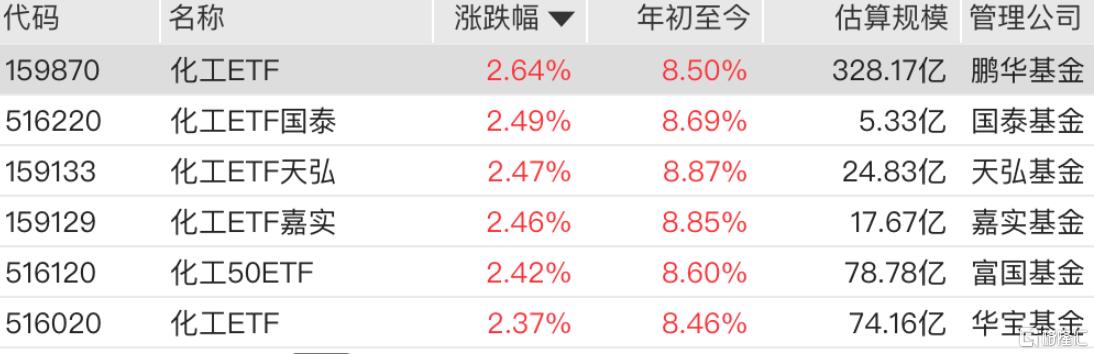
氟化工板块走强,化工ETF、化工ETF国泰、化工ETF天弘、化工ETF嘉实、化工50ETF涨超2%
Ge Long Hui A P P· 2026-02-06 08:52
Market Overview - The three major A-share indices experienced slight declines today, with the Shanghai Composite Index down 0.25% to 4065 points, the Shenzhen Component Index down 0.33%, and the ChiNext Index down 0.73% [1] - The total market turnover was 2.16 trillion yuan, a decrease of 30.8 billion yuan compared to the previous trading day, with over 2700 stocks rising [1] Sector Performance - The mining and oil sectors saw gains, with stocks like Tongyuan Petroleum and Zhun Oil Co. hitting the daily limit [1] - The fluorochemical sector also performed well, with Tianji Co. reaching the daily limit [1] - The chemical sector experienced a comprehensive surge, with various chemical ETFs, including Chemical ETF, Chemical ETF Guotai, Chemical ETF Tianhong, Chemical ETF Jiashi, and Chemical 50 ETF, all rising over 2% [1][2] Chemical Industry Insights - The Chemical ETF tracks the CSI Sub-Industry Chemical Theme Index, covering high-growth areas such as basic chemicals, fertilizers, agricultural chemicals, chemical fibers, and new energy materials, with leading companies like Wanhua Chemical and Yalake Co. among the top ten weighted stocks [2] - The chemical industry is experiencing a tightening supply side, with European companies reducing or shutting down overseas chemical production capacity due to operational pressures [3][4] - Domestic policies are promoting anti-involution, with the "Stabilizing Growth Work Plan for the Petrochemical and Chemical Industry" aiming to strictly control new capacity and eliminate outdated capacity, which is expected to enhance corporate profitability [3] Price Trends and Forecasts - January's PMI data fell below the boom-bust line, but price-related indicators showed improvement, with raw material purchase prices rising to 56, the highest in two years, and the producer price index (PPI) showing positive signals [3] - Chemical prices have rebounded significantly in January, with liquid chlorine, lithium hydroxide, acetonitrile, lithium carbonate, and butadiene performing well, indicating a potential recovery in chemical companies' profitability [3] - According to Zhongyuan Securities, the ongoing anti-involution policies are expected to strengthen supply-side constraints, benefiting certain sub-industries like chlor-alkali, pesticides, and polyester filament, as well as the coal chemical sector due to rising oil prices [3] Global Competitive Landscape - According to Everbright Securities, the chemical industry is experiencing a shift with China's chemical companies gaining global competitiveness while European firms face significant operational pressures [4] - The European Chemical Industry Council (Cefic) reported that from 2022 to 2025, the closure of production capacity in the European chemical industry is expected to increase sixfold, resulting in a cumulative loss of 37 million tons, approximately 9% of Europe's total chemical capacity [4] - China's chemical companies are benefiting from a complete industrial chain and energy cost advantages, with exports of chemical raw materials and products expected to grow by about 13% year-on-year by 2025 [4]
资金逢低介入,推动板块回暖,化工50ETF(516120)盘中涨超4%!
Mei Ri Jing Ji Xin Wen· 2026-02-03 06:58
Group 1 - The chemical sector experienced a rebound on February 3, with the Chemical 50 ETF (516120) rising by 4.10% [1] - More than 90% of the stocks in the index saw an increase, with notable gains from Hongda Co., Ltd. (over 9%), Boyuan Chemical, Zhejiang Longsheng, Guangwei Composite Materials, and Hualu Hengsheng (over 5%) [1] - The Chemical 50 ETF has seen continuous net inflows for 20 days, totaling over 6.5 billion yuan, bringing its latest scale to 7.8 billion yuan, with nearly 2.7 billion yuan net inflow in the past five days [1] Group 2 - Research institutions indicate a confirmed upward trend in the chemical industry's prosperity, with policy-driven supply-side optimization expected to enhance market share for leading companies [1] - The exit of European capacity presents export opportunities for Chinese enterprises, while a slowdown in capital expenditure is beneficial for profit elasticity [1]
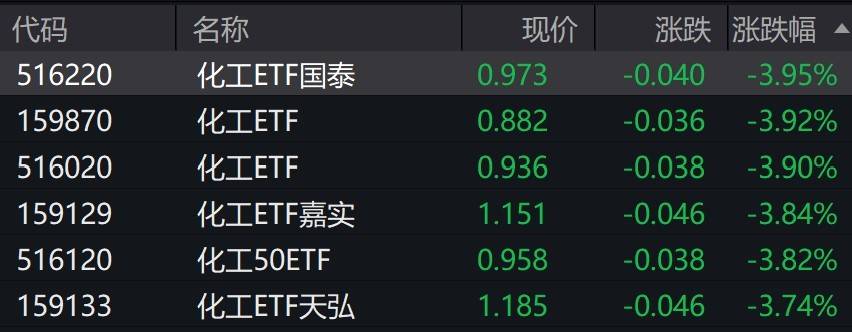
化工概念股走低,相关ETF跌近4%
Sou Hu Cai Jing· 2026-02-02 02:55
Group 1 - Chemical concept stocks declined, with Wanhua Chemical, Hengli Petrochemical, and Baofeng Energy dropping over 6%, while Hualu Hengsheng fell over 5% and Yuntianhua decreased over 4% [1] - Affected by the market, chemical-related ETFs fell nearly 4% [1] Group 2 - Various chemical ETFs reported declines, with the Guotai Chemical ETF at 0.973 (-3.95%), the Chemical ETF at 0.882 (-3.92%), and the Chemical 50 ETF at 0.958 (-3.82%) [2] - Analysts indicate that the chemical industry, being a typical cyclical sector, usually follows a five-year cycle consisting of "profit upturn - capacity expansion - profit bottoming - capacity clearance/demand expectation improvement" [2] - Current industry conditions are at the cycle bottom, with expectations for supply-demand dynamics to improve and accelerate the recovery of industry prosperity [2]


化工股迎“涨停潮”,化工50ETF(516120)盘中大涨3.23%!
Mei Ri Jing Ji Xin Wen· 2026-01-28 06:46
Group 1 - The chemical sector has shown significant movement today, with the Chemical 50 ETF (516120) rising by 3.23% at one point and currently up by 2.52% [1] - Key stocks in the sector, such as Hebang Biotechnology and Zhejiang Longsheng, have hit the daily limit up, while Satellite Chemical and Huafeng Chemical have increased by over 9% and 7% respectively, with 80% of stocks in the sector showing positive performance [1] - Price increases in certain chemicals have been identified as a key driver for the rise in the chemical sector, supported by growing downstream demand and a positive outlook for leading companies in the industry [1] Group 2 - The industry is experiencing a recovery in fundamentals, with several leading chemical companies announcing profit turnarounds and earnings forecasts for 2025 indicating a clear trend of profit recovery [1] - Investors looking to enter the chemical sector are advised to consider the Chemical 50 ETF (516120) and its associated funds, which track the CSI Sub-Industry Chemical Theme Index (000813.CSI), focusing on cyclical areas such as chemical products, agricultural chemicals, and refining trade [1] - The current size of the Chemical 50 ETF (516120) is nearly 6.4 billion, with an increase of approximately 4.7 billion this year, indicating strong investor interest [1]
超630亿元,“跑了”
Zhong Guo Ji Jin Bao· 2026-01-23 06:08
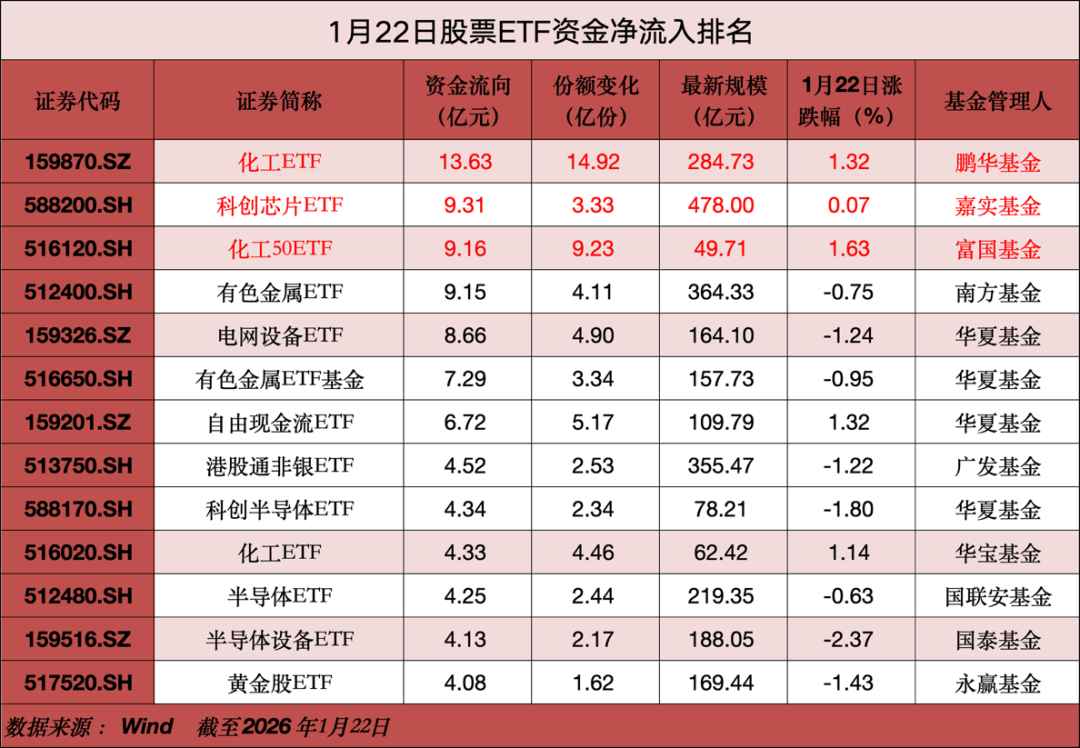
Group 1 - On January 22, A-shares showed mixed performance with major indices fluctuating, leading to a significant net outflow of 63.31 billion yuan from stock ETFs [1][2] - Industry-themed ETFs and commodity ETFs attracted substantial inflows, with net inflows of 12.04 billion yuan and 1.99 billion yuan respectively, while broad-based ETFs experienced significant outflows [2][4] - The semiconductor sector saw the most notable inflow, with a net inflow of 3.86 billion yuan, particularly driven by the Jiashi Fund's Sci-Tech Chip ETF, which had a net inflow of 0.93 billion yuan [2][3] Group 2 - The chemical sector also experienced significant inflows, with a net inflow of 2.97 billion yuan, led by Penghua Fund's chemical ETF with a net inflow of 1.36 billion yuan [2][3] - Other sectors such as electric grid equipment, non-ferrous metals, gold, and pharmaceuticals also saw notable inflows, with the Huaxia Fund's electric grid equipment ETF attracting a net inflow of 0.87 billion yuan [2][3] - In contrast, broad-based ETFs faced heavy outflows, with the CSI 300 ETF experiencing the largest outflow of 46.76 billion yuan, followed by the CSI 1000 ETF with an outflow of 16.6 billion yuan [4][5]
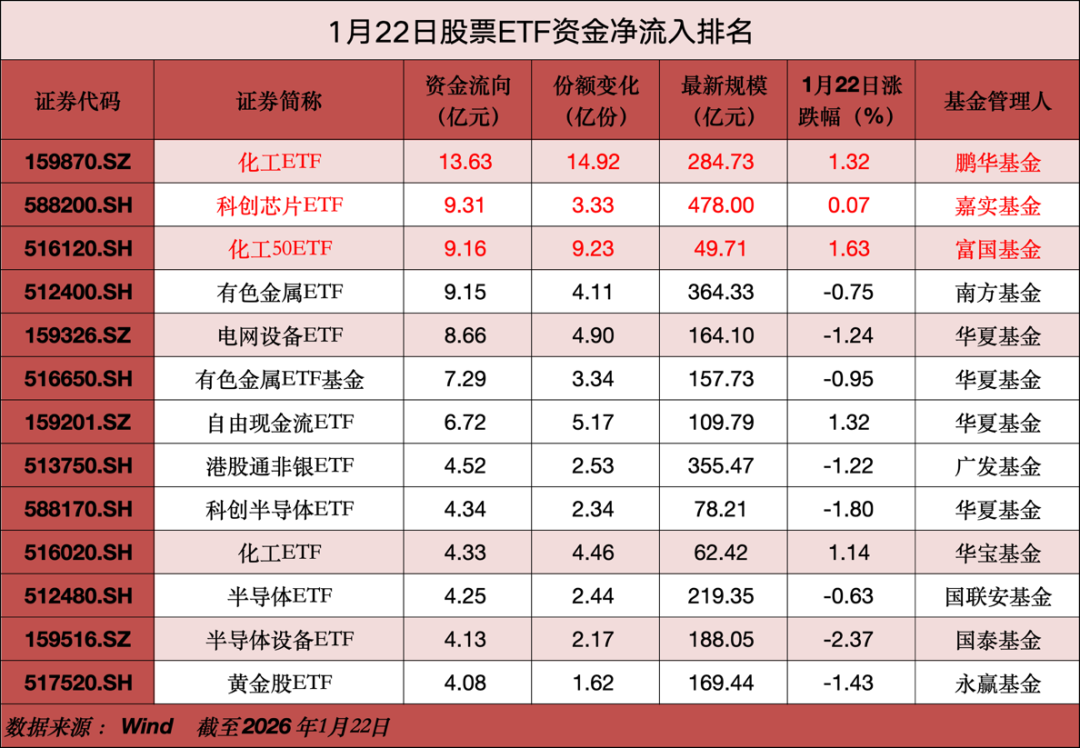
1月22日股票ETF净流出超630亿元
Zhong Guo Ji Jin Bao· 2026-01-23 06:04
Group 1 - On January 22, A-shares showed mixed performance with the three major indices fluctuating, leading to a significant net outflow of 63.31 billion yuan from stock ETFs [1][3] - Industry-themed ETFs and commodity ETFs attracted substantial inflows, with net inflows of 12.04 billion yuan and 1.99 billion yuan respectively, while broad-based ETFs experienced significant outflows [3][6] - The semiconductor sector saw the most notable net inflow of 3.86 billion yuan, with the Jiashan Fund's Sci-Tech Chip ETF leading with a net inflow of 0.93 billion yuan [3][5] Group 2 - The chemical sector also experienced significant inflows, totaling 2.97 billion yuan, with Penghua Fund's Chemical ETF receiving a net inflow of 1.36 billion yuan [3][5] - Other sectors such as electric grid equipment, non-ferrous metals, gold, and pharmaceuticals also saw considerable inflows, with notable contributions from the Huaxia Fund's electric grid equipment ETF [3][5] - Over the past five days, the electric grid equipment index attracted over 7.9 billion yuan in inflows [3] Group 3 - Broad-based ETFs faced heavy outflows, totaling 76.95 billion yuan, with the CSI 300 ETF leading the outflows at 46.76 billion yuan [6][7] - The CSI 1000 ETF and the Shanghai Stock Exchange 50 ETF also saw significant outflows of 16.6 billion yuan and 5.26 billion yuan respectively [7][8] - The overall scale of broad-based ETFs decreased by 72.77 billion yuan [6]
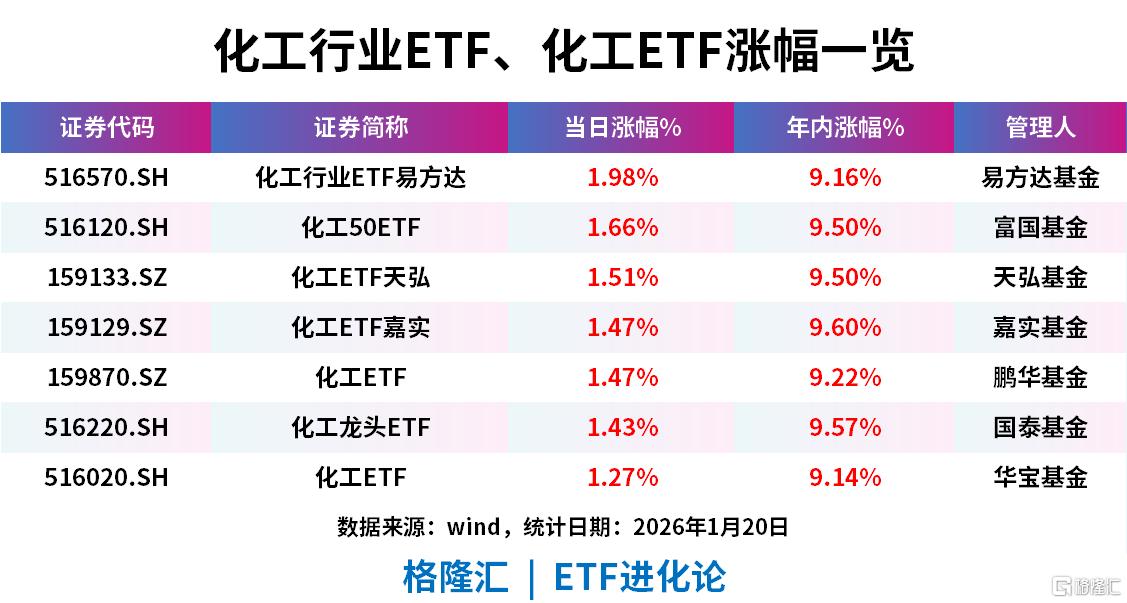
化工板块继续上攻,化工行业ETF易方达、化工50ETF、化工ETF上涨
Ge Long Hui A P P· 2026-01-20 09:46
Core Viewpoint - The chemical industry is experiencing price increases and production adjustments, driven by global giants and domestic market dynamics, indicating potential investment opportunities in leading companies and sectors within the industry [4][5][6]. Group 1: ETF Performance - Several chemical ETFs have shown positive daily and year-to-date performance, with the highest daily increase of 1.98% for the E Fund Chemical Industry ETF and a year-to-date increase of 9.60% for the Jiashi Chemical ETF [2]. Group 2: Market Trends - The chemical ETFs track the CSI Sub-Industry Chemical Theme Index, with nearly 50% of their holdings concentrated in large-cap leading stocks such as Wanhua Chemical and Salt Lake Potash, benefiting from strong market trends [4]. - Recent price increases in key chemical products include a 7.9% weekly rise in epoxy propane and a general upward trend in organic silicon intermediates, reflecting a positive market sentiment [4]. Group 3: Production Adjustments - Domestic polyester filament factories have reduced production by 6% starting January 14, leading to a cumulative reduction of 15%, driven by high raw material costs and seasonal demand patterns [5]. - The reduction in production is expected to help deplete inventories, potentially enhancing profitability for leading companies during the upcoming peak season [5]. Group 4: Industry Outlook - According to Huatai Securities, the chemical industry is facing a challenging period with weak demand and supply-side pressures, predicting a profitability low point for bulk chemicals in the second half of 2025 [6]. - The industry is currently at a turning point regarding capacity and inventory cycles, with expectations of recovery in demand by 2026, which may lead to an upward trend in profitability [6]. - Investment opportunities are suggested in sectors such as glyphosate, fertilizers, import substitution, domestic demand, and high-dividend assets, despite the overall weak performance in the industry [6].