华夏中证细分有色金属产业ETF

Search documents
热门板块进入高波区间 场外产品跟踪指数“受阻”
Zhong Guo Zheng Quan Bao· 2026-02-04 20:29
Core Insights - The A-share commercial aerospace and non-ferrous metals sectors have entered a phase of wide fluctuations, with related index funds experiencing significant tracking errors and volatility [1][3] - Fund managers have taken measures to suspend large subscriptions over 1 million yuan for certain thematic index funds due to the challenges posed by rapid market movements [4][7] Fund Performance and Flows - In January, the Southern CSI Shenwan Non-ferrous Metals ETF saw net inflows exceeding 18 billion yuan, with several other thematic ETFs attracting over 10 billion yuan each [2] - By the end of January, multiple thematic ETFs, including the Southern CSI Non-ferrous Metals ETF and the Guotai CSI Semiconductor Materials and Equipment ETF, surpassed 20 billion yuan in scale [2] Market Volatility and Management Challenges - The recent volatility in popular sectors has led to significant fluctuations in fund net values, with some satellite-themed index funds rising over 8% on January 23, only to drop over 7% by January 26 [3] - Tracking errors for certain index funds have increased, with some exceeding 1% in January, compared to less than 0.5% in the previous month [3][4] Operational Strategies - Fund managers are advised to implement refined operations and disciplined execution to manage tracking errors effectively, especially during periods of high volatility [5][6] - Strategies include phased investments, algorithmic trading, and prioritizing high liquidity core assets to mitigate impact costs [6] Recommendations for Fund Management - It is suggested to adopt a "core + satellite" sampling replication method to ensure high liquidity and weight in core assets while adjusting cash reserves dynamically based on market conditions [6] - Establishing a multi-dimensional prevention and response mechanism is crucial for managing fund flows and tracking accuracy [6]
资金持续流入有色、化工、建材等ETF
HTSC· 2026-02-02 13:25
Investment Rating - The report indicates a positive investment sentiment towards the sectors of non-ferrous metals, chemicals, and construction materials, with significant capital inflows into related ETFs [1][6][12]. Core Insights - Recent trends show a divergence in the ETF market, with broad-based ETFs experiencing net outflows while sector-specific ETFs, particularly in non-ferrous metals, electronics, and basic chemicals, are seeing substantial net inflows [2][6]. - Non-ferrous metals ETFs recorded a net inflow exceeding 26 billion yuan in the past week, with consistent daily inflows even during market downturns [12][26]. - The satellite industry, construction materials, and real estate sectors also attracted notable capital, with inflows exceeding 10% of their respective fund sizes [8][12]. Summary by Sections ETF Market Overview - The overall ETF market has seen a net outflow of over 300 billion yuan, with broad-based ETFs like the CSI 300 experiencing significant withdrawals [2][24]. - Sector-specific ETFs, particularly in non-ferrous metals, electronics, and basic chemicals, have continued to attract capital, indicating strong investor interest [2][6]. Capital Inflows - Non-ferrous metals ETFs had a net inflow of 263.21 billion yuan, marking a 100% historical percentile for the week [7][26]. - Basic chemicals ETFs also saw a net inflow of 98.77 billion yuan, maintaining a strong position in the market [7][26]. - The electronics sector recorded a net inflow of 101.14 billion yuan, reflecting a high level of investor engagement [7][26]. New ETF Launches - In the past week, 10 new ETFs were launched, raising a total of 6.546 billion yuan, with the largest being the first shipbuilding industry ETF [3][37]. - The new ETFs cover various themes, including non-ferrous metals, photovoltaics, and biotechnology, indicating a diversification of investment opportunities [3][36]. Performance Metrics - The absolute return ETF simulation portfolio has shown a year-to-date increase of 2.06%, with a weekly return of 0.03% [4][40]. - The portfolio's annualized return since 2016 stands at 6.51%, with a maximum drawdown of 4.65% [4][40].
ETF规模速报 | 有色金属ETF基金净流入超16亿元,沪深300ETF华泰柏瑞净流出超140亿元
Xin Lang Cai Jing· 2026-01-28 01:13
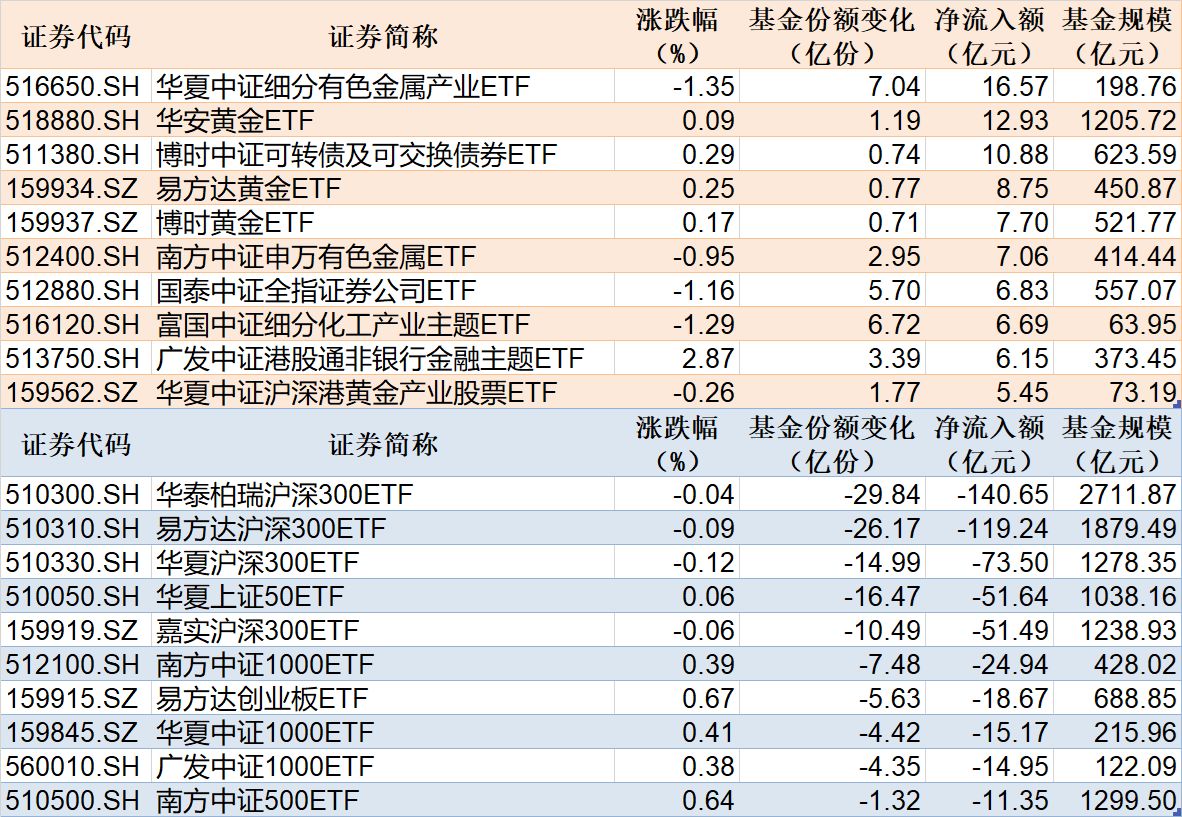
Market Overview - The market rebounded yesterday with all three major indices turning positive, driven by strong performance in the chip industry, precious metals, CPO concepts, and space photovoltaic concepts [1] - Conversely, sectors such as coal and batteries experienced significant declines [1] ETF Fund Flows - On January 27, the non-monetary ETF market saw significant inflows, with the following notable changes: - Huaxia CSI Segmented Nonferrous Metals Industry ETF saw an increase of 704 million shares and a net inflow of 1.657 billion yuan - Huaan Gold ETF increased by 119 million shares with a net inflow of 1.293 billion yuan - Bosera CSI Convertible Bonds and Exchangeable Bonds ETF increased by 74 million shares with a net inflow of 1.088 billion yuan [1][2] ETF Performance - The top 20 ETFs by net inflow as of January 27 include: - Southern CSI Shenwan Nonferrous Metals ETF with a net inflow of 14.474 billion yuan - Huaxia CSI Electric Grid Equipment Theme ETF with a net inflow of 12.740 billion yuan - Penghua CSI Segmented Chemical Industry Theme ETF with a net inflow of 11.980 billion yuan [4] Overall Market Data - As of January 27, the total ETF shares in the market reached 32,858.54 billion shares, with a total scale of 56,365.94 billion yuan - The financial sector saw the largest increase in shares, with 26 funds tracking it - The largest increase in thematic shares was in the CSI Segmented Chemical Industry, with 6 funds tracking it - The highest return index was the Sino-Korean Semiconductor, which increased by 3.98% with 1 fund tracking it [4]

牛气冲天!开年哪些行业主题ETF最吸金,数据揭晓答案
Sou Hu Cai Jing· 2026-01-12 05:58
Core Viewpoint - The A-share market is experiencing a strong upward trend as it enters the first week of 2026, with significant increases in major indices and trading volumes, indicating a potential bullish market phase driven by various factors [1][3][10]. Market Performance - As of January 9, all three major indices closed higher, with the Shenzhen Component Index up 1.15%, the ChiNext Index up 0.77%, and the Shanghai Composite Index up 0.92%, reaching 4120.43 points, marking its first return to this level since July 2015 [3]. - The total trading volume for the Shanghai and Shenzhen markets reached 3.12 trillion yuan, a significant increase of 322.4 billion yuan from the previous trading day, marking the fifth occurrence in A-share history of daily trading volume exceeding 3 trillion yuan [3]. - Over the first five trading days of the year, the Shanghai Composite Index rose by 3.82%, the Shenzhen Component Index by 4.40%, and the ChiNext Index by 3.89%, with the STAR 50 Index increasing by 9.80% [3]. Sector Performance - The metals and satellite sectors have attracted significant capital inflows, with 598 industry-themed ETFs collectively receiving a net inflow of 13.827 billion yuan over five trading days [4][5]. - The Southern CSI Nonferrous Metals ETF led the inflows with 3.721 billion yuan, followed by the Yongying National Satellite Communication Industry ETF with 3.589 billion yuan [4]. - The chemical sector also saw high interest, with related ETFs experiencing a net inflow of 3.853 billion yuan [5]. Fund Flows - The nonferrous metals sector saw a total net inflow of 8.983 billion yuan across 10 related ETFs, while the satellite industry attracted 8.821 billion yuan across 6 ETFs [5]. - Conversely, the robotics and battery sectors experienced significant net outflows, with 1.348 billion yuan and 1.077 billion yuan, respectively [6]. - Other sectors with notable outflows included military and pharmaceutical industries, with net outflows of 785 million yuan and 679 million yuan, respectively [6]. ETF Scale Growth - The total scale of 598 industry-themed ETFs reached 1.178127 trillion yuan, with a cumulative growth of 83.468 billion yuan in the first five trading days of the year [7]. - The Southern CSI Nonferrous Metals ETF saw the largest scale increase of 5.555 billion yuan, followed by the Yongying National Satellite Communication Industry ETF with 5.109 billion yuan [7]. - Despite some ETFs experiencing net outflows, significant increases in net asset values have driven overall scale growth in various sectors, including semiconductors and military [8]. Future Market Outlook - Analysts suggest that 2026 may witness a "Bull Market 2.0," driven by improvements in fundamentals, technological trends, asset migration, and policy easing [10]. - The focus is expected to shift towards technology growth as the main line, with cyclical resources as a supporting factor, both showing potential for sustained excess returns [10]. - Key areas of interest include AI infrastructure, commercial aerospace, and strategic metals, with a particular emphasis on sectors benefiting from policy support and improving supply-demand dynamics [11].

ETF规模速报 | 有色金属ETF基金净流入超27亿元,科创50ETF净流出超8亿元
Sou Hu Cai Jing· 2025-12-31 01:21
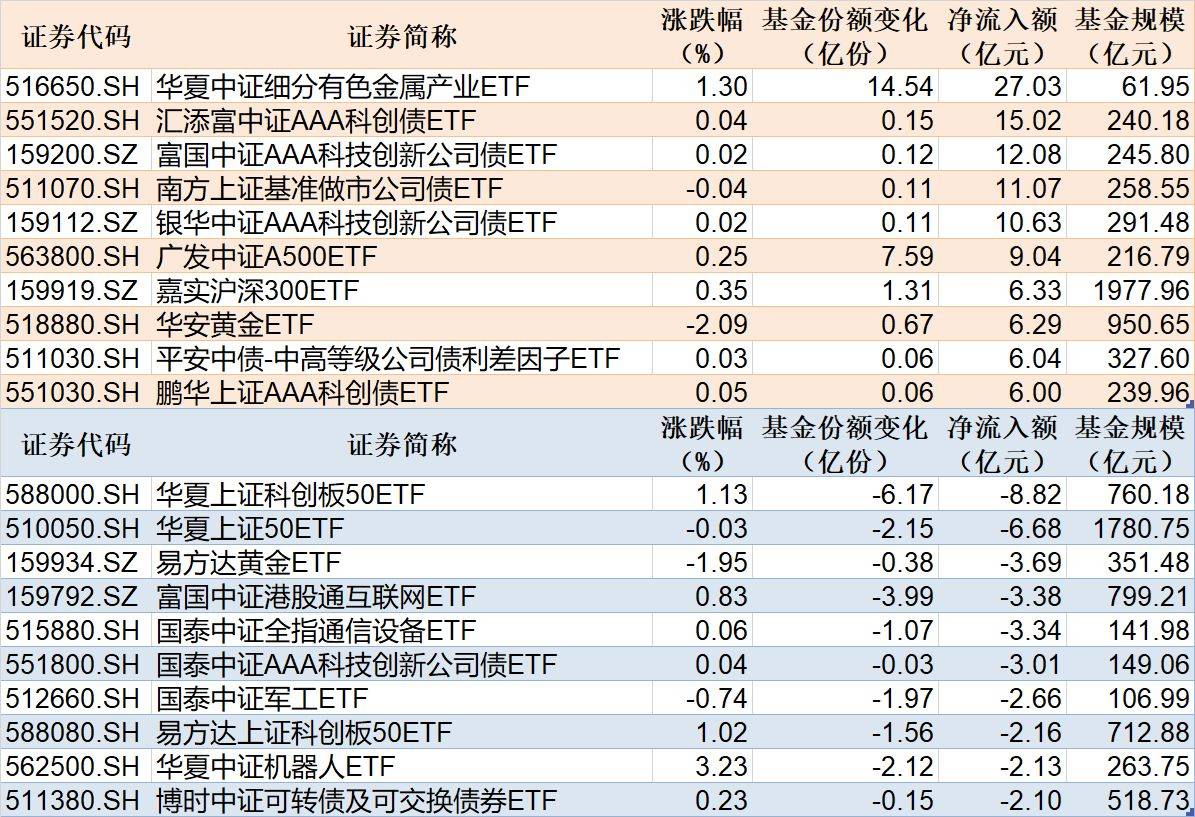
Market Overview - The market experienced a rebound in the afternoon, with the Shanghai Composite Index achieving a ten-day consecutive rise [1] - The robotics sector continued to thrive, while AI applications showed active performance; however, the commercial aerospace concept saw a pullback [1] ETF Market Activity - On December 30, significant inflows were observed in the non-monetary ETF market, with the following notable changes: - Huaxia CSI Subdivided Nonferrous Metal Industry ETF saw an increase of 1.454 billion shares and a net inflow of 2.703 billion yuan [1] - Huitianfu CSI AAA Sci-Tech Bond ETF increased by 0.15 billion shares with a net inflow of 1.502 billion yuan [1] - Fortune CSI AAA Technology Innovation Corporate Bond ETF increased by 0.12 billion shares with a net inflow of 1.208 billion yuan [1] ETF Performance Summary - The top-performing ETFs in terms of net inflow for the month included: - Southern CSI A500 ETF with a net inflow of 24.351 billion yuan and a total fund size of 46.773 billion yuan [4] - Harvest CSI AAA Technology Innovation Corporate Bond ETF with a net inflow of 22.464 billion yuan and a total fund size of 43.446 billion yuan [4] - Huatai-PineBridge CSI A500 ETF with a net inflow of 21.386 billion yuan and a total fund size of 48.806 billion yuan [4] Overall ETF Market Statistics - As of December 30, the total ETF market had 33,637.18 billion shares and a total scale of 60,289.19 billion yuan [4] - The financial sector saw the largest increase in shares, with 26 funds tracking it [4] - The largest thematic increase was in the CSI Subdivided Nonferrous Metal Industry, with 2 funds tracking it [4] - The highest return index was the robotics industry, which increased by 4.33% with 4 funds tracking it [4]
又到了查元素周期表的时刻了
天天基金网· 2025-10-22 10:41
Core Insights - Resource cycle assets, including non-ferrous metals, energy (oil, coal), chemicals, and steel industries, have been largely overlooked by investors in the past but have shown significant performance this year, particularly non-ferrous metals which have risen by 87.15% due to factors like supply-demand balance, inflation hedging, and risk aversion [1] - Different segments within the resource cycle have exhibited varied performance, with the energy sector being favored for its high dividend yield, while chemicals and steel have benefited from "anti-involution" policies, leading to a strong performance in Q3 [1] Fund Types Overview - Index funds are categorized into four types: - Non-ferrous metal funds, which have a long-term holding ratio of over 90%, are the most numerous and have high purity [4] - Rare earth funds, benefiting from China's tariff countermeasures, are critical resources used in new energy, electronics, and military applications [4] - Gold stock funds, which have seen some funds increase by over 90% this year, benefit from multiple factors including risk aversion and central bank gold accumulation [4] - Comprehensive resource funds, which have a balanced industry approach but lower growth compared to non-ferrous metal funds, typically have non-ferrous metals as the largest sector but below 60% [5] Performance of Index Funds - Key index funds in the resource cycle sector have shown varying performance year-to-date: - Non-ferrous metal ETFs have returns ranging from 68.52% to 76.41% [6] - Rare earth ETFs have returns around 67.14% to 73.86% [6] - Gold ETFs have a notable return of 90.33% [6] - Comprehensive resource ETFs have lower returns, with the highest at 42.18% [6] Active Fund Types Overview - Active funds are divided into three categories: - Theme funds primarily focus on non-ferrous metals, typically holding over 50% in this sector, with additional allocations to coal and chemicals [7] - Balanced funds maintain a non-ferrous metal holding ratio generally below 50%, allowing for some rotation in investments [7] - Quantitative funds, which are fewer in number, utilize a strategy combining subjective and quantitative methods to select resource stocks for excess returns [7] Performance of Active Funds - Active funds have also demonstrated significant returns year-to-date, with some notable performances: - The "万家周期驱动股票发起式A" fund has a return of 47.20% [8] - The "中欧周期优选混合发起式A" fund has a return of 64.30% [8] - The "东方兴瑞趋势领航混合A" fund, categorized as balanced, has a return of 70.94% [8] - Resource cycle funds exhibit considerable elasticity, with decision-making centered on identifying turning points and timing [8]