厨房纸

Search documents
家里这种“厨房纸”,别再直接接触食物了!很多人不知道
Xin Lang Cai Jing· 2026-01-18 16:22
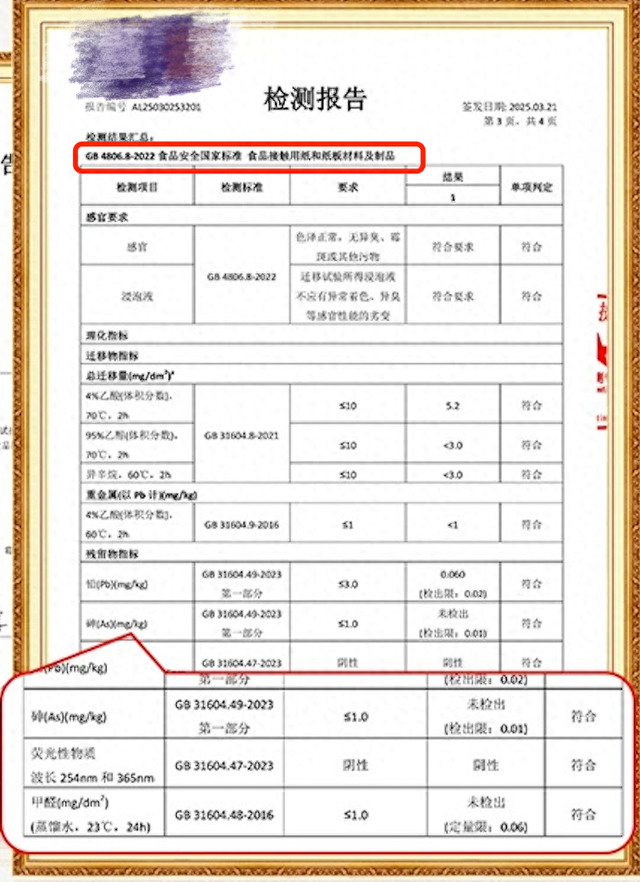
Group 1 - Kitchen paper has become a standard item in many kitchens, primarily used for wiping water and oil, and can also be used to absorb moisture from meat before cooking [1] - The national standard for kitchen paper in China is GB/T 26174-2023, which focuses on its wiping capabilities, including water and oil absorption, and tensile strength [1] - Kitchen paper does not have the same safety requirements for direct food contact as food-grade paper, particularly regarding chemical substances like formaldehyde [1][4] Group 2 - To determine if kitchen paper can safely contact food, two methods can be used: checking if it meets the GB 4806.8-2022 standard or looking for third-party testing reports [2][4] - If the product does not have relevant testing reports or does not meet the GB 4806.8 standard, it is advisable not to use it for food packaging [4] Group 3 - Similar to kitchen paper, the safety of using tissue paper for food packaging also depends on compliance with the GB 4806.8 standard [5] - Tissue paper includes various types, such as toilet paper and hand towels, with varying tensile strengths and material sources [5][6] - Tissue paper must be made from virgin pulp and cannot use recycled pulp, ensuring higher quality compared to toilet paper [7]

从生活用纸看促消费与反浪费
Ren Min Wang· 2025-12-19 04:15
Core Viewpoint - The article discusses the relationship between the upgrade of paper product consumption and the opposition to waste, emphasizing that consumption upgrades do not necessarily lead to increased waste but can enhance quality and efficiency in usage [1][3]. Group 1: Consumption Upgrade - The shift from "just enough" to "specific use" in paper products reflects an improvement in living standards and consumption upgrades, which focus on quality rather than quantity [1][2]. - Higher quality paper products, such as kitchen paper and cream paper, reduce the amount used while improving user experience, demonstrating that consumption upgrades can lead to resource savings and reduced waste [1][3]. Group 2: Supply and Demand Adaptation - Achieving a precise match between supply and demand is crucial for unifying consumption upgrades with waste reduction, as seen in products designed for specific scenarios [2][5]. - The introduction of high-quality, specialized paper products can enhance their utility and effectiveness, thereby minimizing unnecessary consumption [3][4]. Group 3: Trends in Paper Consumption - The current trends in paper consumption include scenario refinement, prioritization of quality, and increased emphasis on green and eco-friendly products, such as biodegradable paper [4][5]. - The popularity of bamboo pulp paper illustrates how environmentally friendly products can attract consumers while also reducing waste and promoting sustainable practices [4][5].
从生活用纸看促消费与反浪费(大家谈)
Ren Min Ri Bao· 2025-12-17 22:11
Core Viewpoint - The article discusses the relationship between the upgrade of paper product consumption and the opposition to waste, emphasizing that consumption upgrades do not necessarily lead to increased waste but can enhance resource efficiency and quality of life [1]. Group 1: Consumption Upgrade - The shift from "just enough" to "scene-specific" paper products reflects an improvement in living standards and consumption upgrades, which focus on quality rather than quantity [2]. - Higher quality paper products, such as kitchen towels and wet wipes, reduce the amount of paper used while enhancing user experience, demonstrating that consumption upgrades can lead to resource savings [2][3]. Group 2: Waste Reduction - The increase in paper product variety allows for more efficient use, reducing unnecessary consumption and waste, as seen with products like cream paper that require fewer sheets for the same task [3]. - The spirit of thriftiness is timeless, and rejecting waste does not mean rejecting consumption upgrades; rather, it promotes the effective use of resources [3]. Group 3: Market Trends - The paper product market is experiencing three trends: fine-tuning for specific scenarios, prioritizing quality, and increasing emphasis on green and eco-friendly products [4]. - Eco-friendly products, such as bamboo pulp paper, not only reduce deforestation but also minimize waste during use, aligning with consumer preferences for sustainable options [4][5]. Group 4: Supply and Demand Dynamics - New consumer demands are driving supply innovations, including the use of environmentally friendly materials and the design of products that are easy to degrade, promoting a balance between quality use and environmental responsibility [5].
28家快速消费品公司坐拥过亿中国家庭,头部快速消费品公司持续吸引新客
凯度消费者指数· 2025-11-27 03:52
Core Insights - In today's fragmented market, attracting consumers is crucial for winning market share, with brand market position highly correlated to penetration rates [1] - The latest data shows that 28 leading FMCG companies have over 100 million purchasing households in urban China, with a total increase of 2.13 million households year-on-year, averaging a growth rate of 0.8% [1] Group 1: Company Performance - Vinda Group achieved significant growth with an increase of 10.4% in purchasing households [1] - Other companies with notable growth include Wahaha Group, Nongfu Spring, Orion, and Uni-President [1] - The top 28 companies collectively saw an increase in urban purchasing households, with specific companies like Yili and Mengniu showing varied performance in household numbers [2][3] Group 2: Consumer Trends - Chinese consumers are becoming more rational, seeking effective spending while meeting product performance and emotional value [3] - The demand for health-oriented products is rising, with sugar-free tea and 100% juice products gaining popularity [5] - The trend towards fitness and exercise is reflected in the popularity of sports and functional beverages [5] Group 3: Market Dynamics - The market is experiencing a shift towards diversified and personalized retail channels, with significant growth in snack stores and membership stores [6] - The penetration rates for snack stores increased by 7.3 percentage points, while membership stores saw a rise of about 5 percentage points [6] - E-commerce platforms like Douyin are also expanding, with penetration rates increasing by over 5 percentage points [6] Group 4: Downstream Market Expansion - The downward market is becoming a key growth engine for the Chinese economy, with significant sales growth in lower-tier cities [7] - The sales growth in first to sixth-tier cities was 1.8%, with town-level markets experiencing a remarkable growth rate of 4.2% [7] - Companies like Vinda and Wahaha are actively expanding their consumer base in lower-tier markets, with a substantial portion of their new households coming from these areas [7] Group 5: Strategic Insights - Expanding consumer penetration is essential for driving growth in a competitive market [10] - Companies need to deeply understand consumer needs and leverage new consumption scenarios and emerging channel opportunities to achieve sustainable growth [10]

李佳琦,带爸妈开始直播带货
3 6 Ke· 2025-05-07 23:36
Core Insights - Li Jiaqi has launched a new live-streaming channel called "All Parents' Happy Home," targeting middle-aged and elderly consumers, marking a strategic shift towards the silver economy [2][5][18] - The first live broadcast garnered nearly 1.8 million views, and within two days, the channel attracted over 190,000 followers, indicating strong initial interest [2][9] - This initiative reflects a broader trend in the live-streaming e-commerce industry, which is shifting focus from younger audiences to activating consumers across all age groups [6][26] Group 1: Market Strategy - Li Jiaqi's approach differs from other top streamers like Xiao Yang and Xin Ba, as he aims to leverage his brand value to expand into the silver economy, which is estimated to be worth around 7 trillion yuan [5][18] - The new channel features products specifically curated for older consumers, including clothing, accessories, and health-related items, with significant sales figures reported [11][13] - The live-streaming format is designed to create a familiar and engaging environment for older viewers, utilizing familiar hosts and interactive elements [16][28] Group 2: Industry Trends - The live-streaming e-commerce market in China is projected to reach 4.9 trillion yuan in 2023, but growth rates are slowing, indicating a need for diversification in target demographics [18][21] - The silver economy presents a largely untapped market, with 329 million active users among the elderly, highlighting significant potential for growth in this segment [23][24] - As competition intensifies, the focus is shifting from price to service quality and consumer experience, which could redefine success metrics in the live-streaming e-commerce landscape [26][28]