
可持续航空燃油(SAF)

Search documents
加快推动全面绿色转型,培育氢能、绿色燃料等新增长点
Xinda Securities· 2026-03-07 09:42
Investment Rating - The industry investment rating is "Positive" as it indicates a favorable outlook for the green fuel sector, which is expected to outperform the benchmark index [13]. Core Insights - The report emphasizes the acceleration of a comprehensive green transition, focusing on hydrogen and green fuels as new growth points, driven by carbon peak and carbon neutrality goals [1][3]. - The strategic value of green fuels is highlighted, particularly in the context of geopolitical complexities and traditional oil and gas price volatility, marking it as a key area for energy security and carbon reduction [3]. - The development of green fuel industries is seen as crucial for replacing petroleum, ensuring energy security, and promoting green development, with a focus on systematic planning and innovation [3]. Summary by Sections Government Initiatives - The government aims to enhance green development momentum through policies that promote low-carbon economic growth and the establishment of a national low-carbon transition fund [3]. - The inclusion of "green fuels" in the government work report signifies its importance alongside hydrogen as a new growth area [3]. Market Potential - By the end of 2024, China is projected to have 119 green ammonia, 165 green methanol, and 45 sustainable aviation fuel (SAF) projects, with potential production capacities of 2.01749 million tons/year, 5.257 million tons/year, and 800,000 tons/year respectively [3]. - The demand for green ammonia, green methanol, and SAF spans various sectors, contributing to the low-carbon transition of the global energy structure [3]. Industry Development - The green hydrogen industry in China is expected to maintain its global leadership, with a production target exceeding 37 million tons by 2025, including over 250,000 tons/year of green hydrogen capacity [3]. - The report anticipates that with improved carbon pricing mechanisms and technological advancements, the green fuel sector will enter a period of rapid growth post-2030, supporting global carbon neutrality goals [3]. Investment Opportunities - Key investment opportunities are identified in three areas: 1. Core equipment manufacturing for hydrogen production and refueling stations, with recommended companies including Huadian Technology, Huaguang Huaneng, and others [4]. 2. Operators of green hydrogen and ammonia, with suggested companies like China Tianying and others [4]. 3. Suppliers in the sustainable aviation fuel (SAF) supply chain, with companies such as Haineng Technology and others highlighted [4].
这家公司要捕集二氧化碳生产万物!首条工艺线在临港发布,何时商业化?
Xin Lang Cai Jing· 2026-01-24 15:26
Core Viewpoint - Shanghai Carbon Life Technology Co., Ltd. (referred to as "Carbon Life") has officially launched its R&D innovation center in the Lingang New Area, with an investment of 300 million yuan, aimed at industrializing its core technologies [1][3]. Group 1: Company Overview - Carbon Life was founded in October 2024 by Ren Yuxiang and Zhang Hongxi, with Ren previously serving as the Vice President of Business Development at Tesla before leaving in 2020 [3]. - The company aims to capture carbon dioxide from the air, convert it into necessary products, and ultimately reduce reliance on fossil fuels [3][4]. Group 2: Technology and Projects - The company has announced its first production line, which is a key component of the world's first industrial project for sustainable aviation fuel (SAF) derived from direct air carbon capture (DAC) [4][6]. - Carbon Life plans to establish a pilot base in Ningxia by 2026 and aims to launch the first 50,000-ton commercial SAF project in 2027, focusing on technology industrialization and cost optimization [1][4]. Group 3: Market Focus and Challenges - The initial market focus is on sustainable aviation fuel (SAF), which is seen as having high market potential and green premium [6]. - Currently, global SAF production is less than 0.2% of total aviation fuel demand, facing challenges due to low production and high costs [6]. Group 4: Funding and Future Plans - In August 2025, Carbon Life completed an angel round of financing, raising several tens of millions of yuan to invest in technology upgrades, project construction, and market expansion [6].


绿色液体燃料万亿级市场蓄势待发
Zheng Quan Shi Bao Wang· 2025-12-12 02:03
Core Viewpoint - Green liquid fuels, including green methanol, green ammonia, and sustainable aviation fuel (SAF), are becoming essential for decarbonization across various industries such as shipping, aviation, and chemicals, due to their zero or ultra-low carbon emissions, high energy density, and ease of storage and transportation [1] Industry Summary - The demand for green liquid fuels is transitioning from "potential" to "rigid" as domestic and international clean energy systems and decarbonization policies improve, guided by the European shipping carbon tax mechanism and long-term net-zero framework goals [1] - Despite a one-year delay in the IMO net-zero framework vote, the trend towards green transformation in the shipping industry remains unchanged [1] - The estimated potential demand for green methanol, green ammonia, and SAF by 2025 is approximately 3 million tons, 2.5 million tons, and 2.5 million tons, respectively, with projections for 2030 reaching 36 million tons, 23 million tons, and 11 million tons, indicating future growth rates of 11 times, 9.2 times, and 3.5 times over the next five years [1] Market Potential - The market for green liquid fuels is expected to experience nearly tenfold growth in the next five years, driven by carbon tax policies and continuous cost reductions, with a long-term market potential reaching trillions of yuan [1] - Domestic manufacturers are leveraging abundant and inexpensive green electricity resources, complete equipment supply, and downstream support systems to accelerate the development of the green liquid fuel industry and business models [1] - Key areas of focus include integrated production manufacturers of green hydrogen, ammonia, and methanol, as well as suppliers of core equipment such as electrolyzers [1]
中信证券:“绿色溢价”逐步收窄 绿色燃料方兴未艾
智通财经网· 2025-12-12 01:49
Core Viewpoint - Green liquid fuels are becoming a key driver for decarbonization in shipping, aviation, and chemical industries, benefiting from increased carbon tax policies and ongoing cost reductions, with potential for nearly tenfold growth in the next five years and a long-term market space reaching trillions [1] Policy Support and Market Demand - The demand for green liquid fuels, including green methanol, green ammonia, and sustainable aviation fuel (SAF), is transitioning from "potential" to "rigid" due to improved clean energy systems and decarbonization policies, with projected global demand by 2025 reaching approximately 300 million tons for green methanol, 250 million tons for green ammonia, and 250 million tons for SAF, and expected to grow significantly by 2030 [2] Supply and Demand Dynamics - Current production processes for green methanol, green ammonia, and SAF are mature, but actual project implementation is limited, with effective capacities projected to be only 50 million tons for green methanol, 130 million tons for green ammonia, and 440 million tons for SAF by 2025, while by 2030, effective capacities are expected to reach 2600 million tons for green methanol, 2400 million tons for green ammonia, and 1700 million tons for SAF [3] Cost Reduction and Pricing Trends - The production cost of green liquid fuels is currently 70%-120% higher than traditional methods, primarily due to the "green premium" from renewable electricity and equipment costs, with projections indicating that the cost of green methanol could decrease to between 2900-3700 RMB per ton by 2030, narrowing the cost gap with traditional fuels [4] Industry Chain Development - The green liquid fuel industry chain is evolving, with upstream suppliers of green electricity and biomass, integrated production operators, and downstream storage and distribution companies, where integrated firms are primarily wind power and state-owned electricity companies, enhancing their value and positioning in the emerging market [5]

破局航空碳减排,共话SAF新未来 | 可持续航空燃油产业交流会在杭举行
合成生物学与绿色生物制造· 2025-12-04 08:11
Core Insights - The article emphasizes that the three core challenges for the industrialization of Sustainable Aviation Fuel (SAF) are policy, certification, and raw materials [1][2]. Group 1: Event Overview - The SAF industry exchange conference was successfully held on November 27, 2025, in Hangzhou, organized by the National Key Laboratory of Bio-based Transportation Fuel Technology and DT New Materials [2]. - The conference gathered 30 top experts and representatives from various institutions, including Zhejiang University and China Southern Airlines, to discuss key issues in SAF development [2]. Group 2: SAF Market and Technology - The aviation industry accounts for 12% of carbon emissions in the transportation sector, with annual emissions reaching 1 billion tons. According to IATA, 65% of carbon reduction in aviation must come from SAF by 2050, indicating a trillion-dollar market potential [8]. - The report compares four main technological routes for SAF production: HEFA, AtJ, G+FT, and PtL. The AtJ route is identified as the most investment-worthy due to its wide raw material sources and high emission reduction efficiency of 85%-100% [8][6]. Group 3: Technological Innovations - The new generation AtJ technology developed by Zhejiang University has achieved three core breakthroughs: flexible raw material adaptability, innovative pathways for simultaneous conversion of low-carbon raw materials, and comprehensive utilization of biomass components [9]. - The AtJ technology has transitioned from laboratory to industrialization, leading to the establishment of New航源 (Hangzhou) Biotechnology Co., Ltd. [9]. Group 4: Economic Viability and Market Trends - The AtJ technology significantly reduces SAF production costs, enhancing profit margins. Current market prices in Europe reach $2,950 per ton, with the technology expected to address the economic bottleneck of SAF [11]. - The new PtL technology has completed laboratory development and is rapidly advancing towards scaling up [12]. Group 5: Industry Challenges and Recommendations - Experts agree that the SAF industry faces challenges in policy clarity, certification standards, raw material supply stability, and cost-sharing mechanisms among stakeholders [16][17][18][20]. - A complete ecosystem for SAF, including raw materials, processing, certification, and usage, is essential for industry growth. Investment institutions are particularly interested in the lower fixed asset investment required for the AtJ route [23]. Group 6: Future Outlook - The SAF industry in China is entering a golden period of development, driven by expanding pilot programs, continuous technological breakthroughs, and an improving industrial chain [23].
国泰与空中客车携手投资 推动可持续航空燃油发展
Ren Min Wang· 2025-10-29 05:42
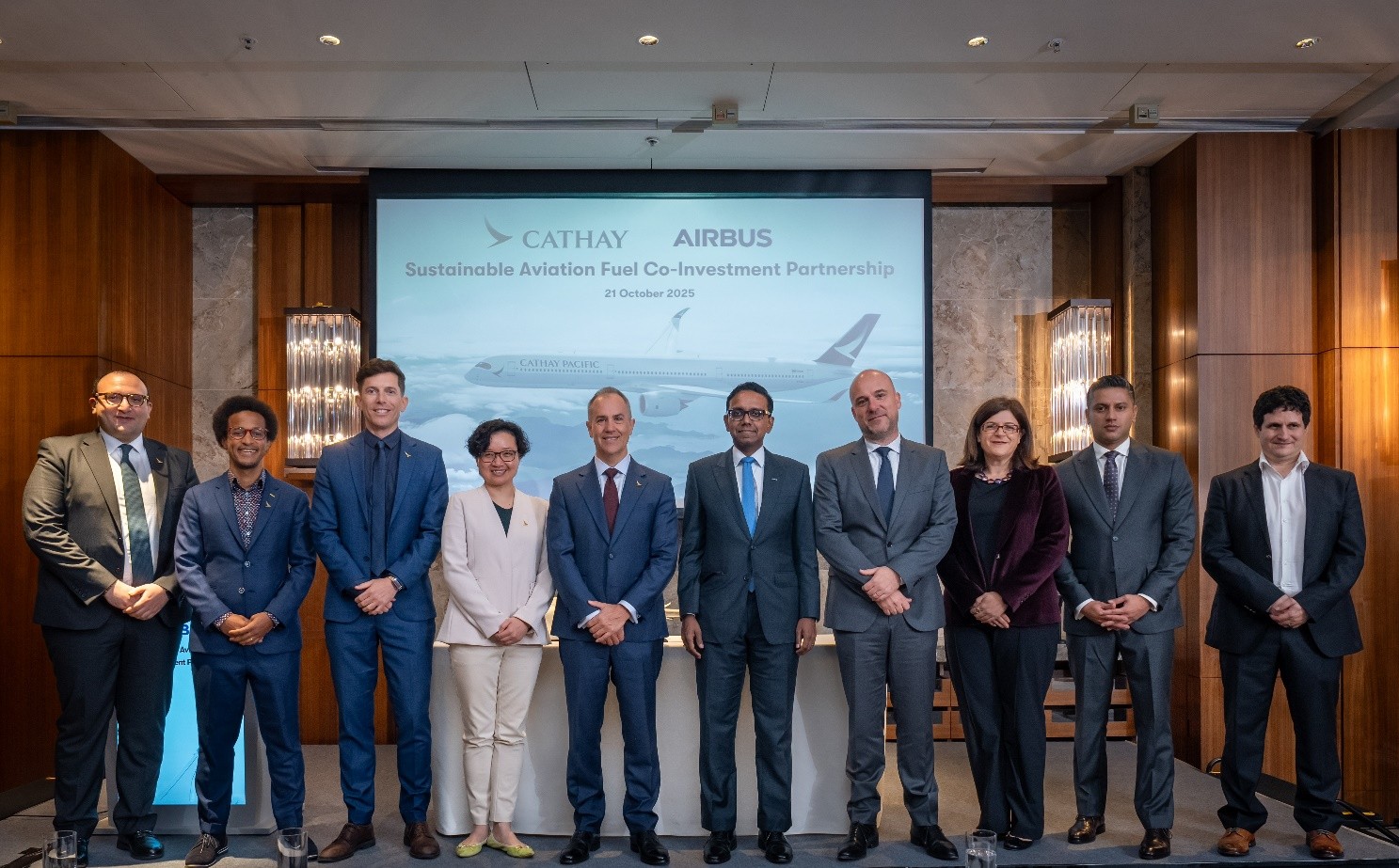
Core Insights - Cathay Pacific Group and Airbus have signed a joint investment agreement to invest up to $70 million (approximately HKD 545 million) to promote the development of Sustainable Aviation Fuel (SAF) in Asia and globally [1][3] Group 1: Investment Agreement - The agreement aims to identify, assess, and invest in commercially viable, technologically mature, and long-term supply potential SAF projects, targeting increased SAF production capacity by 2030 and beyond [1] - The collaboration reflects a commitment to scaling up the sustainable aviation fuel industry in the short term [3] Group 2: Historical Context and Commitment - The partnership between Cathay Pacific and Airbus dates back to 1989, with Cathay operating over 85 Airbus aircraft and more than 70 awaiting delivery [3] - Cathay's President of Operations and Service emphasizes that SAF is crucial for achieving carbon reduction goals in the aviation industry [3] Group 3: Policy Advocacy - Both companies advocate for the development of policies that promote the supply and demand of sustainable aviation fuel in Asia, leveraging the region's strong potential in raw material supply, production capacity, and aviation market [3] - The collaboration serves as a model for unprecedented cross-industry cooperation necessary for the global production and distribution of affordable sustainable aviation fuel [3]


航空业减碳破局:政企“押注”可持续燃料,加速建立本地供应链
2 1 Shi Ji Jing Ji Bao Dao· 2025-10-28 09:37
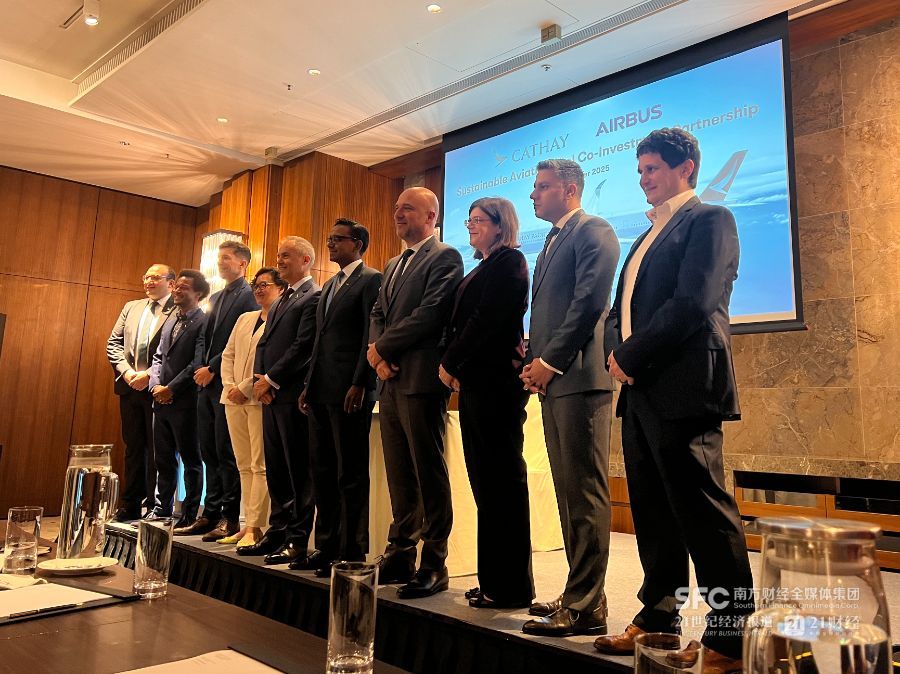
Core Insights - Cathay Pacific Group and Airbus have announced a joint investment agreement to support sustainable aviation fuel (SAF) projects, committing up to $70 million (approximately HKD 545 million) for development in Asia and globally [1][7]. Industry Trends - Major airlines are increasingly investing in the upstream SAF industry to address the financial challenges of achieving net-zero emissions, with initiatives like "green ticket pricing" being introduced [2][4]. - The International Air Transport Association (IATA) predicts that SAF will contribute over 65% of the aviation industry's emissions reductions by 2050, with a demand forecast of 35.8 million tons [4]. Financial Challenges - The aviation industry faces a significant gap between current profit margins and the costs associated with transitioning to net-zero emissions, with estimated annual costs of $174 billion compared to projected net profits of $36 billion [4][6]. - The supply of SAF is expected to fall short of demand, with a projected supply gap of 45% by 2030 due to economic uncertainties and capital-intensive production processes [4][8]. Consumer Engagement - Airlines are launching sustainable flight programs to encourage passengers and corporate clients to pay for SAF or carbon offset credits, with Cathay Pacific's additional charge for 100% SAF contribution on a round trip from Hong Kong to Beijing estimated at HKD 1,578.78 [5][6]. - The willingness of corporate clients with ESG commitments to pay for "green flights" is stronger compared to individual travelers, indicating a potential market for SAF initiatives [6][8]. Government Initiatives - Local governments in regions like Hong Kong, Sichuan, and Shanghai are actively working to establish SAF supply chains, with Hong Kong aiming to develop a local SAF industry and enhance its competitive edge [9][10]. - The Singapore government is exploring a sustainable aviation fuel tax to fund SAF procurement, which could serve as a model for other regions [6][7]. Market Opportunities - The strong raw material advantages in the Chinese mainland market are creating more opportunities for SAF development, with various projects underway to establish a comprehensive SAF industry chain [11].
国泰与空中巴士携手投资 推动可持续航空燃油发展
Zhong Guo Min Hang Wang· 2025-10-22 03:12
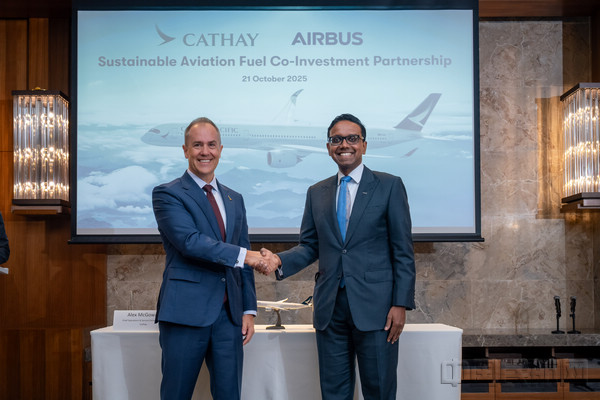
Core Insights - Cathay Pacific Group and Airbus have signed a joint investment agreement to invest up to $70 million (approximately HKD 545 million) to promote the development of Sustainable Aviation Fuel (SAF) in Asia and globally [1][3] - The collaboration aims to identify, assess, and invest in commercially viable SAF projects with technological maturity and long-term supply potential, targeting increased SAF production capacity by 2030 and beyond [1][3] Group 1: Investment and Collaboration - The partnership reflects a commitment to enhancing SAF production capacity and achieving carbon reduction goals in the aviation industry [3] - Cathay Pacific's President of Operations and Service, Ronald Lam, emphasized that SAF is crucial for the airline's and the industry's decarbonization efforts, aligning with their strategy to scale up SAF production in the short term [3][5] - Airbus's Asia-Pacific President, Anand Stanley, highlighted the need for unprecedented cross-sector collaboration to produce and distribute affordable SAF globally [3] Group 2: Sustainable Development Initiatives - Cathay Pacific has been a pioneer in sustainability, voluntarily reporting carbon emissions since 1996 and being the first major airline in Asia to allow passengers to offset carbon emissions in 2007 [4] - The airline has engaged in various initiatives, including investing in SAF production facilities and being the first to use SAF on new aircraft deliveries in France [4] - In 2023, Cathay Pacific became one of the founding investors in the "OneWorld - Breakthrough Energy Ventures Sustainable Aviation Fuel Fund," focusing on next-generation SAF technologies with large-scale potential [5] Group 3: Future Goals and Strategies - Cathay Pacific aims to increase SAF usage to 10% of total fuel consumption by 2030, recognizing the challenges of transitioning to more sustainable energy sources [5] - The airline promotes a "co-create a sustainable future" philosophy, urging stakeholders to unite towards this important goal [5] - The collaboration with Airbus will focus on mature SAF technologies to accelerate supply in the medium to short term [5]
第三届国际航协世界可持续发展大会在港开幕
Xin Hua She· 2025-10-21 08:59
Core Viewpoint - The third International Air Transport Association (IATA) World Sustainability Conference is being held in Hong Kong, focusing on achieving net-zero carbon emissions in the aviation industry by 2050 [1] Group 1: Government Initiatives - The Hong Kong Special Administrative Region (SAR) government is committed to actively promoting the green and low-carbon transformation of the aviation industry [1] - The government aims to collaborate with IATA to contribute to the global aviation industry's transition towards low-carbon and zero-carbon development [1] Group 2: Corporate Efforts - Cathay Group is implementing various measures to reduce carbon emissions, including introducing more fuel-efficient aircraft and expanding its fleet [1] - The company is utilizing Sustainable Aviation Fuel (SAF) and reducing the use of single-use plastics in operations to lower overall carbon emissions [1] Group 3: Conference Participation - Nearly 500 representatives from the aviation, energy, and finance sectors are attending the conference, which will continue until October 22 [1]