国产数据库

Search documents
2025信创产业发展趋势及50强报告
Sou Hu Cai Jing· 2026-01-05 15:58
Core Insights - The Xinchuang industry and generative AI security are in a rapid development phase, with technological innovation and compliance becoming the core development themes [1] - The Xinchuang industry has established a complete industrial chain covering basic hardware, software, cloud services, and application software, focusing on key areas such as chips, servers, databases, and industrial software [1] - Generative AI models are evolving from "call-type" to "intelligent agent" integration, embedding deeply into critical processes across various industries, while facing multiple risks [1] - A comprehensive compliance system based on three major data security laws has been formed in China, with global regulatory frameworks being established through laws like the "Artificial Intelligence Act" [1] Industry Development Status - By 2025, the Xinchuang industry is expected to enter a deep-water phase, with standards becoming more refined and product varieties continuously enriching [6] - The industry is characterized by a stepwise advancement in construction, led by state-owned enterprises with collaboration from SMEs [6] - The application of AI, particularly large models, is driving the growth of the Xinchuang industry, becoming a new growth engine [6] Key Focus Areas - The Xinchuang industry is seeing rapid growth in sectors such as finance, telecommunications, transportation, and energy, with significant advancements in core systems and standards [10][11] - AI is driving structural adjustments in Xinchuang products, with large models accelerating their application in government, telecommunications, finance, and education [12][17] Technological Insights - The Chinese CPU market is projected to reach 250 billion by 2025, with a competitive landscape evolving [25][26] - The demand for domestic databases is increasing, with a significant rise in the production of data and a growing need for non-relational databases [31][41] - The integration of AI with Xinchuang cloud services is becoming a key trend, enhancing the capabilities of various sectors [42][46] Ecosystem Development - The open-source community is playing a crucial role in enhancing the technological ecosystem of Xinchuang, facilitating faster integration of AI capabilities [19][23] - The ability of Xinchuang products to go global is improving, supported by the growing digital infrastructure investments in regions like Southeast Asia and Africa [19][23] Application Software Trends - Application software is transitioning from basic adaptation to value creation, with a focus on accelerating scene-based implementation and intelligent upgrades [44][47] - Industrial software is identified as a core area for Xinchuang, with increasing demand driven by manufacturing upgrades and smart manufacturing initiatives [44][47]


达梦数据:公司始终高度重视产品在多样化场景中的兼容稳定与生态融合能力
Zheng Quan Ri Bao Wang· 2025-12-26 12:41
Core Viewpoint - The company emphasizes the importance of code adaptation complexity and technical ecosystem compatibility during database migration and replacement processes, which are key concerns for both clients and technical service providers [1] Group 1 - The overall smoothness and predictability of migration work are gradually improving due to continuous iterations of domestic database products, the enhancement of development toolchains, and the accumulation of industry knowledge and experience [1] - The company places high importance on the compatibility, stability, and ecological integration of its products across diverse scenarios [1] - Through ongoing technical optimization, service support, and client collaboration, the company actively addresses various challenges that may arise during the migration process [1] Group 2 - The company is committed to providing clients with reliable and efficient technical migration paths and ongoing service guarantees [1]
武汉人工智能产业规模今年有望突破千亿元
Zheng Quan Shi Bao Wang· 2025-12-18 10:41
Group 1 - The core viewpoint of the news is that Wuhan's artificial intelligence industry is expected to exceed 100 billion yuan in scale this year, with over 1,000 AI companies gathered in the city and 9 companies listed in the 2025 Forbes China AI Technology Companies Top 50, ranking fourth nationwide [1][2] - The Wuhan government has implemented multiple policies to support breakthroughs in AI technology and industry, and the city has been approved as a national AI innovation application pilot zone and a national new generation AI innovation development experimental zone, holding an important position in the national strategic layout [1] - The Hubei provincial government has recently released implementation opinions to accelerate the development of the AI industry, aiming to establish a nationally influential AI innovation development highland and industrial development aggregation area by 2027, positioning Wuhan among the top tier of AI cities in the country [1] Group 2 - Wuhan has issued the "Promoting 'AI + Manufacturing' Action Plan," which aims to empower new industrialization through a dual drive of "intelligent industrialization and industrial intelligence," with goals to establish 20 national-level excellent smart factories and cultivate 100 benchmark applications of industrial intelligence by 2027 [2] - Industry leaders, such as the CEO of Ruilei Wisdom, highlighted Wuhan's strong advantages in AI industry development, supported by a national-level cybersecurity base, and expressed intentions to enhance overall industry security and service more fields [2] - The humanoid robot industry in Wuhan is experiencing explosive growth, with plans to establish a regional headquarters in Wuhan and expand market reach in central China, leveraging the city's industrial radiation capabilities [2]
武汉人工智能产业规模今年有望破千亿元
Chang Jiang Ri Bao· 2025-12-18 00:34
Core Insights - The 2025 Wuhan Artificial Intelligence Industry Cooperation and Exchange Conference focused on deepening industry cooperation and demand alignment in the AI sector [1] - Wuhan has implemented multiple policies to support breakthroughs in AI technology and industry, positioning itself as a key player in national strategic layouts [1][2] - The city aims to create a top-tier business environment to attract AI companies and ensure their growth and comfort [1] Industry Development - Wuhan's AI industry is projected to reach a scale of 70 billion yuan in 2024, with an annual growth rate exceeding 30% over the past three years, and is expected to surpass 100 billion yuan this year [2] - The city has over 1,000 AI companies, ranking fourth nationally with nine firms listed in the 2025 Forbes China AI Technology Companies Top 50 [2] - Notable products such as the Chucai series humanoid robots and various "national first" innovations in domestic databases and AI chips for smart vehicles have emerged from Wuhan [2] Company Perspectives - Executives from companies like Ruile Wisdom and Qianxun Intelligent expressed strong confidence in Wuhan's AI industry, highlighting its robust advantages and the presence of a national-level cybersecurity base [2] - Qianxun Intelligent plans to establish its Central China headquarters in Wuhan, leveraging the city's industrial radiation capabilities to expand into the central region market [2] - Attendees at the conference unanimously recognized Wuhan's foundational strengths in AI development, including talent, platforms, scenarios, ecosystems, and supportive policies [2]


达梦数据(688692):收入持续高增,盈利能力大幅改善
Shanxi Securities· 2025-10-31 09:24
Investment Rating - The report maintains a "Buy-A" rating for the company [4][7]. Core Insights - The company has shown strong revenue growth, with a 31.90% year-on-year increase in revenue for the first three quarters of 2025, reaching 830 million yuan. The net profit attributable to shareholders increased by 89.11% year-on-year to 330 million yuan [4][5]. - The company's gross margin improved to 96.26%, up 9.93 percentage points from the previous year, driven by a higher proportion of high-margin software product licensing revenue [5]. - The company is benefiting from the acceleration of domestic innovation demand in key sectors such as energy, finance, and transportation, leading to significant revenue growth [5][6]. Financial Performance Summary - For the first three quarters of 2025, the company achieved a net profit margin of 39.33%, an increase of 12.19 percentage points year-on-year [5]. - The company’s earnings per share (EPS) for 2025 is projected to be 4.46 yuan, with expected EPS growth of 6.01 yuan in 2026 and 7.68 yuan in 2027 [7][9]. - The projected revenue for 2025 is 1.338 billion yuan, with a year-on-year growth rate of 28.1% [9][11]. Market Position and Strategy - The company is positioned as a leading domestic database provider, benefiting from government policies promoting self-reliance in technology and increased procurement of innovative products [6]. - The company has successfully completed compatibility testing for its products with a major domestic cloud platform, enhancing its service offerings across various transportation sectors [6].
发布需求、供给、招商项目376个 第五届数字经济投融资机构四川行在达州举行
Sou Hu Cai Jing· 2025-10-28 14:44
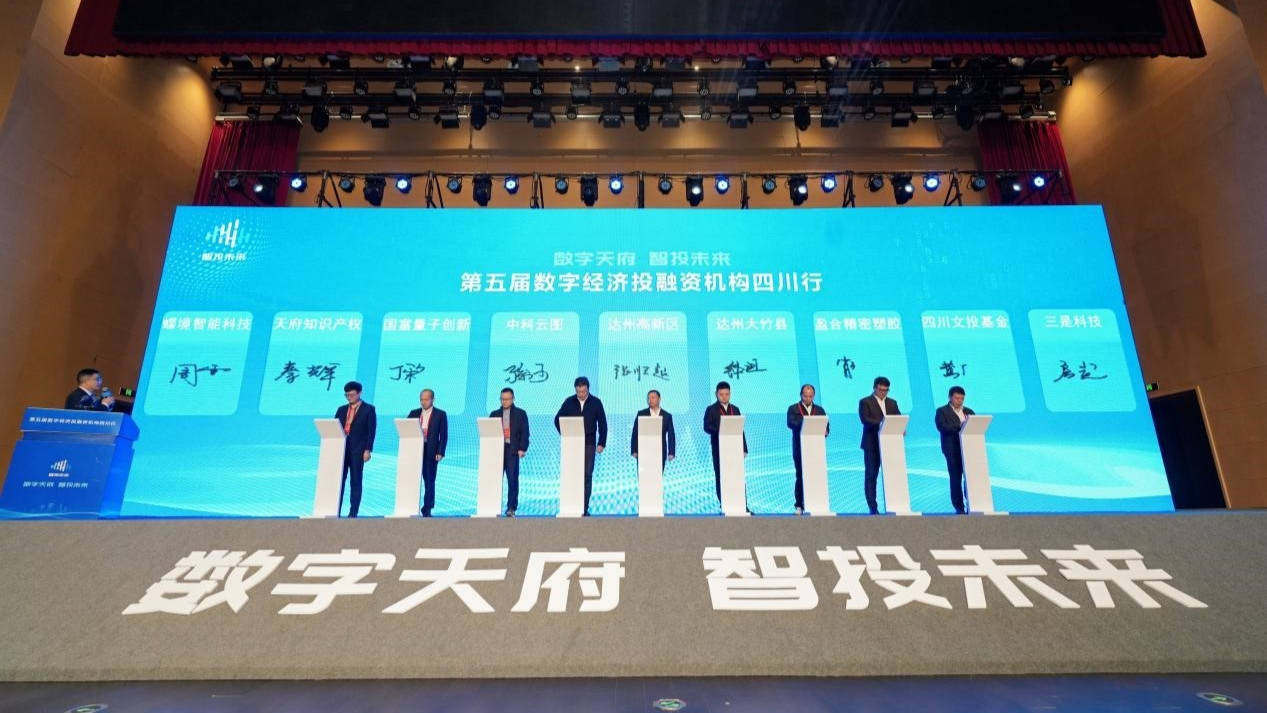
Group 1 - The fifth Digital Economy Investment and Financing Institutions event in Sichuan, themed "Digital Tianfu, Smart Investment Future," was held in Dazhou, promoting the development of the Sichuan internet and information industry [2] - Eight internet companies, including Chengdu Jinggong Huayao Technology Co., Ltd. and Chengdu Chenxian Optoelectronics Co., Ltd., presented their projects, covering sectors such as smart rail transit equipment, new displays, domestic databases, semiconductor manufacturing, AI+AR hardware, vertical e-commerce, and service robots [2] - A total of 18 internet companies expressed financing needs amounting to 2.61 billion yuan, with 46 well-known investment institutions providing on-site feedback and engaging in discussions during the investment and financing exchange salon [2] Group 2 - Eight departments, including the Sichuan Provincial Internet Information Office, jointly released a 2025 development opportunity list for the digital economy in Sichuan, which includes 82 scene demand projects, 259 supply projects, and 35 quality investment promotion projects across various fields [3] - Significant agreements were signed during the event, with a total signing amount exceeding 1 billion yuan, involving partnerships in equity capital increase, AI digital rights application, and the construction of a drone remote sensing data operation center [3] - Attendees also visited the digital economy achievement exhibition and the Dazhou Digital Economy Industrial Park to experience the development results and innovative vitality of digital Dazhou [3] Group 3 - The Dazhou Digital Economy Industrial Park is the only park in the northeastern Sichuan economic zone capable of constructing internal data centers with fewer than 3,000 standard racks, serving as a key platform for developing a digital industry cluster worth billions [4] - Dazhou has made significant progress in digital development, establishing the Sichuan East Big Data Center and the first super-intelligent integrated data center in the West, with an expected intelligent computing scale exceeding 1,600P by the end of 2025 [4] - The Sichuan Provincial Internet Information Office aims to accelerate the construction of a national hub node for integrated computing power networks, leveraging this event to boost regional economic coordination and stimulate innovation in the northeastern Sichuan economic zone [4]
自主可控系列:国产数据库
2025-10-15 14:57
Summary of the Conference Call on Domestic Database Industry Industry Overview - The domestic database industry is benefiting from national technology development plans and the Xinchuang project, presenting significant growth opportunities [1][3] - Major players in the domestic database market include Dameng, JKC (JianKe JinCang), Nanda General, and Aerospace Shenzhou, but they still lag behind international giants like Oracle and IBM [1][4] - The market is expected to reach $70 billion by 2025, with growth rates significantly higher than those in foreign markets [1][7] Key Points and Arguments - **Market Dynamics**: The domestic database market is complex, with competition from internet giants, traditional relational database vendors, telecom operators, and emerging companies [1][4] - **Technological Advancements**: Future trends include breakthroughs in technology (high concurrency and high-frequency data processing), market expansion into IoT and big data analytics, policy support, and international cooperation [1][5][8] - **Shift in Architecture**: The industry is transitioning from centralized to distributed systems, with cloud deployments increasing significantly; currently, cloud databases account for 40% of the market [10][11] - **Financial Performance**: - Dameng reported revenue of 523 million yuan in H1 2025, a 48.65% increase year-on-year, with net profit of 205 million yuan, up 98.36% [14][15] - JKC achieved revenue of 150 million yuan in H1 2025, a 66.11% increase, particularly excelling in the healthcare and transportation sectors [16][17] - Haima Data reported revenue of 232 million yuan in H1 2025, a nearly 14% increase, but remains in a loss position [18] Challenges and Opportunities - **Challenges**: The domestic database industry faces challenges such as insufficient supply capacity and high dependency on foreign vendors, particularly in critical sectors like finance and telecommunications [2][7] - **Opportunities**: The Xinchuang initiative and national policies are expected to continue supporting the growth of domestic databases, creating a favorable environment for local companies to thrive [6][12] Future Outlook - The domestic database industry is poised for rapid development, with expectations of narrowing the gap with international leaders due to policy support, technological innovation, and a broad market outlook [6][13] - The competitive landscape is anticipated to evolve, with leading companies gaining more advantages while smaller firms may grow into larger entities [12][19]
“关键软件”的国产化率及市场空间测算
2025-10-13 01:00
Summary of Key Points from Conference Call Records Industry Overview - The conference call discusses the **domestic software industry** in China, particularly focusing on the **localization of key software** and the **信创 (Xinchuang) industry** which is expected to accelerate by 2026 due to government mandates [1][4][3]. Key Software Localization - The **localization rate** of domestic operating systems in the government sector has reached **65%**, but the overall rate is only **4.55%**. By the end of 2025, the localization rate in the government sector is expected to exceed **80%**, with a market size of over **1 trillion yuan** [1][6]. - The **localization rate** for databases is low across various industries, with financial non-core systems at **40%**, energy at **15%**, and many sectors below **5%**. The domestic database market is projected to reach **668 billion yuan** by 2025, growing to over **800 billion yuan** by 2027, with a compound annual growth rate (CAGR) of approximately **12%** [1][9]. - Middleware localization has increased to **45%**, with financial, telecommunications, and government sectors exceeding **70%**. The middleware market is expected to reach **160 billion yuan** by 2025, with a year-on-year growth rate of **17%** in 2023 [1][11]. Market Dynamics - The **Office software** localization rate in the government and civilian B-end is around **40%-50%**, with Kingsoft WPS holding a significant market share. The government sector has achieved **100% localization** [1][14]. - The **ERP market** has the highest localization rate among industrial software, exceeding **70%**. The market size is expected to be around **500-600 billion yuan** by 2025, growing at **10%-15%** annually [1][17]. - The **R&D design software** sector, including EDA, CAD, and CAE, has low localization rates of **10%-15%** for EDA and CAE, and **25%-30%** for CAD. The market space for these segments is significant, with EDA alone estimated at **120-140 billion yuan** [1][19]. Company Performance and Valuation - Representative companies in the **database sector** include **达梦数据 (Dameng Data)**, with a projected PS ratio of **22x** in 2025, and **太极股份 (Taiji Co.)**, with a PS ratio of **1.9x** [1][10]. - In the **middleware sector**, companies like **宝兰德 (Baolande)** and **普元信息 (Puyuan Information)** are highlighted, with PS ratios of **8.94x** and a competitive market landscape [1][12]. - The **R&D design software** companies are experiencing varied growth rates, with **华大九天 (HuaDa JiuTian)** expected to grow by **20%** due to reliance on a single client, while others like **广立微 (Guangliwei)** are expanding rapidly [1][21]. Regulatory Impact - The **79th document** from the State-owned Assets Supervision and Administration Commission mandates that state-owned enterprises complete the localization of information systems by **2027**, which is expected to drive significant growth in the domestic software market [1][4]. Conclusion - The conference call emphasizes the rapid development and localization of key software in China, driven by government policies and market demand. The potential for growth in various software sectors, particularly in databases, middleware, and ERP systems, presents significant investment opportunities. The performance of leading companies in these sectors indicates a robust market environment, despite challenges in localization rates across certain software categories.
湖北数字经济综合实力 跻身全国第一梯队
Zheng Quan Shi Bao· 2025-08-26 22:24
Group 1 - The core value added of Hubei's digital economy reached 574.29 billion yuan in 2024, which is 2.4 times that of 2020, and is expected to exceed 10% of GDP this year [1] - Hubei has over 6,000 "Four Up" enterprises in the digital economy sector, including 92 national-level specialized and innovative "little giant" companies and 48 listed companies on A-shares [1] - Wuhan's digital economy core industry value added is projected to reach 308.7 billion yuan in 2024, with an annual growth rate of over 10% [1] Group 2 - The optical electronic information industry in Hubei surpassed 1 trillion yuan last year, with software business revenue accounting for nearly half of the total in Central China [2] - Hubei has established significant projects for computing power infrastructure, including the Wuhan Supercomputing Center and various data centers, with a total computing power scale exceeding 15,000 P [2] - A 400G computing power corridor has been built, creating a low-latency network centered around Wuhan, with latency times of 1 millisecond within the city and 5 milliseconds within the province [2] Group 3 - Hubei is focusing on developing a trusted data space system to enhance data infrastructure and promote efficient data circulation, with 15 provincial pilot projects recently announced [3] - The province aims to accelerate the construction of a dual hub for computing power and data elements, striving to elevate the level of digital development in Hubei [3]
中信建投:联通服务器集采招投标启动 关注信创板块投资机会
智通财经网· 2025-07-30 00:00
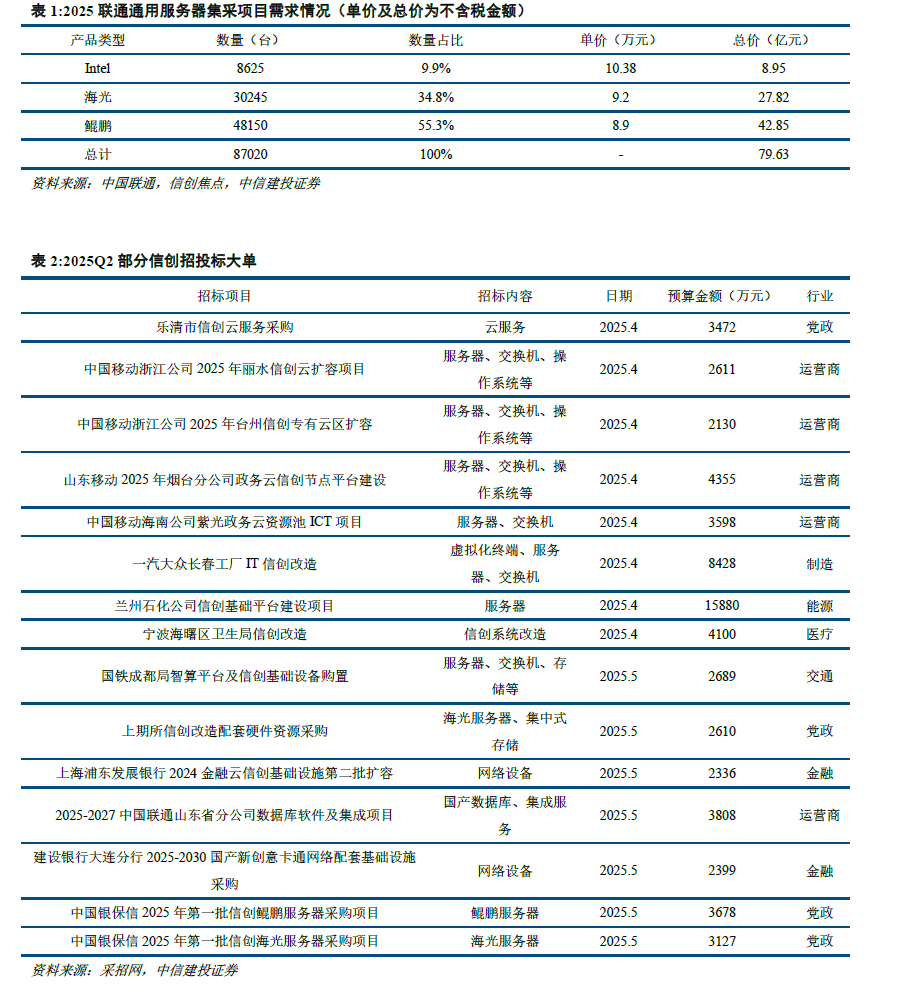
Group 1 - China Unicom's 2025 general server procurement demand has been announced, with a domestic production ratio exceeding 90%, significantly higher than previous levels [1] - The total procurement scale amounts to 87,020 servers, with a total value of approximately 7.963 billion yuan [1] - The procurement includes 8,625 Intel CPU servers, 30,245 Haiguang servers, and 48,150 Kunpeng servers, reflecting a substantial increase in domestic chip server share compared to 40% in 2020 and 2022 [1] Group 2 - The demand for domestic innovation in the government and key industries has been deepening, with a notable increase in bidding activities since the fourth quarter of last year [2] - In the first half of this year, there were 60 projects with budgets exceeding 20 million yuan, totaling over 3 billion yuan, indicating a recovery in the bidding landscape [2] - Database-related companies in the domestic innovation sector have reported significant revenue growth, with increases of 41-46% and 66% year-on-year for various domestic database vendors [2]