
官方现金利率(OCR)

Search documents
刚刚宣布!降息25个基点
中国基金报· 2025-11-26 02:59
Core Viewpoint - The Reserve Bank of New Zealand has lowered the Official Cash Rate (OCR) by 25 basis points to 2.25%, aligning with market expectations and aimed at supporting consumer and business confidence amid a slower economic recovery [2][4][5]. Monetary Policy Decision - The decision to cut the OCR was made after a discussion between maintaining the rate at 2.5% and lowering it to 2.25%, with a vote of 5 to 1 in favor of the reduction [4]. - The committee believes that lowering the OCR will help bolster consumer and business confidence and mitigate risks associated with a slower economic recovery [5]. Economic Indicators - The annual consumer price inflation rate rose to 3% in the September quarter, reaching the upper limit of the central bank's target range of 1% to 3% [7]. - The OCR's significant reduction since August 2024 is expected to support economic activity recovery, with inflation projected to return to around 2% by mid-2026 [8]. - The committee noted improvements in short-term economic activity indicators, suggesting a moderate GDP growth in the September quarter [8]. Leadership Transition - The recent monetary policy meeting was the last chaired by acting chair Christian Hawkesby, with Anna Blayman set to officially take over as the new chair [11]. - Blayman is perceived as a dovish member from her time at the Swedish central bank, which may signal a tendency towards more accommodative policies in the future [11]. Labor Market and Demographics - New Zealand's unemployment rate rose to 5.3%, the highest since Q4 2016, reflecting weak economic conditions and reduced hiring demand [12]. - There is a notable outflow of young people from New Zealand, with approximately 73,000 citizens expected to leave between September 2024 and September 2025, marking an 8% increase year-on-year [12].


刚刚宣布:降息25个基点
Zhong Guo Ji Jin Bao· 2025-11-26 02:26
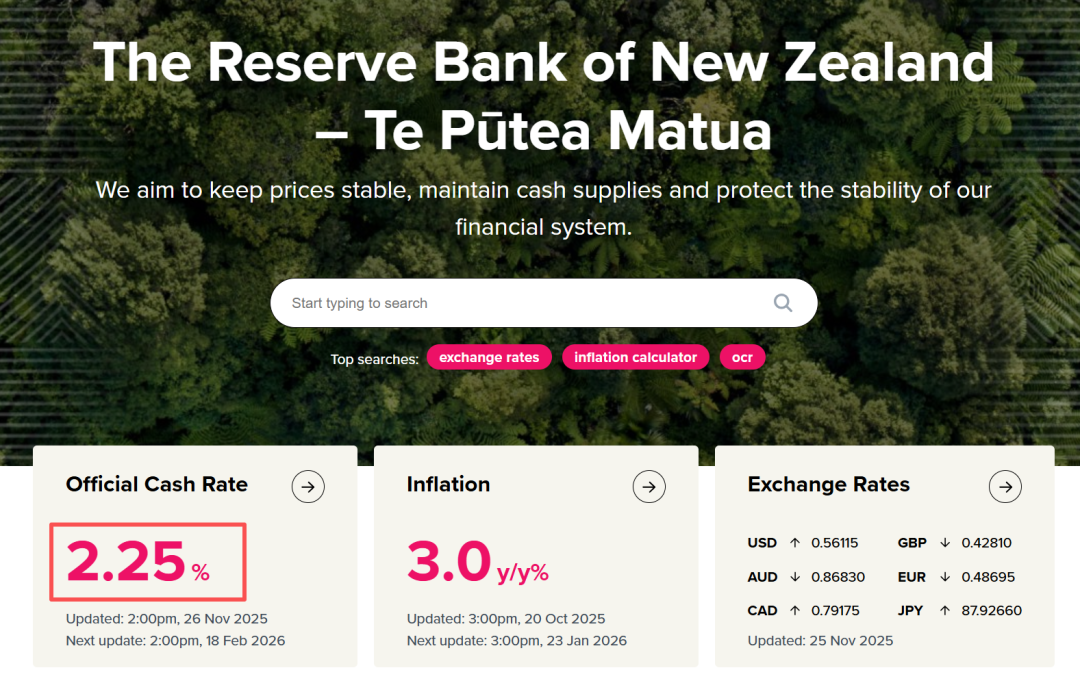
Core Points - The Reserve Bank of New Zealand (RBNZ) has lowered the Official Cash Rate (OCR) by 25 basis points to 2.25%, aligning with market expectations [1][3] - The decision was made after a discussion between maintaining the OCR at 2.5% and reducing it to 2.25%, with a 5:1 vote in favor of the latter [3] - The RBNZ aims to support consumer and business confidence and mitigate risks associated with slower economic recovery compared to inflation targets [3][5] Economic Indicators - The annual consumer price inflation rate rose to 3% in the September quarter, reaching the upper limit of the RBNZ's target range of 1% to 3% [4][5] - The RBNZ anticipates that inflation will decline to around 2% by mid-2026, despite current pressures from high gasoline and food prices [5] - The unemployment rate in New Zealand increased to 5.3%, the highest level since Q4 2016, reflecting weak economic conditions [8] Leadership Transition - The recent monetary policy meeting was the last chaired by Acting Governor Christian Hawkesby, with Anna Blighman set to take over as the new RBNZ Governor [8] - Blighman is perceived as a dovish member from her time at the Swedish central bank, which may signal a future inclination towards more accommodative policies [8] Demographic Trends - New Zealand is experiencing a significant outflow of young people, with approximately 73,000 citizens expected to leave for Australia between September 2024 and September 2025, marking an 8% increase year-on-year [9]
刚刚宣布!降息25个基点
Zhong Guo Ji Jin Bao· 2025-11-26 02:21
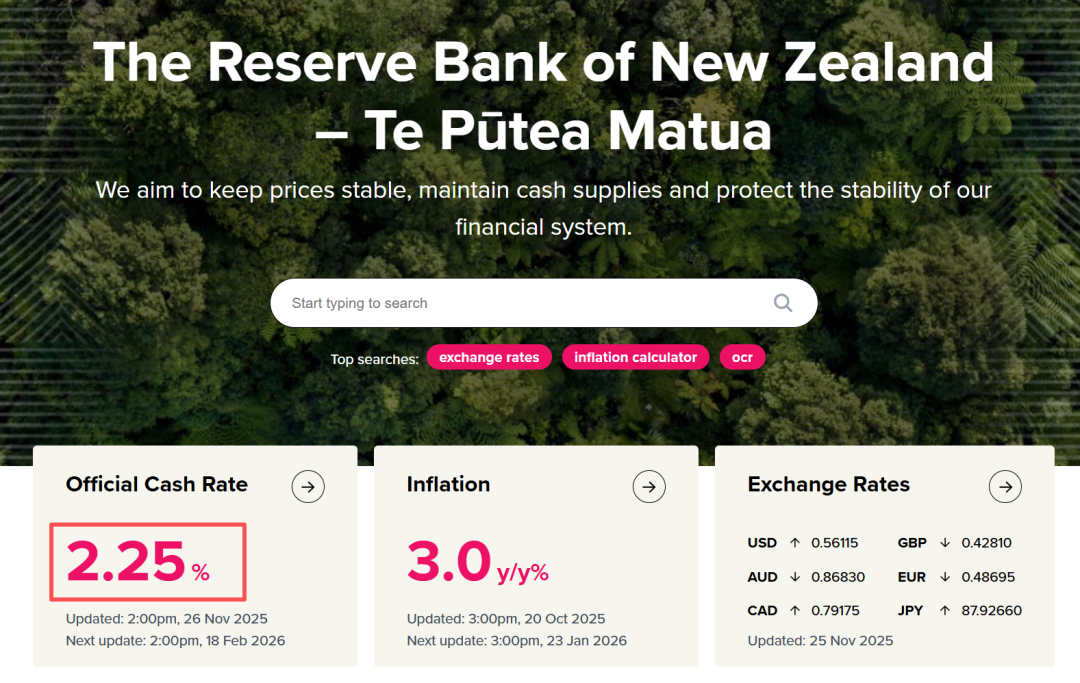
Core Viewpoint - The Reserve Bank of New Zealand has lowered the official cash rate (OCR) by 25 basis points to 2.25%, aligning with market expectations and aiming to support consumer and business confidence amid a slower economic recovery [1][3]. Monetary Policy Decision - The decision to cut the OCR was made after a discussion between maintaining the rate at 2.5% and lowering it to 2.25%, with a 5:1 vote in favor of the latter [3]. - The committee noted that the reduction in OCR is intended to bolster confidence and counteract the slower-than-expected economic recovery [3]. Economic Indicators - The annual consumer price inflation rate rose to 3% in the September quarter, reaching the upper limit of the monetary policy target range of 1% to 3% [3]. - The committee anticipates that inflation will decline to around 2% by mid-2026, despite current pressures from high gasoline and food prices [3]. - Economic activity indicators have shown improvement since the June quarter, suggesting a moderate GDP growth for the September quarter [4]. Labor Market and Migration - There are initial signs of stabilization in labor demand, with increases in job vacancies and total hours worked [4]. - New Zealand is experiencing a significant outflow of young people, with nearly 73,000 citizens expected to leave for Australia between September 2024 and September 2025, marking an 8% increase year-on-year [8]. Leadership Transition - The recent monetary policy meeting was the last chaired by acting chair Christian Hawkesby, with Anna Blayman set to take over, who is perceived as a dovish member from her time at the Swedish central bank [7]. - Market expectations regarding Blayman's future policy stance are mixed, with some analysts predicting a potential shift towards a "neutral to hawkish" approach [7].
RBNZ Expected To Cut Interest Rates To 2.25% In November
Yahoo Finance· 2025-11-25 21:28
Crypto Interest Rates. Photo by BeInCrypto The Reserve Bank of New Zealand (RBNZ) is expected to cut the Official Cash Rate (OCR) to 2.25% from 2.5%, following the conclusion of the November monetary policy meeting on Wednesday. The decision will be announced at 01:00 GMT, accompanied by the Monetary Policy Statement (MPS) and followed by RBNZ Governor Christian Hawkesby’s press conference at 02:00 GMT. The New Zealand Dollar (NZD) will likely experience a big reaction to the central bank’s policy announ ...
降息50个基点!刚刚,直线大跳水!
Sou Hu Cai Jing· 2025-10-08 12:33
Core Points - The Reserve Bank of New Zealand unexpectedly cut the official cash rate by 50 basis points to 2.5%, exceeding market expectations of a 25 basis point reduction [1][2] - The New Zealand dollar fell sharply against the US dollar, with an intraday drop of over 1%, reaching its lowest level since mid-April [1][2] Monetary Policy Decision - The decision to lower the rate was based on discussions between two viewpoints: one supporting a 25 basis point cut due to signs of economic recovery, and the other advocating for a 50 basis point cut to address ongoing economic weakness and support consumption [3] - The Reserve Bank emphasized the need for flexibility in policy to ensure inflation remains stable around the 2% target [3] Economic Outlook - The monetary policy committee expects economic activity to remain weak until mid-2025, with inflation pressures anticipated to ease [4] - The annual CPI inflation is projected to approach the target midpoint in the first half of next year, with overall inflation expected to reach 3.0% by the third quarter of 2025 [4] Impact on Financial Markets - Following the rate cut, New Zealand bond yields fell across the board, with the 2-year government bond yield dropping by 7 basis points to 2.64% [2] - The New Zealand dollar has been the worst-performing G10 currency against the US dollar over the past 12 months, with a cumulative decline of 5.7% [2] Global Economic Context - The Reserve Bank noted that global trade and economic activity have shown resilience, with growth expectations for several trading partners being revised upward due to investments in AI and adjustments to new tariff environments [5] - Despite the overall inflation in the US rising, the impact of tariffs on consumer prices has been weaker than expected, with no substantial evidence of tariffs affecting New Zealand's import and export prices [5]
新西兰央行降息50个基点至2.5% 降息幅度超市场预期
Zhong Guo Ji Jin Bao· 2025-10-08 03:57
Core Viewpoint - The Reserve Bank of New Zealand (RBNZ) has lowered the official cash rate (OCR) by 50 basis points to 2.5%, exceeding market expectations of a 25 basis point cut, in an effort to stabilize inflation around the 2% target midpoint in the medium term [1][3]. Economic Activity and Inflation - The RBNZ noted a slight recovery in economic activity in Q3, but significant idle capacity remains in the New Zealand economy [2]. - The annual consumer price index inflation is currently at the upper limit of the RBNZ's target range of 1% to 3%, but overall inflation is expected to decline to the 2% target midpoint by mid-2026 due to idle capacity in the economy [1][2]. - Household consumption is recovering, partly due to lower interest rates, while high commodity prices continue to support the primary sector [1]. Monetary Policy Discussion - The RBNZ discussed two options for the OCR adjustment: a 25 basis point cut or a 50 basis point cut. The decision to cut by 50 basis points was influenced by ongoing idle capacity and the need to support consumption and investment [3]. - The committee expressed concerns about the cautious sentiment among households and businesses, which could hinder economic recovery and reduce mid-term inflation pressure [2][3]. Global Trade and Economic Outlook - Global trade volumes and economic activity remain resilient, with growth expectations for several trading partners, particularly in Asia, being revised upward due to increased investment in AI-related industries and adjustments in global trade flows [2]. - However, growth expectations for 2026 are projected to be modest, with a slowdown anticipated in trading partner economies [2]. Rate Cuts History - Since August 2024, the RBNZ has cumulatively cut rates by 300 basis points [4].
刚刚!降息25个基点
中国基金报· 2025-08-20 03:21
Core Viewpoint - New Zealand's central bank has initiated a monetary easing cycle by lowering the benchmark interest rate by 25 basis points to 3.00%, responding to signs of economic stagnation and aiming to support fragile economic recovery [3][9]. Group 1: Interest Rate Changes - On August 20, New Zealand's central bank reduced the benchmark interest rate by 25 basis points to 3.00%, aligning with market expectations [3]. - This reduction marks a total decrease of 250 basis points since August 2024, aimed at bolstering the weak economic recovery [7]. - The decision to lower the rate was made with a majority vote of 4 to 2, considering the economic conditions [8]. Group 2: Economic Conditions - New Zealand's economy showed signs of stagnation in the second quarter, with household and business spending constrained by global economic uncertainties and rising prices of essential goods [9]. - The central bank anticipates that overall inflation will return to around 2% by mid-2026, as domestic inflationary pressures ease [9]. - Economic forecasts suggest a potential GDP decline of 0.3% in Q2 2025, followed by a modest growth of 0.3% in Q3 2025 [10]. Group 3: Future Projections - Analysts predict that the official cash rate (OCR) may remain at supportive levels for an extended period to stimulate the economy, with a possibility of further reductions below 3% by the end of the year [10][11]. - The central bank's monetary policy stance may shift to a more accommodative position if inflation continues to stay within the target range [10]. - New Zealand's ASB Bank forecasts a further reduction of the cash rate to 2.5% in November [11].

结束六连降!新西兰联储维持3.25%利率,通胀与全球不确定性成焦点
智通财经网· 2025-07-09 03:01
Core Viewpoint - The Reserve Bank of New Zealand (RBNZ) decided to maintain the Official Cash Rate (OCR) at 3.25%, ending a series of six consecutive rate cuts, which diverged from the expectations of most economists who predicted a 25 basis point cut [1][2] Group 1: Monetary Policy Decision - The RBNZ's decision to pause rate cuts reflects a cautious approach due to the complex economic situation, where domestic demand is weak but inflation has shown signs of recovery [1] - The RBNZ indicated that future rate movements will depend on the pace of economic recovery, the persistence of inflation, and the impact of tariffs [1] - The central bank noted that the cumulative effect of 225 basis points of rate cuts since last August has not fully materialized, and external pressures from U.S. trade policies contribute to its cautious stance on inflation expectations [1] Group 2: Economic Indicators - New Zealand's inflation rate accelerated to 2.5% in the first quarter, with expectations that it may reach the upper limit of the 1-3% target range by mid-year, before gradually returning to the 2% target by early 2026 [1] - The first quarter GDP growth of 0.8% exceeded expectations, and there has been some improvement in business confidence, although the real estate and labor markets remain weak [2] - The RBNZ highlighted that rising export prices and lower interest rates support economic growth, but global policy uncertainties may delay recovery and alleviate inflation pressures [2] Group 3: Market Reaction - Following the RBNZ's decision, the New Zealand dollar experienced a slight appreciation, with the USD/NZD exchange rate moving from 0.60 to 0.6008, before retreating to 0.5988 [2] - The decision to maintain rates was reached unanimously, contrasting with the previous meeting where a 5-1 vote favored a rate cut [2] - The RBNZ's pause in rate cuts aligns with a broader trend of diverging global monetary policies, as other central banks have entered easing cycles [3]
新西兰联储主席Hawkesby:我们的确看到增速在短期内面临逆风。对官方现金利率(OCR)预测路径的修订是温和的/适度的。这样的修正体现出,通胀前景较2月份预估走弱。
news flash· 2025-05-28 21:21
Group 1 - The Reserve Bank of New Zealand's Governor Hawkesby indicated that growth is facing headwinds in the short term [1] - The revision of the Official Cash Rate (OCR) forecast path is described as moderate [1] - This adjustment reflects a weaker inflation outlook compared to the February estimates [1]
5月28日汇市晚评:新西兰联储将利率下调至3.25% 纽元/美元缩减了部分跌幅
Jin Tou Wang· 2025-05-28 09:38
Group 1: Currency Market Overview - The Euro has rebounded towards 1.1350 against the USD, while the GBP is challenging the 1.3500 level [1] - The JPY has fallen to its lowest level in over a week against the USD, remaining weak amid a general USD recovery [1] - The AUD has continued its negative trend, testing the 0.6430 area and breaking below the key 200-day moving average due to the strong USD [1] - The NZD, after a drop of over 1% on Tuesday, has reduced some of its losses on Wednesday [1] - The USD/CAD has shown a recovery for the third consecutive day, starting from the 1.3685 area, which is the lowest level since October 2024 [1] Group 2: Central Bank Insights - ECB Governing Council member Holzmann stated that the ECB should at least postpone further rate cuts until September [3] - The Bank of Japan's Governor Ueda mentioned ongoing tariff negotiations, indicating uncertainty in the economic outlook [3] - The Reserve Bank of New Zealand has lowered its policy rate from 3.50% to 3.25%, marking the sixth consecutive cut, with expectations for at least another 25 basis points reduction [3][4] - The Westpac Bank now anticipates the RBNZ will cut the official cash rate to 3% in August instead of July [4] - Hungary has maintained its benchmark interest rate at 6.5%, aligning with market expectations [5] Group 3: Technical Analysis - The EUR/USD is showing a bullish bias, despite facing strong resistance at 1.1400 [7] - The GBP/USD is in an overbought state with an RSI above 70, facing support at 1.3500 and resistance at 1.3600 [7] - The AUD/USD is attempting to break through an RSI of 60.00, with potential upward targets at 0.6515 and 0.6550 [8]