
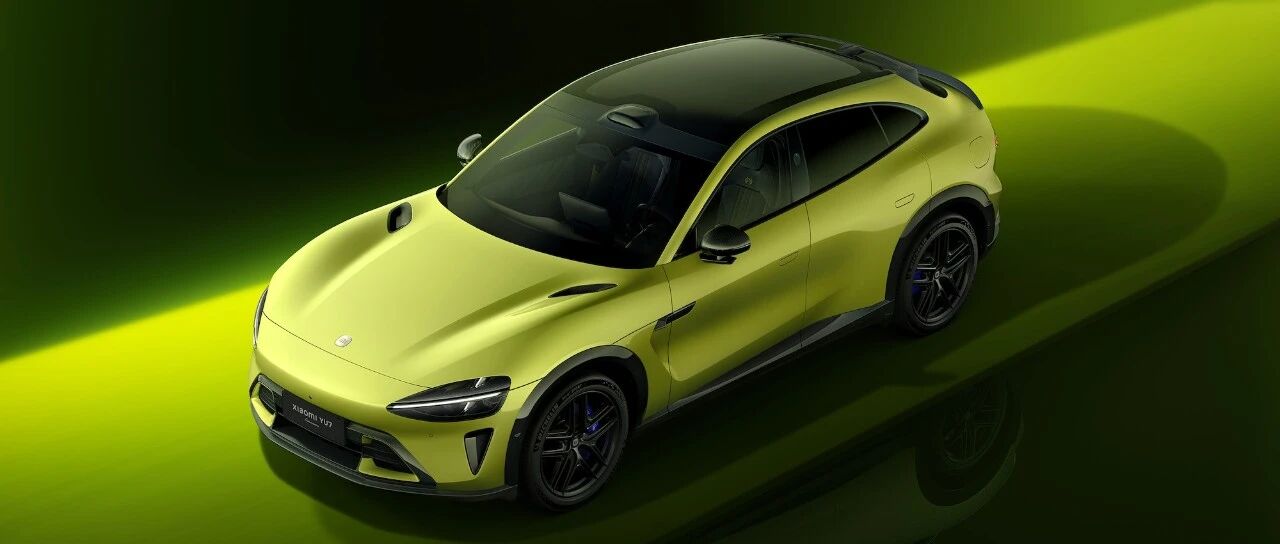
小米 17 系列

Search documents
小米的AB面:流量场的争议与竞技场的心力
阿尔法工场研究院· 2026-01-09 00:04
Core Viewpoint - Xiaomi's transformation from "scale expansion" to "quality competition" in the tech industry is exemplified by its achievements in 2025, including the mass production of its first 3nm flagship chip and significant sales milestones in its smartphone and automotive sectors [1][4]. Group 1: Business Performance - Xiaomi's 2025 performance is attributed to a shift in its profit logic, moving from volume-based earnings to technology breakthroughs and ecosystem synergy, making it more stable [4]. - The automotive sector has emerged as a surprising highlight, with the SU7 and YU7 exceeding annual delivery targets and achieving quarterly profitability, indicating a successful transition past initial challenges [4][17]. - The Xiaomi 17 series achieved over one million sales in just five days, reflecting not only sales success but also a significant improvement in product quality and innovation [4][5]. Group 2: Technological Advancements - The launch of the self-developed 3nm flagship SoC, the Xuanjie O1 chip, fills a gap in domestic advanced processes and signifies Xiaomi's commitment to building a technological moat [7][11]. - Xiaomi's investment in R&D has exceeded 100 billion yuan over the past five years, with plans to increase this to 200 billion yuan in the next five years, establishing a strong technological foundation [11]. - The integration of the 澎湃 OS 3.0 across devices enhances connectivity and user experience, creating a comprehensive ecosystem that is difficult for competitors to replicate [11][13]. Group 3: Market Perception and Challenges - Despite strong performance, Xiaomi faces ongoing controversies stemming from misaligned expectations, particularly when compared to established giants like Apple and Tesla [8]. - The company has adopted a strategy of reducing inefficient marketing expenditures to focus on core technological development, which is seen as a rare and valuable approach in a market driven by traffic [15]. - Global capital markets and industry leaders have recognized Xiaomi's fundamental advantages, with institutions like Goldman Sachs and Morgan Stanley acknowledging its potential in the automotive and high-end markets [17][19]. Group 4: Future Outlook - Xiaomi's strategic shift towards hard technology and innovation aligns with national goals for technological self-reliance, positioning it as a model for China's manufacturing transformation [19]. - The company is committed to continuous improvement in chip technology and automotive competitiveness, with a long-term vision that emphasizes steady progress rather than immediate results [20].


每日投资摘要-20251212
光大新鸿基· 2025-12-12 07:21
Economic Outlook - Unemployment rate is expected to remain around 4% due to AI taking over entry-level jobs[2] - 40% of companies are optimistic about revenue growth in the coming year[2] Market Performance - Hang Seng Index closed at 25,530.51, down 0.04% for the day, but up 27.27% year-to-date[5] - The technology index fell by 0.83%, with a year-to-date increase of 23.87%[5] - Total market turnover decreased by 5.6% to HKD 182.477 billion[7] Sector Analysis - Financial index rose by 0.56%, with a year-to-date increase of 15.56%[5] - Utility index increased by 0.59%, year-to-date up 25.53%[5] - Real estate index saw a slight increase of 0.17%, with a year-to-date rise of 14.48%[5] Stock Highlights - JD.com (9618.HK) reported advancements in anti-fraud capabilities, enhancing its risk management system[7] - Xiaomi (1810.HK) achieved a revenue of HKD 340.37 billion, a year-on-year increase of 32.5%[15] - Xiaomi's adjusted profit for Q3 reached HKD 11.311 billion, marking an 80.9% year-on-year increase[15] Investment Recommendations - Xiaomi is recommended for purchase at HKD 42, with a target price of HKD 46 and a stop-loss at HKD 38[16] - Tencent (700.HK) and Alibaba (9988.HK) are also highlighted for potential investment, with target prices set at HKD 680 and HKD 175 respectively[12]
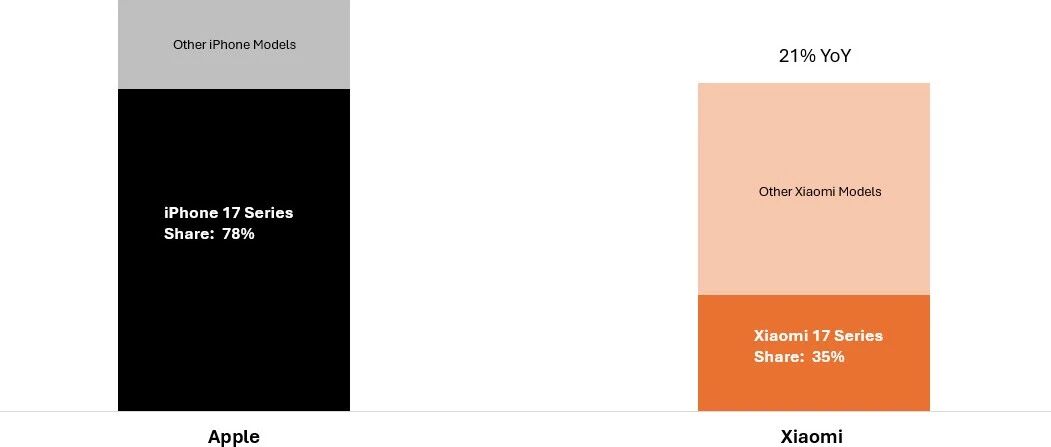
Counterpoint Research:苹果(AAPL.US)推动中国双11期间智能手机销量同比增长3%
Zhi Tong Cai Jing· 2025-12-04 02:34
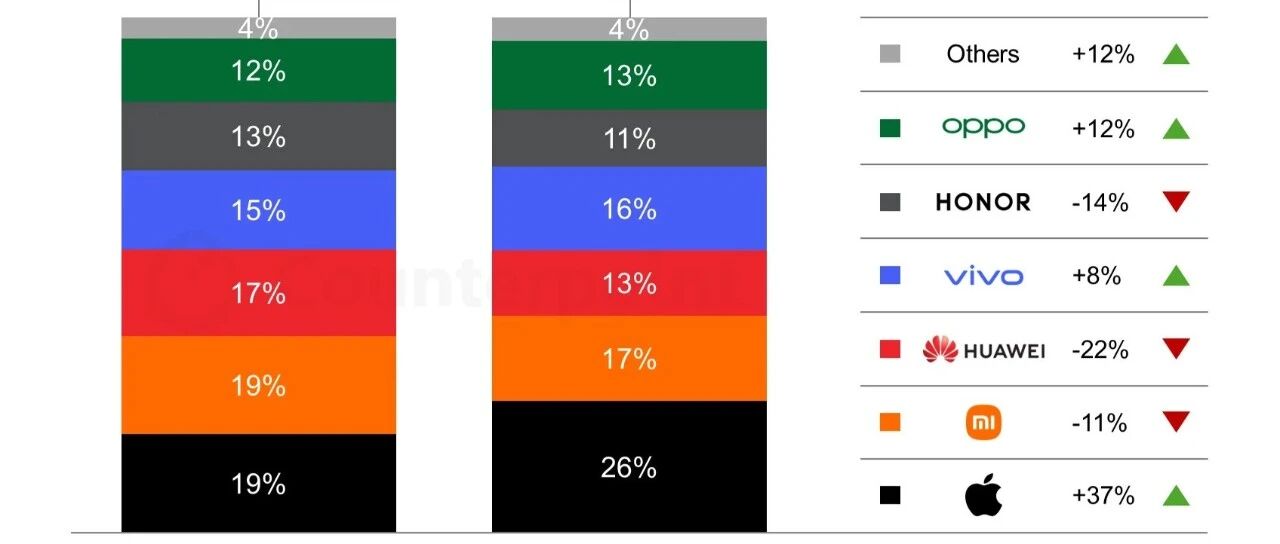
Group 1 - The core viewpoint of the articles highlights that Apple's iPhone 17 series significantly boosted smartphone sales in China during the Double 11 shopping period, leading to a 3% year-on-year increase in overall smartphone sales [1] - The iPhone 17 base model saw over a 100% increase in sales compared to the previous year, while the Pro and Pro Max models also experienced mid to high double-digit growth, aided by a promotional discount of 300 RMB [1] - Excluding Apple, the smartphone market in China experienced a 5% decline year-on-year, indicating a cautious consumer environment and weak momentum heading into Q4 [1] Group 2 - Huawei faced the largest decline in performance due to the delayed launch of its flagship Mate 80 series, which was released two weeks after Double 11 [2] - Xiaomi's sales dropped by 11% year-on-year, primarily due to the early release of its Xiaomi 17 series, which shifted the sales peak forward by a month, coupled with weaker performance of older models [2]

苹果推动中国双 11 期间智能手机销量同比增长 3%
Counterpoint Research· 2025-12-04 01:03
Core Insights - The article highlights that the smartphone sales in China during the Double 11 shopping festival saw a year-on-year increase of 3%, primarily driven by strong demand for the Apple iPhone 17 series [4][5][7]. Smartphone Market Performance - The iPhone 17 series, particularly the base model, has shown remarkable performance with sales more than doubling year-on-year, while the Pro and Pro Max models also experienced mid to high double-digit growth [5][8]. - Excluding Apple, the overall smartphone market in China declined by 5% year-on-year, indicating a more cautious consumer environment and weak momentum at the start of Q4 [7][8]. - Huawei faced the largest decline among major smartphone brands due to the delayed launch of its flagship Mate 80 series, which missed the Double 11 sales period [7][8]. - Xiaomi's sales dropped by 11% year-on-year, attributed to the early release of the Xiaomi 17 series, which shifted the sales peak forward by a month [7][8]. Strategic Shifts in the Industry - Major smartphone brands are shifting their focus towards newly launched high-end models, which has further suppressed overall sales [8]. - The early launch of the Xiaomi 17 series and the strong performance of the previous generation Xiaomi 15 series during the Double 11 period highlight the impact of product timing on sales performance [8].
东兴证券晨报-20251121
Dongxing Securities· 2025-11-21 09:06
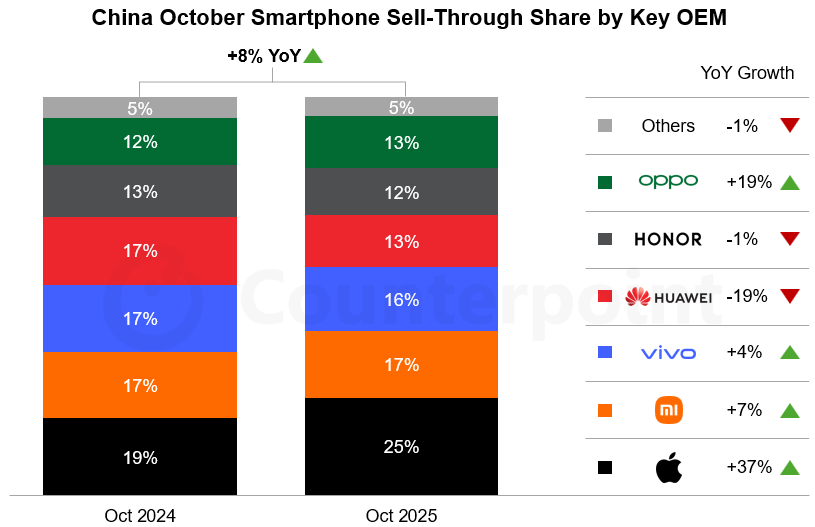
Core Insights - The report highlights a significant increase in electricity consumption in October, with a total of 857.2 billion kWh, representing a year-on-year growth of 10.4% [2] - The Chinese smartphone market experienced a notable recovery in October, with overall sales increasing by 8% year-on-year, driven by strong performances from brands like Apple and Xiaomi [5] - The airline industry showed positive trends in October, with an increase in passenger load factors and capacity deployment, indicating a favorable supply-demand relationship [7][8] Electricity Consumption - In October, the total electricity consumption reached 857.2 billion kWh, with the first industry consuming 12 billion kWh (up 13.2%), the second industry 568.8 billion kWh (up 6.2%), and the third industry 160.9 billion kWh (up 17.1%) [2] - Cumulative electricity consumption from January to October was 8,624.6 billion kWh, reflecting a year-on-year increase of 5.1% [2] Smartphone Market - The smartphone market in China saw a significant uptick in October, with Apple leading the market with a 37% year-on-year increase in sales, capturing a 25% market share [5] - Xiaomi ranked second for the first time in over a decade, with a 7% increase in sales, attributed to its diverse product offerings [5] - OPPO also contributed to market growth with a 19% increase in sales, while other brands like vivo and Honor experienced minor fluctuations [5] Airline Industry - Domestic airline capacity increased by approximately 3.6% year-on-year in October, with a corresponding rise in passenger load factors by about 1.8 percentage points [8] - International airline capacity saw a year-on-year increase of 14.3%, with a slight rise in load factors, indicating a healthy demand despite some overcapacity risks [9] - The report notes that the recent travel advisories may impact demand for certain international routes, particularly to Japan [10][11] Financial Sector - The report indicates a continued decline in social financing growth, with a year-on-year increase of 8.5% as of October, reflecting a slowdown in credit demand [14][15] - The total new RMB loans in October amounted to 220 billion, with a year-on-year decrease of 280 billion, highlighting a weak credit environment [16] - The M1 growth rate decreased to 6.2%, while M2 grew by 8.2%, indicating a trend towards "de-banking" in the financial sector [18]
Counterpoint Research:中国10月智能手机销量同比增长8% iPhone Q4销量持续攀升
智通财经网· 2025-11-20 05:52
Core Insights - Apple's smartphone sales in October increased by 8% year-on-year, driven by a 37% growth in iPhone sales, particularly the iPhone 17 series [1][6] - The iPhone 17 series has achieved significant sales, with over 80% of new iPhone sales coming from this model, leading to an expected rise in overall sales due to increased average selling prices [1][6] - October marked Apple's best-ever Q4 start, with iPhones accounting for one in four smartphones sold in China, a feat only previously achieved in 2022 [4][6] Company Performance - OPPO emerged as the second-largest growth driver in the domestic smartphone market, thanks to its flagship Find X9 series and the youth-oriented Reno 14 series, exceeding expectations [6] - Xiaomi launched its Xiaomi 17 series early, along with a diverse product lineup, allowing it to reclaim the second position in the domestic market for the first time in over a decade [6] - Apple's sales momentum remains strong entering November, with expectations of achieving the best quarterly performance in December, despite potential competition from Huawei's upcoming Mate 80 series [6]
中国 10 月智能手机销量同比增长 8%;iPhone Q4 销量持续攀升,有望创历史新高
Counterpoint Research· 2025-11-20 04:14
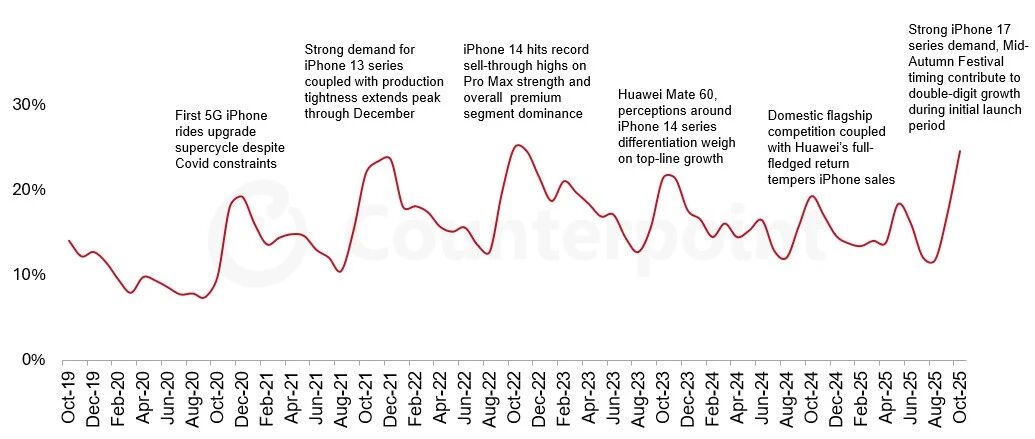
Core Insights - In October, China's smartphone sales increased by 8% year-on-year, driven by Apple's 37% growth in sales [4][5][7] - The iPhone 17 series has significantly contributed to Apple's performance, with over 80% of sales coming from this new lineup, leading to an expected increase in overall sales due to rising average selling prices [5][7] - October marked Apple's best-ever Q4 start, with one in four smartphones sold in China being an iPhone, a feat only previously achieved once in 2022 [7] Market Performance - The iPhone 17 series, including the base, Pro, and Pro Max models, achieved double-digit growth rates in October, with the base model showing the fastest growth [7][9] - OPPO's flagship Find X9 series has performed well, driven by its strong imaging capabilities and large battery capacity, making it the second-largest growth driver in the domestic smartphone market [9] - Xiaomi reached the second position in the domestic market for the first time in over a decade, aided by its strong product lineup, including the Xiaomi 17 series launched during the Mid-Autumn Festival sales peak [9] Future Outlook - Apple's strong sales momentum is expected to continue into November, with the potential for record quarterly performance in December [9] - The upcoming launch of Huawei's Mate 80 series on November 25 poses a potential challenge, but current trends suggest that Apple's growth is robust and unlikely to see significant declines [9]
iPhone 17 与小米 17 系列在中国上市首月热销
Counterpoint Research· 2025-11-20 04:14
Core Insights - The iPhone 17 and Xiaomi 17 series are key drivers for growth in their respective brands during the first month of sales [4][5] - Both Apple and Xiaomi experienced similar overall sales growth, with Apple increasing by 22% and Xiaomi by 21% year-on-year [5] Sales Performance - The iPhone 17 series contributed significantly to Apple's sales in China, with nearly 80% of iPhones sold during the period coming from the new series [8] - Xiaomi's early launch of the 17 series effectively supported its smartphone sales, leading to a 21% year-on-year increase [8] Market Trends - The timing of the new product launches before the Mid-Autumn Festival boosted sales compared to the previous year [8] - Consumers are seeking high cost-performance products while also expecting innovative features, which the latest offerings from Apple and Xiaomi fulfill [8] Consumer Behavior - There is a strong demand for the new iPhone models, particularly the standard and Pro versions, driven by a wave of users upgrading from older models post-COVID [10] - Xiaomi's 17 Pro and 17 Pro Max have become the main sales drivers, indicating a shift in consumer preference towards higher-end models [10]
2025 年 Q3 中国智能手机销量同比下滑 2.7%;在 iPhone 17 需求推动下 Q4 销量增长势头向好
Counterpoint Research· 2025-11-06 07:03
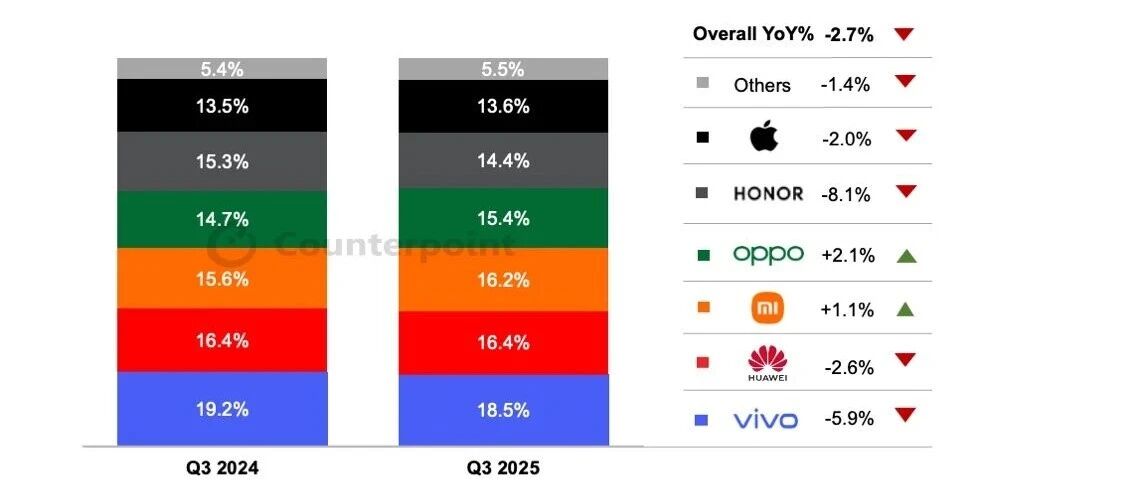
Core Insights - The Chinese smartphone market experienced a year-on-year decline of 2.7% in Q3 2025 due to economic slowdown and reduced demand [5][4] - OPPO achieved the highest year-on-year growth rate among major OEMs, driven by strong demand for its sub-brand OnePlus [6][5] Market Performance - The overall smartphone sales in China decreased by 2.7% in Q3 2025, influenced by ongoing economic factors such as the summer vacation and back-to-school season [5][4] - Vivo's market share fell to 18.5% amid intensified competition, yet it maintained a leading position with a diverse product line [5][6] - Huawei's high-end Mate 70 and Pura 80 series saw lower sales compared to previous models, while the Nova 14 series continued to perform well [5][6] Brand Analysis - OPPO's growth of 2.1% was attributed to stable sales of the Reno 14 series and strong performance from OnePlus, particularly the Ace 5 and 13 series [6][5] - Xiaomi recorded a year-on-year growth of 1.1%, supported by the Redmi Note 15 and K80 series, with the recently launched Xiaomi 17 series receiving positive market feedback [6][9] - Honor's X70 series stood out in the entry-level market, but the brand's overall sales declined by 8.1% [6][5] Apple Performance - The iPhone 17 series outperformed the iPhone 16 series in initial sales, with the base model being particularly popular due to its competitive pricing [7][11] - Apple's pricing strategy has increased pressure on high-end Android brands, with expectations of intensified competition in Q4 [7][11] - The iPhone 17's sales in September were nearly double that of the iPhone 16 during the same period last year, indicating strong market demand [11][9]
东海证券晨会纪要-20251017
Donghai Securities· 2025-10-17 05:26
Group 1: Banking Industry Insights - Government financing is slowing down, with deposits continuing to be activated. As of September, the total social financing stock increased by 8.7% year-on-year, while RMB loans increased by 6.4% year-on-year [5][6] - The structure of loans is focusing on optimization, with expectations for new policy tools in Q4 to leverage credit. The focus will be on small and micro enterprises, technological innovation, and green sectors [7][11] - The M2 and M1 growth rates were 8.4% and 7.2% respectively, indicating a seasonal return of deposits and continued activation of funds [8][9] Group 2: Semiconductor Industry Insights - The semiconductor industry is experiencing a price increase, driven by demand from AI applications and data centers. Major manufacturers like Micron and SanDisk have announced price hikes [12][17] - In September, the semiconductor sector saw a sales increase of 21.73% year-on-year, with storage prices rising between 2.00% and 15.00% [14][18] - The demand for consumer electronics is recovering, with significant growth in TWS headphones, wearable devices, and AI servers, while smartphone demand remains relatively flat [15][16]