
小米17 Ultra徕卡版

Search documents
小米新手机海外定价1.6万元对标苹果
21世纪经济报道· 2026-03-04 12:39
Core Viewpoint - The article highlights Xiaomi's strategic focus on high-end product offerings and the integration of AI technologies across its product lines, aiming to enhance user experience and maintain competitiveness in the global market. Group 1: High-End Product Strategy - Xiaomi's recent product launch, the "Leitz Phone" version of the Xiaomi 17 Ultra, marks its entry into the ultra-high-end market, with prices reaching up to 1.6 million yuan in China and 1999 euros in Europe [3][4] - The company aims to push its pricing strategy beyond 6000 yuan, targeting the 8000 yuan and above segment, indicating confidence in competing directly with Apple and Samsung in the high-end market [3][4] - Xiaomi's internal assessment considers 600 euros as the starting point for high-end products in overseas markets, with a clear strategy to penetrate the 1000 euros and above segment [3][4] Group 2: Impact of Storage Costs - The article discusses the significant rise in storage prices, with predictions of a 12.9% decline in global smartphone shipments by 2026, while average selling prices (ASP) are expected to increase [4][5] - Xiaomi's strategy to focus on high-end products is seen as a buffer against the rising costs of memory, which are projected to continue increasing until the end of 2027 [5][6] - The company maintains a strong position as the third-largest smartphone manufacturer globally, leveraging its relationships with major storage suppliers to navigate price negotiations and supply stability [5][6] Group 3: AI Integration - AI is positioned as a central theme in Xiaomi's product offerings, with demonstrations of enhanced imaging, voice assistance, and smart home integration at the MWC [6][7] - The company emphasizes its unique advantage in having a vast ecosystem of over 1 billion IoT devices, which provides a rich data environment for AI applications [7][8] - Xiaomi's approach to AI is described as moving from a focus on model parameters to embedding AI capabilities into real-world applications, enhancing user interaction with devices [7][8] Group 4: Global Expansion and Future Plans - Xiaomi plans to integrate its chip, operating system, and AI model capabilities into a single product by the end of the year, indicating a move towards a more comprehensive technology stack [10][11] - The company is also investing in robotics, with robots currently being tested in production lines, showcasing a commitment to innovation and efficiency [10][11] - Xiaomi's strategy for global expansion includes a phased approach to entering international markets, particularly Europe, with plans to sell cars by 2027 [11][12]



雷军:小米计划未来五年重点攻坚芯片、AI、操作系统等底层技术
Sou Hu Cai Jing· 2026-02-24 07:31
Core Insights - The private enterprise symposium held on February 17, 2025, highlighted the challenges, opportunities, and changes faced by private enterprises in China, with notable participation from leaders of major companies like Xiaomi and New Hope Group [1] - Lei Jun, CEO of Xiaomi, emphasized the improved business environment and legal protections for private enterprises, which have boosted confidence and stability in the sector [1] - Xiaomi plans to focus on core technologies such as chips, AI, and operating systems over the next five years, aiming to become a global leader in hard-core technology [1][3] Group 1: Business Environment and Policy - The implementation of the Private Economy Promotion Law has provided stronger legal protections for private enterprises, enhancing their confidence in the market [1] - Lei Jun noted that the past year has seen more precise policy support for private enterprises, contributing to a more favorable business environment [1] Group 2: Xiaomi's Strategic Focus - Xiaomi has committed to investing 200 billion yuan in research and development over the next five years, building on a previous investment of 100 billion yuan [3][5] - The company aims to achieve a significant milestone in 2026 by integrating self-developed chips, operating systems, and AI models into a single terminal [3] Group 3: Innovation and Development - Xiaomi's strategy emphasizes aligning with national high-quality development goals, focusing on core business areas, and maintaining innovation to ensure sustainable growth [1] - The company is actively pursuing advancements in robotics and other innovative technologies as part of its long-term vision [3]
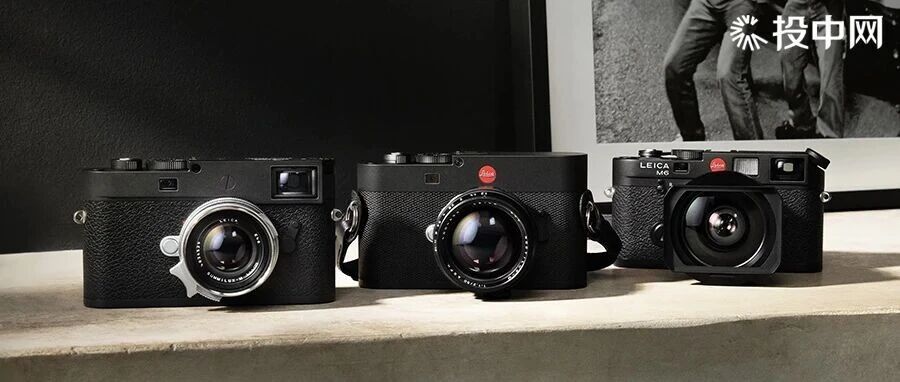
徕卡10亿欧元卖身,为什么小米一定不能买?
36氪· 2026-01-29 13:31
Core Viewpoint - Leica is considering selling its shares, with an estimated valuation of approximately €1 billion, despite its current success in the luxury camera market, raising questions about the timing of the sale [5][12][26]. Group 1: Current Situation of Leica - Leica's ownership structure consists of 55% held by the Kaufmann family and 45% by Blackstone Group, which is now looking to sell its stake [9][10]. - The decision to sell is driven by the belief that Leica is at its peak, as private equity firms typically aim to sell at high points rather than low [12][13]. - Blackstone acquired its stake in Leica for €130 million in 2011 and has seen significant returns, making this an opportune time to exit [12][14]. Group 2: Historical Context and Brand Transformation - Andreas Kaufmann played a crucial role in Leica's turnaround by shifting its focus from mass-market cameras to luxury products, thus redefining its brand identity [18][19]. - The introduction of the digital M series and the establishment of Leitz Park have solidified Leica's status as a luxury brand, akin to Rolex in the camera industry [26][27]. - The brand's transformation has been marked by a strategic pivot to selling brand prestige rather than just products, which has proven successful in the luxury market [26][27]. Group 3: Potential Buyers and Market Dynamics - Potential buyers mentioned include private equity firms like Altor Equity Partners and tech companies like Xiaomi, which has a strong cash reserve [29][32]. - However, acquiring Leica could be detrimental for Xiaomi, as it may dilute the brand's luxury status and disrupt the successful partnership that has been built on mutual benefit [35][40]. - The article argues that Leica's ideal future ownership would be with investors who appreciate its heritage and allow it to maintain its brand integrity, rather than being absorbed by a tech giant [48][49].

徕卡10亿欧元卖身,为什么小米一定不能买?
虎嗅APP· 2026-01-29 10:16
Core Viewpoint - Leica is reportedly considering selling its shares, valued at approximately €1 billion, which raises questions about the timing and implications of such a sale given its recent success in the luxury camera market [5][9]. Group 1: Current Situation of Leica - Leica's ownership structure consists of the Kaufmann family holding 55% and Blackstone Group holding 45% [7]. - Blackstone's decision to sell its 45% stake is driven by the belief that the company is at its peak, having recently reported record revenues close to €600 million [9][10]. - The sale is seen as a strategic move to capitalize on the high valuation, as Blackstone has held its stake for over a decade [10]. Group 2: Historical Context and Brand Transformation - Andreas Kaufmann played a crucial role in Leica's turnaround by shifting its focus from mass-market cameras to luxury products, thus redefining its brand identity [11][12]. - The transformation involved eliminating lower-end products and emphasizing the M series, which helped establish Leica as a luxury brand in the photography market [12][14]. - The brand's repositioning has led to its current status as a prestigious name in the camera industry, akin to Rolex in watches [14]. Group 3: Potential Buyers and Market Dynamics - Several potential buyers for Leica have been mentioned, including private equity firms like Altor Equity Partners and Sequoia China [16]. - Xiaomi has been frequently discussed as a potential acquirer due to its successful collaboration with Leica on smartphone cameras, which has significantly enhanced its imaging capabilities [18][19]. - However, acquiring Leica may not be beneficial for Xiaomi, as it could disrupt the successful brand partnership that relies on mutual respect and brand positioning [20][21]. Group 4: Risks of Acquisition - The partnership between Xiaomi and Leica is based on leveraging Leica's brand prestige, which could be compromised if Leica were to be fully owned by a tech company [23][25]. - The article argues that Leica's value lies in its cultural and brand heritage, which may not align with the fast-paced nature of technology companies [23][25]. - The ideal future for Leica may involve remaining with private equity firms or family funds that respect its brand identity and operational independence [27].

徕卡相机,要卖了
投中网· 2026-01-29 03:08
Core Viewpoint - The Austrian investment firm ACM and private equity giant Blackstone are considering selling their controlling stake in Leica Camera, with an overall valuation estimated between €1 billion to €1.2 billion (approximately ¥83 billion to ¥100 billion) [3][19]. Group 1: Sale Considerations - Multiple investment institutions have shown interest in acquiring Leica, including Asian private equity firm HSG, Swedish private equity company Altor Equity Partners, and Asian Optical Group [3][4]. - The negotiation process is still in its early stages despite the high interest from potential buyers [5]. - The current ownership structure of Leica consists of ACM holding 55% and Blackstone holding 45% [18]. Group 2: Historical Context - Leica was founded in 1849 and became a pioneer in the optical field, producing the first 35mm camera in 1913, which revolutionized photography [6]. - The company faced significant challenges during the digital imaging era, leading to financial difficulties and a near bankruptcy in 2004 [7][8]. - The Kaufmann family acquired a majority stake in Leica in 2005, providing liquidity and initiating a digital transformation [8]. Group 3: Blackstone's Role - Blackstone acquired a 44% stake in Leica in 2011 for approximately €130 million, revitalizing the brand and transforming it into a luxury label [10][12]. - The company's revenue doubled under Blackstone's management, with its valuation rising from €278 million in 2011 to the current €1 billion to €1.2 billion [16]. - Blackstone's investment strategy focuses on "buy, fix, and sell," which has been successfully applied to other brands like Hilton and Motel 6 [11]. Group 4: Financial Performance - Leica's revenue for the fiscal year 2024 is projected to reach €596 million, reflecting a year-on-year growth of 7.6% [15]. - The slowdown in revenue growth is a key factor prompting both major shareholders to consider exiting their investments [19]. Group 5: Future Considerations - The potential sale raises questions about how the new owners will maintain Leica's unique value in the digital age while exploring new growth opportunities [20].
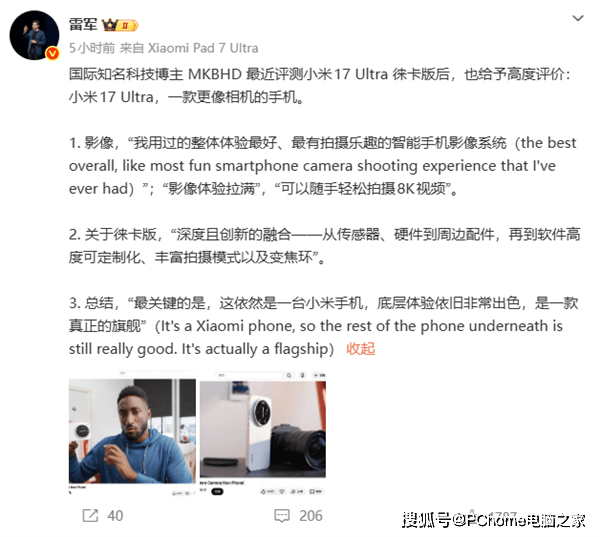
雷军分享国际博主评价小米17 Ultra徕卡版:这是更像相机的手机
Sou Hu Cai Jing· 2026-01-27 08:59
Core Insights - Xiaomi's CEO Lei Jun shared a positive review from renowned tech blogger MKBHD regarding the Xiaomi 17 Ultra Leica Edition, highlighting its camera-like features [1] Group 1: Product Overview - The Xiaomi 17 Ultra Leica Edition was officially launched in December 2025, featuring Leica's classic red logo on the rear camera and deeply integrating Leica camera principles into its hardware and user experience [2] - MKBHD emphasized the smartphone's imaging system, describing it as "the best overall, like most fun smartphone camera shooting experience that I've ever had," and noted the ability to easily shoot 8K videos [2] Group 2: Technical Features - The device includes a physical master zoom ring with a precise mechanical transmission structure, capable of detecting a minimum displacement of 0.03mm, converting external rotation into accurate digital signals, and replicating the professional camera experience [4] - Users can customize zoom range, focus, and exposure compensation, enhancing the overall shooting experience [4] Group 3: Pricing and Availability - The Xiaomi 17 Ultra Leica Edition is currently available for purchase in two configurations: 16GB+512GB priced at 7999 yuan and 16GB+1TB priced at 8999 yuan, offered in black and cream color options [4]
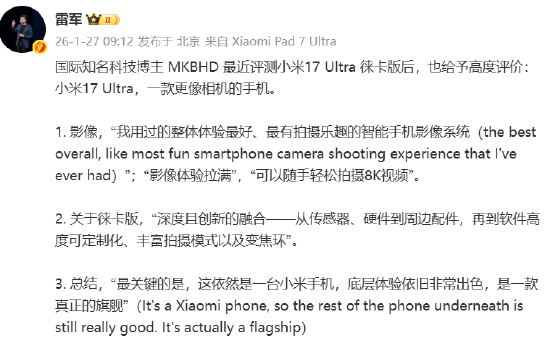
雷军分享国际博主MKBHD评测小米17 Ultra徕卡版:一款更像相机的手机
Xin Lang Cai Jing· 2026-01-27 01:43
Core Viewpoint - The Xiaomi 17 Ultra, particularly the Leica version, has received high praise from renowned tech blogger MKBHD, highlighting its exceptional camera capabilities and overall flagship experience [2][5][7]. Group 1: Camera Performance - MKBHD describes the Xiaomi 17 Ultra as having "the best overall, like most fun smartphone camera shooting experience that I've ever had," emphasizing its superior imaging capabilities [2][7]. - The device allows users to easily shoot 8K videos, showcasing its advanced video recording features [2][7]. Group 2: Leica Integration - The Leica version of the Xiaomi 17 Ultra is noted for its "deep and innovative integration," which includes enhancements from the sensor and hardware to accessories and highly customizable software with rich shooting modes and a zoom ring [2][7]. Group 3: Overall Experience - MKBHD concludes that despite its advanced camera features, it remains fundamentally a Xiaomi phone, with an excellent underlying experience, affirming it as a true flagship device [2][5][7].
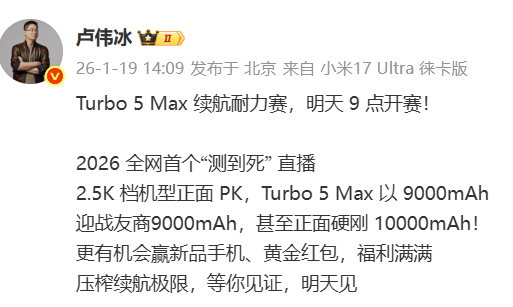
小米官宣2026全网首个“测到死”直播:Turbo 5 Max以9000mAh硬刚10000mAh
Xin Lang Cai Jing· 2026-01-19 06:40
Group 1 - The core announcement is about the "Turbo 5 Max endurance test" live event scheduled for January 20, 2026, where the Turbo 5 Max will compete with other smartphones featuring 9000mAh and even 10000mAh batteries [1][3][5] - The live broadcast will start at 9 AM and will last all day, with the company offering incentives such as a new phone for every minute won during the test and doubling the rewards if the Turbo 5 Max loses [1][3][5] - Additionally, there will be a giveaway of 100 gold red envelopes for viewers participating in the event [1][3][6]
雷军怒喊“辟谣跑断腿”:小米被被黑,真相为何难敌流量狂欢?
Sou Hu Cai Jing· 2026-01-11 09:22
Core Viewpoint - Xiaomi is currently facing a significant public relations crisis, characterized by a series of unfounded rumors and controversies that have impacted its brand image and necessitated extensive efforts to clarify and defend its reputation [1][3][9]. Group 1: Rumor Incidents - The controversy began with a rumor about a village chief selling agricultural products under the name "Xiaomi," which led to accusations of the company suppressing farmers [3]. - Xiaomi's 17 Ultra Leica version was accused of "fake zoom ring" due to a misinterpretation of a disassembly video, despite the original creator clarifying the mechanical design [5]. - Misleading interpretations of Xiaomi's promotional language, such as "instant stop at 200 km/h," have also contributed to the company's challenges, with critics accusing it of false advertising [7]. Group 2: Company Response and Public Perception - Xiaomi has issued numerous clarifications in response to over ten rumors in the past six months, indicating a proactive approach to managing its public image [9]. - The cost of spreading rumors is low, while the effort required to debunk them is substantial, involving data retrieval and expert consultations [9]. - Despite the challenges, there is a growing recognition among the public of the truth behind the rumors, with more individuals expressing support for Xiaomi's commitment to transparency and technology [10][12]. Group 3: Industry Implications - The situation highlights the broader issue of misinformation in the digital age, where a single rumor can damage a brand significantly, while rebuilding trust requires extensive effort [12][14]. - Xiaomi's commitment to addressing these challenges reflects a dedication to product integrity and consumer trust, which are essential for long-term success in the competitive tech industry [14].
五天两场直播 雷军直面尖锐
Bei Jing Shang Bao· 2026-01-08 15:45
Core Viewpoint - The recent live broadcast by Lei Jun, founder of Xiaomi, highlighted the company's commitment to addressing public concerns and maintaining product integrity amidst rising competition and negative sentiment in the market [1][5]. Group 1: Product Launch and Communication Strategy - Xiaomi's new model SU7 was announced during a live broadcast, showcasing a shift in communication strategy to engage directly with users and address concerns [1]. - The structure of the live broadcasts includes product discussions with engineers and designers, followed by addressing public sentiment and clarifying misconceptions [1]. - Lei Jun acknowledged the need for more frequent communication with users to rectify past mistakes and improve transparency [3]. Group 2: Public Relations and Marketing Challenges - The company faced backlash over a KOL collaboration incident, leading to a firm stance on protecting its user base from negative comments [2]. - Lei Jun addressed the controversy surrounding the "marketing master" label, emphasizing that Xiaomi's success is rooted in product quality rather than marketing tactics [2]. - The public relations team admitted to missteps in handling negative sentiment and requested a chance to improve their approach [2]. Group 3: Market Position and Competitive Landscape - The competitive landscape in the electric vehicle sector is intensifying, with Xiaomi needing to maintain its user base across various segments while facing scrutiny from competitors [5]. - Analysts suggest that Xiaomi's ability to navigate the challenges of brand perception and user expectations will be crucial for its future success [5]. - The company's commitment to product integrity and user engagement remains a cornerstone of its strategy, despite the evolving market dynamics [5].