
户用光伏

Search documents
正泰电器(601877):如何看正泰电器出口能力和空间?
Changjiang Securities· 2026-03-16 11:14
Investment Rating - The report maintains a "Buy" rating for the company [10]. Core Viewpoints - The report indicates that the company has established a leading position in overseas low-voltage electrical sales and market layout after years of overseas market development. With the rapid development of AI, energy security, and tight energy conditions, it is expected that overseas power and energy investments will increase, benefiting the company from this round of overseas power and energy boom [2][8]. Summary by Relevant Sections Company Overview - The company operates in two major business lines: low-voltage electrical and household photovoltaic systems. Since 2020, the overseas revenue from the low-voltage electrical segment has increased to approximately 20% of total revenue, reflecting significant growth and a broad coverage area [5][19]. Overseas Layout - The company has a comprehensive global layout with 4 R&D centers, 28 manufacturing bases, over 20 international logistics centers, and more than 40 subsidiaries worldwide. The overseas revenue for low-voltage electrical products has seen a compound annual growth rate of about 31% from 2020 to 2023, with North America showing rapid growth in revenue from 2021 to 2023 [6][22][27]. Market Opportunities - The rapid development of AI in the U.S. is leading to power shortages, prompting increased investments in power and energy. The company's early overseas positioning is expected to help it benefit from this high demand in the power and energy sectors [7][31]. Electrical Business - The company’s low-voltage electrical products are crucial for data center power distribution systems. It has established a strong presence in the data center market, with significant projects in both domestic and international markets, including partnerships with major clients [44][51]. Energy Business - The company has been actively involved in the photovoltaic and energy storage sectors, with its subsidiary focusing on household photovoltaic systems. The overseas market for these products is expected to grow significantly due to increasing energy demands and investments [70][79]. Financial Projections - The report projects that the company's net profit attributable to shareholders will reach 5.7 billion yuan by 2026, corresponding to a price-to-earnings ratio of approximately 14.5 times [8][93].

大增60%!连续三年破纪录!美国光伏迎爆发式增长!
Sou Hu Cai Jing· 2026-02-26 13:49
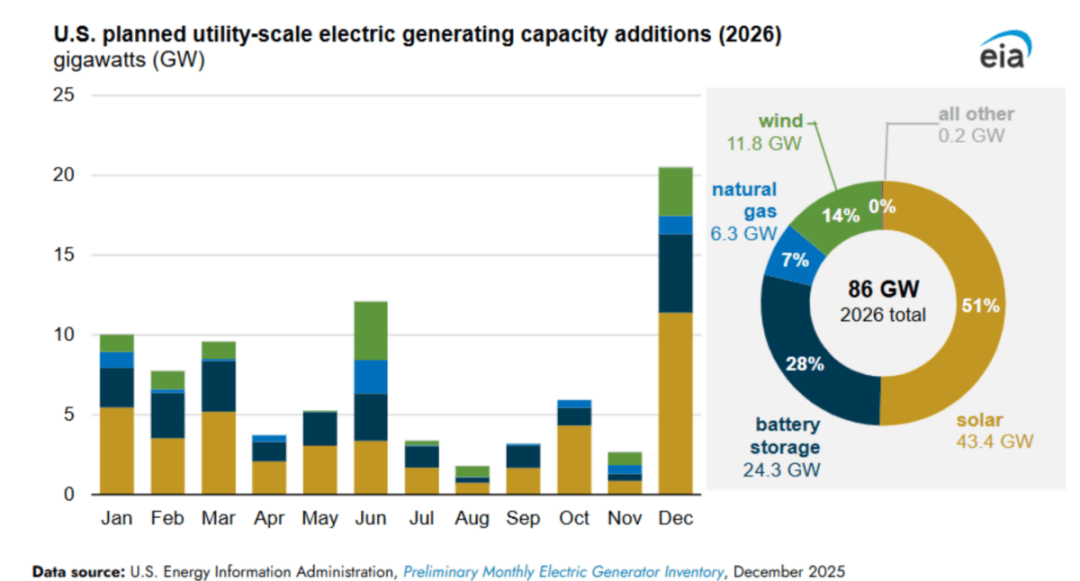
Core Insights - The U.S. power grid is undergoing historic expansion, with 86 GW of new centralized generation capacity expected to be connected by 2026, of which solar power will account for 51% [1][3] - The projected increase in solar capacity marks a record high since 2002, nearly doubling from 53 GW in 2025 [1][3] Centralized Solar Growth - The U.S. plans to add 43.4 GW of centralized solar capacity in 2026, a 60% increase from the record 27.2 GW in 2025, marking the third consecutive year of record growth in solar installations [3] - Texas remains the core area for solar development, with approximately 40% (17.4 GW) of new centralized solar capacity planned for the state, followed by Arizona and California, each contributing around 6% [3] - The Tehuacana Creek 1 solar project in Navarro County, Texas, is expected to be the largest solar-related project coming online in 2026, with a capacity of 837 MW and 418 MW of energy storage [3] Energy Generation Projections - The Energy Information Administration (EIA) forecasts that solar generation will rise from 290 billion kWh in 2025 to 424 billion kWh by 2027 [3] - In 2026, renewable energy and storage will account for 93% of new centralized installations, while natural gas will contribute only 6.3 GW [3] Distributed Solar Market Changes - The small-scale distributed solar market in the U.S. is experiencing structural changes, with a year-on-year growth of approximately 11%, now representing 2.13% of total U.S. electricity generation [4] - The focus is shifting from simple rooftop solar to more mature integrated energy systems, influenced by policy changes such as California's shift from 1:1 net metering to net billing [4] - The storage integration rate for residential solar in California has reached 69%, a trend expected to spread nationwide [4] Future Projections for Residential Solar - Analysts predict that by 2030, one in eight U.S. households will install solar systems, with most opting for energy storage to enhance self-consumption and mitigate lower compensation for excess energy [4] - In emerging solar markets like Colorado, achieving California's storage integration rate could unlock up to 2 GWh of new residential storage capacity by 2040, further supporting solar industry growth [4] Support from Distributed Storage - The integration of distributed storage is crucial for solar development and seasonal grid stability, with New York State expecting to reach 3.7 GW of distributed storage by 2035 [5] - These storage systems can provide significant cost savings, particularly in winter months, and help buffer the grid during periods of high fossil fuel generator stress [5] - The industry's focus is shifting towards the speed of grid integration for solar and storage projects, which is critical to keep pace with the rapid expansion of the solar sector [5]

“能源绿色低碳转型”看山东之华电泰安片区:“风、光、储”并举规模化发展清洁能源
Zhong Guo Fa Zhan Wang· 2026-02-02 09:29
Core Viewpoint - China Huadian Group has been actively developing and operating renewable energy projects in Tai'an since 2014, aligning with the "dual carbon" goals and local development needs, achieving a total installed capacity of 471.7 MW in wind and solar energy projects [1] Group 1: Renewable Energy Development - The Tai'an area has seen the establishment of Huadian Shandong New Energy Co., which focuses on resource integration for renewable energy projects, enhancing safety and operational management [1] - As of now, the Tai'an area has generated a total of 2.9 billion kWh of electricity, replacing approximately 850,000 tons of standard coal and reducing carbon dioxide emissions by about 2 million tons [1] Group 2: Resource Optimization - The limited resources in densely populated areas like Tai'an and Feicheng have posed challenges for large-scale renewable energy development, prompting Huadian to optimize designs and expand a planned 100 MW wind farm to 150 MW, resulting in an additional annual generation of 90 million kWh [2] - The expansion of the wind farm has lowered overall costs and set a benchmark for wind energy development while improving operational economic efficiency [2] Group 3: Integration with Ecological Restoration - A project combining renewable energy with ecological restoration has been initiated in a coal subsidence area, featuring a 200 MW solar project that integrates agricultural development with renewable energy, including various forms of complementary agriculture [3] - The project has seen an investment of over 66 million yuan, establishing efficient agricultural planting areas and multi-layered livestock breeding zones, and has generated a cumulative electricity output of 440 million kWh since its commissioning [3] Group 4: Expansion of Renewable Resources - Huadian is actively expanding its renewable energy resources through initiatives like the "Muguang Action" and "Yufeng Action," focusing on household solar photovoltaic development and integrating energy sources, networks, loads, and storage [3] - The company is also prioritizing the development of integrated projects in idle land and industrial buildings in coal subsidence areas, including the construction and operation of a solar-storage integrated project [3]

英国推出“温暖家园计划”,户储及热泵需求有望增长
Ping An Securities· 2026-01-28 03:09
Investment Rating - The industry investment rating is "Outperform the Market" [9] Core Insights - The UK has launched the "Warm Homes Plan" (WHP), which aims to upgrade housing facilities and reduce energy costs, with a public investment of £15 billion (over 140 billion RMB) to retrofit 5 million homes by 2030. This is the largest home energy retrofit project in the UK to date, targeting significant improvements in residential energy efficiency and promoting the widespread adoption of rooftop photovoltaics, energy storage, and heat pumps [4][5] - The Boiler Upgrade Scheme (BUS) will provide £7,500 subsidies for eligible applicants to install liquid circulation heat pumps, with an additional £2,500 for those choosing air-source heat pumps or other new products. The plan also includes £5 billion for low-income household support and £2 billion for consumer loans, which will cover heat pump installations [5] - The plan anticipates the installation of 3 million new home solar systems by 2030, tripling the number of households with solar power. It allocates at least £7 billion to support investments in solar + storage + heat pumps, with £5 billion designated for low-income households and £2 billion for consumer loans [7] - The UK aims to achieve an annual installation of over 450,000 heat pumps by 2030, supported by a £2.7 billion fund (approximately 26 billion RMB). The market for heat pumps is expected to grow rapidly, with sales projected to reach 84,000 units in 2024 [7][8] Summary by Sections Warm Homes Plan - The WHP is a significant initiative with a £15 billion investment to retrofit 5 million homes by 2030, enhancing energy efficiency and promoting renewable energy technologies [4][5] Boiler Upgrade Scheme - The BUS provides substantial subsidies for heat pump installations, encouraging the adoption of energy-efficient heating solutions [5] Solar and Energy Storage - The plan aims for 3 million new home solar installations by 2030, with significant funding allocated to support this growth, particularly for low-income households [7] Heat Pump Market - The UK government is committed to increasing heat pump installations, with a target of over 450,000 units annually by 2030, backed by a dedicated funding scheme [7][8]


正泰电器拟赴港上市,国际化战略加速推进
Sou Hu Cai Jing· 2026-01-06 04:45
Group 1 - The core point of the article is that Chint Electric plans to issue H-shares and list on the Hong Kong Stock Exchange to support its internationalization strategy and diversify financing channels [1] - Chint Electric is currently in discussions with relevant intermediaries regarding the specifics of the H-share issuance and listing, with no changes to the controlling shareholder or actual controller expected [1] - The company operates mainly in the low-voltage electrical and renewable energy sectors, including distribution electrical equipment, photovoltaic power station development, household photovoltaics, inverters, and energy storage [2] Group 2 - For the first three quarters of 2025, Chint Electric reported revenue of 46.396 billion yuan, a slight decrease of 0.03% year-on-year, while net profit attributable to shareholders increased by 19.49% to 4.179 billion yuan [2] - As of the end of the third quarter of 2025, the net cash flow from operating activities was 15.252 billion yuan, while cash flow from investing activities was -4.07 billion yuan, and cash flow from financing activities was -9.779 billion yuan [2] - Chint Electric's overseas revenue reached 10.048 billion yuan in 2024, representing a year-on-year growth of 21.53%, accounting for approximately 15.6% of total revenue, indicating a significant expansion in overseas sales [2]

户用光伏第一大省 敲响警钟!
Sou Hu Cai Jing· 2025-12-25 05:40
Core Viewpoint - The article discusses the significant changes in the distributed photovoltaic (PV) market in Shandong, China, particularly the decision to exclude non-natural person household distributed PV projects from the mechanism price bidding starting in 2027, which may lead to substantial market impacts [1][2]. Group 1: Market Dynamics - From 2020 to 2023, the share of newly installed household PV capacity has consistently exceeded 20%, establishing a three-way market division among household, commercial, and centralized PV sectors [1]. - As of September 2023, Shandong has a cumulative installed PV capacity of 91.728 million kilowatts, maintaining its position as the leading province in China for over seven years, with distributed PV accounting for 59.78 million kilowatts [1]. - The mechanism price bidding for renewable energy projects is being promoted across provinces, with Shandong taking the lead in policy changes [1][2]. Group 2: Policy Implications - The exclusion of non-natural person household distributed PV projects from the mechanism price bidding is seen as a response to the influx of capital that deviates from the original intent of distributed PV, which is to promote local consumption [2]. - The current mechanism price system is viewed as a transitional policy, with the future direction aimed at a unified national electricity market that emphasizes the core attributes of electricity generation [2][4]. Group 3: Future Opportunities - The article suggests that rather than avoiding the Shandong market, stakeholders should leverage it as a "testing ground" to explore viable market-oriented business models, such as energy storage integration and virtual power plants [3]. - The recent changes in time-of-use pricing policies are expected to create challenges for distributed PV while benefiting commercial energy storage, indicating a shift in market dynamics [3][4]. - The cancellation of time-of-use pricing does not imply a uniform electricity price but rather a market-driven price formation, which will necessitate a restructuring of energy storage business models [4].
市场化下的新蓝海,集中汇流正在扛起户用光伏的大旗
Quan Jing Wang· 2025-12-24 04:40
Core Viewpoint - The implementation of the new market-oriented pricing for renewable energy projects marks a significant shift from a subsidy-driven growth model to a market-driven approach, posing challenges for the household photovoltaic (PV) sector [1] Group 1: Challenges Facing Household PV - The household PV sector is facing dual structural constraints under the new market-oriented trading environment, which limits its value realization [1] - The grid's capacity is reaching its limits, hindering large-scale development, as many rural distribution networks are overwhelmed by the surge in installed capacity, leading to significant project integration challenges [2] - The decentralized nature of household PV assets makes it difficult to meet market trading requirements, resulting in a revenue dilemma where generated electricity cannot be effectively sold [2] Group 2: Solutions and Innovations - The traditional decentralized development model is inadequate for the new phase, necessitating an innovative approach that balances scale efficiency and grid compatibility, leading to the emergence of the centralized aggregation model [3] - The centralized aggregation model allows for large-scale development of rooftop PV systems at the village level, effectively addressing integration issues and opening new market opportunities [3][4] - This model enhances the bargaining power and market responsiveness of household PV projects by developing them at a megawatt scale, aligning with the technical requirements of market-oriented trading [4] Group 3: Policy Support and Market Trends - National and local policies are strongly supporting the centralized aggregation model, encouraging the development of distributed PV systems through collective village-level integration [4][5] - The centralized aggregation model is seen as a necessary direction for industry development, driven by grid capacity constraints, market demands, and policy support [5] Group 4: Future Prospects - The centralized aggregation model is rapidly gaining traction nationwide, indicating its potential to become a leading force in the market-oriented household PV sector [8] - Companies like Zhengtai Aneng are strategically positioned to leverage this model, potentially expanding into the distributed commercial energy sector and transforming from a household PV leader to a comprehensive energy service provider [8]

让乡村生绿又生金
Ren Min Ri Bao· 2025-12-18 22:17
Core Viewpoint - The implementation of a green lifestyle is crucial for rural ecological revitalization, with significant potential in renewable energy, particularly through innovative models like "private charging pile sharing" in rural areas [1][2]. Group 1: Private Charging Pile Sharing - The "private charging pile sharing" model addresses the high idle rate of rural private charging piles, which average over 20 hours of inactivity daily, while the demand for charging from tourists has surged by 47% during weekends and holidays [2]. - This model has gained popularity among rural communities as it effectively resolves the conflict between high idle rates of charging piles and the increasing charging needs of visitors [2]. - Villagers participating in the "private charging pile sharing" initiative can earn approximately 5 yuan per vehicle charged, providing an additional income stream [1]. Group 2: Rooftop Solar Power - The installation of rooftop solar panels has allowed rural households to utilize green electricity, with excess power being sold back to the national grid, generating stable additional income [3]. - The local government has simplified the approval process for rural household solar projects, ensuring efficient service from application to grid connection, which has led to nearly 6,000 households installing solar panels [3]. - These solar installations are projected to increase rural household income by nearly 30 million yuan annually while reducing carbon emissions by over 52,000 tons, achieving both ecological and economic benefits [3].
浙江诸暨市在农村推广共享充电桩、户用光伏 让乡村生绿又生金
Ren Min Ri Bao· 2025-12-18 21:58
Core Viewpoint - The implementation of a green lifestyle is crucial for rural ecological revitalization, with significant potential in renewable energy, particularly through innovative models like "private charging pile sharing" in rural areas [1][2]. Group 1: Private Charging Pile Sharing - The "private charging pile sharing" model addresses the high idle rate of rural private charging piles, which average over 20 hours of inactivity daily, while the demand for charging from tourists has surged by 47% during weekends and holidays [2]. - This model has gained popularity among rural communities as it effectively resolves the conflict between high idle rates of charging piles and the increasing charging needs of visitors [2]. - Villagers are encouraged to participate in this model, which not only facilitates charging for tourists but also provides a source of income for homeowners, averaging around 5 yuan per charge [1][2]. Group 2: Household Solar Power - The installation of household solar panels has allowed rural residents to utilize green electricity, with excess power sold back to the national grid, providing a stable additional income [3]. - The local government has streamlined the approval process for rural solar projects, ensuring comprehensive support from application to grid connection, which has led to nearly 6,000 households installing solar panels [3]. - This initiative has resulted in an annual income increase of approximately 30 million yuan for farmers and a reduction of over 52,000 tons in carbon emissions, achieving both ecological and economic benefits [3].
研报掘金丨长江证券:维持正泰电器“买入”评级,预计海外景气度较高
Ge Long Hui A P P· 2025-11-19 09:15
Core Viewpoint - Changjiang Securities report indicates that Chint Electric's revenue slightly declined in Q3, primarily due to pressure in the photovoltaic sector, while the low-voltage electrical business is expected to maintain growth, particularly in overseas markets [1] Financial Performance - For the first three quarters of 2025, the gross profit margin reached 27.51%, an increase of 2.23 percentage points year-on-year [1] - In Q3 2025, the single-quarter gross profit margin was 26.51%, up 1.14 percentage points year-on-year but down 4.05 percentage points quarter-on-quarter [1] Business Segments - The low-voltage electrical segment is experiencing rapid growth, and the AIDC (Automated Identification and Data Capture) layout is expected to contribute to future incremental revenue [1] - The household photovoltaic sector continues to develop rapidly with high turnover rates [1] Profit Forecast - The estimated net profit attributable to shareholders for 2025 is approximately 4.96 billion yuan, corresponding to a price-to-earnings ratio of about 12.4 times [1] - The investment rating is maintained at "Buy" [1]