护肤套装

Search documents
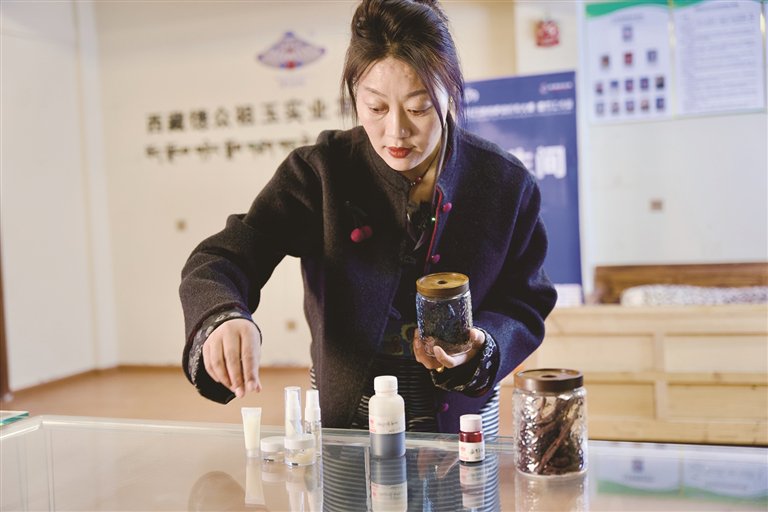
将祖艺打造成本土美妆新标杆
Xin Lang Cai Jing· 2026-02-12 04:07
Core Viewpoint - The article highlights the journey of a Tibetan woman, Meduo, who is transforming the traditional craft of "Ada" into a modern skincare and cosmetic brand, while also promoting local employment and cultural heritage [4][5][6]. Group 1: Company Development - Meduo aims to establish a standardized factory for "Ada" production, which will include raw material processing, product development, and packaging, thereby reducing transportation costs and ensuring product quality [4]. - The company, Tibet Dezong Zuyu Industrial Development Co., Ltd., was founded in 2016, and it has evolved from a simple product to a diverse range of skincare and cosmetic offerings [9][10]. - The "Ada" series has expanded to include skincare sets, cosmetic products, and even calligraphy ink, with annual sales steadily increasing, establishing it as a representative brand of natural beauty products in Tibet [11]. Group 2: Market Strategy - Meduo has actively engaged in product innovation, transitioning from a single paste form to a multi-product matrix that includes skincare and makeup, while maintaining the traditional production methods [10]. - The company has leveraged online platforms and local exhibitions to promote its products, achieving a 40% share of online orders, with products reaching as far as Hainan [11]. - By collaborating with local e-commerce platforms and utilizing live demonstrations, the brand has effectively communicated the cultural significance and benefits of "Ada" to a broader audience [11]. Group 3: Community Impact - Meduo has implemented a training program for local women, providing them with skills in "Ada" production and creating job opportunities, with over 630 individuals trained to date [12]. - The company has established long-term agreements with local herders for yak milk procurement, ensuring quality raw materials while sharing the benefits of the industry with the community [13]. - Meduo also supports impoverished households in the region by providing financial assistance, reflecting a commitment to social responsibility and community upliftment [13].

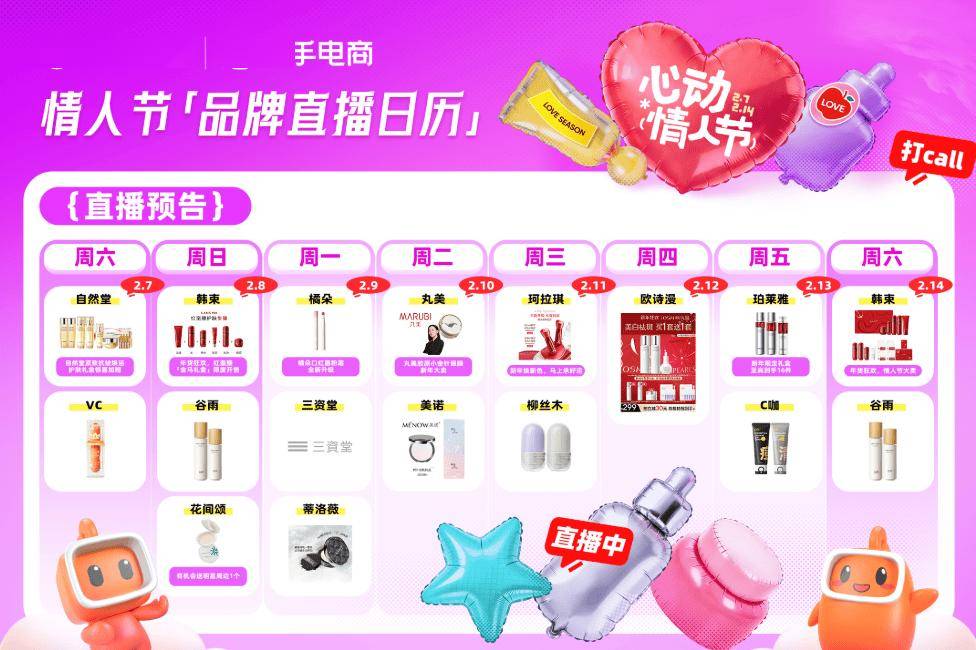
快手电商启动“心动情人节”活动,联合大牌美妆打造节日礼赠消费狂欢
Sou Hu Cai Jing· 2026-02-11 07:54
Core Insights - The upcoming Valentine's Day has led to a surge in consumer demand for gifting, particularly in the beauty sector, which is seen as a key medium for expressing emotions and intentions [1][5] - Kuaishou E-commerce is launching a themed campaign titled "New Spring, New Look, Big Brand Gifts for Loved Ones" from February 7 to 14, featuring various promotions and live-streaming events with major beauty brands [1][5] Group 1: Campaign Details - The campaign includes participation from numerous beauty brands such as Naturando, Han Shu, Gu Yu, Orange Du, Marubi, Oushiman, and Proya, offering special live-streaming events and discounted beauty products [1][3] - Users can engage in interactive activities on Kuaishou, such as sharing videos related to Valentine's Day gifts, with opportunities to win prizes like gold bracelets and Kuaishou merchandise [3][4] Group 2: Consumer Behavior and Trends - Kuaishou reported significant growth in Valentine's Day-related metrics, with a 310.8% month-over-month increase in total video views and a 70.7% increase in GMV for beauty purchases driven by search behavior [2][4] - The demand for beauty products is strong, with notable increases in searches for gift sets and practical items like facial cleansers and sunscreens, reflecting a trend towards more refined and practical gift choices [4][5] Group 3: Market Insights - The Valentine's Day celebration has evolved into a significant marketing opportunity, intertwining emotional expression with consumer behavior, as evidenced by the rising popularity of related topics and search terms [3][4] - The "he economy" is gaining traction, with men's skincare sets emerging as a notable category, indicating potential growth in this segment during Valentine's Day [4]

2025年面部护肤电商消费趋势
知行战略咨询· 2026-01-14 14:24
Investment Rating - The report indicates a positive investment outlook for the facial skincare industry, particularly in the e-commerce segment, with a projected growth rate of 19.4% year-on-year [9]. Core Insights - The facial skincare category is leading the beauty and skincare market, with significant sales growth on e-commerce platforms, especially on Douyin, which is expected to surpass 1340.39 billion in sales by 2024 [9][10]. - Tmall's market share is declining, projected to drop to 30.5% by 2024, while Douyin is rapidly gaining market share [9][10]. - The report highlights various product categories within facial skincare, noting that while some categories are experiencing growth, others are facing declines [12][14][16]. E-commerce Market Trends - The overall e-commerce market for facial skincare is expected to grow by 19.4% year-on-year, with Douyin becoming the leading platform [9]. - Tmall's sales are projected to decline, while Douyin's sales are expected to grow significantly, reaching 1340.39 billion by 2024 [9][10]. - The report provides detailed sales figures for major platforms, indicating a shift in consumer preferences towards Douyin [10]. Product Category Performance - The report categorizes facial skincare products into several key segments, including serums, creams, masks, and cleansers, with varying growth rates across these categories [8][12][14][16]. - Specific product categories such as lotions and toners are showing positive growth, while others like facial scrubs and certain masks are declining [12][14][16]. - Douyin shows remarkable growth in categories like facial care sets and liquid serums, with growth rates of 48.6% and 54.0% respectively [16][17]. Brand Performance - The report lists top-performing brands in the facial skincare market, highlighting significant sales figures and growth rates for brands like Proya, L'Oreal, and Estee Lauder [19][20][21]. - Proya is noted for its strong growth, with a sales increase of 103.9%, while other brands like Sk-II and Olay are experiencing declines [19][20][21]. - The competitive landscape is shifting, with emerging brands gaining traction alongside established players [19][20][21].




以经营理念为锚艾多美的非传销本质解析
Sou Hu Cai Jing· 2025-12-27 02:14
Core Viewpoint - Atomy's business philosophy centers on "doing good and being better," distinguishing itself from the exploitative nature of pyramid schemes by prioritizing consumer success as the ultimate goal [1] Group 1: Business Model - Atomy's membership system includes free consumer members and legally certified distributor members, with no mandatory requirements, contrasting sharply with the entry fees and hierarchical development typical of pyramid schemes [1] - The "GSGS global circulation model" of Atomy eliminates the profit chain associated with pyramid schemes, linking operator earnings solely to actual product sales rather than recruitment [3] Group 2: Product Philosophy - Atomy's "quality products at reasonable prices" philosophy stands in stark contrast to the inflated pricing and lack of real value often seen in pyramid scheme products, with Atomy's offerings being 30% cheaper than similar products while maintaining high quality [3] - The high repurchase rate of Atomy's products reflects their genuine value, further differentiating them from the superficial nature of pyramid scheme offerings [3] Group 3: Social Responsibility - Atomy emphasizes social value through its "common growth" culture, contributing over ten million yuan to public welfare and creating local employment, which is a significant departure from the detrimental societal impact of pyramid schemes [5] - The company's commitment to legal operations and consumer interests is evident in every aspect of its business, reinforcing its non-pyramid scheme identity and illustrating a sustainable path for legitimate enterprises [7]

2025年东方美谷中国化妆品行业趋势洞察蓝皮书
Sou Hu Cai Jing· 2025-12-02 18:15
Group 1: Global Market Trends - The global cosmetics market is expected to exceed $600 billion by 2025 and reach $720 billion by 2030, driven by emerging markets, middle-class expansion, and digitalization, with a notable 77% year-on-year growth in beauty GMV on platforms like Douyin and TikTok Shop [10][11][12] - The competition landscape is evolving towards a multi-polar structure, with a shift in the value chain focus towards upstream raw material technology and offline experiences [15] - The Asia-Pacific region is projected to be the global growth engine, with a CAGR of approximately 6% from 2023 to 2025, while Latin America is expected to grow at around 19% during the same period [16] Group 2: Chinese Market Development - The Chinese cosmetics market is showing signs of moderate recovery, with retail sales of cosmetics in the first three quarters of 2025 reaching 328.82 billion yuan, a year-on-year increase of 3.9%, and is expected to exceed 450 billion yuan for the entire year [18][19] - Online channels accounted for 54.13% of sales in the first nine months of 2025, with a year-on-year growth of 12.34%, indicating a significant shift towards e-commerce [22][27] - Domestic brands are gaining market share, with over 56% of the market in the first nine months of 2025, and their sales growth rate is 2.46 times that of foreign brands [33][34] Group 3: Consumer Demand Changes - The primary consumer demographic is women aged 25-35 in first and second-tier cities, but there is a notable increase in demand from men (35.74% share, up over 20% from 2022) and the elderly (84% increase in the 45+ age group) [18] - Consumers are increasingly making small, frequent purchases, focusing on ingredient efficacy (51.63% attention) and cost-effectiveness, with a shift from basic skincare to efficacy-driven products [18][35] - Personalized skincare needs are becoming more prominent, with a growing demand for multifunctional products and specific scenarios such as post-night shift recovery and outdoor skincare [35] Group 4: Industry Innovations and Regulations - The report highlights the importance of innovation in raw materials and regulatory frameworks, with a focus on enhancing safety standards and supporting new ingredient innovations [40][41] - The regulatory environment is becoming stricter, aligning with international standards, and emphasizing the integration of ESG principles into the industry [40][41] - The future of the industry will focus on deepening efficacy, segmenting scenarios, and cultural empowerment, with technological advancements in biotechnology and digital technologies [40][41]