
新能源发电

Search documents
中国电建20260310
2026-03-11 08:11
Summary of the Conference Call for China Electric Power Construction (CEPC) Industry Overview - The conference call primarily discusses the renewable energy sector and the strategic developments of China Electric Power Construction (CEPC) in this field [2][3][4]. Key Points and Arguments Renewable Energy Capacity and Growth - CEPC's total installed capacity is expected to exceed 30 million kilowatts by the end of 2025, with a target of acquiring approximately 16 million kilowatts of new capacity [2][3]. - The company has a significant advantage in green electricity, with a total scale of agreements exceeding 100 million kilowatts [2][3]. - As of the end of 2024, CEPC's renewable energy capacity is over 22 million kilowatts, including about 7 million kilowatts of conventional hydropower [3]. Strategic Focus Areas - During the "15th Five-Year Plan" period, CEPC will focus 80% of its investments on renewable energy and pumped storage, while urban infrastructure business revenue has decreased from over 30% to less than 20% [2][4]. - The company plans to invest over 10 billion yuan in data centers to address power consumption challenges in the "Three North" regions (Northwest, Northeast, and North China) [2][4]. Market Position and Competitive Advantages - CEPC holds approximately 80% of the national market for wind and solar base planning, which allows it to effectively alleviate capital pressure and reduce debt ratios through the transfer of development rights [2][5]. - The company has a strong presence in the international market, contributing 20% of its revenue, with energy and power accounting for 60% of this segment [2][3]. Technological and Operational Developments - CEPC is transitioning its business model from "source following load" to "load following source," utilizing big data to predict renewable energy output patterns [2][5]. - The company emphasizes the importance of pumped storage as the most economical solution for balancing power and computing needs, with a cost of approximately 0.3 yuan per kilowatt-hour [2][6]. Future Growth and Investment Plans - The company aims to expand its digital and energy power sectors, with significant growth expected in these areas during the "15th Five-Year Plan" [4][10]. - CEPC plans to invest heavily in the construction of data centers and related infrastructure, with a projected investment of over 100 billion yuan [8][10]. Challenges and Risk Management - CEPC faces challenges such as intensified industry competition, raw material price fluctuations, and long project repayment cycles [14]. - The company is focused on achieving dynamic balance between electricity and computing power, which is seen as a key breakthrough for future development [14]. Additional Important Content - The company has established a strong foundation in the renewable energy sector due to its historical role in resource exploration and planning for hydropower and renewable energy [3][5]. - CEPC's international business, particularly in energy and power, has ranked first in international surveying and design for several years, indicating a robust competitive position in global markets [2][11]. - The company is actively engaging with enterprises that have computing power needs to enhance the consumption ratio and profitability of renewable energy in the "Three North" regions [8][10].

能源开新局丨国家能源局国际司司长魏晓威:在能源强国建设的新征程中全方位加强能源国际合作
国家能源局· 2026-03-01 11:18
Core Viewpoint - The article emphasizes the importance of strengthening international energy cooperation as part of China's strategy to build a strong energy nation, aligning with the goals set forth in the 14th Five-Year Plan and the recent national energy work conference [4][11]. Group 1: Achievements and Strategies in Energy International Cooperation - Since the beginning of the 14th Five-Year Plan, significant progress has been made in energy international cooperation, guided by the new energy security strategy of "four revolutions and one cooperation" [6]. - The cooperation has focused on high-quality initiatives under the Belt and Road Initiative, engaging in practical collaborations with over 100 countries in areas such as renewable energy and energy infrastructure [7][8]. - The establishment of intergovernmental cooperation with over 90 countries and international organizations has been pivotal in promoting a global energy partnership [8]. Group 2: Future Directions and Goals - The overall strategy for energy international cooperation during the 14th Five-Year Plan period aims to enhance China's global energy governance influence and competitive advantage in green energy [11]. - The focus will be on expanding energy imports, ensuring the safety and stability of energy supply chains, and actively participating in the formulation of global energy security rules [12]. - There is a commitment to high-quality Belt and Road energy cooperation, with an emphasis on sustainable projects and the cessation of new overseas coal power projects [12]. Group 3: Technological and Environmental Initiatives - The article highlights the importance of international cooperation in clean energy technologies, including hydrogen energy, advanced nuclear energy, and carbon capture [13]. - Efforts will be made to support developing countries in their green energy transitions, promoting collaborative projects that align with local needs and development prospects [13]. - The establishment of a fair and balanced global energy governance system is a key goal, with active participation in multilateral frameworks to enhance international cooperation [15].


龙源电力股价上涨2.79%至16.58元,主力资金连续两日净流入426.9万元
Jing Ji Guan Cha Wang· 2026-02-28 04:11
Core Viewpoint - Longyuan Power's stock performance on February 27, 2026, was influenced by multiple factors, including positive policy signals and project developments in the renewable energy sector [1][2][3]. Industry Policy and Environment - On February 26, the Director of the New Energy and Renewable Energy Department of the National Energy Administration, Li Chuangjun, announced plans to accelerate the revision of the Renewable Energy Law in 2026 and simultaneously prepare the "14th Five-Year" plan, which brings positive expectations for the green power sector [2]. - The electric power sector showed strong performance on the same day, with green power leading the gains. Analysts noted that China's AI model usage has surpassed that of the U.S., and since electricity is a major cost for AI operations, China's cost advantage in green power is significant, catalyzing interest in power stocks [2]. Company Project Advancement - Longyuan Power recently signed a cooperation development framework agreement with the People's Government of Tieli City, Heilongjiang Province, for a 3.53 million kilowatt renewable energy generation project, which includes a 3 million kilowatt pumped storage project, demonstrating the company's ongoing expansion capabilities in the renewable energy field [3]. Fund Movement - On February 27, there was a net inflow of 4.269 million yuan in main funds, marking the second consecutive day of net inflow, indicating increased attention from some investors towards the stock [4]. Stock Price Situation - The stock price approached the technical resistance level of 16.64 yuan and successfully broke through the 60-day moving average. The KDJ indicator showed a K value of 78.17, indicating a relatively strong position [5].

河南这家省属国资上市公司入局算力,股价开盘即涨停
Xin Lang Cai Jing· 2026-02-11 10:32
Core Viewpoint - The company, YN Holdings, is planning to invest in the computing power industry, which is seen as a strategic move to align with its development needs and capitalize on the growing demand for digital infrastructure [2][4][16]. Group 1: Investment in Computing Power - YN Holdings announced its intention to acquire a controlling stake in Zhengzhou Heying Data Co., Ltd. through its subsidiary, Xiantian Computing (Henan) Technology Co., Ltd. [2][5][17]. - Xiantian Computing was established on March 27, 2024, with a registered capital of 100 million yuan, and is currently wholly owned by Henan Investment Group [5][17]. - Zhengzhou Heying primarily operates large-scale data centers, with facilities located in Hebei Province, serving the real-time computing needs of the Beijing-Tianjin-Hebei region [5][17]. Group 2: Data Center Capacity and Strategic Positioning - As of the announcement date, Zhengzhou Heying holds and plans data center IT capacity exceeding 1 GW, ranking among the top in the country [6][17]. - The Heying Data (Huailai) Technology Industrial Park is noted as the largest green computing cluster in the Beijing area, utilizing advanced cooling technologies and integrated site selection strategies [6][17]. - The transaction is expected to leverage both companies' strengths in green power supply and regional layout, promoting low-carbon transformation and seizing industry opportunities [18]. Group 3: Financial Performance and Market Impact - Following the announcement, YN Holdings' stock price surged to 7.54 yuan per share, marking a new high in nearly three and a half years, with a market capitalization of 11.5 billion yuan [18]. - The company has been focusing on enhancing its renewable energy generation capacity and adjusting its asset structure to support its transformation [20]. - YN Holdings anticipates a significant turnaround in profitability, projecting a net profit of 305 million to 391 million yuan for 2025, compared to a loss of 121 million yuan in the previous year [22].


今年中国电力供需预计总体平衡 新能源保持较大投产规模
Zhong Guo Xin Wen Wang· 2026-02-02 14:15
Core Insights - The report predicts that by 2026, the overall balance of electricity supply and demand in China will be achieved, with significant production capacity from renewable energy sources [1][2] - The report anticipates a stable growth in China's macro economy, which will drive a steady increase in electricity consumption [1] Electricity Demand and Supply - The total electricity consumption in China is expected to reach between 10.9 trillion and 11 trillion kilowatt-hours in 2026, representing a year-on-year growth of 5% to 6% [1] - The maximum electricity load for the year is projected to be between 1.57 billion and 1.63 billion kilowatts [1] - During peak summer periods, certain regions such as Southwest, Central China, and East China may experience tight electricity supply, but this can be mitigated through inter-provincial and inter-regional cooperation [2] Renewable Energy Development - By 2026, it is expected that over 400 million kilowatts of new power generation capacity will be added, with more than 300 million kilowatts coming from renewable sources [1] - The combined installed capacity of wind and solar energy is projected to account for about half of the total installed capacity, with solar power expected to surpass coal power for the first time [1] - By the end of 2026, the total installed power generation capacity in China is anticipated to reach approximately 4.3 billion kilowatts, with non-fossil energy sources accounting for 2.7 billion kilowatts, representing 63% of the total capacity [1] Historical Context and Future Projections - As of the end of 2025, the installed capacity of non-fossil energy sources is expected to be 2.4 billion kilowatts, a year-on-year increase of 23%, making up 61.7% of the total installed capacity [2] - The total installed capacity across all energy sources is projected to be 3.89 billion kilowatts by the end of 2025, reflecting a year-on-year growth of 16.1% [2] - The report indicates that during the "14th Five-Year Plan" period, the total installed capacity is expected to grow at an average annual rate of 12% [2] Contribution of Renewable Energy to Electricity Generation - In 2025, the total electricity generation from non-fossil energy sources is expected to reach 4.47 trillion kilowatt-hours, a year-on-year increase of 14.1%, accounting for 42.9% of total electricity generation [2] - The contribution of new electricity generation from wind, solar, and biomass sources is projected to constitute 97.1% of the total increase in electricity consumption [2]

京能电力(600578.SH)2025年累计发电量同比下降3.09%
智通财经网· 2026-01-12 12:16
Core Viewpoint - The company, Jingneng Power (600578.SH), reported a decrease in total power generation for the year 2025, with a notable increase in renewable energy generation despite a decline in thermal power generation [1] Group 1: Overall Power Generation - The total power generation for 2025 reached 95.188 billion kWh, representing a year-on-year decrease of 3.09% [1] - Thermal power generation accounted for 90.788 billion kWh, with a year-on-year decline of 5.91% [1] - Renewable energy generation totaled 4.401 billion kWh, showing a significant year-on-year increase of 154.01% [1] Group 2: Power Supply to the Grid - The total power supply to the grid for 2025 was 88.226 billion kWh, reflecting a year-on-year decrease of 2.99% [1] - Thermal power contributed 83.908 billion kWh to the grid, with a year-on-year decline of 5.98% [1] - Renewable energy supplied 4.318 billion kWh to the grid, marking a year-on-year increase of 153.29% [1] Group 3: Fourth Quarter Performance - In the fourth quarter (October-December), thermal power generation was 22.218 billion kWh, down 5.67% year-on-year [1] - The thermal power supply to the grid in the fourth quarter was 20.487 billion kWh, with a year-on-year decline of 5.76% [1] - Renewable energy generation in the fourth quarter reached 1.295 billion kWh, up 69.93% year-on-year, while the supply to the grid was 1.270 billion kWh, reflecting a year-on-year increase of 69.13% [1]

嘉泽新能1月6日获融资买入9668.50万元,融资余额4.99亿元
Xin Lang Cai Jing· 2026-01-07 01:37
Group 1 - The core viewpoint of the news is that 嘉泽新能 (Jiaze New Energy) has shown significant trading activity and financial performance, indicating strong investor interest and potential growth in the renewable energy sector [1][2][3] Group 2 - On January 6, 嘉泽新能's stock price increased by 5.18%, with a trading volume of 706 million yuan. The financing buy-in amount for the day was 96.68 million yuan, while the financing repayment was 52.16 million yuan, resulting in a net financing buy-in of 44.52 million yuan [1] - As of January 6, the total financing and securities lending balance for 嘉泽新能 was 500 million yuan, with the financing balance at 499 million yuan, accounting for 4.21% of the circulating market value, which is above the 90th percentile level over the past year [1] - 嘉泽新能's main business includes renewable energy generation, development, construction, and sale of renewable energy power stations, with 93.64% of revenue coming from these activities [2] - For the period from January to September 2025, 嘉泽新能 reported a revenue of 1.864 billion yuan, representing a year-on-year growth of 2.66%, and a net profit attributable to shareholders of 595 million yuan, with a year-on-year increase of 7.99% [2] - The company has distributed a total of 1.495 billion yuan in dividends since its A-share listing, with 905 million yuan distributed in the last three years [3] - As of December 31, 2025, 嘉泽新能's top ten circulating shareholders included 东方红新动力混合A (Dongfanghong New Power Mixed A) as the eighth largest shareholder, holding 20.15 million shares, while 香港中央结算有限公司 (Hong Kong Central Clearing Limited) was the tenth largest shareholder, holding 18.76 million shares, a decrease of 9.44 million shares from the previous period [3]

136号文破局之后 多省新能源电价机制出炉
2 1 Shi Ji Jing Ji Bao Dao· 2026-01-05 15:31
Core Viewpoint - The introduction of the "136 Document" marks a significant shift in China's renewable energy development model from a fixed price system to a market-driven pricing mechanism, aimed at promoting high-quality development in the renewable sector [1][3][5]. Group 1: Impact of the 136 Document - The 136 Document has led to a decline in photovoltaic (PV) installations in the second half of the year due to market adjustments [1][2]. - Different regions have implemented varying mechanisms for pricing, resulting in significant disparities in electricity prices across provinces, with some like Shanghai and Guangdong nearing their bidding caps, while others like Shandong are closer to their bidding floors [1][7][9]. Group 2: Market Dynamics and Investment Shifts - The differences in mechanism pricing are influencing investment directions, with lower prices in regions like Shandong potentially driving capital towards wind energy instead of solar [2][9]. - Companies in the renewable sector are urged to enhance their financial analysis models and establish electricity trading teams to adapt to the new market conditions [2][11]. Group 3: Transition Challenges - The transition from a policy-driven to a market-driven approach has caused short-term disruptions in the renewable energy sector, leading to a "rush to install" projects before the policy changes take full effect [4][11]. - The 136 Document aims to create a sustainable pricing mechanism that compensates for price differences, fostering a stable environment for industry growth [3][4]. Group 4: Regional Pricing Strategies - Regional pricing strategies reflect local supply and demand conditions, with provinces like Hebei setting competitive prices to attract renewable projects, while others like Shandong limit solar allocations due to oversupply [8][9][11]. - The pricing for renewable energy projects is often aligned with local coal-fired power benchmarks, indicating a strategic approach to encourage investment while managing competition [12][13]. Group 5: Future Outlook - The market-driven approach is expected to enhance the overall efficiency of the renewable energy sector, with the potential for prices to better reflect the true value of renewable energy, including its environmental benefits [5][13]. - As the renewable energy market matures, the integration of storage solutions and improved management capabilities will be crucial for achieving a balanced energy system [10][13].
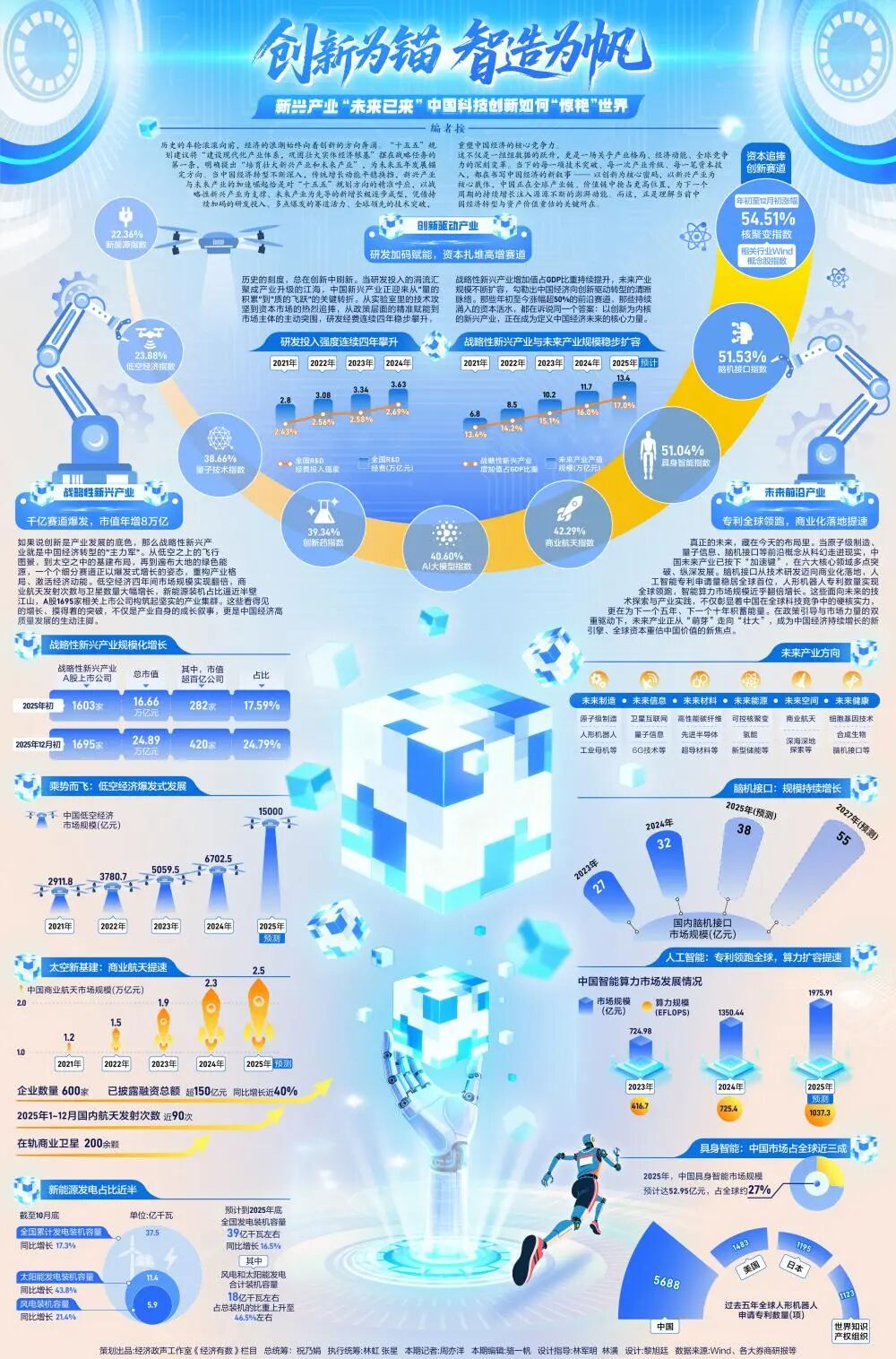
新兴产业“未来已来”,中国科技创新如何惊艳世界
2 1 Shi Ji Jing Ji Bao Dao· 2026-01-04 02:37
Group 1 - The core viewpoint emphasizes the importance of innovation in driving China's economic transformation and the rise of emerging industries as a response to the "14th Five-Year Plan" [1] - The plan highlights the construction of a modern industrial system and the strengthening of the real economy as strategic tasks, with a focus on nurturing emerging and future industries [1] - Continuous R&D investment and technological breakthroughs are reshaping China's core competitiveness in the global industrial and value chains [1] Group 2 - As of the end of October, China's installed power generation capacity reached approximately 3.9 billion kilowatts, with a year-on-year growth of 17.3% [3] - The share of renewable energy generation, particularly wind and solar power, has increased significantly, with solar power capacity growing by 43.8% year-on-year [3] - The humanoid robot market in China is projected to account for nearly 30% of the global market by 2025, with an expected market size of 5.295 billion yuan [3]
京运通:股东京运通达兴质押股份730万股
Mei Ri Jing Ji Xin Wen· 2025-12-29 08:10
Group 1 - The core point of the news is that Beijing Jingyuntong Technology Co., Ltd. announced that its controlling shareholder, Beijing Jingyuntong Daxing Technology Investment Co., Ltd., pledged 7.3 million shares of the company, which is part of a larger total of approximately 221 million shares pledged, representing 31.62% of the shareholder's total holdings [1] - As of the announcement date, Beijing Jingyuntong Daxing holds 700 million shares, accounting for 28.99% of the company's total share capital [1] - For the first half of 2025, the revenue composition of Jingyuntong is as follows: new materials business accounts for 53.87%, new energy power generation business accounts for 36.0%, other businesses account for 5.26%, energy-saving and environmental protection business accounts for 4.84%, and equipment accounts for 0.03% [1] Group 2 - The market capitalization of Jingyuntong is reported to be 9.9 billion yuan [2]
