
新能源汽车胶粘剂

Search documents
回望“十四五”| 绿水青山遍神州 “数”看产业与金融共谱新画卷
Shang Hai Zheng Quan Bao· 2025-10-20 00:09
Core Viewpoint - The concept of "green finance" has become a crucial focus for supporting the real economy in China, aligning with the "Two Mountains" theory and "dual carbon" goals, marking a significant shift towards high-quality green development during the 14th Five-Year Plan period [2][5]. Group 1: Green Industry Development - During the 14th Five-Year Plan, China's green industry has achieved significant advancements, leading globally in various sectors, including renewable energy and electric vehicles [3]. - By 2024, China has established the world's largest and most complete new energy industrial chain, providing 80% of global photovoltaic components, 70% of wind power equipment, and 60% of power batteries [3]. - As of the first quarter of this year, China's wind and solar power generation capacity has added 74.33 million kilowatts, surpassing a cumulative capacity of 1.482 billion kilowatts, historically exceeding that of thermal power [3]. Group 2: Environmental Improvements - Since the beginning of the 14th Five-Year Plan, the proportion of days with good air quality in cities has stabilized at around 87%, and forest coverage is expected to exceed 25% by 2024, contributing to about one-fourth of the world's new greening area [4]. - China's energy consumption per unit of GDP has decreased by 11.6% compared to the end of the 13th Five-Year Plan, making it one of the fastest countries in terms of energy intensity reduction globally [4]. Group 3: Green Finance Growth - Over 100 projects have received financial support since the 14th Five-Year Plan, with a total credit amount of 216.4 billion yuan and loans issued amounting to 76.4 billion yuan [5]. - By the second quarter of 2025, the balance of green loans in China is expected to reach approximately 42.4 trillion yuan, while the balance of green bonds will exceed 2.2 trillion yuan [6]. - The national carbon emissions trading market has seen a cumulative transaction volume of 696 million tons and a total transaction value of 47.826 billion yuan as of August 2025 [6]. Group 4: Innovative Financial Models - A new financing model linking loan interest rates to companies' greenhouse gas emissions intensity has been introduced, transforming ESG investments into strategic returns [9]. - Banks are actively creating zero-carbon bank branches and supporting various climate investment projects, contributing to the development of a green financial ecosystem [10]. Group 5: Future Outlook - The integration of green finance with technology finance is essential for supporting green and low-carbon technology enterprises, providing diverse financial products and services [12]. - The collaboration between industry and finance is expected to continue, focusing on innovation and green development to create a "Beautiful China" [13].


绿水青山遍神州“数”看产业与金融共谱新画卷
Shang Hai Zheng Quan Bao· 2025-10-19 18:49
Core Viewpoint - The article emphasizes the significant progress in green development in China during the "14th Five-Year Plan" period, highlighting the integration of industry and finance in promoting sustainable growth and achieving carbon neutrality goals. Group 1: Green Industry Development - During the "14th Five-Year Plan," China's green industry has made remarkable advancements, leading globally in several sectors, including renewable energy and electric vehicles [3][4]. - By 2024, China has established the world's largest and most complete new energy industry chain, providing 80% of global photovoltaic components, 70% of wind power equipment, and 60% of power batteries [3]. - As of the first quarter of this year, China's wind and solar power generation capacity has reached a cumulative installed capacity of 1.482 billion kilowatts, surpassing that of thermal power [3]. Group 2: Environmental Improvements - Since the beginning of the "14th Five-Year Plan," the proportion of days with good air quality in cities has stabilized at around 87%, and forest coverage is expected to exceed 25% by 2024, contributing to a significant increase in global greening [4]. - By 2024, China's energy consumption per unit of GDP has decreased by 11.6% compared to the end of the "13th Five-Year Plan," making it one of the fastest countries in terms of energy intensity reduction [5]. Group 3: Green Financial System - A multi-layered and comprehensive green financial system has emerged, providing substantial financial support for green industries, with over 100 projects receiving financial backing amounting to 216.4 billion yuan [6][7]. - By the second quarter of 2025, the balance of green loans in China is expected to reach approximately 42.4 trillion yuan, and the balance of green bonds will exceed 2.2 trillion yuan [7]. - The national carbon emissions trading market has seen a cumulative transaction volume of 696 million tons and a total transaction value of 47.826 billion yuan by August 2025, indicating significant progress in carbon finance [7]. Group 4: Policy and Financial Innovations - The Chinese government has introduced various policies to encourage financial support for green industries, including the issuance of guidelines to enhance financial backing for low-carbon development [9]. - Innovative financing models, such as ESG-linked loans, are being adopted, allowing companies to benefit from reduced interest rates based on their environmental performance [10]. - The integration of green finance with consumer behavior is being promoted through initiatives like carbon accounts and low-carbon cards, encouraging sustainable consumption practices [10]. Group 5: Future Outlook - The collaboration between industry and finance is expected to continue, focusing on innovation and sustainability to create a "Beautiful China" in the future [13].
绿水青山遍神州 “数”看产业与金融共谱新画卷
Shang Hai Zheng Quan Bao· 2025-10-19 18:49
Core Insights - The article highlights China's significant progress in green finance and environmental sustainability, emphasizing the country's commitment to achieving its dual carbon goals and the development of a robust green financial system [2][5][10] Group 1: Environmental Improvements - Since the 14th Five-Year Plan, the proportion of days with good air quality in cities has stabilized at around 87%, and the forest coverage rate is expected to exceed 25% by 2024, an increase of approximately 2 percentage points from 2020 [1] - By 2024, China's energy consumption per unit of GDP is projected to decrease by 11.6% compared to the end of the 13th Five-Year Plan, making it one of the fastest countries in terms of energy intensity reduction [1] Group 2: Green Financial System - A multi-layered green financial system has emerged, providing substantial financial support for green industries, with over 100 projects receiving financial backing amounting to 216.4 billion yuan [2][3] - As of mid-2025, the balance of green loans in China is approximately 42.4 trillion yuan, and the balance of green bonds exceeds 2.2 trillion yuan [3] Group 3: Carbon Market Development - The national carbon emissions trading market was launched in July 2021, with cumulative trading volume reaching 696 million tons and total transaction value of 47.826 billion yuan by August 2025 [3] - In 2024, the annual transaction value of carbon emission allowances reached a record high of 18.114 billion yuan [3] Group 4: Policy Support and Financial Innovation - Various policies have been introduced to encourage financial institutions to support green projects, including the issuance of guidelines to enhance financial backing for green low-carbon development [5][6] - Innovative financing models, such as linking loan interest rates to ESG performance, are being adopted, exemplified by a recent agreement between Trina Solar and Industrial Bank [6] Group 5: Industry Growth and IPOs - New material company Daosheng Tianhe, which specializes in wind turbine blades, recently went public, indicating a trend of green technology and renewable energy companies accessing capital markets for growth [8] - The integration of green finance with technology finance is seen as crucial for supporting sustainable innovation and providing diverse financial products [9]

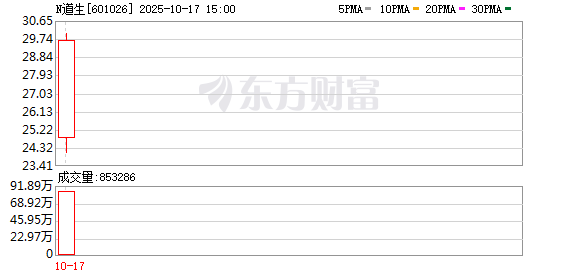
盘中涨超400%!道生天合 今日上市
Shang Hai Zheng Quan Bao· 2025-10-17 09:56
Core Viewpoint - Daosheng Tianhe, a leading global player in wind power materials, successfully listed on the Shanghai Stock Exchange, with its stock price surging over 396% on the first day of trading, reaching a market capitalization of 19.57 billion yuan [2][3]. Company Overview - Daosheng Tianhe focuses on high-performance thermosetting resin materials, with applications in wind power, new energy vehicles, aviation, and electricity [3][5]. - The company aims to become a leading comprehensive new materials solution provider globally, emphasizing long-term investment and technological innovation [3][4]. Market Position - Daosheng Tianhe is recognized as the largest producer of epoxy resin for wind turbine blades globally, maintaining a leading position in the market for three consecutive years [12][13]. - The company plans to expand its overseas market share, targeting a 50% contribution to revenue from international sales by 2030 [14]. Financial Performance - The company reported revenues of 3.436 billion yuan, 3.202 billion yuan, and 3.238 billion yuan for 2022, 2023, and 2024 respectively, with net profits of 110 million yuan, 155 million yuan, and 155 million yuan [17]. - For the first nine months of 2025, Daosheng Tianhe expects revenue to reach between 2.6 billion yuan and 2.7 billion yuan, reflecting a year-on-year growth of 22.32% to 27.03% [17]. Future Strategy - The primary focus of the IPO proceeds will be on expanding production capacity for new energy vehicle adhesives, driven by strong demand from leading automotive and battery manufacturers [17]. - The company aims to leverage capital market resources for talent acquisition and industry expansion, with a goal of entering 2 to 3 new industry sectors every five years [18].
道生天合季刚:从风电材料“细分第一”迈向跨国新材料平台
Shang Hai Zheng Quan Bao· 2025-10-16 18:55
Core Insights - The company "TECHSTORM" (道生天合) has successfully launched on the Shanghai Stock Exchange, aiming to expand its platform and global presence in the materials industry [1] Group 1: Company Background and Vision - The name "道生天合" reflects the company's ambition to evolve from a core material provider for wind turbine blades to a platform-based materials company, leveraging advanced technology [1] - The founder, Ji Gang, identified a market opportunity in the wind energy sector around 2015, leading to the establishment of the company focused on producing domestic epoxy resin for wind turbine blades [2] - The company has successfully built trust with major clients in the wind energy sector, overcoming initial challenges as a new entrant by sharing risks and demonstrating product quality [2][3] Group 2: Globalization and Platform Strategy - The company has achieved the highest sales of epoxy resin for wind turbine blades globally for three consecutive years, but aims to increase its overseas revenue from approximately 20% to 50% by 2030 [4] - The first international client was Vestas, a leading wind turbine manufacturer, with whom the company has developed a collaborative relationship, enhancing its credibility in the overseas market [4] - The company plans to expand into new industries, including semiconductors and high-end materials, by leveraging its strong R&D capabilities and existing client relationships [5] Group 3: Financial Performance and Future Outlook - The company's financial performance shows steady growth, with projected revenues of 3.436 billion yuan, 3.202 billion yuan, and 3.238 billion yuan from 2022 to 2024, alongside net profits of 110 million yuan, 155 million yuan, and 155 million yuan [6] - The IPO proceeds will primarily fund the expansion of production capacity for automotive adhesives, driven by increasing demand from leading automotive and battery manufacturers [6] - The company aims to utilize capital market resources for talent acquisition and industry expansion, with a goal of entering 2 to 3 new industry sectors every five years [7]