
智选假日酒店

Search documents
北京城市副中心将再添一交通枢纽,可换乘7号线,配套两家酒店
Xin Jing Bao· 2026-01-20 11:37
Core Viewpoint - The Wansheng West Transportation Hub, located in the northwest corner of Beijing's urban sub-center cultural tourism area, has completed construction and is entering the operational preparation phase, featuring seamless transfers between subway and multiple bus lines, along with two star-rated hotels and various commercial offerings to attract visitors from the Beijing Universal Resort [1][2][3]. Group 1: Project Overview - The Wansheng West Transportation Hub integrates multiple functions including transportation, hotels, and commercial spaces, with a total construction area of approximately 176,000 square meters [3]. - The hub is strategically located near the Universal Resort, only five subway stops away, and is designed to facilitate seamless transfers between the subway Line 7 and ground transportation [2][3]. Group 2: Facilities and Features - The hub will feature two star-rated hotels, the Holiday Inn Express and Wanda Jin Hua Hotel, which are set to open in the first half of this year, providing over 800 guest rooms to meet accommodation needs [4][5]. - The transportation hub includes a ground bus station with 45 bus parking spaces and an underground parking lot with over 700 spaces for small vehicles, catering to both hotel guests and shoppers [4]. Group 3: Commercial and Cultural Integration - The commercial area within the hub focuses on "leisure dining + artistic scenes," incorporating creative retail and social spaces, aiming to meet the immediate consumption needs of commuters and provide diverse leisure options for tourists [4]. - The hub will connect with key functional areas such as the Tongzhou Cultural Tourism Zone and Taihu Performing Arts Town, creating a synergistic effect with ongoing projects like the Top Park and Haichang Ocean Park, enriching the regional cultural tourism offerings [5][6].
洲际酒店集团中国市场的倍增计划
Bei Jing Shang Bao· 2026-01-18 15:11
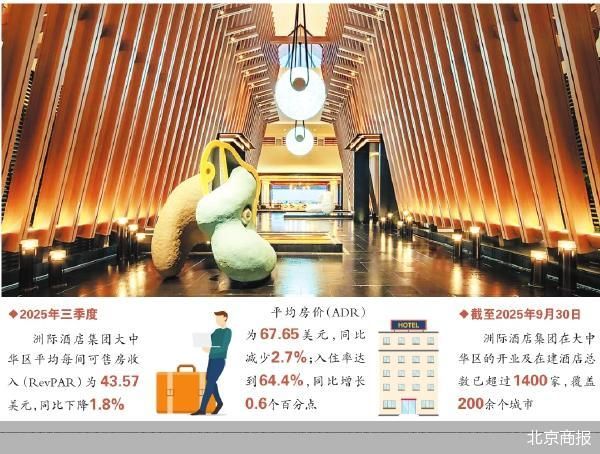
Core Insights - The Chinese hotel market is transitioning from a focus on speed to a focus on quality, with foreign hotel giants adapting to this shift [1][3] - InterContinental Hotels Group (IHG) remains optimistic about the Chinese market despite anticipated pressure in 2025, planning to expand its presence in first-tier cities and along high-speed rail lines [1][6] Market Trends - The overall performance of the Chinese hotel industry is expected to face pressure in 2025, but the decline in key metrics is narrowing [3] - In Q3 2025, IHG's average revenue per available room (RevPAR) in Greater China was $43.57, down 1.8% year-on-year, while the average daily rate (ADR) was $67.65, down 2.7% year-on-year; however, occupancy rates increased by 0.6 percentage points to 64.4% [3] - Domestic travel demand remains strong, with 4.998 billion trips taken by residents in the first three quarters of 2025, an increase of 18% year-on-year [4] Consumer Behavior - Chinese consumers are shifting their accommodation preferences from basic functionality to experiential value, emphasizing quality and service [5] - Business travel is returning with a focus on quality and efficiency, while leisure travel is increasingly characterized by short trips and family outings [5] Strategic Expansion - IHG is focusing on high-quality locations along high-speed rail lines while continuing to strengthen its presence in first-tier cities [6] - As of September 30, 2025, IHG had over 1,400 hotels in Greater China, covering more than 200 cities [6] - The company plans to increase its city coverage from over 200 to more in the future, maintaining a cautious expansion pace [6] Investment Outlook - The hotel investment market is expected to return to rationality, with a focus on long-term stable returns [7] - The trend towards brand and chain hotel growth continues, with a projected increase in the chain ratio in the Chinese hotel market [8] - The total number of hotel rooms in China is approximately 17.64 million, with chain rooms accounting for about 7.07 million, indicating significant potential for brand development [8] Competitive Landscape - The competition in the hotel industry is expected to shift towards internal capabilities, with stronger brands likely to dominate [8] - Local hotels are simultaneously expanding and closing underperforming locations to optimize their market presence [9] - IHG has established 13 hotel brands in Greater China, with a clear strategy for brand positioning and market entry [9]


孙健独家解密洲际酒店集团的倍增计划:加密一线城市、布局高铁沿线
Bei Jing Shang Bao· 2026-01-18 13:45
Core Insights - The Chinese hotel market is transitioning from a focus on speed to a focus on quality, with foreign hotel giants adapting to this shift [2][3] - Despite facing pressure in 2025, InterContinental Hotels Group (IHG) remains optimistic about the Chinese market, planning to expand its presence in first-tier cities and along high-speed rail lines [2][6] Market Trends - The overall performance of the Chinese hotel industry is expected to face challenges in 2025, but the decline in key metrics is narrowing [3] - In Q3 2025, IHG's average revenue per available room (RevPAR) in Greater China was $43.57, down 1.8% year-on-year, while the average daily rate (ADR) was $67.65, down 2.7% year-on-year; however, occupancy rates increased by 0.6 percentage points to 64.4% [3] - Domestic tourism demand remains strong, with 4.998 billion trips taken by residents in the first three quarters of 2025, an increase of 18% year-on-year [4] Consumer Behavior - Chinese consumers are shifting their accommodation preferences from basic functionality to experiential value, emphasizing quality and service [4][6] - Business travel is returning with a focus on quality and efficiency, while leisure travel is increasingly characterized by a willingness to pay for valuable experiences [4] Strategic Expansion - IHG plans to strategically expand its hotel presence in first-tier cities and high-speed rail locations, with a goal to increase the number of covered cities from over 200 to more [6][10] - As of September 30, 2025, IHG had over 1,400 hotels in operation or under construction in Greater China, covering more than 200 cities [6] Future Outlook - The hotel market in China is expected to stabilize and see an increase in chain hotel penetration, with a focus on long-term stable returns for investors [7][8] - The overall hotel industry is predicted to experience a trend towards consolidation, with stronger brands gaining market share while weaker, non-competitive hotels face challenges [8][9] - IHG is committed to a multi-brand strategy in China, with plans to introduce new brands based on market trends and operational capabilities [10]
孙健独家解密洲际酒店集团的倍增计划: 加密一线城市、布局高铁沿线
Sou Hu Cai Jing· 2026-01-18 09:15
Core Insights - The Chinese hotel market is transitioning from a focus on speed to a focus on quality, with foreign hotel giants adapting to this shift [1][3] - Despite facing pressure in 2025, the InterContinental Hotels Group remains optimistic about the Chinese market, planning to expand its presence in first-tier cities and along high-speed rail lines [1][5] Market Trends - The overall hotel industry in China is expected to face performance pressures in 2025, but the decline in key metrics is slowing down [3] - In Q3 2025, the average revenue per available room (RevPAR) for InterContinental in Greater China was $43.57, a decrease of 1.8% year-on-year, while the average daily rate (ADR) was $67.65, down 2.7% [3][6] - Occupancy rates, however, increased by 0.6 percentage points to 64.4% [3] Consumer Behavior - Chinese consumers are shifting from basic accommodation needs to a focus on quality and experience, with travel demand remaining strong [4] - In the first three quarters of 2025, domestic travel increased to 4.998 billion trips, a rise of 18% year-on-year, with spending reaching 4.85 trillion yuan, up 11.5% [4] Strategic Expansion - InterContinental is focusing on high-speed rail locations and first-tier cities for future hotel openings, with plans to increase the number of cities covered from over 200 [5][6] - The group has over 1,400 hotels in operation or under construction in Greater China [6] Investment Outlook - The hotel investment market is expected to return to rationality, emphasizing long-term stable returns [9] - The trend towards brand and chain hotel growth continues, with significant potential in the Chinese market [9][10] Competitive Landscape - The competition in the hotel industry is shifting towards internal capabilities, with a focus on quality and operational excellence [10] - The chain hotel rate in China is projected to increase, with international and quality domestic brands expected to accelerate their opening pace [10] Brand Strategy - InterContinental has established 13 hotel brands in Greater China, with a strategy that adapts to local market conditions [11] - The group plans to continue its multi-brand strategy while monitoring market trends for potential new brand introductions [11]

酒店“跑步前进”产业园区!
3 6 Ke· 2025-11-18 02:34
Core Insights - The article discusses the trend of hotel brands, particularly Huazhu's Meilun, entering industrial parks, marking a shift from traditional city center locations to these emerging areas [1][2][8] - The demand for diverse accommodation options in industrial parks is increasing, as businesses require not only short-term stays but also long-term housing solutions for employees [5][7][14] Group 1: Hotel Development in Industrial Parks - Huazhu Group's Meilun brand has opened its largest hotel in Xiamen's Jimei Software Park, featuring 310 rooms and targeting business and conference clientele [1] - The shift in hotel location strategy reflects a broader trend where hotels are moving from city centers to industrial parks, which are seen as new growth areas with potential [2][8] - Other hotel brands, including Qianxi and InterContinental, are also establishing properties in industrial parks, indicating a growing interest in these locations [3][6] Group 2: Changing Accommodation Needs - The demand for "business + conference + activity" accommodations in industrial parks is being recognized by hotel operators, leading to the inclusion of meeting rooms and dining facilities [2][5] - The combination of hotels and serviced apartments is becoming more common, catering to the long-term needs of professionals in industrial parks [5][6] - Local state-owned enterprises and development platforms are also entering the market, promoting standardized accommodation solutions for employees [6][10] Group 3: Investment and Economic Implications - The investment logic for hotels is changing, with industrial park hotels offering stable clientele and lower land costs, making them attractive for major hotel groups and local investors [7][10] - The trend reflects a redistribution of urban dynamics, where hotels are now following businesses rather than just tourist flows [7][8] - Policies at both national and local levels are encouraging the development of living and service facilities in industrial parks, facilitating the entry of hotels and apartments [9][10] Group 4: Future Outlook - The future of hotels may lie in industrial parks rather than traditional urban centers, as the boundaries between work, life, and leisure continue to blur [11][14] - Hotels in industrial parks are expected to become integral parts of the local ecosystem, serving not just as accommodation but also as cultural and community hubs [12][14] - The concept of "park-customized hotels" is gaining traction, offering both operational returns and cultural value, which could enhance the brand image of the parks [14]

外资五星酒店摘牌潮来了?
虎嗅APP· 2025-09-03 10:29
Core Viewpoint - The article discusses the recent trend of foreign hotel brands in China, particularly the increasing number of hotels being delisted from international chains and transitioning to local management, highlighting the underlying issues faced by hotel owners and the changing dynamics in the hospitality industry [2][28]. Group 1: Recent Delistings - The Westin Xiamen has been delisted without any formal announcement or compensation for guests, raising concerns about the future of this popular hotel [7][8]. - Three Hyatt hotels in Jiangsu, previously under Suning Group, were delisted and transitioned to Suning's own brand, marking a significant shift in the local hotel landscape [10][11]. - The Grand Hyatt Nanchang will cease using the Hyatt brand and is expected to be taken over by a local chain, indicating a trend of international brands losing ground to local operators [12][13]. - The Crowne Plaza in Guangzhou has also rebranded to a local name, further illustrating the trend of international brands exiting the market [14]. Group 2: Underlying Issues - Many of the delisted hotels are owned by real estate companies or struggling former giants, reflecting broader economic challenges in the industry [17][18]. - Since the pandemic in 2020, numerous foreign luxury hotels have been put up for sale, but many have not found buyers, leading to a situation where high-end properties are available but unsold [20][21]. - The management fees associated with foreign hotel brands have become burdensome for owners, adding to the financial strain on hotel operations [22][23]. Group 3: Future Prospects - Despite the challenges, there is still potential for growth among international hotel brands in China, as evidenced by new projects like the upcoming Westin in Xiamen [28]. - International brands are increasingly focusing on mid-range and affordable markets to adapt to economic fluctuations and capture a broader customer base [29][30]. - The shift in focus from prestige to profitability indicates a changing operational logic in the high-end hotel sector, where cash flow and internal rates of return (IRR) are becoming critical metrics for success [31][32].

中高端酒店纷纷升级,存量品牌如何吸引新投资人?
2 1 Shi Ji Jing Ji Bao Dao· 2025-05-15 11:39
Group 1 - The core viewpoint of the article highlights the increasing competition in the mid-to-high-end hotel sector, with InterContinental Hotels Group (IHG) launching the upgraded 5.0 version of its Holiday Inn Express brand to enhance competitiveness in this market [1] - The investment market is becoming more rational and refined, leading to a growing interest in mid-to-high-end select service hotels as investment hotspots, with a focus on controlling construction costs to safeguard profits [1] - IHG is re-evaluating owner investment returns and emphasizing cost reduction and efficiency improvements, aiming for the upgraded brand to help investors navigate industry cycles while achieving both investment and profitability [1] Group 2 - Since entering the Greater China region in 2004, the Holiday Inn Express brand has accelerated its expansion from first-tier cities to nationwide, focusing on locations near high-speed rail hubs and urban subway networks, with 366 hotels currently in operation and 214 under construction [2] - Major hotel brands are launching new brands or upgrades to better position themselves in key new market segments, with IHG's recent strategic upgrades across its mid-to-high-end brands aimed at optimizing investment cost structures and enhancing brand value [2] - The Chief Development Officer of IHG's Greater China region stated that standard business hotels no longer meet increasingly personalized consumer demands, indicating a shift in the hotel market towards more diversified offerings to cater to evolving market needs [2] Group 3 - In 2024, Huazhu's mid-to-high-end hotels are expected to grow by 35%, reaching 873 hotels, with the number of hotels under construction increasing to 521 [3] - Jinjiang Hotels reports that 60.76% of its opened hotels are mid-range or above, indicating that the growth of mid-to-high-end hotels is becoming a dominant force in the company's market development [3] - According to Frost & Sullivan, the domestic mid-to-high-end hotel market is projected to reach a scale of 155 billion yuan by 2026, with a compound annual growth rate of 27.6% [3]