
标准粉

Search documents
破解粮食加工产能结构性失衡|粮食大事
Xin Lang Cai Jing· 2026-02-05 06:55
Core Viewpoint - The grain processing industry is crucial for food security and rural revitalization, but it faces structural imbalances that hinder sustainable development. The focus should shift from scale expansion to quality and efficiency improvement [1]. Group 1: Structural Imbalances - The grain processing capacity is characterized by an excess in primary processing and a deficiency in deep processing. Many small and medium enterprises operate at low efficiency, while high-value products are underdeveloped [2]. - The current processing mainly focuses on ordinary rice and general flour, with a lack of specialized and high-value products. By-products like rice bran and bran are not utilized effectively, leading to resource waste [2]. Group 2: Planning and Optimization - There is a need for better planning and optimization of the grain processing industry to avoid redundant low-level projects. A national grain processing industry map should be established to guide capacity integration and development [3]. - The industry should focus on coordinated development of primary processing, deep processing, and by-product utilization, ensuring that value-added benefits remain within local areas [3]. Group 3: Industry Chain Extension - The grain industry should extend its value chain by moving from primary to deep processing, developing specialized grains and functional foods, and exploring new strategic industries like bio-materials and bio-pharmaceuticals [4]. - By fully utilizing by-products, the industry can break free from low-end competition and achieve a balance between economic and ecological benefits [4]. Group 4: Technological Innovation - The grain deep processing sector is technology-intensive but faces challenges such as insufficient R&D investment and poor integration of research and application. A focus on technological innovation is essential for industry transformation [5]. - Emphasis should be placed on developing key equipment, enhancing the utilization of by-products, and creating a collaborative innovation system to drive high-quality development in the grain industry [5].
中经评论:破解粮食加工产能结构性失衡
Jing Ji Ri Bao· 2026-02-05 00:02
Core Viewpoint - The grain processing industry is crucial for food security and rural revitalization in China, but it faces structural imbalances that hinder sustainable development. The focus should shift from scale expansion to quality and efficiency improvement [1]. Group 1: Structural Imbalances - The grain processing capacity is characterized by an excess in primary processing and a shortage in deep processing. Many small and medium-sized enterprises operate at low efficiency, while high-value products are underdeveloped [2]. - The current processing mainly focuses on common rice and general flour, with a lack of specialty products and insufficient utilization of by-products like rice bran and bran [2]. Group 2: Planning and Optimization - There is a need for better planning and optimization of the grain processing industry to avoid redundant low-level construction. The government should create a national grain processing industry map to guide capacity integration and development [3]. - A long-term mechanism for capacity exit should be established to phase out outdated capacities while avoiding a simplistic "one-size-fits-all" approach [3]. Group 3: Industry Chain Extension - The grain industry should extend its value chain by moving from primary to deep processing, developing specialized grains and functional foods, and exploring new strategic industries like bio-materials and bio-pharmaceuticals [4]. - By fully utilizing by-products, the industry can break free from low-end competition and achieve a balance between economic and ecological benefits [4]. Group 4: Technological Innovation - The grain processing sector is technology-intensive but faces challenges such as insufficient R&D investment and poor integration of research and application. A focus on technological innovation is essential for industry transformation [5]. - Emphasis should be placed on developing new technologies for high-value utilization of by-products and creating a collaborative innovation system that integrates academia and industry [5].
破解粮食加工产能结构性失衡
Jing Ji Ri Bao· 2026-02-04 22:15
Core Viewpoint - The grain processing industry in China faces a structural imbalance characterized by an excess of primary processing capacity and a lack of deep processing capacity, necessitating coordinated efforts to enhance deep processing capabilities and ensure food security while promoting rural revitalization [1][2][5]. Group 1: Structural Imbalance - The grain processing capacity is currently imbalanced, with primary processing capacity being excessive and deep processing capacity insufficient [2]. - Many small and medium-sized processing enterprises operate at low efficiency, while only a few leading companies maintain high operating rates [2]. - There is a lack of high-value-added products in deep processing, with most rice processing focused on ordinary rice, and limited development of specialty products like selenium-rich rice and rice oil [2]. Group 2: Industry Development Strategy - A systematic approach is needed to build a modern grain industry system that emphasizes high value, advanced technology, and effective utilization of by-products [2][4]. - The industry should transition from a focus on scale expansion to prioritizing quality and efficiency, enhancing the overall sustainable development of the grain sector [1][2]. Group 3: Planning and Optimization - The government should strengthen planning and create a national grain processing industry map to guide capacity integration and development in key production areas [3]. - There is a need to avoid blind investments in low-level projects and instead focus on coordinated development of primary processing, deep processing, and by-product utilization [3]. Group 4: Chain Extension and Value Addition - The grain industry should extend its value chain by moving from primary processing to deep processing, developing specialized grains and functional foods, and exploring new strategic industries [4]. - By fully utilizing by-products and enhancing their value, the industry can break free from low-end competition and achieve a balance between economic and ecological benefits [4]. Group 5: Technological Innovation - The grain deep processing sector is technology-intensive but currently faces challenges such as insufficient R&D investment and poor integration of research and application [5]. - There is a need to implement a technology-driven development strategy, focusing on enhancing domestic capabilities in key equipment and integrating various technologies for improved processing [5]. - Building a collaborative innovation system that connects academia, industry, and research will be crucial for driving high-quality development in the grain sector [5].
双节期间滨州市居民主要消费品价格整体稳定,节后部分商品略有回落
Zhong Guo Fa Zhan Wang· 2025-10-09 05:03
Core Insights - The overall consumer goods prices in Dongying City decreased by 0.55% compared to the pre-holiday period and fell by 5.21% year-on-year [1] - Prices of pork, eggs, and vegetables showed a downward trend, while beef and lamb prices increased compared to the previous year [1][2] Price Trends - The prices of staple food items such as flour and rice remained stable during the holiday period, with specific prices being 2.24 CNY/kg for special flour, 2.05 CNY/kg for standard flour, and 3.05 CNY/kg for ordinary rice [1] - Pork prices decreased slightly during the holiday, with retail prices for lean pork, fatty pork, boneless hind leg meat, and ribs being 15.35 CNY/kg, 14.7 CNY/kg, 12.71 CNY/kg, and 21.16 CNY/kg respectively, showing declines of 1.6%, 1.34%, 1.03%, and 5.58% compared to the pre-holiday period [1] - Egg prices dropped to 3.76 CNY/kg, down 6.7% from the pre-holiday period and 25.1% year-on-year [2] Vegetable and Fruit Prices - The average price of 22 monitored vegetables in Binzhou decreased by 2.65% post-holiday, with an average price of 3.33 CNY/kg, and a year-on-year decline of 24.09% [2] - Significant price drops were observed in celery, cabbage, and carrots, with declines of 39.74%, 47.74%, and 29.16% respectively compared to the previous year [3] - The average price of five monitored fruits was 3.52 CNY/kg, showing a year-on-year decrease of 16.86%, with apples remaining stable at 5.87 CNY/kg, up 10.06% year-on-year [3]
滨州市2025年上半年居民生活消费品价格形势分析
Zhong Guo Fa Zhan Wang· 2025-07-25 05:44
Price Trends in Binzhou, Shandong Province - In the first half of 2025, the price of raw grains in Binzhou showed a steady increase, while grain and oil prices remained stable. Pork prices decreased slightly, beef and lamb prices increased to varying degrees, and egg prices continued to decline [1][2]. Grain Prices - Wheat prices remained stable at a low level, with an average market purchase price of 1.22 yuan per jin from January to June, a year-on-year decrease of 9.67%. The decline narrowed each month, indicating a gradual upward trend [1]. - Corn prices exhibited a strong upward trend, with an average purchase price of 1.12 yuan per jin in the first half of the year, which is 5.2% lower than last year. From March, the year-on-year decline significantly narrowed, and by June, prices had increased by 21.21% compared to the beginning of the year [1]. Oil and Other Commodities - The prices of cooking oils remained stable, with peanut oil averaging 154.95 yuan for 5 liters and soybean oil at 63.03 yuan for 5 liters. Other staple food prices, such as flour and rice, also showed stability [1]. Meat Prices - Pork prices showed a gradual decline, with an average purchase price of 35.52 yuan per jin, an increase of 8.23% year-on-year. Retail prices for lean pork and pork belly were 15.62 yuan and 15.28 yuan per jin, respectively, reflecting year-on-year increases of 2.03% and 2.71% [2]. - Beef and lamb prices saw slight increases, with retail prices at 34.2 yuan and 40.2 yuan per jin, respectively. Beef prices had a significant decline earlier in the year, but the decline narrowed by May and June [4]. Egg and Vegetable Prices - Egg prices continued to decline, with an average retail price of 3.84 yuan per jin, down 8.79% year-on-year. The most significant declines occurred in February and June, with year-on-year drops of 15.41% and 24.2%, respectively [4]. - Vegetable prices showed a gradual decline, with an average retail price of 3.06 yuan per jin, down 11.3% year-on-year. Certain vegetables experienced significant price drops, with celery and cabbage seeing declines of 52.6% and 26.4%, respectively [4]. Fruit Prices - Fruit prices remained stable, with apples averaging 5.03 yuan per jin and oranges at 4.38 yuan per jin, both showing year-on-year declines. However, banana prices increased by 15.67% to an average of 3.38 yuan per jin [5].

湖南重要民生商品价格趋稳 市民“菜篮子”拎得更轻松
Sou Hu Cai Jing· 2025-06-21 06:07
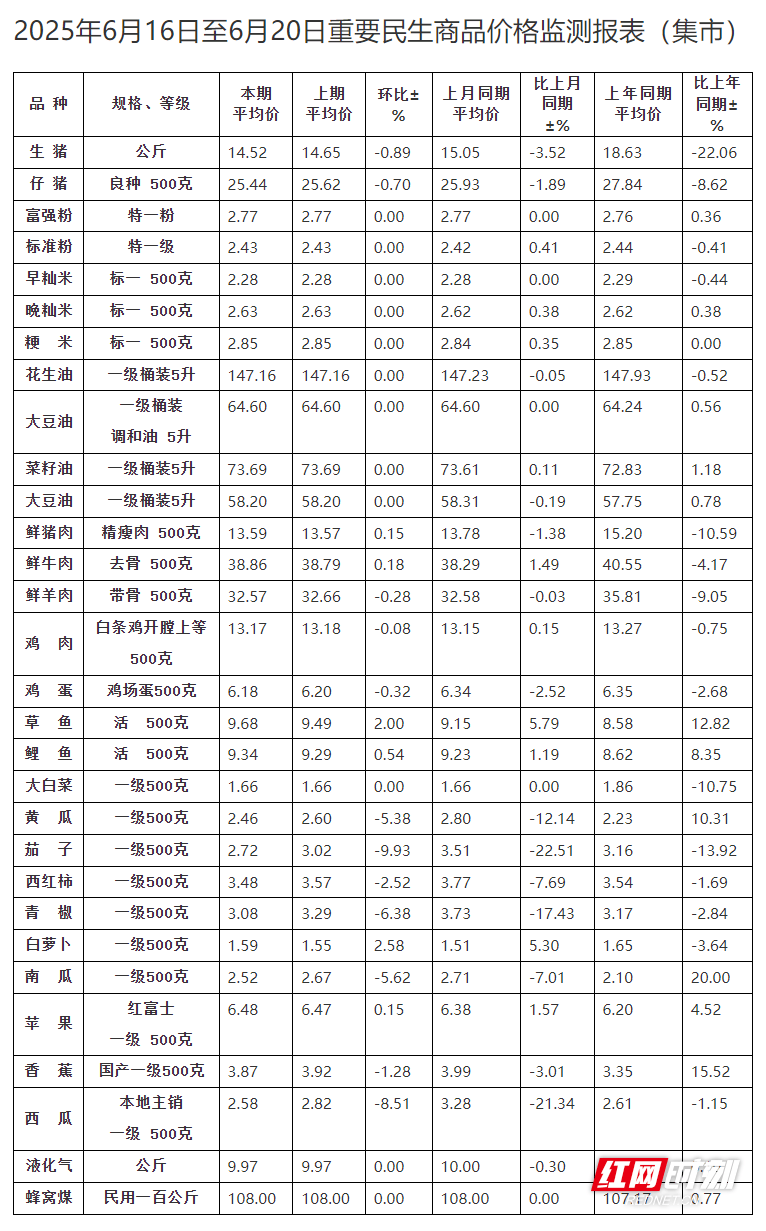
Core Insights - The monitoring report from June 16 to June 20, 2025, indicates that the supply of essential consumer goods in Hunan Province is sufficient, with overall market prices remaining stable [4][5]. Price Stability in Grains and Oils - The average prices for early indica rice, late indica rice, and japonica rice remain stable at 2.28 yuan, 2.63 yuan, and 2.85 yuan per 500 grams respectively [4]. - The prices of edible oils show minor fluctuations, with peanut oil and soybean oil experiencing slight declines, while rapeseed oil sees a slight increase [4]. Trends in Pork Prices - Prices for live pigs and piglets continue to decline, with average market prices at 14.52 yuan per kilogram and 25.44 yuan per 500 grams, reflecting decreases of 0.89% and 0.70% respectively [5]. - Fresh pork prices (lean meat) have seen a slight increase of 0.15%, reaching 13.59 yuan per 500 grams, but compared to the same period last year, live pig prices have dropped by 22.06% [5]. Fluctuations in Beef, Lamb, and Poultry Prices - The average market prices for fresh beef (boneless) and fresh lamb (bone-in) are 38.86 yuan and 32.57 yuan per 500 grams, showing increases of 0.18% and decreases of 0.28% respectively [6]. - Chicken and egg prices have slightly decreased, with chicken priced at 13.17 yuan and eggs at 6.18 yuan per 500 grams, reflecting changes of -0.08% and -0.32% respectively [6]. Vegetable and Fruit Price Trends - Among the monitored vegetables, only white radish prices increased by 2.58%, while cucumber, eggplant, tomato, and pumpkin prices generally fell, with eggplant experiencing the largest drop of 9.93% [7]. - In the fruit category, apple prices saw a minor increase of 0.15%, while banana and watermelon prices decreased by 1.28% and 8.51% respectively [7].
端午期间东营主要居民生活消费品市场价格总体稳定
Zhong Guo Fa Zhan Wang· 2025-06-03 03:11
Core Insights - The overall price of major consumer goods in Dongying City remains stable during the Dragon Boat Festival, with a monitoring of 55 key products showing a mixed performance in price changes [1] Group 1: Grain and Oil Prices - Grain and oil prices are stable, with 12 monitored products showing no change in price. Standard flour is priced at 2.060 yuan per 500 grams, with a year-on-year decrease of 4.76% [2] Group 2: Meat, Poultry, and Egg Prices - Meat prices are stable, with an average price of 23.782 yuan for 7 types of meat, showing a year-on-year decrease of 10.27%. Specific prices include lean pork at 16.858 yuan and fresh beef at 36.080 yuan, with the latter experiencing a significant year-on-year decline of 17.85% [3] - Egg prices remain stable at an average of 3.616 yuan, with a year-on-year decrease of 21.66% [4] Group 3: Vegetable and Fruit Prices - Vegetable prices are generally stable, with an average price of 2.945 yuan for 17 common vegetables, showing a slight decrease of 0.16% year-on-year [5] - Fruit prices show slight fluctuations, with an average price of 4.911 yuan for 5 types of fruit, reflecting a year-on-year increase of 13.04% [5]