
次高端白酒

Search documents
水井坊:2025年净利润暴跌71%,主动控货策略能否缓解渠道压力?
Hua Er Jie Jian Wen· 2026-01-19 12:20
Financial Performance - The company expects a net profit of 392 million yuan in 2025, a dramatic decline of 71% compared to 1.341 billion yuan in 2024, with revenue dropping from 5.217 billion yuan to 3.038 billion yuan, a decrease of 42% [1][2] - The non-recurring net profit is also projected to be 381 million yuan, reflecting a 71% decline, indicating that the performance drop is due to core business challenges rather than one-off losses [2] Industry Context - The company attributes its performance decline to a deep adjustment in the liquor industry, influenced by macroeconomic cycles, industry adjustments, and policy changes, with traditional business dining scenarios recovering slowly and high inventory levels persisting [2][3] - The high inventory levels suggest significant pressure on channels, as distributors face excess stock, which limits the company's ability to ship products, explaining why revenue decline (42%) is greater than net profit decline (71%) due to the dual pressure on gross margins and expense ratios [2] Inventory and Channel Management - The company has implemented a series of inventory control measures, including moderating shipment pace, optimizing inventory structure, and ensuring channel financial safety, prioritizing channel health [3] - While these measures may improve channel inventory quality and stabilize pricing, there are concerns about whether they can restore channel confidence during an industry downturn [3][4] Strategic Investments - Despite the significant drop in performance, the company emphasizes maintaining investments in brand building, terminal expansion, product innovation, and organizational capabilities while also optimizing expense efficiency [5] - The rising expense ratio is inevitable given the 42% revenue decline, suggesting that the effectiveness of the company's expense optimization efforts may be limited [5] Future Outlook - The company stresses the importance of laying a healthy foundation for future growth, but investors are concerned about the timeline for recovery [6] - Key uncertainties include when the industry cycle will bottom out, how long it will take to digest channel inventory, the stability of the pricing system, and the challenges of regaining lost market share [6][7][8] Investor Considerations - Investors should monitor the company's first-quarter performance, channel inventory data, pricing stability, changes in competitive dynamics, and trends in expense ratios to gauge the effectiveness of the company's adjustments [9]

2025年上半年白酒上市公司业绩点评:增长停滞、分化显现、韧性仍存
Lian He Zi Xin· 2025-10-28 11:29
Investment Rating - The report indicates a negative growth trend in the white liquor industry, with a recommendation for cautious investment due to the ongoing challenges and market adjustments [2][4][6]. Core Insights - The white liquor industry experienced its first decline in overall operating performance since 2015, with a decrease in total revenue and profit among 20 A-share listed companies [4][5]. - The leading companies, such as Guizhou Moutai, Wuliangye, and Shanxi Fenjiu, showed revenue growth, while the majority of other companies faced significant sales pressure, highlighting a trend of industry differentiation [2][9]. - The industry is currently facing an imbalance in supply and demand for mid-to-high-end products, with social inventory needing further clearance [2][13]. Summary by Sections Industry Performance - In the first half of 2025, the total revenue of 20 A-share listed companies in the white liquor sector reached 241.51 billion yuan, with a year-on-year decline of 0.86% [5][12]. - Excluding Guizhou Moutai, the remaining 19 companies saw a more pronounced decline, with total revenue dropping by 6.07% [5][10]. Market Dynamics - The report notes that the white liquor industry has entered a phase of "total decline, head and shoulder concentration" since 2017, with a gradual decrease in production and sales volume among large enterprises [9][15]. - The introduction of stricter policies, such as the revised regulations on waste reduction, has significantly impacted consumer behavior and sales in the second quarter of 2025 [6][15]. Future Outlook - Short-term challenges remain, with expectations of continued downward pressure on operating performance into the second half of 2025 and potentially into 2026 [12][14]. - Long-term trends suggest a potential contraction in the industry, but opportunities for product structure optimization and increased industry concentration may support the resilience of existing listed companies [15][16].



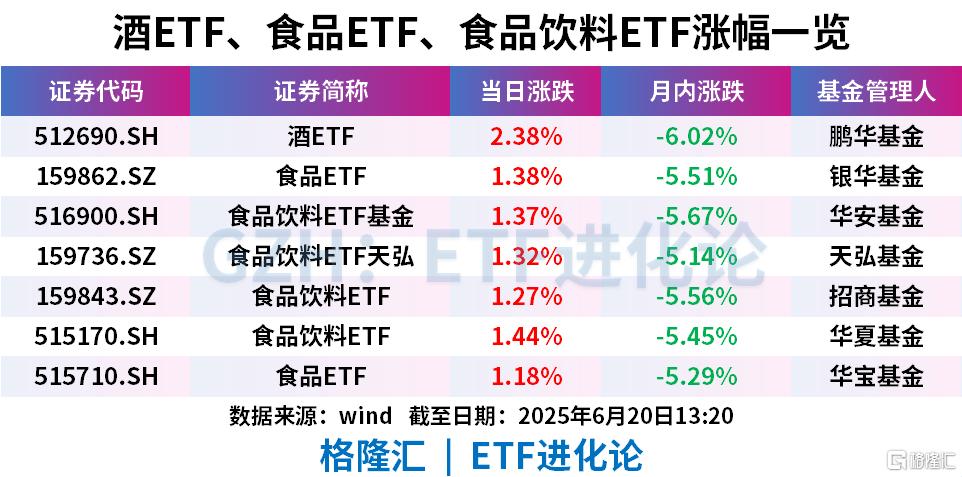
酒ETF、食品ETF、食品饮料ETF上涨,6月以来酒ETF逆势吸金超20亿元
Ge Long Hui· 2025-06-20 05:34
Group 1: Market Performance - The liquor stocks have seen significant increases, with Huangtai Liquor reaching the daily limit, Jinzhongzi Liquor and Yingjia Gongjiu rising over 5%, and the liquor ETF increasing by over 2.3% [1] - The liquor ETF has attracted a net inflow of 20.83 billion yuan, despite the overall decline of over 5% in liquor and food ETFs this month [2][3] Group 2: Industry Outlook - Current demand for liquor is at a historical low, with limited downside risk; supportive policies are expected to aid in the gradual recovery of liquor demand [5] - The liquor industry is anticipated to show a rebound in demand, particularly in the high-end segment, supported by low base effects in Q3 and Q4 [5] - The food and beverage sector is expected to see structural growth, with opportunities in high-end liquor, mid-range liquor, and real estate liquor products [5][6] Group 3: Consumer Trends - New consumption trends are emerging, with a focus on health and emotional value, leading to the rise of new consumer categories [5] - The snack sector is experiencing high growth, driven by strong categories and new channels, with products like konjac gaining popularity [6][7] - The restaurant supply chain is expected to benefit from policy stimuli, with significant growth potential in the industry [7]

平安证券晨会纪要-20250605
Ping An Securities· 2025-06-05 06:21
Group 1: Market Overview - The domestic market shows a slight improvement with the Shanghai Composite Index closing at 3376, up by 0.42% on the day, while the Shenzhen Component Index increased by 0.87% [1] - The overseas market also reflects positive trends, with the Dow Jones Index rising by 0.51% and the S&P 500 Index increasing by 0.58% [2] Group 2: Economic Policy and Trends - The report highlights that the Politburo meeting at the end of April clarified the direction of future economic policies, leading to a coordinated effort in financial and industrial policies [3][8] - Since May, the uncertainty in the overseas environment has gradually decreased, indicating an improvement in both internal and external market conditions [3][8] Group 3: Industry Insights - In the food and beverage sector, companies are focusing on strategic transformations and high-quality development, particularly in the high-end liquor market, which is expected to benefit from a recovering consumption environment [4][14] - The beverage industry is seeing innovation with new product launches aimed at meeting diverse consumer demands, particularly in the beer, soft drink, and snack segments as the peak season approaches [14] Group 4: Bond Market Analysis - The bond market is currently in a fluctuating state, with the yield on 10-year government bonds rising by 0.8 basis points to 1.68% [5][15] - The report suggests that the bond market remains in a range of 1.65% to 1.70%, with opportunities for investment at the upper end of this range [5][15] Group 5: Sector-Specific Opportunities - The report identifies several sectors that may benefit from policy support, including consumer goods, automotive, and renewable energy, with a focus on high-quality development and innovation [10][11][12] - The TMT sector is expected to accelerate domestic supply chain replacement due to new export controls from the U.S., while the pharmaceutical sector is witnessing a transformation with Chinese innovative drugs gaining global traction [12]