
水产预制菜

Search documents
礼盒开启私人定制,高端水产更普及丨年货新趋势
Bei Ke Cai Jing· 2026-02-12 07:17
Core Insights - The article highlights three prominent trends in the seafood market for the upcoming Lunar New Year: customization of gift boxes, the popularization of high-end seafood, and the normalization of prepared seafood dishes [1][5][20] Group 1: Customization of Gift Boxes - Customized seafood gift boxes are gaining popularity, with prices ranging from hundreds to thousands of yuan, catering to various consumer preferences [5][6] - The demand for gift boxes is driven by consumers' desire for convenience, quality, and a sense of occasion during family gatherings [5][12] - Sales of seafood gift boxes have seen a significant increase, with Tmall reporting a 50.6% year-on-year growth in sales by January 28 [5][12] Group 2: Popularization of High-End Seafood - High-end seafood items such as king crabs, Boston lobsters, and salmon are increasingly appearing on family shopping lists, indicating a shift in consumer behavior towards premium products [10][11] - The sales of high-end seafood have surged, with specific items like sea cucumbers and king crabs seeing sales growth of 160% and 154% respectively [12][16] - The market for salmon is expected to continue growing, with projections indicating a 10%-20% increase in imports by 2026, driven by both supply and demand factors [16] Group 3: Normalization of Prepared Seafood Dishes - Prepared seafood dishes are becoming a popular choice for family meals, allowing for quicker preparation and more time spent with family during the festive season [19][20] - The variety of prepared seafood options has expanded, catering to different tastes and price points, with products like Buddha Jumps Over the Wall and various seafood combinations gaining traction [20][22] - The trend reflects a broader consumer shift towards convenience and quality, with prepared dishes being viewed as a worthwhile investment for festive occasions [23]

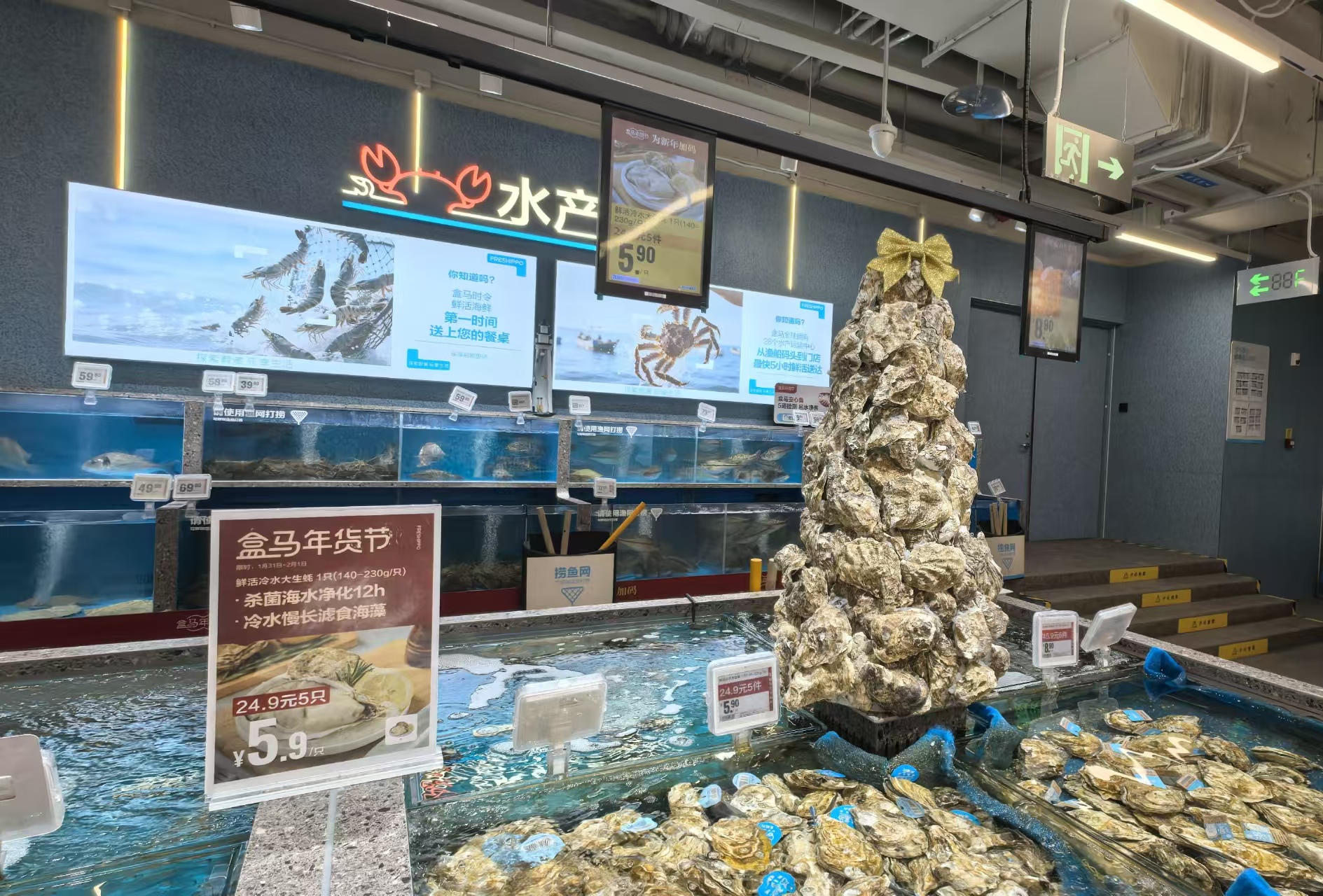
转型预制菜反走业绩下坡路,国联水产连亏六年
Xin Lang Cai Jing· 2025-12-10 08:43
Core Viewpoint - Guolian Aquatic Products (300094.SZ) announced the sale of its wholly-owned subsidiary, Xinying Foods, to its controlling shareholder, Xinyu Guotong, for a total payment of 315 million yuan. This transaction aims to convert idle upstream assets into more liquid cash assets and refocus on the company's main business [1][14]. Group 1: Financial Performance - From 2019 to 2024, the company has accumulated a net profit loss of approximately 2.028 billion yuan, with revenue only showing a brief positive growth in 2022. In the first three quarters of this year, the net profit loss reached nearly 800 million yuan [14]. - In 2023, the company reported a revenue decline of 4.79% and a net profit loss of 532 million yuan, attributing the losses to a poor seafood consumption market and declining sales prices [21][22]. - The company's revenue from aquatic food dropped by 16.97% year-on-year, with a gross margin decrease of 17.05 percentage points to -2.89% [24]. Group 2: Subsidiary Performance - Xinying Foods, established in 2011, reported revenues of 5.0117 million yuan and a net profit of 499,400 yuan in 2024, but incurred a loss of 1.06219 million yuan in the first ten months of the year [3][16]. - The sale of Xinying Foods reflects the company's ongoing strategy to divest upstream assets, which have not provided a competitive advantage and have instead burdened operations [4][16]. Group 3: Strategic Challenges - The company has faced significant challenges in its strategic transition to prepared foods, with a lack of core competitiveness in this area. The planned fundraising projects aimed at expanding production capacity were terminated due to changes in market demand and economic conditions [22][23]. - The company has been forced to accelerate the divestment of its upstream aquaculture business, which has been unprofitable for several years, in order to focus on prepared food processing [4][17]. Group 4: Market Conditions - The overall market for prepared foods is expected to grow, with projections indicating that the market size in China could exceed 1.072 trillion yuan by 2026. However, the company has struggled to capitalize on this growth due to external market conditions and internal strategic missteps [22][24].


揭秘涨停 | 水产板块多股持续涨停
Zheng Quan Shi Bao· 2025-11-19 10:54
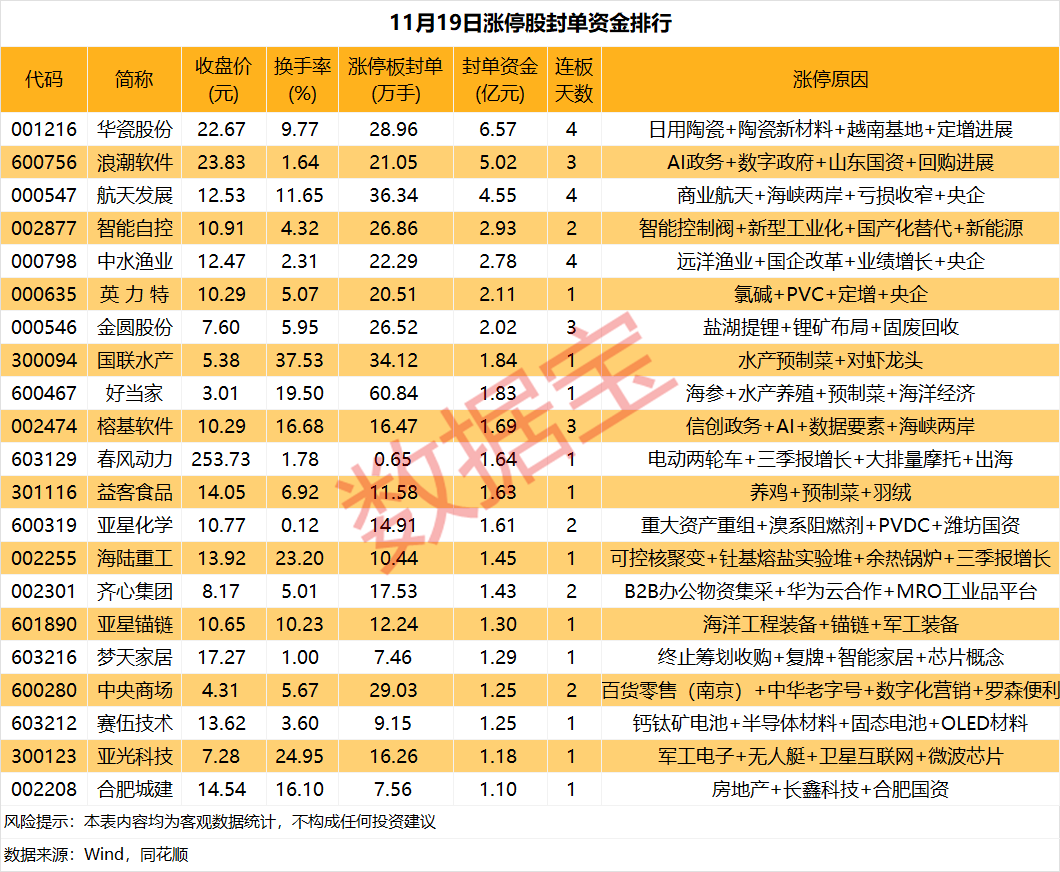
Group 1 - On November 19, 21 stocks had a closing limit order amount exceeding 100 million yuan, with the top three being Huaci Co., Ltd., Aerospace Development, and Guolian Aquatic Products, with amounts of 6.57 billion yuan, 5.02 billion yuan, and 4.55 billion yuan respectively [1] - Huaci Co., Ltd. achieved a cumulative increase of 46.35% with four consecutive limit ups, focusing on the production and sales of daily ceramics, and has commenced construction of a production facility in Vietnam [1][2] - The stock market saw significant activity in the aquatic products sector, with multiple stocks like Guolian Aquatic Products and Zhongshui Marine Industry experiencing limit ups, indicating strong investor interest in this industry [1][4] Group 2 - Huaci Co., Ltd. reported a revenue of 1.133 billion yuan for the first three quarters, representing a year-on-year growth of 15.32%, and a net profit attributable to shareholders of 189 million yuan, up 12.17% year-on-year [2] - The aquatic products sector is highlighted by companies like Zhongshui Marine Industry, which is actively involved in deep-sea economic development and sustainable marine resource projects [1][4] - Other companies in the aquatic sector, such as Dahu Co., Ltd. and Kaichuang International, are also expanding their operations, focusing on integrated supply chains from fishing to processing and sales [4]




11月19日主题复盘 | 水产养殖大涨,黄金、有机硅等走强
Xuan Gu Bao· 2025-11-19 08:33
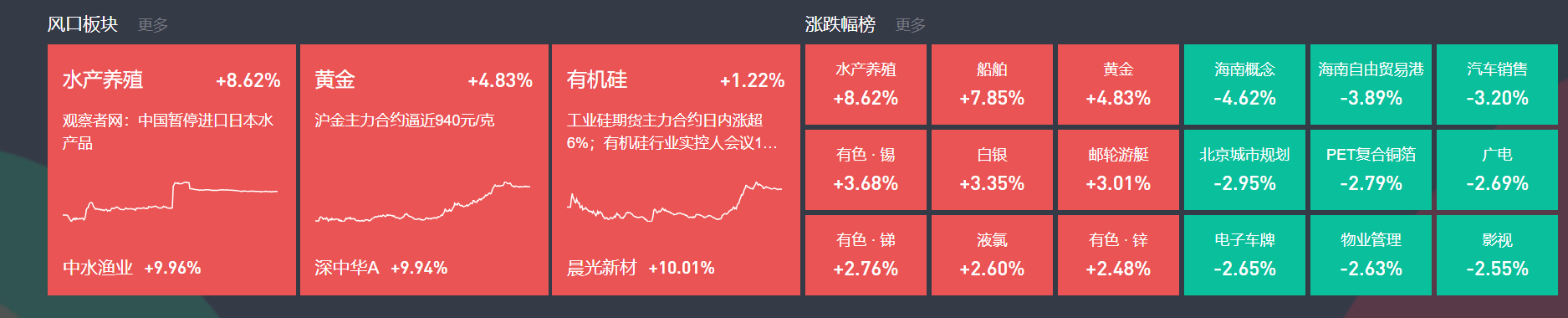
Market Review - The Shanghai Composite Index experienced narrow fluctuations, while the ChiNext Index saw a rise followed by a decline. The aquaculture sector surged, with stocks like Zhangzi Island and Dahu Co. hitting the daily limit. Gold stocks also rose in the afternoon, with Shen Zhonghua A reaching the daily limit and Zhongjin Gold touching the limit. The military industry performed actively, with Jianglong Shipbuilding and China Shipbuilding Defense hitting the daily limit. Conversely, popular sectors in Fujian and Hainan saw declines, with Haima Automobile and Sanmu Group hitting the daily limit. Overall, over 4,200 stocks in the Shanghai, Shenzhen, and Beijing markets were in the red, with a total transaction volume of 1.74 trillion yuan [1]. Hot Topics Aquaculture - The aquaculture concept saw a significant rise today, with Zhongshui Fishery achieving four consecutive limits, and stocks like Kaichuang International, Guolian Aquatic Products, Dongfang Ocean, and Haodangjia also hitting the daily limit. According to CCTV news, on November 19, the Chinese Foreign Ministry announced the suspension of imports of Japanese seafood due to strong public outrage over Japanese Prime Minister Fumio Kishida's remarks on major issues like Taiwan. This situation suggests that even if Japan exports seafood to China, there will be no market for it [4]. Organic Silicon - The organic silicon sector saw renewed activity in the afternoon, with Chenguang New Materials hitting the daily limit and Dongyue Silicon Materials and Yuanxiang New Materials rising over 10%. A seminar on the high-quality development of methyl chlorosilane enterprises is being held in Shanghai, which may lead to the establishment of production reduction targets [6]. Gold - The gold sector experienced another significant rise, with Shen Zhonghua A hitting the daily limit and Zhongjin Gold and Shandong Gold following suit. Market data indicated that the main gold futures contract surged over 1% in the afternoon, approaching 940 yuan per gram [8]. Military Industry - The military sector remains active, with stocks like Jianglong Shipbuilding and China Shipbuilding Defense hitting the daily limit. Reports indicate heightened concerns regarding Japan's military stance, as highlighted in a recent article from the Liberation Army Daily [14]. Lithium Battery - The lithium battery sector showed signs of recovery, with lithium carbonate futures breaking through the 100,000 yuan mark, and prices of electrolyte additives continuing to rise [16].
红宝书20250518
2025-05-19 02:34
Summary of Key Points from Conference Call Records Industry or Company Involved - **Industry**: Chemical Industry, specifically focusing on Polyoxymethylene (POM) and its substitutes - **Core Companies**: Jiangtian Chemical, Yuntian Chemical, Kailuan Co., and others in the chemical sector Core Insights and Arguments 1. **Anti-Dumping Tax on POM**: The Ministry of Commerce announced an anti-dumping tax on imported POM from the US, EU, Taiwan, and Japan, effective May 19, 2025, which opens up domestic substitution opportunities [2] 2. **POM Characteristics**: POM, known as "super steel," is a thermoplastic resin with high mechanical strength and fatigue resistance, suitable for automotive and electronic applications [2] 3. **Domestic Substitution Potential**: In 2023, China imported 330,000 tons of POM, with over 70% dependency in high-end sectors. The goal is to achieve a 40% self-sufficiency rate by 2025, translating to a substitution potential of approximately 230,000 tons per year, valued at around 5.75 billion yuan [2] 4. **Core Companies' Revenue Breakdown**: - Jiangtian Chemical: 53.78% of revenue from POM, with a designed capacity of 80,000 tons/year [2] - Yuntian Chemical: 2.09% of revenue from POM, with a production of 31,300 tons in Q1 2025 [3] - Kailuan Co.: 3.05% of revenue from POM, with a production of 15,700 tons in Q1 2025 [3] Other Important but Possibly Overlooked Content 1. **M&A Activity**: The revised regulations for major asset restructuring by the China Securities Regulatory Commission aim to simplify the process, allowing for quicker approvals and reduced financial pressure on companies [5] 2. **Food and Beverage Sector**: Upcoming events such as the National Food and Beverage Forum are expected to boost demand in the food and beverage sector, supported by government policies to expand domestic consumption [8] 3. **Pet Industry Growth**: The pet economy in China is projected to exceed 300 billion yuan, with companies like Tianyuan Pet leading in pet supplies and food, showing significant growth in both segments [20] 4. **Technological Collaborations**: Companies like Madi Technology and Yian Technology are collaborating with Huawei to develop smart robots and flexible gears, indicating a trend towards automation and AI integration in various sectors [13][14] Conclusion The conference call records highlight significant developments in the chemical industry, particularly regarding POM and its domestic substitution potential. Additionally, the M&A landscape is evolving with regulatory changes, and sectors like food and beverage and pet products are poised for growth, driven by consumer demand and technological advancements.