
深度求索

Search documents
聚力向新:中国新质生产力的全球担当与共赢图景
人民网-国际频道 原创稿· 2025-12-24 02:51
Core Viewpoint - The 20th Central Committee's Fourth Plenary Session emphasizes the strategic importance of developing new quality productivity to accelerate the construction of a modern industrial system, positioning it as a new engine for high-quality development in China and offering global opportunities [1]. Group 1: Innovation and Economic Growth - The third industrial revolution's impact on global economic growth is diminishing, necessitating a shift to higher levels of productivity to rejuvenate economic growth [2]. - By 2029, strategic emerging industries in China are projected to account for over 20% of GDP, indicating significant growth opportunities for global tech companies in areas like AI and biotechnology [2]. - PwC forecasts that global opportunities from business model transformation will reach $7.1 trillion by 2025, with the Chinese market contributing $1.66 trillion [2]. Group 2: Technological Advancements and Global Leadership - China's high-tech manufacturing sector is expected to see a 9.2% year-on-year increase in value added by November 2025, with smart consumer device manufacturing growing by 7.6% [3]. - China is leading in setting global standards for industrial 5G, contributing to the digital transformation of global manufacturing [3]. - China is a major player in the green energy sector, exporting over 80% of the world's photovoltaic components and 70% of wind power equipment, aiding global sustainable development [3]. Group 3: International Cooperation and Development - China's new quality productivity is becoming a key term in global South cooperation, with various countries expressing interest in collaborative efforts to avoid traditional modernization pitfalls [5][6]. - The establishment of cooperation mechanisms, such as the China-Vietnam railway, and significant agreements like the $22 billion high-tech industrial park project with Malaysia, highlight China's commitment to fostering international partnerships [5]. - China's approach to innovation and cooperation is seen as a model for developing countries to achieve sustainable development [6]. Group 4: Open Cooperation and Global Governance - China advocates for inclusive technological cooperation, sharing the benefits of new quality productivity with other nations to promote a more inclusive global economy [7]. - The country positions artificial intelligence as a global public good, inviting global South countries to collaborate in its development [7]. - Through initiatives like the Belt and Road, China is sharing its development experiences in satellite navigation and e-commerce with the world [7]. Group 5: Future Directions - China is committed to advancing new quality productivity through technological innovation, aiming for higher quality and more inclusive development that contributes to global economic growth [8].
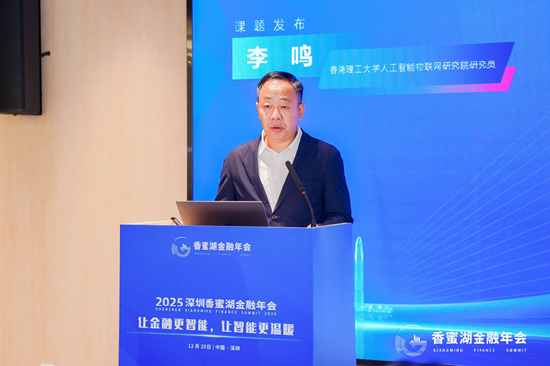
香港理工大学李鸣:AIGC作品的独创性判断标准尚未确立,生成内容的版权归属争议不断
Xin Lang Cai Jing· 2025-12-20 09:40
Core Insights - The second "Shenzhen Xiangmi Lake Financial Annual Conference" will be held on December 20-21, 2025, focusing on promoting a positive cycle among technology, industry, and finance in the Guangdong-Hong Kong-Macao Greater Bay Area [1][4] - The AI large model industry in China is rapidly developing, with significant contributions from companies like DeepSeek, ByteDance, Alibaba, and Tencent [3][6] Industry Development - As of November 1, 2025, there are 611 generative AI services registered in China, and 306 generative AI applications or features have been documented [3][6] - The open-source strategy is breaking monopolies and fostering an open ecosystem, while engineering innovations are lowering deployment barriers and accelerating the democratization of AI technology [3][6] Challenges in AI Industry - There are several challenges facing the large model sector, including difficulties in AI governance, which encompasses model interpretability, data quality, and privacy security [3][6] - A shortage of high-end talent with algorithm research capabilities and a lack of application-oriented professionals who understand both technology and finance are significant issues [3][6] - Weak intellectual property protection and ongoing disputes over copyright ownership of generative content are notable concerns [3][6] - Startups face challenges in financing, with high R&D costs and long return cycles, particularly in the basic research funding landscape [3][6]

从“数字化”到“数智化”(观象台)
Ren Min Ri Bao· 2025-11-25 22:20
Core Insights - The transition from "digitalization" to "intelligent digitalization" reflects China's commitment to seizing opportunities in artificial intelligence and systematically promoting innovation and application in the AI industry [1][3]. Group 1: Definition and Importance - Digitalization refers to the use of digital technologies to upgrade and reshape the value of various segments of the real economy's supply chain [2]. - Intelligent digitalization combines digitalization with intelligent technologies, enhancing production efficiency, resource allocation, management levels, and innovation capabilities [2]. Group 2: Strategic Significance - The shift to intelligent digitalization is a strategic move in response to technological advancements, with AI being a transformative technology driving economic and social development [3]. - Examples include AI algorithms optimizing production processes in synthetic biology factories, achieving a tenfold increase in efficiency, and reducing air dynamics calculation time from one day to seconds in high-speed train development [3]. Group 3: Current State of AI in China - China's AI industry has seen robust growth, with the core AI industry scale expected to exceed 900 billion yuan by 2024 and over 5,000 AI companies operating [4]. - As of June 2023, the total scale of operational computing centers in China reached 10.85 million standard racks, with intelligent computing power at 788 billion billion operations per second [4]. - A total of 1,509 large models have been released, with competitive general models emerging, leading the global open-source innovation ecosystem [4]. Group 4: Future Directions - The key to advancing intelligent digitalization is integrating AI into various industries to provide strong momentum for high-quality development [5]. - The "AI+" initiative aims to enhance technology supply and accelerate the intelligent transformation of industries, promoting high-quality development in the AI sector [5]. - The transition to intelligent digitalization outlines a new blueprint for development, leveraging AI technology to build a robust material and technological foundation for modernization in China [5].
从“数字化”到“数智化”,一字之变深意何在?
Ren Min Ri Bao· 2025-11-20 02:39
Group 1 - The core concept of the news emphasizes the transition from "digitalization" to "intelligent digitalization" (数智化), highlighting its significance in China's "14th Five-Year Plan" [1][6] - Digitalization refers to the process of using digital technologies to transform and upgrade various aspects of the real economy's industrial and supply chains [3] - Intelligent digitalization combines digitalization with intelligent technologies, enhancing production efficiency, resource allocation, management levels, and innovation capabilities [3][5] Group 2 - An example of a large chain supermarket illustrates the difference: digitalization involves real-time data collection for procurement and sales, while intelligent digitalization includes developing smart systems that automatically adjust pricing and predict product demand based on various factors [4] - The shift to intelligent digitalization is seen as a necessary response to technological advancements, with artificial intelligence being a transformative technology driving this change [5] - The "14th Five-Year Plan" reflects China's commitment to seizing opportunities in artificial intelligence and systematically promoting innovation and application in the AI industry [6] Group 3 - China's AI industry has seen significant growth, with projections indicating that the core AI industry scale will exceed 900 billion yuan by 2024, and the number of AI companies surpassing 5,000 [7] - The infrastructure for computing power is strengthening, with a total of 10.85 million standard racks in use and an intelligent computing power scale reaching 788 hundred quintillion operations per second as of June this year [7] - The development of algorithms is flourishing, with 1,509 large models released by mid-year, showcasing strong competitive domestic models leading the global open-source innovation ecosystem [7] Group 4 - The integration of artificial intelligence into various industries is crucial for high-quality development, emphasizing the need for deep integration with the real economy, particularly manufacturing [8] - The success of the current wave of AI, led by large models, hinges on its ability to merge with the real economy, necessitating the implementation of the "AI+" initiative to promote both "intelligent industrialization" and "industrial intelligence" [8][9] - The future vision aims to leverage the "multiplicative" effect of AI technology to build a robust material and technological foundation for China's modernization [9]

马小军:稳步推进包容性软实力建设正当其时
Huan Qiu Wang· 2025-05-15 23:43
Group 1 - The article discusses the decline of American soft power and its implications for global leadership, highlighting that more countries are distancing themselves from the U.S. [1][2] - The U.S. government's recent policies have exacerbated domestic social divisions, contributing to the decline of its soft power [2][3] - The U.S. has initiated a global tariff war, undermining the existing international economic order and damaging its credibility [3] Group 2 - China's soft power is on the rise, with its global ranking improving due to its stable development and the promotion of initiatives like the Belt and Road [4][7] - The article emphasizes China's diplomatic focus on cooperation, stability, and mutual benefit, contrasting with the U.S.'s confrontational approach [4][8] - China's cultural exports, including literature and entertainment, are gaining international traction, showcasing its growing influence [5][6] Group 3 - The article highlights the importance of China continuing to strengthen its global narrative and improve mutual understanding with other countries [7][9] - It suggests that China should actively represent the interests of the Global South and enhance its role in global governance [8][9] - The potential for technological collaboration and support for developing countries is emphasized as a means to bridge gaps and enhance China's soft power [8]
为什么中国意味着确定性、未来性、机遇性
Ren Min Ri Bao· 2025-04-25 21:50
Group 1 - The article emphasizes that amidst global uncertainties, China is perceived as a reliable partner that can create a better future, showcasing its determination and opportunities for collaboration [1][7][22] - China's response to U.S. tariffs is characterized by decisive countermeasures aimed at protecting its legitimate rights and maintaining international fairness, which has garnered widespread international support [1][10][12] - The article highlights the significant economic resilience of China, with a reported GDP growth of 5.4% year-on-year and a 9.7% increase in high-tech manufacturing value added [4][11] Group 2 - The article discusses the legal actions taken by U.S. small businesses and states against the government's tariff policies, indicating a growing discontent with the current trade measures [2][3] - It notes that the International Monetary Fund has observed a reset in the global trade system, with increased volatility in financial markets and heightened uncertainty in trade policies [3][4] - The article mentions that China has become a key player in global supply chains, with its industrial capabilities and innovation driving its economic growth, making it difficult for other nations to disengage [11][18][23] Group 3 - The article outlines China's commitment to high-quality development and international cooperation, as evidenced by its participation in various international trade fairs and agreements with neighboring countries [5][26][27] - It highlights the strategic importance of China's semiconductor industry, which has seen significant growth and innovation despite external pressures, with a record production of 4.514 billion chips and an export value of 1.1 trillion yuan [15][16][17] - The article concludes by asserting that China's approach to open cooperation and mutual benefit positions it as a leader in global economic stability and growth opportunities [22][28][29]