灵创平台

Search documents
智元彭志辉最新分享:具身智能进入「部署态」元年,坚持“沿途下蛋”策略
IPO早知道· 2026-03-03 01:50
Core Viewpoint - The entire embodied intelligence industry is still in a phase of exploration, with no single company able to provide the correct answers alone. Collaboration is essential to overcome bottlenecks and achieve practical deployment [3]. Industry Status - According to the Ministry of Industry and Information Technology, there are over 140 humanoid robot companies in China, with 330 products released. The industry has transitioned from laboratory demonstrations to engineering and scenario-based competition [3]. - The focus has shifted from basic mobility to advanced capabilities, with robots now able to perform complex tasks, indicating that the industry is moving towards practical application [3]. Engineering Paradigm - The company has developed a practical engineering paradigm called "One Body, Three Intelligences." The "One Body" refers to the robot's physical structure, which requires a comprehensive approach to reliability, supply chain, and safety engineering [4]. - Core components like joints and dexterous hands are critical for the robot's operational capabilities and account for a significant portion of the overall cost. The company has standardized its product lines to eight series of joints to enhance efficiency [4]. AI Integration - AI is considered the "soul" of the robot, categorized into three dimensions: movement, interaction, and operation. The company has launched the "Lingchuang Platform" to simplify the action training process, making it accessible for users to deploy robots easily [4]. Open Ecosystem - The company is building an open and shared ecosystem by open-sourcing its operating system, Lingqu OS, and releasing the largest real machine dataset in the industry. This aims to create a positive cycle of capability reuse, data feedback, and model evolution [5]. Scene Deployment Strategy - The company employs a "laying eggs along the way" strategy, focusing on performing complex tasks in simple environments, such as structured factory settings. This contrasts with autonomous driving, which operates in complex environments with simpler tasks [7]. - The company has applied humanoid robots in eight typical scenarios, including entertainment, industrial manufacturing, logistics sorting, and security inspection, emphasizing the importance of real-world applications for reliability and system iteration [8]. Rationale for Humanoid Robots - The underlying logic for pursuing humanoid robots is that they serve as a universal interface in the physical world, similar to how computers interface with the digital world. The design of the physical environment is tailored to human bodies, suggesting that AI's most compatible form will likely resemble humans [8]. Call for Standardization - The company advocates for the establishment of a standard system within the industry, emphasizing that the key to scaling physical AI lies in data loops, reliability engineering, and standardized operational capabilities. Sharing data governance methods and operational experiences is crucial for accelerating the systematic deployment of physical AI [9].


一台晚会能办成什么样,取决于机器人
Guan Cha Zhe Wang· 2026-02-12 01:13
Core Viewpoint - The article highlights the significant advancements in the field of embodied intelligence, showcased through the first large-scale robot gala, "Robot Wonderful Night," which demonstrated the capabilities of robots in entertainment and performance settings, indicating a potential turning point in public perception of robotic technology [1][2][3]. Group 1: Event Highlights - The "Robot Wonderful Night" featured over 200 robots performing various acts, including magic and dance, and was broadcasted live across multiple regions, setting several industry records [2][3]. - The event was described as a pivotal moment for understanding robot capabilities, akin to a "ChatGPT moment" for the industry, reflecting growing confidence in the technology [2]. Group 2: Technological Advancements - The performance relied on advanced embodied intelligence systems, enabling robots to execute complex movements and express basic emotions, showcasing a new standard of "stage-level system intelligence" [3][4]. - The self-developed "Lingchuang" platform allows users to convert human actions into robotic performances without programming knowledge, indicating a significant leap in user accessibility [4]. Group 3: Market Dynamics - The current market for embodied intelligence is characterized by a dual-track structure: a pragmatic B-end market with clear demands and a C-end market driven by imaginative expectations [5][6]. - The B-end market benefits from defined customer requirements, while the C-end market faces challenges in meeting consumer expectations, particularly in home applications [5][6]. Group 4: Future Prospects - The industry is at a critical juncture, with the potential for significant growth in the next few years as products become more modular and commercial pathways are established [12][13]. - The integration of large models with robotics remains a challenge, with current capabilities limited to basic interactions, highlighting a gap in operational decision-making [10][11]. Group 5: Industry Challenges - Despite positive signals, such as the emergence of a robot rental platform and initial revenue generation from entertainment robots, the industry still faces hurdles in achieving stability and standardization [12][13]. - The lack of consensus on optimal configurations and operational standards continues to hinder widespread commercialization [12][13].


从跨年舞台到直播间 人形机器人“卖艺”破圈
Di Yi Cai Jing· 2026-01-04 04:42
Core Insights - The rapid advancement of humanoid robots in entertainment settings is highlighted, showcasing their ability to perform complex tasks such as singing, dancing, and interacting with audiences in live events [1][2] Group 1: Technological Advancements - The humanoid robots from Zhiyuan have demonstrated significant capabilities by performing at high-profile events like the New Year's Eve concert, indicating a leap in their performance skills [1] - The "Lingxin" platform allows robots to exhibit human-like expressions and tones, while the "Lingchuang" platform enables them to learn dance moves quickly, enhancing their adaptability in entertainment scenarios [2] Group 2: Market Opportunities - The entertainment industry serves as a low-barrier entry point for humanoid robots, allowing them to reach a large audience quickly through live performances and interactions [2] - Engaging with celebrities and audiences in real-time helps to demystify the technology behind humanoid robots, fostering a better public understanding of their capabilities [2] Group 3: Testing Grounds - The transition of humanoid robots from controlled environments to dynamic settings like live performances provides a valuable testing ground for improving their motion control, interaction, and system stability [2]
人形机器人走向大众?宇树科技首发应用商店,行业生态“暗战”浮出水面
Hua Xia Shi Bao· 2025-12-17 04:59
Core Insights - The article discusses the challenges and advancements in the humanoid robot market, particularly focusing on the efforts of companies like Yushu Technology and Zhiyuan Robotics to lower the technical barriers for users [3][9][10] Group 1: Market Demand and User Experience - Many sellers on second-hand platforms are offloading humanoid robots due to high technical barriers, indicating that widespread adoption of humanoid robots in daily life is still a distant goal [3][6] - Yushu Technology has launched its first humanoid robot application store, allowing users without professional knowledge to operate robots, while Zhiyuan Robotics has introduced the "Lingchuang" platform to encourage user participation in robot development [3][6][9] - The current application store from Yushu Technology is in public testing, offering only three actions for its G1 humanoid robot, which reflects the limited initial offerings available to users [5][7] Group 2: Development Platforms and Ecosystem - The development of platforms like Yushu Technology's application store and Zhiyuan Robotics' "Lingchuang" is driven by the market demand for secondary development of humanoid robots [9][10] - The platforms aim to bridge the gap between developers and ordinary users, allowing for easier access to robot programming and customization [9][10] - Experts suggest that the success of these platforms hinges on building a robust ecosystem that combines hardware and software, similar to successful models seen in companies like Apple and NVIDIA [10][11] Group 3: Challenges and Future Outlook - Despite the advancements, the hardware sales of humanoid robots have not reached a critical mass, making the software offerings seem less essential in the current market [11] - The article emphasizes that the primary challenge remains in expanding the user base for humanoid robots, as a larger user base is necessary for a thriving software ecosystem [11]

人形机器人的2025:一半是迷雾森林,一半是星辰大海
Tai Mei Ti A P P· 2025-12-16 08:03
Core Viewpoint - The humanoid robot industry is experiencing significant investment and interest, with projections suggesting that humanoid robots could become as common as computers and smartphones in households within the next two decades. However, there are contrasting opinions regarding the feasibility and practicality of these robots, with some industry leaders expressing skepticism about their commercial viability and technological readiness [2][3][9]. Investment Trends - In the first nine months of 2025, global investments in humanoid robots reached approximately $7 billion, driven particularly by the Chinese market, marking a 250% increase compared to the same period last year [3]. - Major companies like UBTECH have reported significant order volumes, with UBTECH's cumulative order amount reaching 1.3 billion yuan [9]. Technological Challenges - The VLA (Vision-Language-Action) model, widely used in humanoid robot training, faces limitations due to the need for dynamic, three-dimensional data, which is scarce and complex to obtain [5][6]. - Critics argue that the reliance on language as an intermediary in the VLA model leads to information loss and inefficiencies, suggesting a shift towards a "World Model" that directly connects visual input to actions [8]. Market Dynamics - There is skepticism regarding the authenticity of reported large orders, with concerns that many are framework agreements or intention orders rather than binding contracts, which could lead to inflated market expectations [10][12]. - The industry is witnessing a surge in companies entering the humanoid robot space, with over 150 firms established, many of which are seeking capital to sustain operations amid unclear technological and commercial pathways [17]. Future Outlook - Despite current technological uncertainties, there is a strong belief in the potential of humanoid robots to integrate into everyday life, with predictions of significant advancements in the next few years [14][15]. - The investment return cycle for humanoid robots is expected to be short, with some analysts estimating a payback period as brief as 36 weeks, particularly in household service applications [15]. Industry Developments - Companies like Yuzhu Technology and Zhiyuan Robotics are preparing for capital market engagements, with Yuzhu Technology expected to submit an IPO application soon [16][17]. - The market for humanoid robots is showing signs of volatility, with some startups already ceasing operations, indicating potential challenges ahead for the industry [19].

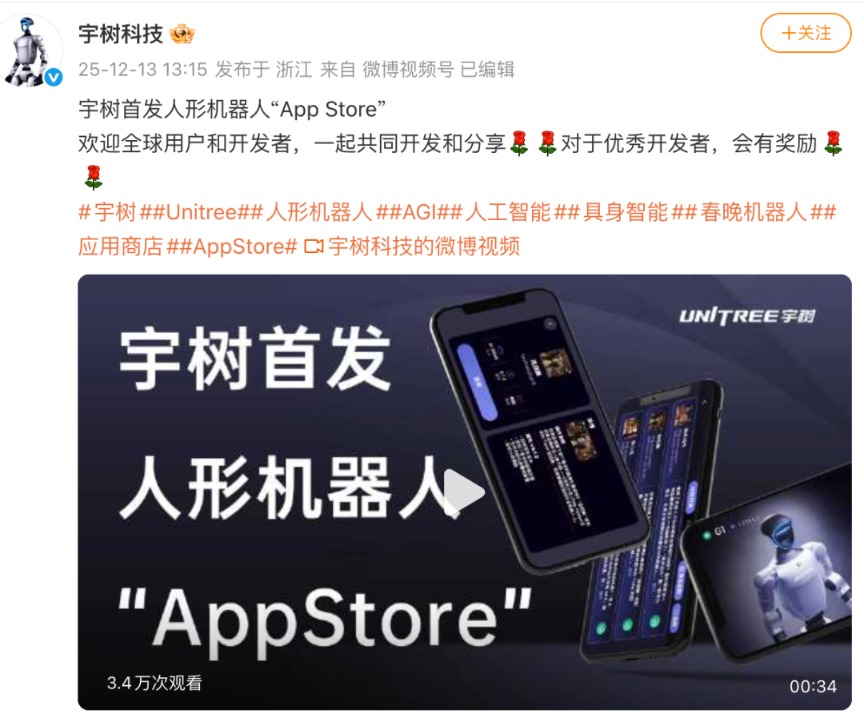
宇树发布人形机器人App Store,一键还原李小龙招牌动作
2 1 Shi Ji Jing Ji Bao Dao· 2025-12-13 10:34
Group 1 - Yushu Technology has launched its humanoid robot "App Store," allowing users to upload and share trained models for various actions such as dance and martial arts [1] - The platform includes data collected from real robots, enabling users to upload their own datasets or download others' for algorithm training and optimization, thus saving development time for both amateurs and professional teams [3] - The public beta version features preset actions including humorous movements, a dance, and Bruce Lee's martial arts, showcasing the company's advanced motion control capabilities [5] Group 2 - Yushu Technology, founded on August 26, 2016, focuses on the R&D, production, and sales of high-performance humanoid robots and dexterous robotic arms [6] - The company's annual revenue has exceeded 1 billion yuan, meeting the basic requirements for an IPO on the A-share market [7] - The IPO process is accelerating, with the China Securities Regulatory Commission indicating that Yushu Technology has completed its counseling phase and is in the "counseling acceptance" status, preparing to submit its IPO prospectus between October and December [8]
宇树发布人形机器人App Store,一键还原李小龙招牌动作
21世纪经济报道· 2025-12-13 10:24
Core Viewpoint - Yushu Technology has launched its humanoid robot "App Store," allowing users to upload and share trained models for various actions, significantly enhancing the development process for both amateurs and professionals [1][3]. Group 1: Product Development - The "App Store" enables users to upload their own data or download datasets collected by real robots for algorithm training and optimization, streamlining the development process [3]. - The platform currently features preset actions such as humorous movements, dance, and Bruce Lee's martial arts, showcasing its versatility [5]. - Yushu Technology's proprietary dynamics algorithm and motion capture data allow for seamless integration of Bruce Lee's Jeet Kune Do movements into user robots [5]. Group 2: Company Growth and IPO Progress - Founded in August 2016, Yushu Technology focuses on high-performance consumer and industrial humanoid robots and robotic arms, with annual revenue exceeding 1 billion yuan, meeting the basic requirements for A-share listing [7]. - The company is accelerating its IPO process, with the China Securities Regulatory Commission indicating that Yushu Technology has completed its counseling phase and is in the "counseling acceptance" status [8]. - Yushu Technology plans to submit its IPO prospectus between October and December, indicating a smooth progression in its IPO project [10].
下线5000台机器人,智元迈过量产临界点
Di Yi Cai Jing· 2025-12-08 13:26
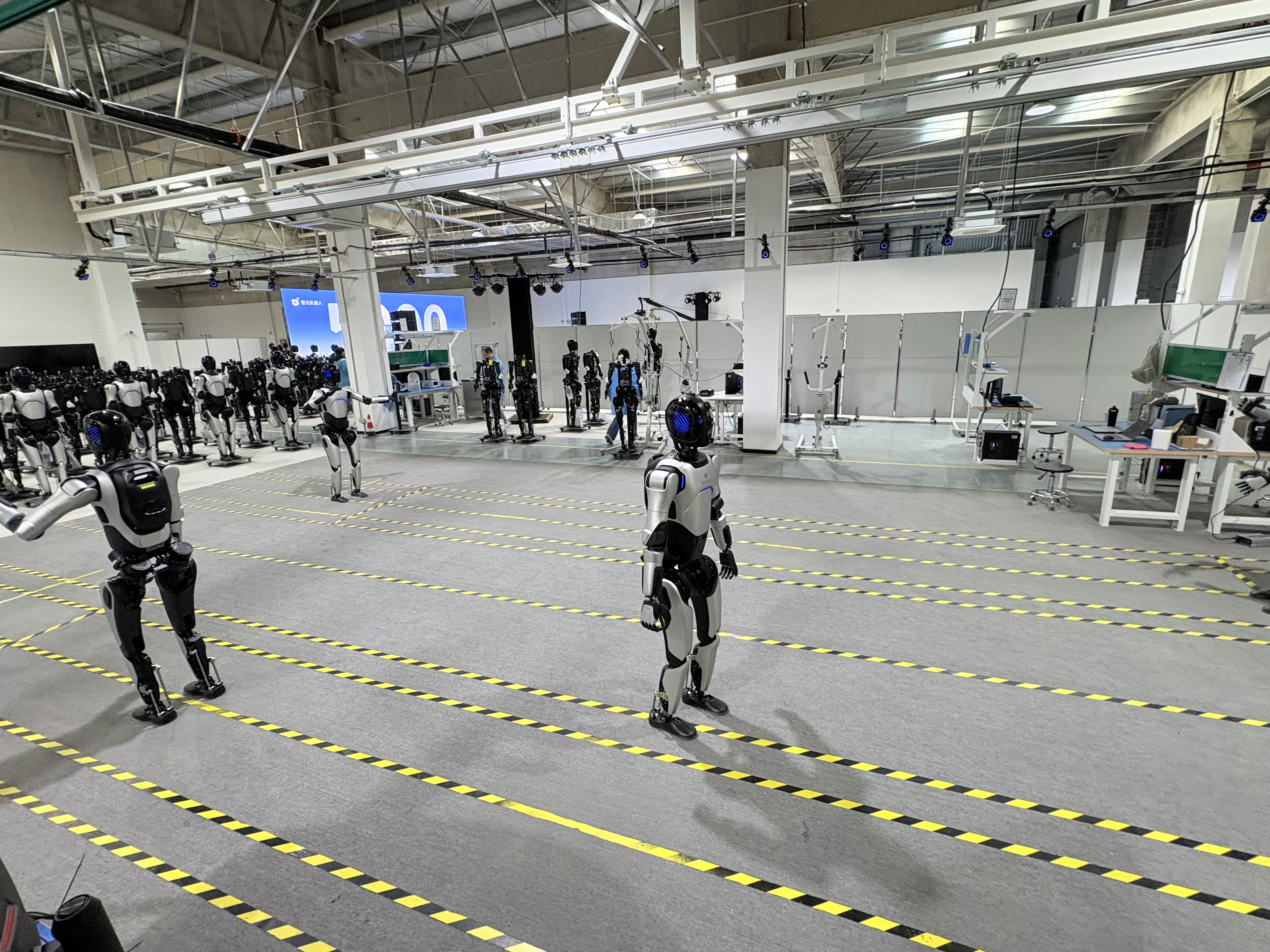
Core Insights - The core focus of the articles is on the production and application of Zhiyuan Robotics' humanoid robots, particularly the significance of reaching a production milestone of 5,000 units, which indicates a critical threshold in the industrialization process of robotics [1][3][4]. Production Milestones - The production of 5,000 units signifies a major achievement in the robotics industry, as most companies have reported shipments of only 500 to 1,000 units, with few exceeding that number [3][4]. - The transition from producing 200 units to 1,000 units is a crucial phase, marking the shift from prototype to mass production, which requires a stable supply chain and quality control [4]. - Achieving 1,000 units indicates a maturation of production processes, where the research and development team is no longer present, and production workers independently manage assembly and quality control [4][5]. Cost Reduction - The scale effect of mass production is becoming evident, with the cost of the A2 series robots reportedly decreasing by approximately 50% compared to earlier in the year [5] . Application Scenarios - Current applications of Zhiyuan Robotics' products are primarily in entertainment performances and guided tours, with significant orders from companies like China Mobile and Longqi Technology, amounting to several million to over a hundred million yuan [2][9]. - The process of refining application scenarios is critical, as the robots must be tested in real environments to determine their effectiveness in solving user problems [9][10]. Testing and Quality Assurance - The production process includes rigorous testing phases, such as walking tests and joint precision checks, to ensure the robots meet quality standards before delivery [10][14]. - A comprehensive testing protocol is necessary to validate the robots' capabilities and ensure consistency in mass production [14]. Future Challenges - The next phase of competition for Zhiyuan Robotics will focus on the ability to maintain operational scenarios and ensure that robots are integrated into real-world applications rather than just participating in one-time events [1][9].
微博(WB):3Q广告低于预期,26年迎来赛事催化
HTSC· 2025-11-19 03:05
Investment Rating - The report maintains a "Buy" rating for the company with a target price of $14.13, down from a previous value of $14.74, reflecting a price-to-earnings (PE) ratio of 7.5 times the adjusted net profit for 2026 [7][17]. Core Insights - The company's 3Q revenue decreased by 4.8% year-over-year to $442 million, aligning with consensus expectations, while adjusted net profit fell by 20% to $111 million, also meeting forecasts. Management expenses decreased due to a one-time bad debt recovery, but a loss is expected in 4Q [1][5]. - The company is focusing on enhancing AI capabilities, with significant growth in monthly active users (MAU) and daily active users (DAU) driven by new features and improved advertising integration [2][4]. - Advertising revenue in 3Q declined by 6% to $375 million, slightly below expectations, with notable growth in e-commerce and local life sectors, while the automotive sector may face challenges due to reduced subsidies [3][4]. Summary by Sections Financial Performance - 3Q revenue was $442 million, down 4.8% year-over-year, while adjusted net profit was $111 million, down 20% [1][12]. - Advertising revenue decreased by 6% to $375 million, with VAS revenue increasing by 1.6% to $67 million [3][12]. - The company expects a slight improvement in advertising revenue growth due to upcoming major events in 2026 [1][5]. User Engagement and AI Integration - The company reported 70 million MAU and significant growth in DAU and search volume, with AI features enhancing user interaction [2][4]. - The integration of AI in advertising processes has led to a 30% consumption rate of AI-generated materials in information flow bidding ads by the end of October [2]. Profitability and Forecasts - Adjusted net profit forecasts for 2025-2027 have been revised to $450 million, $449 million, and $491 million, respectively, reflecting a decrease in expected sales expenses [5][13]. - The report anticipates challenges in the automotive and 3C sectors due to weakening subsidies, impacting revenue growth [5][13]. Valuation - The target price of $14.13 corresponds to a PE ratio of 7.5 times the adjusted net profit for 2026, which is significantly lower than the average PE of 24 times for comparable global companies, attributed to liquidity issues and slower revenue growth [17][18].

拒绝第三方赚差价,机器人企业转向二次开发
Di Yi Cai Jing· 2025-11-12 12:35
Core Insights - The competition in humanoid robotics is shifting towards the development of tool platforms for secondary development, which enhances usability and marketability of robots [1][7] - Companies are recognizing that the true competitive advantage lies not in the complexity of robotic actions but in providing comprehensive tools for customers to utilize [1][7] Group 1: Development of Tool Platforms - Multiple companies, including Beijing Humanoid Robot Innovation Center and Yushu Technology, have launched tool platforms aimed at different customer segments, such as industrial deployers and research institutions [1][7] - The introduction of secondary development platforms is becoming a critical battleground in humanoid robotics, serving as both a means to attract developers and a commercial strategy for sales [1][7] Group 2: Custom Development Needs - In practical applications, such as assembly lines, robots require not only the ability to understand commands but also the capability for custom development to meet specific operational needs [2][5] - The need for customizable development tools has been identified as essential for users to adapt robots to various tasks and environments [2][5] Group 3: Open Source and Model Architecture - Beijing Humanoid has recently open-sourced its embodied intelligence platform "Hui Si Kai Wu" SDK, which features a layered model architecture rather than the mainstream end-to-end Vision-Language-Action (VLA) model [4][6] - The layered model approach allows for better control and adaptability in real-world applications, although it introduces risks of error propagation through multiple layers [5][6] Group 4: Competitive Strategies - Companies are increasingly focusing on providing complete development tools to differentiate themselves in a market where hardware performance is becoming less distinguishable [7][8] - The introduction of platforms that allow users to customize robot behaviors without programming is seen as a way to capture new revenue streams and enhance user engagement [8][9] Group 5: Long-term Sustainability - The development of these platforms requires significant initial investment and time, but the potential for substantial returns through user engagement and subscription models is recognized [9] - The ultimate challenge for companies is not just selling robots but ensuring their continuous use and integration into various applications, which will determine long-term success in the market [9]