
罐头食品

Search documents
光明肉业(600073) - 光明肉业2025年度经营数据公告
2026-03-30 14:00
| 渠道类别 | 2025 年 1-12 月 | 2024 年同期 | 同比变动 | | --- | --- | --- | --- | | 直营 | 4,687,856,787.91 | 5,090,919,097.98 | -7.92% | | 分销 | 15,979,563,480.47 | 15,103,701,939.45 | 5.80% | | 其他 | 1,462,552,923.97 | 1,792,271,469.91 | -18.40% | | 合计 | 22,129,973,192.35 | 21,986,892,507.34 | 0.65% | 1 / 2 证券代码:600073 证券简称:光明肉业 公告编号: 2026-017 上海光明肉业集团股份有限公司 2025 年度经营数据公告 本公司董事会及全体董事保证本公告内容不存在任何虚假记载、误导性陈述或者重大遗漏, 并对其内容的真实性、准确性和完整性承担个别及连带责任。 根据《上海证券交易所上市公司行业信息披露指引第十四号——食品制造》第 十四条相关规定,现将上海光明肉业集团股份有限公司(以下简称"公司")2025 年度主要经营数据( ...

当心春节“剩宴”暗藏隐形刺客
Xin Lang Cai Jing· 2026-02-11 03:19
Core Viewpoint - The article emphasizes the importance of safely handling leftover food during the Spring Festival to prevent foodborne illnesses while minimizing waste. Group 1: Foodborne Pathogens - Staphylococcus aureus is commonly found in the environment and on human skin, capable of proliferating in leftover high-protein and high-starch foods, producing toxins that can cause food poisoning even after heating. Symptoms include severe vomiting and diarrhea [2] - Escherichia coli O157:H7 can lead to hemorrhagic diarrhea and is often found in undercooked beef and unpasteurized milk. Symptoms include severe diarrhea, abdominal pain, nausea, and vomiting. Proper cooking of meat to an internal temperature of at least 74°C is essential [3] - Listeria monocytogenes can grow under refrigeration and is found in ready-to-eat meats, raw vegetables, soft cheeses, and ice cream, posing a significant risk to pregnant women and immunocompromised individuals. Symptoms include fever, muscle pain, headache, nausea, vomiting, and diarrhea [4] - Clostridium botulinum produces a potent neurotoxin and is commonly associated with contaminated canned and preserved foods. Symptoms include blurred vision, dry mouth, muscle paralysis, and respiratory difficulties [5] Group 2: Safety Measures for Leftovers - Inspect leftover food for color, smell, and texture before consumption; discard if any abnormalities are detected [6] - Separate raw and cooked foods during handling and storage to prevent cross-contamination [7] - Refrigerate leftovers within 2 hours of cooking to inhibit bacterial growth; most meat dishes can be stored for 1 to 2 days, while seafood should be consumed immediately [7] - Leafy greens can generate high levels of nitrites overnight, making them unsuitable for consumption as leftovers, while other vegetables can typically be refrigerated overnight [8] - Reheat leftovers thoroughly, ensuring the food reaches an internal temperature of at least 75°C to kill potential pathogens [9] - Use clean, sealable containers for storing leftovers to prevent bacterial contamination [10]
《罐头食品加工工》国家职业技能标准通过终审
Xiao Fei Ri Bao Wang· 2026-02-11 00:40
Core Viewpoint - The approval of the national vocational skill standard for canned food processing workers marks a significant step towards standardizing and professionalizing the canned food industry in China, addressing the urgent need for skilled personnel in product innovation and market expansion [1][2]. Group 1: Standard Development - The national vocational skill standard for canned food processing workers was finalized in Beijing, providing a unified and standardized basis for skill evaluation in the industry [1]. - The standard was developed by the China Light Industry Federation and the China Canned Food Industry Association, involving extensive industry research and input from leading enterprises, research institutions, and vocational schools [1][2]. Group 2: Content of the Standard - The standard defines the profession of canned food processing workers, outlining skill levels, training requirements, and evaluation criteria, categorizing the theoretical knowledge and operational skills required for different levels of personnel [2]. - Experts reviewed the standard rigorously, providing professional feedback on aspects such as level settings, skill requirements, and evaluation norms, leading to the finalization of the standard [2]. Group 3: Industry Impact - The successful finalization of the standard is seen as a crucial measure to meet the national requirements for building a high-skilled talent workforce, filling a gap in the canned food industry's vocational skill standard system [2]. - The establishment and refinement of the standard are expected to promote the standardization and professional development of the canned food industry, fostering a high-quality talent pool and injecting strong momentum into the industry's growth [2].
2026年第5周:食品饮料行业周度市场观察
艾瑞咨询· 2026-02-04 03:25
Group 1: Canned Food Industry - The State Administration for Market Regulation has released three draft national standards for canned food to enhance industry standards and applicability [3] - The canned food industry in China is diverse but lacks innovation, particularly in attracting younger consumers [3][4] - Canned food prices are generally affordable, benefiting from economies of scale and technological advancements, with the industry upgrading through self-heating products and high-end categories [3][4] Group 2: New Beverage Trends - The sugar water shop model has gained popularity among franchisees, with brands like Mai Ji Milk rapidly expanding, but faces challenges such as high costs and low-frequency consumption [5] - The market for traditional Chinese health drinks is booming, with products like red bean and barley water seeing increased sales, driven by young consumers' health consciousness [6] - The beverage market is experiencing a shift towards health-oriented products, with low-sugar and functional drinks becoming mainstream, while traditional brands face declining sales [7] Group 3: Functional and Innovative Products - Vitamin drinks are becoming essential for young consumers, especially during flu seasons, with brands like Nongfu Spring seeing significant sales growth [9] - The introduction of banana-flavored drinks by major brands reflects a trend towards health-conscious and innovative beverage offerings [10] - The global nutrition and health industry is witnessing a peak in raw material innovation, with a focus on standardized and stable ingredients [11] Group 4: Market Dynamics and Brand Strategies - The "medicinal food" trend is emerging, with a market size projected to reach 370 billion yuan, driven by policy support and technological advancements [12] - The rise of Chinese-style health drinks is creating a competitive landscape, with brands needing to address issues of standardization and supply chain integration [14] - The dairy industry is shifting focus from consumer markets to B2B opportunities, driven by the growth of new consumption formats like tea and coffee [15] Group 5: Brand Developments and Challenges - The beverage brand COMMUNE is preparing for an IPO, aiming to expand its presence despite facing challenges in same-store sales and rising costs [24] - The acquisition of the domestic soda brand Dayao by KKR marks a shift towards capitalizing on efficiency over emotional branding [25] - Dongpeng's coffee brand has rapidly gained market share, positioning itself among the top three in the ready-to-drink coffee market through strategic pricing and targeted marketing [26] Group 6: New Market Entrants and Innovations - The launch of Baoshifu's first bread store in Wuhan indicates its entry into the competitive bakery market, focusing on fresh and affordable products [27] - The Mexican baking group Bimbo is increasing investment in the Chinese market, leveraging local strategies and brand acquisitions to enhance market presence [28] - The recent leadership change at China Resources Beverage aims to optimize costs and drive new business growth amid evolving consumer trends [29]


2026年第5周:食品饮料行业周度市场观察
艾瑞咨询· 2026-02-04 00:08
Group 1: Canned Food Industry - The State Administration for Market Regulation has released draft recommendations for national standards for canned food to enhance industry standards and applicability [3] - The canned food industry in China is diverse but lacks innovation, particularly in attracting younger consumers, with Fujian province accounting for 36% of national production [3][4] - The industry is upgrading through the development of self-heating foods, high-end products like bird's nest canned food, and customized dining products [3][4] Group 2: New Beverage Trends - The sugar water shop has become a new franchise trend, with brands like Mai Ji Milk and Zhao Ji Chuan Cheng rapidly expanding, but facing challenges such as high costs and low-frequency consumption [5] - The Chinese herbal health water market is experiencing a sales surge due to hot weather, with products like red bean and coix seed water gaining popularity, potentially exceeding a market size of 10 billion yuan [6] - The beverage market is accelerating its health trend, with low-sugar and no-sugar products becoming standard, while traditional giants face declining sales [7] Group 3: Functional and Innovative Products - Vitamin drinks are gaining popularity among young consumers for their health benefits, with sales of Nongfu Spring's water-soluble C100 increasing by 34% year-on-year [9] - The rise of banana-flavored drinks from major brands reflects a growing market potential, leveraging high national recognition and health trends [10] - The global nutrition and health industry is set for a peak in raw material innovation and technological iteration by 2025, with a focus on standardized and stable ingredients [11] Group 4: Market Dynamics and Brand Strategies - The "medicinal food" trend is becoming a significant market, with a projected scale of 370 billion yuan, driven by policy support and technological advancements [12] - The rise of Chinese herbal health water reflects a shift in consumer behavior towards health-conscious products, but the industry faces challenges like exaggerated claims and quality control [14] - The dairy industry is shifting focus from consumer markets to B2B markets, driven by the growth of new consumption formats like tea and coffee [15] Group 5: Brand Developments and Challenges - The beverage brand Commune is preparing for an IPO, aiming to expand its presence while facing challenges like declining same-store sales and rising costs [24] - The acquisition of the beverage brand Dayao by KKR marks a shift towards capitalizing on efficiency over emotional branding, as the brand faces challenges in national expansion [25] - Dongpeng's coffee brand has achieved a market share of 14%, positioning itself among the top three in the ready-to-drink coffee market through a focus on quality and targeted marketing [26]







开创国际收盘上涨1.19%,滚动市盈率29.12倍,总市值30.67亿元
Sou Hu Cai Jing· 2025-11-27 10:28
Group 1 - The core viewpoint of the article highlights the performance and valuation of Kaichuang International, which closed at 12.73 yuan with a PE ratio of 29.12 times and a total market value of 3.067 billion yuan [1] - The company operates in the marine resources sector, focusing on deep-sea fishing, seafood processing, and related trade, with main products including tuna, canned food, and fish fillets [1] - As of September 30, 2025, the number of shareholders for Kaichuang International was 14,895, a decrease of 408 from the previous period, with an average holding value of 352,800 yuan per shareholder [1] Group 2 - In the latest quarterly report for Q3 2025, the company reported a revenue of 1.7 billion yuan, a year-on-year decrease of 1.74%, while net profit increased by 269.47% to 60.5173 million yuan, with a gross margin of 33.42% [1] - The average PE ratio for the agriculture, animal husbandry, and fishery industry is 33.94 times, with a median of 37.24 times, positioning Kaichuang International at the 50th rank within the industry [2] - The static PE ratio for Kaichuang International is 50.12 times, and the price-to-book ratio is 1.32 [2]

BBB Foods(TBBB) - 2025 Q3 - Earnings Call Transcript
2025-11-20 17:02
Financial Data and Key Metrics Changes - Total revenues increased by 36.7% year-over-year, reaching MXN 20.3 billion [4][5] - Same-store sales grew by 17.9%, driven by improvements in the value proposition [4][5] - EBITDA reported a loss of MXN 404 million, but excluding non-cash share-based payments, EBITDA increased by 43.6% to a positive MXN 1.2 billion [4][5] Business Line Data and Key Metrics Changes - The company opened 131 net new stores in the quarter, totaling 3,162 stores, with 390 stores opened in the first nine months of 2025 compared to 346 in the same period last year [4][5] - Cash flow generated by operating activities reached MXN 3 billion, a 30% increase year-on-year [5] Market Data and Key Metrics Changes - The gap versus ANTAD continues to increase, now almost 17 percentage points [6] - The company is one of the fastest-growing retailers globally, with significant room for expansion in Mexico, targeting a total of 14,000 stores [10] Company Strategy and Development Direction - The company focuses on continuous improvement of its value proposition, which is driving same-store sales growth [10] - There is a strong emphasis on talent investment as a key success factor, with a high talent density within the team [11] - The company plans to continue expanding its store network and product offerings while maintaining operational efficiency [10][11] Management's Comments on Operating Environment and Future Outlook - Management expressed confidence in maintaining strong sales growth, driven by product improvements and a robust pipeline [45] - The company anticipates that margins will improve over time due to better purchasing terms and logistics efficiency [14][15] - Management noted that the competitive landscape remains strong but healthy, with no significant changes in competition [37] Other Important Information - The company has a net cash position of approximately MXN 1.1 billion and $151 million in short-term deposits [5] - Share-based compensation has been a key driver of attracting talent and aligning interests with shareholders [11] Q&A Session Summary Question: Comments on gross margin and market share - Management indicated that margins will improve as purchasing costs decrease and logistics efficiency increases, with a focus on enhancing the value proposition [14][15] Question: Maturation of new store vintages - New store vintages are maturing faster than expected, leading to improved returns on invested capital [23][24] Question: Sales expenses and regional performance - Management expects more favorable comparisons for sales expenses in the next quarter and noted consistent performance across regions [29][32] Question: Product development and customer journey - The customer journey typically starts with basic goods, leading to increased basket sizes as customers try new products [57][60] Question: Interest from larger players - Management stated there has been no significant interest from larger national or international players regarding a potential acquisition [86]

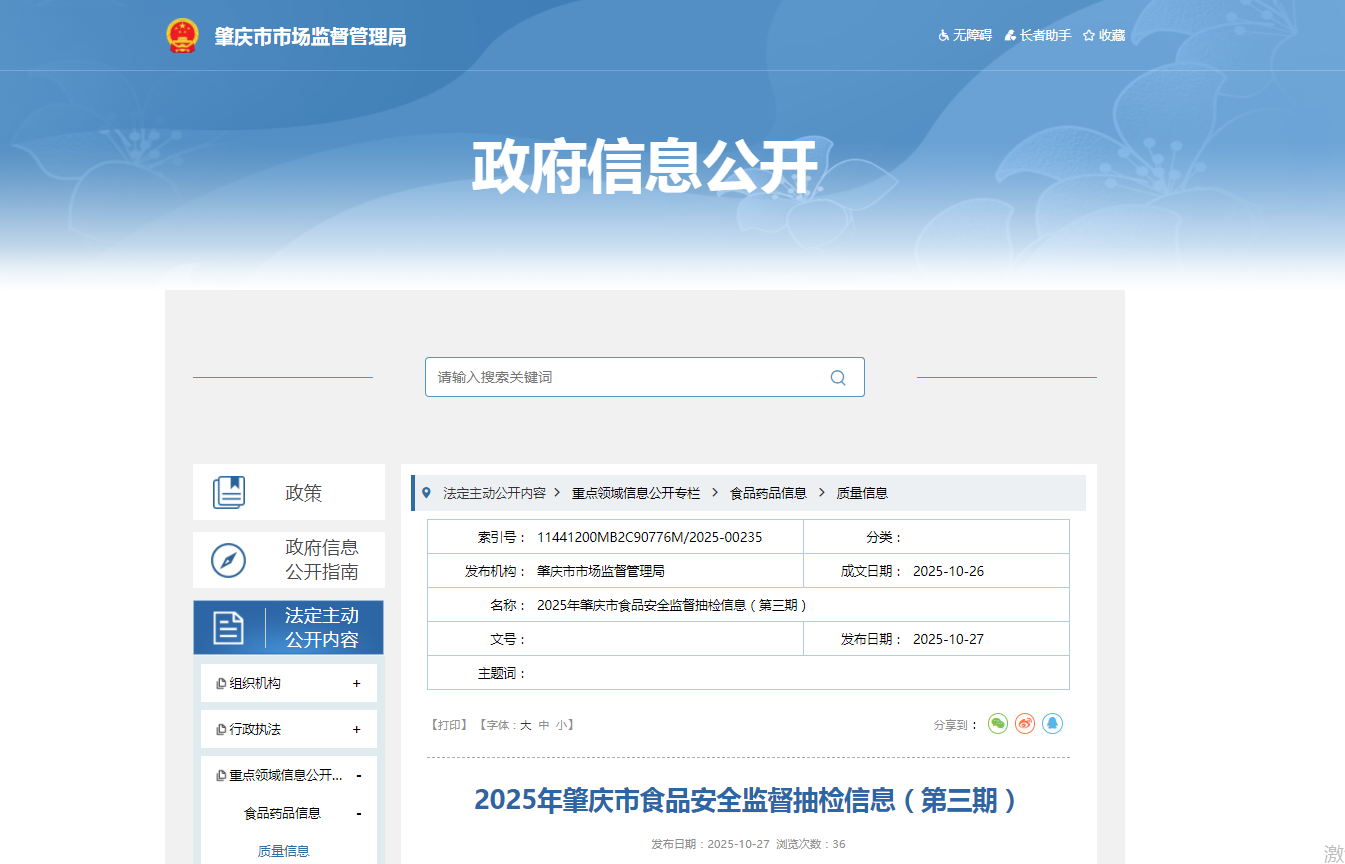
2025年广东省肇庆市食品安全监督抽检信息(第三期)
Zhong Guo Zhi Liang Xin Wen Wang· 2025-11-06 08:57
Overall Situation - Zhaoqing City Market Supervision Administration conducted a supervision sampling of 267 batches of food across 14 categories, including edible agricultural products, catering food, tea and related products, alcoholic beverages, grain products, meat products, edible oils, beverages, aquatic products, vegetable products, soybean products, food additives, bee products, and special dietary foods [2]. - Out of the 267 batches, 252 were qualified, while 15 were found to be unqualified, indicating a qualification rate of approximately 94.4% [2]. Breakdown of Unqualified Products - Among the 172 batches of edible agricultural products, 9 were unqualified [2]. - For 14 batches of catering food, 3 were unqualified [2]. - In the tea and related products category, all 22 batches were qualified [2]. - The alcoholic beverages category had 3 batches, all of which were qualified [2]. - Grain products had 3 batches, all qualified [2]. - Meat products included 10 batches, with no unqualified samples [2]. - Edible oils and related products had 5 batches, all qualified [2]. - The beverage category had 2 batches, both qualified [2]. - Aquatic products included 11 batches, with no unqualified samples [2]. - Vegetable products had 8 batches, with 3 unqualified [2]. - Food additives had 3 batches, all qualified [2]. - Soybean products included 7 batches, all qualified [2]. - Bee products had 3 batches, all qualified [2]. - Special dietary foods included 5 batches, all qualified [2]. Handling of Unqualified Products - Zhaoqing City Market Supervision Administration has mandated relevant local market supervision departments to investigate and handle unqualified food products and their producers promptly [4]. - Companies are required to trace the distribution of unqualified products, recall them, and analyze the reasons for non-compliance to implement corrective actions [4]. - Businesses must take immediate measures such as removing unqualified food from shelves to control risks and face legal consequences [4].
光明肉业(600073) - 光明肉业2025年前三季度经营数据公告
2025-10-29 08:17
证券代码:600073 证券简称:光明肉业 公告编号: 2025-045 上海光明肉业集团股份有限公司 2025 年前三季度经营数据公告 本公司董事会及全体董事保证本公告内容不存在任何虚假记载、误导性陈述或者重大遗漏, 并对其内容的真实性、准确性和完整性承担个别及连带责任。 根据上海证券交易所《上市公司自律监管指引第 3 号——行业信息披露之第十 四号——食品制造》第十四条的相关规定,现将上海光明肉业集团股份有限公司(以 下简称"公司")2025 年前三季度主要经营数据(未经审计)公告如下: 一、2025 年前三季度主要经营数据 1、主营业务分产品情况 2、主营业务分渠道情况 单位:元 币种:人民币 | 渠道类别 | 2025 年 1-9 月 | 2024 年同期 | 同比变动 | | --- | --- | --- | --- | | 直营 | 3,595,788,492.97 | 4,037,631,732.81 | -10.94% | | 分销 | 11,862,063,500.46 | 11,264,598,520.41 | 5.30% | | 其他 | 1,396,229,629.58 | 1,08 ...
Perfat Technologies获融资;奈雪进入纽约;盒马CEO将兼任CMO
Sou Hu Cai Jing· 2025-09-23 15:20
Investment Dynamics - Finnish startup Perfat Technologies raised 20.879 million RMB in Series A funding, led by Newtree Impact and Beyond Impact. The company has developed a plant oil conversion technology that transforms liquid oils into solid functional fats, reducing fat content by 80% and calories by 30% compared to traditional fats, while adding dietary fiber [3] - McDonald's plans to invest 200 million USD (approximately 1.4 billion RMB) in regenerative agriculture practices across U.S. ranches over the next seven years, covering 4 million acres across 38 states. This is the largest investment by McDonald's in the U.S. to support regenerative agriculture [5] - M Stand acquired Shanghai restaurant brand RAC BAR, which was established in 2017 and operates several locations in Shanghai. The acquisition allows RAC BAR to maintain independent operations at its original location [8][9] - Regal Food, a UK baking manufacturer, acquired soft drink brand Suncrest, known for its tropical fruit-flavored beverages. This acquisition aims to expand Regal Food's beverage product portfolio and create new growth opportunities in the UK and international markets [10][12] - Saks Global is negotiating to sell 49% of its luxury department store Bergdorf Goodman for approximately 1 billion USD. The sale could help stabilize Saks Global's financial situation, which is burdened by over 4 billion USD in debt [13][15] - Winland Foods and La Doria merged to create a new food manufacturing entity valued at 4 billion USD, named Windoria. The merger aims to enhance product offerings and strengthen the supply chain for retailers and food distributors globally [18] - SPC has reached a cooperation agreement with Fonterra to produce Fonterra brand products at its Carrum Downs factory for overseas markets. This partnership is expected to enhance the flexibility of regional supply chains in the dairy processing sector [21] - Nayuki Tea launched a pop-up store in Flushing, New York, attracting significant foot traffic in a Chinese community area. The store's location is strategically chosen due to lower rental costs compared to Manhattan and the presence of other Chinese tea brands [23] - Jean-Marc Bellaiche, former CEO of Printemps, will become the CEO of Sani/Ikos Group, a resort operator, starting January 1. His transition reflects a trend of fashion industry leaders moving into the hospitality sector [24] - Hema announced a major organizational restructuring, with CEO Yan Xiaolei also taking on the role of Chief Merchandise Officer (CMO) to enhance product development and supply chain management, aiming to strengthen Hema's competitive position in the fresh and instant retail market [28]

