
理想AD Max

Search documents
【重磅深度】2026年主流车企城市NOA试驾报告—2月上海篇
东吴汽车黄细里团队· 2026-02-13 15:40
Investment Highlights - The main contradiction in C-end automotive intelligence has shifted from coverage to experience optimization in 2026. Major intelligent driving manufacturers and solution providers have achieved urban NOA (Navigation on Autopilot) experiences in complex scenarios such as roundabouts and U-turns, and have improved advanced functions like parking and ETC passage. The primary optimization direction moving forward will be the handling capability of Corner Cases to enhance the driving experience for passengers and safety operators [2][7]. Road Testing Overview - This report conducted both large-sample concentrated road tests and small-sample in-depth road tests. It qualitatively and quantitatively evaluated the intelligent driving experiences of six manufacturers/solution providers: Horizon, Li Auto, Qianli Zhijia, Qingzhou Zhihang, WeRide, and Xpeng, based on dimensions such as scenario implementation, takeover frequency, and comfort. Due to subjective scales, actual road conditions, and the trust level of safety operators in intelligent driving, the report does not rank the intelligent capabilities of specific manufacturers/solution providers [3][7]. Performance Improvement - Compared to 2025, all major manufacturers have improved their intelligent driving capabilities in Q1 2026, while third-party suppliers have also demonstrated excellent implementation results. The self-research camp of manufacturers is expected to continue iterating. Li Auto and Xpeng have developed mature self-research solutions that cover full-scene NOA on public roads and some internal roads, showing improvements in static and dynamic lateral perception, scenario understanding, and Corner Case handling. Li Auto's OTA 8.2 iteration has made AD Max smoother, reducing driving jolts and stabilizing responses. Xpeng's XOS 5.8.5 version can achieve three-point U-turns and autonomously learn from parking to parking, with VLA 2.0 expected to launch after the Spring Festival, enhancing reasoning efficiency and response speed [4][7]. Third-Party Supplier Performance - Third-party intelligent driving suppliers have shown impressive results. Their solutions have been launched to cover all external public roads seamlessly, with roundabouts and U-turns executed without interruptions. Horizon's HSD demonstrated smooth performance, achieving a full hour of deep road testing with zero takeovers (with one intervention for acceleration). Qianli Zhijia's G-ASD solution on the Zeekr model significantly reduced takeover rates. Qingzhou Zhihang utilized a single J6M chip (with 128 TOPS computing power) to achieve mass production of urban NOA, which is the lowest computing power among urban NOA models. WeRide's solution won the championship at the China Intelligent Driving Competition in Taizhou, showcasing excellent lane selection logic with no safety takeovers [4][7].



2026年主流车企城市NOA试驾报告:2月上海篇
Soochow Securities· 2026-02-12 12:12
Investment Rating - The industry investment rating is "Overweight," indicating an expected outperformance of the industry index relative to the benchmark by more than 5% over the next six months [71]. Core Insights - The main contradiction in C-end automotive intelligence has shifted from coverage to experience optimization, with major intelligent driving manufacturers achieving urban NOA experiences in complex scenarios such as roundabouts and U-turns, and enhancing advanced features like parking and ETC passage. Future optimization will focus on handling corner cases to improve the driving experience for passengers and safety personnel [2][66]. - Compared to 2025, all major manufacturers have improved their intelligent driving capabilities in Q1 2026, with third-party suppliers also showing excellent implementation results [2][66]. - The report evaluates the intelligent driving experiences of six manufacturers, including Horizon, Ideal, Qianli Zhijia, Lightyear, WeRide, and Xiaopeng, through both large-sample and small-sample road tests, focusing on scene implementation, takeover frequency, and comfort [2][66]. Summary by Sections Road Test Overview - The report includes two types of road tests: large-sample centralized road tests and small-sample deep road tests, each with distinct advantages and limitations [6][7]. - The large-sample test involved over 30 participants and standardized routes, while the small-sample test used consistent evaluators and longer durations for a more in-depth experience [7][8]. Intelligent Driving Models Tested - The models tested in February 2026 included: - Xingtou ET5 - Ideal i6 - Geely 9X - Ideal L6 Pro - Xingtou Star Era ES - Xiaopeng X9 [8][10]. Performance Metrics - Key performance metrics evaluated include overall evaluation, takeover frequency, stability performance, and efficiency in various driving scenarios such as roundabouts and U-turns [23][41]. - The report provides detailed performance scores for each model, indicating their ability to handle complex driving situations and overall driving smoothness [41][46][50][56][61][62]. Manufacturer Insights - Horizon's HSD achieved an average score of 4.55 with a total takeover frequency of 0.16, demonstrating excellent handling of road test scenarios [41]. - Ideal's AD Max scored 3.51 with an average takeover frequency of 1.86, showcasing strong performance in stability and handling [46]. - Qianli's G-ASD scored 3.05 with a takeover frequency of 2.60, indicating good performance in complex scenarios [50]. - Lightyear's AD Pro scored 2.89 with a takeover frequency of 2.75, performing well in roundabout scenarios [56]. - WeRide's E2E scored 3.84 with a low takeover frequency of 0.70, indicating strong performance in efficiency [61]. - Xiaopeng's XNGP scored 3.64 with a takeover frequency of 1.20, showing good stability and efficiency [62].
理想汽车的智驾自研前传:「圆桌模式」与供应链骑士团
雷峰网· 2025-08-29 00:35
Core Viewpoint - Li Auto has successfully transitioned from a follower to a leader in the smart driving sector by leveraging a unique self-research model and a collaborative supply chain approach, focusing on user-centric product development and efficient organizational practices [2][3][4]. Group 1: Company Strategy and Development - Since February 2021, Li Auto has initiated comprehensive self-research in smart driving, smart cockpit, and chip development, marking a significant shift in its operational strategy [3]. - The appointment of Wang Kai as CTO was pivotal, bringing extensive experience from his previous roles, including leading the MBUX smart cockpit project at Mercedes-Benz, which generated over $1.5 billion in revenue [4][6]. - Li Auto's strategic focus on a limited number of high-quality products, akin to Apple's model, has been instrumental in its market success [5]. Group 2: Technological Advancements - Li Auto made a critical decision to switch from the Mobileye EyeQ4 chip to Horizon's J3 chip for its smart driving system, achieving a remarkable seven-month timeline for mass production [7][14]. - The launch of the self-developed smart driving system, Li AD Max, in March 2022 marked a significant milestone in Li Auto's technological evolution [8]. - By 2023, Li Auto had accumulated 1.2 billion kilometers of effective data and achieved a cloud computing power of 13 EFLOPS, showcasing its commitment to data-driven development [32]. Group 3: Supply Chain and Collaboration - Li Auto's "roundtable cooperation model" with suppliers emphasizes collaboration over competition, allowing for a more efficient and responsive supply chain [17][20]. - The company has streamlined its supplier base, focusing on elite partners to enhance operational efficiency and reduce complexity [18][19]. - This collaborative approach has led to significant growth for suppliers, with Horizon's revenue increasing from 467 million yuan in 2021 to 1.552 billion yuan in 2023 [22]. Group 4: Talent and Organizational Structure - The establishment of a dedicated smart driving team, initially comprising only 20 members, has been crucial for rapid technological advancements [25]. - Li Auto's internal structure separates research and development (RD) from product development (PD), facilitating efficient collaboration and rapid iteration [28]. - The recruitment of top talent, such as Jia Peng from NVIDIA, has strengthened Li Auto's capabilities in data management and algorithm development [27]. Group 5: Future Outlook - Li Auto aims to become a leader in smart driving by 2024, with a focus on integrating AI technologies into its vehicles [37]. - The company's commitment to continuous improvement in user experience and data utilization positions it well for future growth in the competitive automotive landscape [29][34].

智驾价格“打下去”:车企密集“亮剑”,下探到6万元车型
Bei Ke Cai Jing· 2025-03-25 09:31
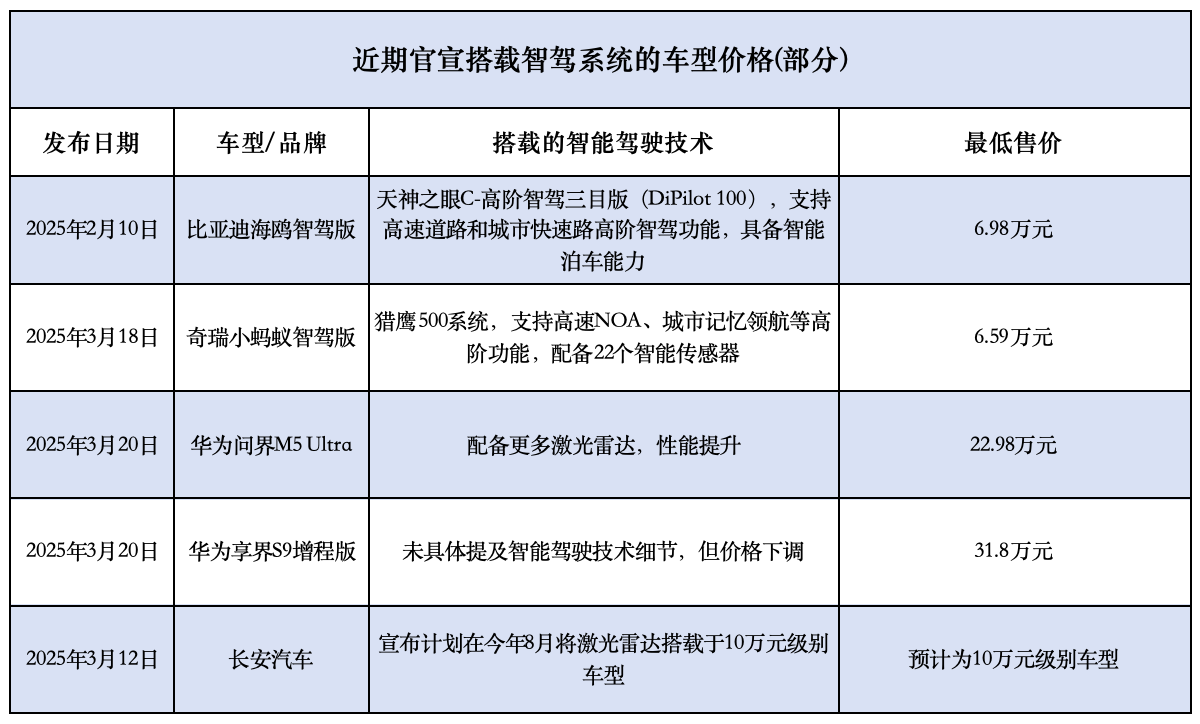
Core Viewpoint - The automotive industry is experiencing a fierce competition in the smart driving sector, with companies like BYD and Chery introducing advanced driving technologies at increasingly lower price points, marking a significant shift in market dynamics [1][4][6]. Group 1: Price and Technology Competition - BYD has introduced its high-end smart driving system in models priced at 69,800 yuan, while Chery has followed suit by offering smart driving features in models starting at 65,900 yuan [3][4]. - Multiple companies, including Huawei, Chery, and GAC, have recently held smart driving technology launch events, emphasizing a strategy of "no lowest, only lower" pricing [2][6]. - The introduction of smart driving technology in lower-priced models is seen as a "dimensionality reduction strike," significantly lowering the entry barrier for consumers [6]. Group 2: Features and Specifications - Chery's new model, the small ant smart version, is equipped with 22 intelligent sensors and supports 23 smart driving functions, including automatic parking and high-speed navigation [5][6]. - The BYD Seagull model features the "Tian Shen Eye" high-end smart driving system, which is the first of its kind in a vehicle priced under 70,000 yuan [7]. Group 3: Market Trends and Predictions - The competition is expected to intensify as more automakers, like Changan, plan to introduce smart driving features in models priced at 100,000 yuan and below [8]. - Analysts suggest that the increasing maturity of sensor technologies, such as millimeter-wave and ultrasonic radars, is driving down the costs of smart driving systems, making them more accessible [9][10]. - The penetration rate of L2 and above smart driving new cars is projected to exceed 60% by 2025, with L3 level vehicles accounting for 8.5% of the market [22].

理想汽车(02015) - 自愿公告2024年11月交付更新资料
2024-12-01 10:06
在20萬元以上乘用車市場,理想汽車連續八個月獲得中國品牌銷量冠軍。理想 L6累計交付量突破16萬輛,自6月起蟬聯20萬元以上中國品牌車型銷量第一。此 外,理想汽車智駕技術的迭代帶動搭載理想AD Max的車型需求增長,11月,30 萬元以上車型及40萬元以上車型中,搭載理想AD Max的定單佔比分別超過70% 和80%。11月,理想汽車推送OTA 6.5版本車機系統,基於端到端(E2E)+視覺語 言模型(VLM)技術的「車位到車位」一鍵智駕已向AD Max用戶開啟全量推送。 截至2024年11月30日,理想汽車在全國已有475家零售中心,覆蓋141個城市;售 後維修中心及授權鈑噴中心451家,覆蓋223個城市。理想汽車在全國已投入使用 1,135座理想超充站,擁有5,680個充電樁。 香港交易及結算所有限公司及香港聯合交易所有限公司對本公告的內容概不負責,對其準確性 或完整性亦不發表任何聲明,並明確表示概不會就本公告全部或任何部分內容而產生或因倚賴 該等內容而引致的任何損失承擔任何責任。 Li Auto Inc. 理想汽車 (於開曼群島註冊成立以不同投票權控制的有限責任公司) (股份代號:2015) 自願公告 ...