
生成式AI智能手机

Search documents
全球生成式 AI 消费支出将大幅增长, 2030 年逼近 7000 亿美元,但能否满足投资者预期仍存疑
Counterpoint Research· 2025-12-25 06:14
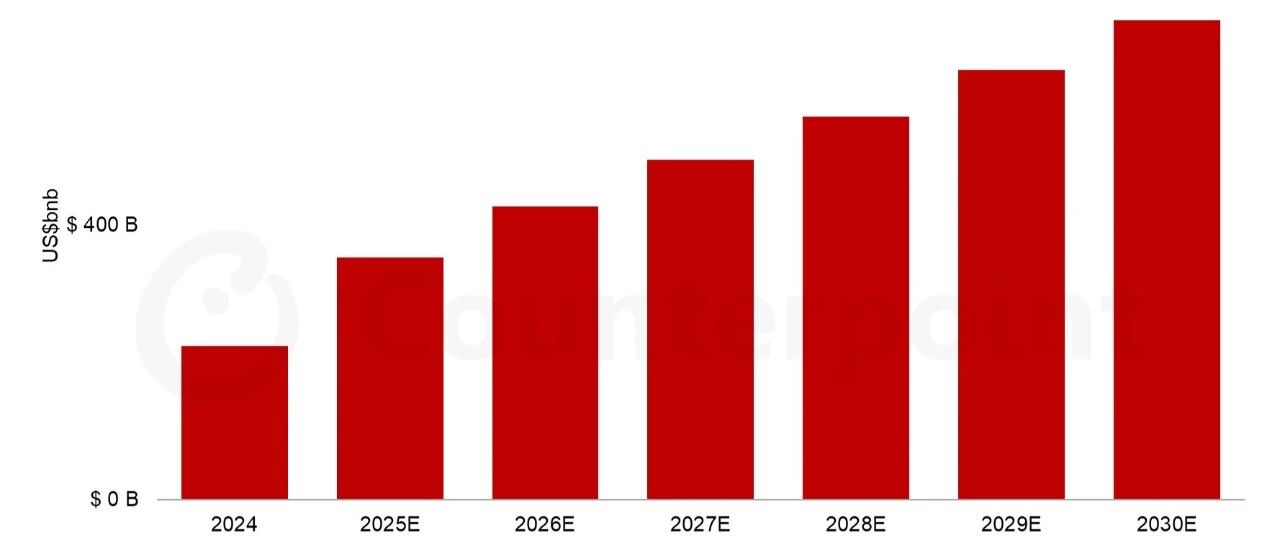
Core Insights - The report from Counterpoint Research highlights that consumer spending in the generative AI sector is rapidly reshaping the global technology landscape, with significant growth expected in both AI software and the hardware required to run it [5][6] - AI hardware is projected to maintain the largest share of overall consumer spending, driven by the integration of AI functionalities in personal devices [5][6] - The global generative AI smartphone shipment is expected to grow at a compound annual growth rate (CAGR) of 26% from 2023 to 2030, with corresponding revenue growth at a CAGR of 16% [5][7] AI Software Market - The consumer AI software market is anticipated to expand significantly, primarily due to a substantial increase in user base, with monthly active users of AI dialogue platforms expected to reach nearly 5 billion during the forecast period [5][7] - The competition among large language model (LLM) providers is intensifying, and notable changes in market dynamics and shares are expected throughout the forecast period [7] Hardware and Software Dynamics - While AI hardware spending is expected to remain strong in the coming years, the success of the next generation of the AI ecosystem will largely depend on the growth of software spending [6] - High-end smartphones will continue to support revenue until 2030, but growth in shipments is increasingly driven by mid-range models, indicating a trend towards broader AI capability adoption [6] Market Growth Projections - Global generative AI consumer spending is projected to increase from $225 billion in 2023 to $699 billion by 2030, with an overall CAGR of 21% [7] - The AI dialogue platform segment is identified as the fastest-growing area, with personal assistant AI and content generation tools also expected to see significant expansion [7] Industry Challenges - A key question facing the industry is whether the rapid market growth justifies the unprecedented capital investments in the sector [8]

中金2026年展望 | 马来西亚:林吉特强势,新叙事催化增长
中金点睛· 2025-12-23 23:36
Core Viewpoint - Malaysia's economy is projected to grow at 4.7% in 2025, supported by a strong labor market and sustained consumer spending, despite external pressures from geopolitical factors affecting key exports [2][6]. Group 1: Economic Outlook - The Malaysian economy is expected to maintain resilience with a GDP growth target of 4.5% to 5.5% set for the 13th Malaysia Plan (2026-2030), driven by sectors such as AI, semiconductors, and tourism [3][12]. - The unemployment rate has dropped to a ten-year low, contributing to robust consumer spending [2][6]. - The overnight policy rate (OPR) is likely to remain at 2.75% through the end of 2025 and early 2026, as current monetary policy supports economic growth [12][19]. Group 2: Capital Markets - The FBMKLCI index underperformed compared to regional markets in 2025, primarily due to weak earnings growth expectations and a lack of new tech IPOs [4][23]. - Despite the Malaysian ringgit appreciating by 8.8% against the US dollar in 2025, the market valuation remains below the ten-year average, indicating potential for upward movement [4][32]. - Foreign capital inflow may provide support for the market, as the ringgit's strength enhances the attractiveness of Malaysian assets [36][40]. Group 3: Investment Themes - Key investment opportunities are identified in sectors driven by AI capital expenditure, subsidies, and policy initiatives, including: - **Electrical and Electronics**: The sector is expected to benefit from a doubling of electronic exports to 1 trillion ringgit by 2030, supported by the national semiconductor strategy [5][48]. - **Digital Infrastructure**: Major investments in data centers by tech giants are anticipated to boost demand in the power and construction sectors [5][48]. - **Modern Retail**: Government subsidy programs are expected to enhance consumer spending and support retail growth [5][48]. - **Tourism Services**: The 2026 Malaysia Tourism Year aims to attract 47 million visitors and generate 329 billion ringgit in tourism revenue, with government support for infrastructure and promotional activities [5][49].

生成式AI重塑手机市场!消费电子ETF上涨2.19%,歌尔股份上涨8.84%
Sou Hu Cai Jing· 2025-08-18 02:40
Group 1 - The A-share market saw a collective rise on August 18, with the Shanghai Composite Index increasing by 0.66%, driven by strong performances in the communication, comprehensive, and computer sectors, while real estate and banking sectors lagged [1] - The Consumer Electronics ETF (159732.SZ) rose by 2.19%, with notable gains from its constituent stocks such as GoerTek (up 8.84%), Lianyi Intelligent Manufacturing (up 8.10%), and Hengxuan Technology (up 6.47%) [1] - According to Counterpoint Research's "AI 360 Service Forecast Report," it is projected that by 2025, one-third of global smartphone shipments will support Generative AI (GenAI), with total shipments expected to exceed 400 million units, up from one-fifth in 2024 [1] Group 2 - Dongwu Securities reports that the emergence of Generative AI smartphones is driving a new generation of smart terminal upgrades, with numerous companies set to launch flagship AI smartphones starting in 2024 [2] - The demand for edge AI capabilities is increasing, with AI features initially being integrated into high-end products, indicating a strategic shift among major manufacturers towards high-end market positioning [2] - The Consumer Electronics ETF (159732) tracks the Guozheng Consumer Electronics Index, primarily investing in 50 A-share listed companies involved in the consumer electronics industry, with significant focus on electronic manufacturing and optical optoelectronics sectors [2]


东吴证券:人工智能产业处于快速发展阶段 关注消费电子增长潜力
智通财经网· 2025-08-10 07:49
Group 1: AI Industry Overview - The AI industry has transitioned from exploration and growth phases to a rapid development stage, with China's generative AI user base reaching 249 million, accounting for 17.7% of the total population [1] - The global AI market size increased from $1,917 billion in 2019 to $4,732.7 billion in 2023, with expectations to exceed $11.6 trillion by 2027 [1] - China's AI market is projected to surpass 400 billion yuan by 2025, driven by large models, embodied intelligence, and smart driving [1] Group 2: AIPC and AI Applications - AIPC represents an intelligent revolution in productivity tools, with PCs naturally aligning with AI large models due to their computing power, storage capacity, and diverse application scenarios [2] - AIPC applications are expanding from traditional sectors like office and entertainment to education, healthcare, and finance [2] Group 3: Wearable Devices - Wearable devices are not just hardware but also integrate software and cloud interactions to enhance functionality, including smart glasses, smartwatches, and smart bands [4] - These devices enable users to monitor their health and environment seamlessly, covering areas such as health management, social interaction, and mobile payments [4] Group 4: AI Smartphones - Starting in 2024, numerous companies will launch flagship AI smartphones, with a growing demand for edge AI capabilities in high-end products [6] - The AI capabilities are becoming a key factor for smartphone manufacturers to move towards high-end market positioning [6] Group 5: AI in Home Appliances - In 2024, major e-commerce platforms will see significant sales in AI home appliances, with large appliances leading at 6.05 billion yuan [8] - The integration of IoT technology in smart homes is intensifying competition and collaboration between the home appliance and technology industries [8]

北交所AI产业链深度报告系列:消费电子
Soochow Securities· 2025-08-08 09:21
Investment Rating - The report does not explicitly state an investment rating for the industry or specific companies Core Insights - The AI industry is currently in a rapid development phase, with global market size expected to grow from $191.7 billion in 2019 to $473.27 billion in 2023, and projected to exceed $11.6 trillion by 2027 [5][19] - China's AI market is anticipated to surpass 400 billion yuan by 2025, driven by large models, embodied intelligence, and intelligent driving [5][19] - The AI industry chain is categorized into three layers: foundational, technical, and application [5][26] Summary by Sections 1. AI Industry Development - The AI industry has evolved through exploration and growth phases over the past two decades, now entering a rapid development stage [5][14] - China's AI development has been recognized as a national strategic project since 2016, with significant government support [5][14] 2. AIPC: Intelligent Revolution of Productivity Tools - AIPC (AI Personal Computer) is seen as a natural match for AI large models due to its strong computing and storage capabilities [5][28] - The application scenarios for AIPC are expanding into education, healthcare, and finance [5][36] 3. AI Wearable Devices - Wearable devices are not just hardware but integrate software and data interaction to enhance user experience [5][52] - The market for wearable devices in China is expected to grow significantly, with a projected CAGR of 13.8% from 2024 to 2029 [5][54] 4. Generative AI Smartphones - The market for generative AI smartphones is rapidly expanding, with major brands launching flagship models [5][77] - By 2025, it is expected that one-third of global smartphone shipments will support generative AI capabilities [5][82] 5. AI-Driven Home Appliances - The sales of AI-enabled home appliances are increasing, with major appliances leading in e-commerce sales [5][7] - Smart home technology is fostering collaboration and competition between the home appliance and technology industries [5][7] 6. Key Companies to Watch - Companies such as 雷神科技 (Thunderobot) and 泓禧科技 (Hongxi Technology) are highlighted for their roles in the AI and consumer electronics sectors [5][42][47] - 卓兆点胶 (Zhuozhao Technology) and 豪声电子 (Haosheng Electronics) are noted for their contributions to precision manufacturing and audio components, respectively [5][61][70]