AI对话平台

Search documents
对话复旦大学金立印教授:从通用到专用,AI正在淘汰那些“无库”企业
3 6 Ke· 2026-01-08 23:32
Core Insights - The accuracy of AI output is heavily dependent on the quality of the knowledge base provided to it, with high-quality structured industry knowledge leading to precise outputs [1] - The concept of "All In AI" is gaining consensus across industries by 2025, but issues like AI hallucinations and limitations remain unresolved, posing economic risks to businesses [1] - A proposed solution is the construction of proprietary knowledge bases for companies, which can transform AI from a generalist tool into a strategic asset [1] Group 1: Changes in Consumer Behavior - AI is not changing consumer behavior but rather the way businesses connect with consumers, with fundamental consumer needs remaining stable [2][3] - The shift in consumer behavior is evident in the decline of traditional search engine traffic as AI tools become more prevalent, affecting marketing strategies and budget allocations [2][3] Group 2: Marketing Strategy Evolution - The marketing landscape is undergoing a fundamental shift, with traffic moving from traditional search engines to AI dialogue platforms, necessitating a reevaluation of marketing strategies [4] - Brands must adapt their strategies to ensure they are recommended by AI during the early stages of consumer decision-making [4] Group 3: AI Insights and Knowledge Base - The depth of AI insights is determined by the capabilities of the users and the richness of the company's knowledge base, rather than solely by the AI technology itself [5][6] - Companies need to establish high-quality, structured internal knowledge systems to enhance AI's ability to generate unique insights [9][10] Group 4: Organizational Transformation - The rise of AI will lead to a structural transformation in marketing organizations, with traditional roles diminishing and new roles like knowledge base designers and prompt engineers emerging [12][13] - Marketing teams will need to develop new capabilities, including understanding AI logic and translating business goals into effective AI instructions [13][14] Group 5: Future of AI in Marketing - AI is expected to generate not just content but also market strategies, identifying gaps in consumer needs and suggesting new product categories [15][16] - The quality of AI-generated strategies will depend on the quality and depth of the knowledge fed into the AI, emphasizing the importance of a robust knowledge base [16][20] Group 6: Actionable Recommendations - Companies should embrace AI with an open mindset, invest in building structured knowledge bases, and implement a feedback loop for continuous improvement in AI capabilities [20]
贾国龙后悔正面硬刚罗永浩|首席资讯日报
Xin Lang Cai Jing· 2025-12-26 05:05
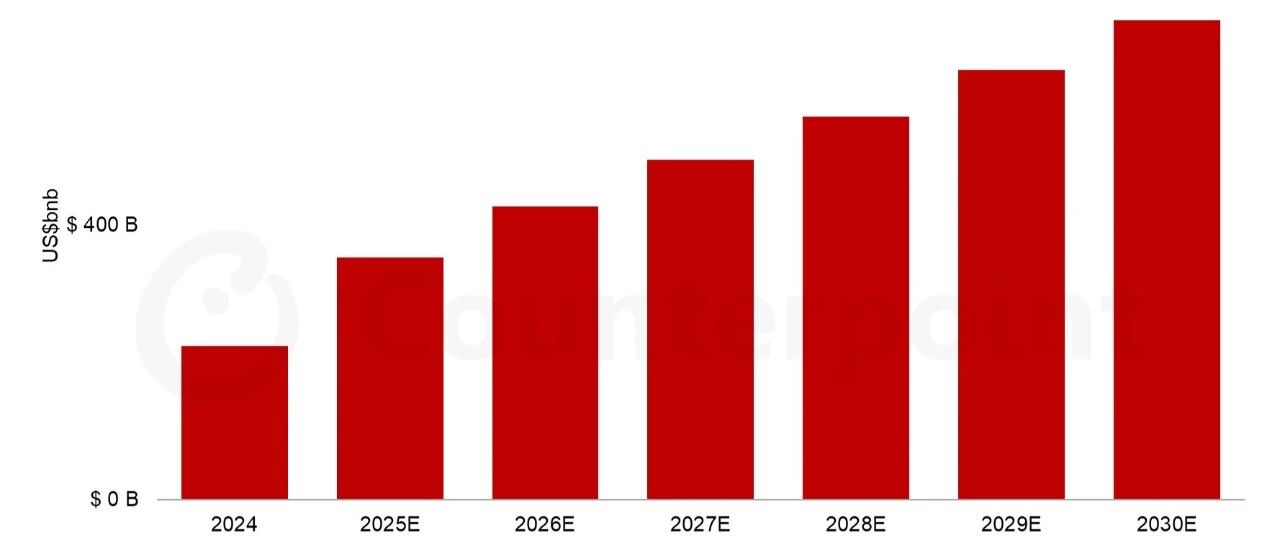
Group 1 - JD Logistics has launched its first overseas automated warehouse in the UK, covering over 3,000 square meters and deploying nearly 200 robots, achieving a fourfold increase in picking and shipping efficiency [1] - Counterpoint Research forecasts global generative AI consumer spending to grow from $225 billion in 2023 to $699 billion by 2030, with a compound annual growth rate (CAGR) of 21%, particularly in AI dialogue platforms [2] - The Jiangsu Province held a meeting to promote the embodied intelligent robotics industry, emphasizing a long-term and systematic approach to develop the industry, including establishing industry alliances and public platforms [15] Group 2 - The new CEO of Oriental Selection, Sun Jin, has been appointed, which may pave the way for the company's expansion into the cultural tourism sector [17] - The National Grid is expected to exceed 650 billion yuan in fixed asset investment in 2025, marking a historical high, with a total investment of over 2.85 trillion yuan planned during the 14th Five-Year Plan [20] - The rental price for some robots has halved, with basic models now available for as low as 200 yuan per day, reflecting significant changes in the rental market due to supply and demand dynamics [21]
英伟达回应:未收购Groq,聘请了Groq人才加入英伟达;机构预计2030年全球生成式AI消费支出达6990亿美元丨AIGC日报
创业邦· 2025-12-26 00:08
Group 1 - The core viewpoint of the article highlights the significant growth potential of generative AI, with global spending expected to rise from $225 billion in 2023 to $699 billion by 2030, reflecting a compound annual growth rate (CAGR) of 21% [2] - The fastest-growing segment within generative AI is AI dialogue platforms, with personal assistant AI and content generation tools also anticipated to expand significantly [2] - By 2030, the number of monthly active users (MAUs) for global AI dialogue platforms is projected to exceed 5 billion [2] Group 2 - NVIDIA has clarified that it has not acquired AI chip manufacturer Groq for approximately $20 billion, but has instead obtained a non-exclusive license for Groq's intellectual property and hired engineering talent from Groq [2] - DingTalk announced plans to create a monetizable AI market by fully opening its computing power, industry models, and AI capabilities, boasting a cost advantage of 5%-50% compared to mainstream AI computing service solutions [2] - The number of core developers in the Ascend open-source community has surpassed 52,000, with over 120,000 service code contributions and cumulative downloads of over 13 million, covering more than 150 countries and regions [2]



影响市场重大事件:上海加速航空航天产业发展,支持卫星互联网星座建设;我国创造超导电动磁悬浮推进世界纪录
Mei Ri Jing Ji Xin Wen· 2025-12-25 22:29
Group 1: Aerospace and Technology Development - Shanghai is accelerating the development of the aerospace industry, supporting satellite internet constellation construction with funding up to 15% of total investment, capped at 50 million yuan [1] - Shanghai is creating a national 6G comprehensive testing base to promote 6G technology research and development, providing funding support up to 30% of total investment, capped at 30 million yuan [4] - The global spending on generative AI is expected to grow from 225 billion yuan in 2023 to 699 billion yuan by 2030, with a compound annual growth rate (CAGR) of 21% [5] Group 2: Financial Support and Economic Development - Guangdong has released "Twelve Measures" to support the low-altitude economy, encouraging banks and insurance institutions to develop targeted financial products for the entire lifecycle of low-altitude economic activities [2] - The Hainan Free Trade Port has seen over 400 million yuan in zero-tariff imports during its first week of closure, with a significant increase in duty-free shopping, reflecting the positive impact of the new policies [8] Group 3: Infrastructure and Asset Management - Shanghai is focusing on enhancing regional computing power infrastructure, promoting the layout of intelligent computing centers to improve supply and demand matching [10] - The State Administration for Market Regulation has approved four national standards for asset management, focusing on digital transformation and providing guidance for organizations to enhance their asset management capabilities [11]
全球生成式AI:2023 - 2030年支出增超4700亿美元
Sou Hu Cai Jing· 2025-12-25 07:10
Core Insights - Global generative AI consumer spending is projected to increase from $225 billion in 2023 to $699 billion by 2030, with a compound annual growth rate (CAGR) of 21% [1] Segment Analysis - The AI dialogue platform is identified as the fastest-growing segment within the generative AI market [1] - Personal assistant AI and content generation tools are also expected to see significant expansion [1] - By 2030, the monthly active users (MAUs) of global AI dialogue platforms are anticipated to exceed 5 billion [1]
Counterpoint:预计2030年全球生成式AI消费支出将达到6990亿美元
Zhi Tong Cai Jing· 2025-12-25 06:32
Core Insights - Consumer spending in generative AI is rapidly reshaping the global tech industry, with projections indicating an increase from $225 billion in 2023 to $699 billion by 2030, reflecting a compound annual growth rate (CAGR) of 21% [1] Group 1: Market Growth - The report highlights that both consumer-facing AI software and the hardware required for its operation will experience significant growth in the coming years [1] - The AI dialogue platform is identified as the fastest-growing segment, with personal assistant AI and content generation tools also expected to expand significantly [1] - By 2030, the number of monthly active users (MAUs) for global AI dialogue platforms is projected to exceed 5 billion [1] Group 2: Hardware and Software Dynamics - AI hardware will continue to dominate overall consumer spending, driven by the integration of AI functionalities in personal devices [4] - From 2023 to 2030, global shipments of generative AI smartphones are expected to grow at a CAGR of 26%, with corresponding revenue growth at 16% [4] - The consumer AI software market is anticipated to show even greater growth potential, primarily due to a significant increase in user base [4] Group 3: Competitive Landscape - The competitive landscape at the platform level indicates that while OpenAI is expected to maintain a leading user base, Google and Microsoft are projected to experience the most significant growth in monthly active users during the forecast period [4] - Beyond AI dialogue platforms, other AI application markets, including AI art generation tools, companion applications, and photo editing software, also exhibit strong growth momentum [4] Group 4: Market Evolution - Generative AI is evolving from a "high-end differentiated feature" to a "mainstream market standard" [5] - Although high-end smartphones will remain the primary revenue driver until 2030, growth in shipments is increasingly being driven by mid-range devices, indicating a trend towards broader AI capability adoption [5] - Emerging forms such as laptops, XR devices, and AI-native terminals, while currently limited in scale, are expected to become important growth areas, pushing the AI hardware ecosystem towards greater diversification beyond smartphones [5]
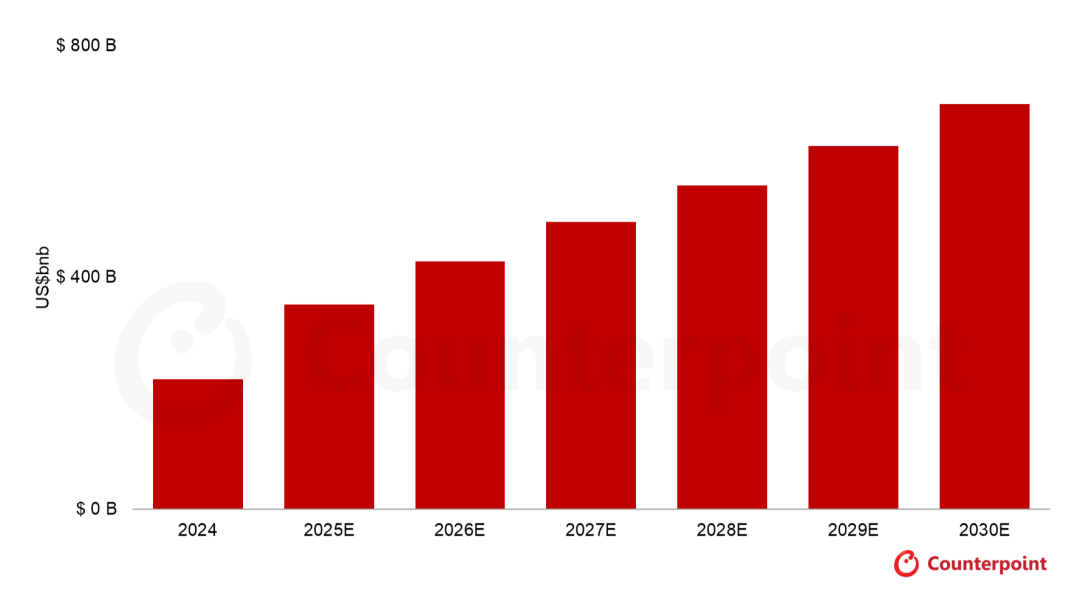
全球生成式 AI 消费支出将大幅增长, 2030 年逼近 7000 亿美元,但能否满足投资者预期仍存疑
Counterpoint Research· 2025-12-25 06:14
Core Insights - The report from Counterpoint Research highlights that consumer spending in the generative AI sector is rapidly reshaping the global technology landscape, with significant growth expected in both AI software and the hardware required to run it [5][6] - AI hardware is projected to maintain the largest share of overall consumer spending, driven by the integration of AI functionalities in personal devices [5][6] - The global generative AI smartphone shipment is expected to grow at a compound annual growth rate (CAGR) of 26% from 2023 to 2030, with corresponding revenue growth at a CAGR of 16% [5][7] AI Software Market - The consumer AI software market is anticipated to expand significantly, primarily due to a substantial increase in user base, with monthly active users of AI dialogue platforms expected to reach nearly 5 billion during the forecast period [5][7] - The competition among large language model (LLM) providers is intensifying, and notable changes in market dynamics and shares are expected throughout the forecast period [7] Hardware and Software Dynamics - While AI hardware spending is expected to remain strong in the coming years, the success of the next generation of the AI ecosystem will largely depend on the growth of software spending [6] - High-end smartphones will continue to support revenue until 2030, but growth in shipments is increasingly driven by mid-range models, indicating a trend towards broader AI capability adoption [6] Market Growth Projections - Global generative AI consumer spending is projected to increase from $225 billion in 2023 to $699 billion by 2030, with an overall CAGR of 21% [7] - The AI dialogue platform segment is identified as the fastest-growing area, with personal assistant AI and content generation tools also expected to see significant expansion [7] Industry Challenges - A key question facing the industry is whether the rapid market growth justifies the unprecedented capital investments in the sector [8]