
白银ETF(iShares Silver Trust)

Search documents
1月21日iShares白银持仓量较上日减少56.38吨
Xin Hua Cai Jing· 2026-01-22 01:13
Group 1 - The largest silver ETF, iShares Silver Trust, saw a decrease in holdings by 56.38 tons as of January 21, bringing the current holdings to 16,166.1 tons [1]
1月20日iShares白银持仓量较上日增加149.42吨
Xin Hua Cai Jing· 2026-01-21 01:10
Group 1 - The iShares Silver Trust, the world's largest silver ETF, increased its holdings by 149.42 tons as of January 20, bringing the total holdings to 16,222.48 tons [1]
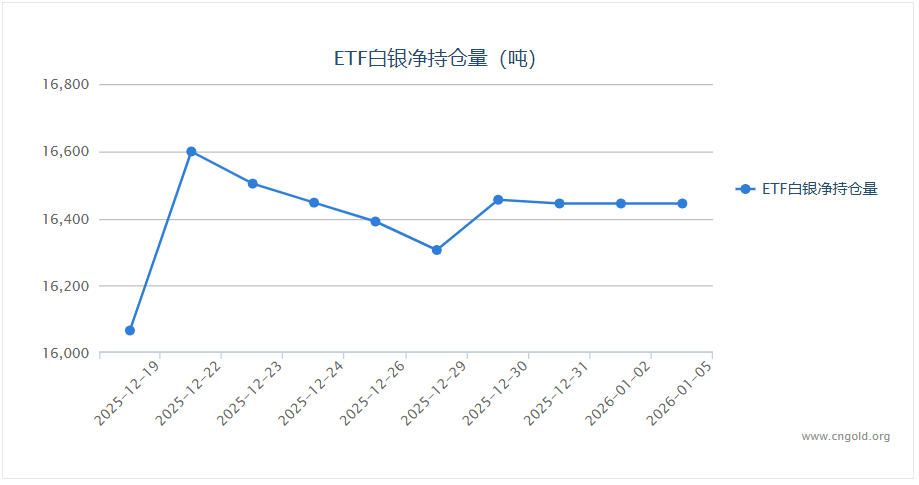
【白银etf持仓量】1月5日白银ETF较上一交易日减少90.54吨
Jin Tou Wang· 2026-01-06 08:09
Core Insights - The BlackRock Investment Institute indicates that the U.S. economic data schedule is returning to normal after delays caused by last year's government shutdown, which aids investors in assessing economic conditions, particularly labor market data [2] - The December employment report is set to be released on Friday, with analysts from The Wall Street Journal forecasting an increase of 73,000 jobs in December, up from 64,000 in November, making this data crucial for determining the Federal Reserve's next policy moves [2] Economic Data Recovery - The return to a normal economic data schedule is expected to clarify the labor market situation, which had been obscured by previous delays [2] - The focus on December's employment data is significant for market participants as it serves as a key indicator for future Federal Reserve policy decisions [2] Employment Forecast - Analysts predict a rise in non-farm payrolls for December to 73,000, indicating a positive trend in job creation compared to the previous month's figure of 64,000 [2] - This employment data is critical for market assessments regarding the Federal Reserve's monetary policy direction [2]

白银逼空行情结束了?
Sou Hu Cai Jing· 2026-01-03 04:18
Core Viewpoint - The Chicago Mercantile Exchange (CME) has raised the initial margin requirements for COMEX silver futures for the third time in two weeks, leading to a decline in silver prices to around $71 per ounce. This move is part of a broader trend of speculative capital entering the silver futures market amid tight physical silver supply [2][3][19]. Group 1: Margin Adjustments and Price Movements - CME has increased the initial margin for non-high-risk silver futures to $32,500 per contract and for high-risk positions to $35,750 per contract [2]. - Following these adjustments, COMEX silver futures prices fell from a peak of $82.67 per ounce to approximately $71 per ounce [19]. - The price of silver futures has seen an 83% increase since November 2025, driven by speculation and tight physical supply [3]. Group 2: Supply and Demand Dynamics - The current silver squeeze began in October 2025, triggered by rumors of significant purchases in the London market, leading to a shortage of physical silver [4][5]. - Major banks like JPMorgan and Goldman Sachs are involved in both physical silver transactions and holding large short positions in COMEX silver futures, creating a complex market dynamic [6][8]. - The structural supply-demand imbalance in the silver market has resulted in a cumulative supply gap of approximately 790 million to 820 million ounces over the past five years [14]. Group 3: Market Reactions and Speculation - Speculative interest has surged, with social media discussions amplifying the "squeeze" sentiment, leading to increased participation from retail investors [3][10]. - The trading volume of bullish options on major silver ETFs has reached levels not seen since 2021, indicating heightened investor interest [10]. - A significant transfer of silver from registered to eligible inventory on COMEX has further signaled tightening supply conditions [8]. Group 4: Historical Context and Future Outlook - Historical instances of silver squeezes occurred in the late 1970s and early 2010s, often curtailed by margin increases and monetary policy shifts [20][21]. - Current market analysts suggest that a combination of tighter monetary policy from the Federal Reserve and further margin increases from CME may be necessary to address the ongoing silver squeeze [21]. - Despite the recent price corrections, some analysts believe that silver prices could still exceed $100 per ounce in the short term due to continued speculative interest [16][21].

白银反弹4%,此前为何突然暴跌?对冲基金老将警示了五大短期风险
美股研究社· 2025-12-31 11:25
Core Viewpoint - The silver market is experiencing significant volatility, with recent price fluctuations highlighting both short-term risks and long-term bullish fundamentals [2][5]. Short-term Risks - The first risk is tax-driven selling, as investors holding substantial unrealized gains may sell before year-end to benefit from long-term capital gains tax rates, leading to potential profit-taking in early January [8]. - The second risk involves a strengthening dollar, driven by strong GDP growth data, which typically exerts pressure on dollar-denominated commodities like silver [9]. - The third risk is the increase in margin requirements announced by the Chicago Mercantile Exchange, which could reduce leverage and speculative demand, although current margin levels are still lower than those seen during the 2011 silver price crash [10][11]. - The fourth risk is technical selling due to silver being perceived as "overbought," although this assessment is challenged by the underlying demand from the solar industry [12]. - The fifth risk is the potential for copper to replace silver in industrial applications, particularly in solar manufacturing, although this transition would take several years [14]. Market Dynamics - A technical pressure is anticipated from the upcoming rebalancing of the Bloomberg Commodity Index, which may force passive funds to sell approximately 9% of their silver futures positions, coinciding with the tax-driven selling window [17]. Long-term Fundamentals - Despite short-term risks, the long-term outlook for silver remains strong, supported by structural supply-demand imbalances. Current spot prices in markets like Dubai and Shanghai are significantly higher than COMEX futures prices, indicating tightness in the physical market [19]. - Investment demand is also robust, with speculative net long positions in silver being lower than in gold, suggesting room for price increases. Silver ETFs are seeing renewed inflows, indicating a shift towards silver as a monetary asset [21]. - The solar industry is projected to drive substantial increases in silver demand, with expectations of 290 million ounces in 2025 and 450 million ounces by 2030, marking a significant change in the market dynamics after years of stagnant demand [21][24].
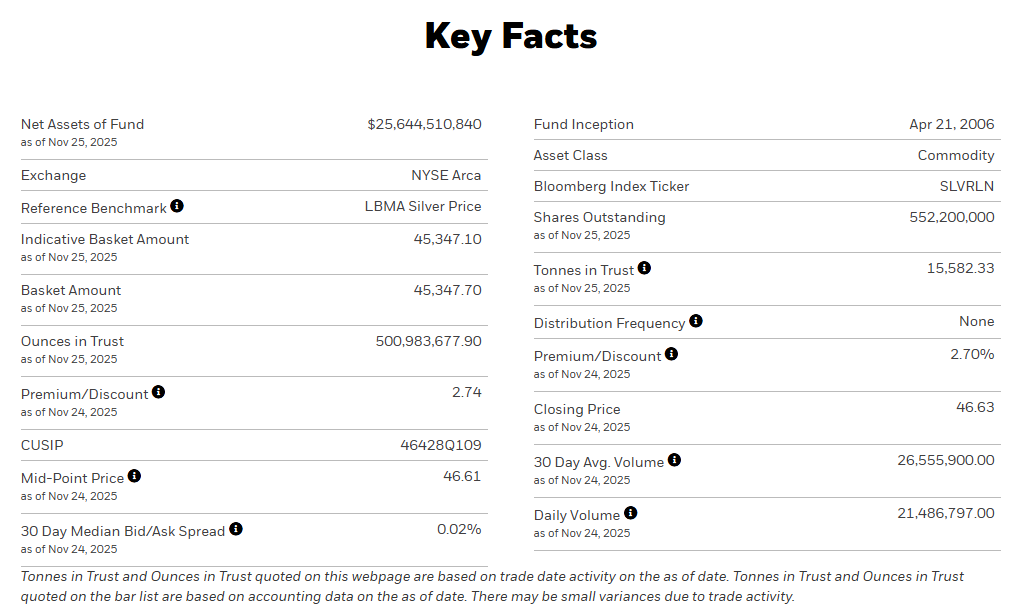
截至11月25日 全球最大的白银ETF——iShares Silver Trust的白银持仓量为15,582.33吨
Xin Hua Cai Jing· 2025-11-25 23:09
Core Insights - The fund has net assets totaling $25.64 billion as of November 25, 2025, indicating a significant scale in the commodity asset class [2] - The fund was established on April 21, 2006, and has been operational for nearly two decades [2] - The fund is traded on the NYSE Arca and is benchmarked against the LBMA Silver Price [2] Fund Performance Metrics - As of November 25, 2025, the fund has 552.2 million shares outstanding and holds 15,582.33 tonnes of silver in trust [2] - The indicative basket amount is reported at 45,347.10, with a closing price of $46.63 as of November 24, 2025 [2] - The fund's premium/discount was 2.70% on November 25, 2025, slightly down from 2.74% the previous day [2] Trading Activity - The 30-day average trading volume stands at approximately 26.56 million shares, with a daily volume of about 21.49 million shares as of November 24, 2025 [2] - The 30-day median bid/ask spread is recorded at 0.02%, indicating low trading costs for investors [2]
10月8日iShares白银持仓量较上日增加19.76吨
Xin Hua Cai Jing· 2025-10-09 06:18
Core Insights - As of October 8, the world's largest silver ETF, iShares Silver Trust, increased its holdings by 19.76 tons, bringing the total holdings to 15,415.53 tons [1] Summary by Category - **ETF Holdings** - iShares Silver Trust's holdings rose by 19.76 tons [1] - Current total holdings stand at 15,415.53 tons [1]
美联储“鸽”派转向 贵金属价格上行
Qi Huo Ri Bao· 2025-08-26 00:26
Core Viewpoint - The precious metals market, particularly gold and silver, is experiencing a positive trend due to expectations surrounding the Federal Reserve's monetary policy shift, with gold showing reduced sensitivity to these changes while silver remains highly responsive [1][3]. Group 1: Precious Metals Performance - Gold futures saw a slight increase of 0.46%, while silver futures rose by 1.89% [1]. - Analysts indicate that silver's price is significantly influenced by its industrial applications and domestic macroeconomic policies, leading to greater volatility compared to gold [1]. - The strong performance of copper is also contributing positively to silver prices, as both metals often exhibit correlated price movements [1]. Group 2: Silver Demand and Market Sentiment - The solar photovoltaic industry's explosive growth has increased silver demand, with photovoltaic silver paste accounting for over 20% of total silver demand [2]. - The global silver supply-demand gap is projected to exceed 5,000 tons by 2025, driven by demand from electric vehicles and 5G electronics [2]. - The gold-silver ratio has decreased from over 100 to below 90, indicating a relative undervaluation of silver compared to gold, attracting more investment into silver [2]. Group 3: Economic Indicators and Federal Reserve Policy - Upcoming U.S. PCE data is a focal point for the market, with expectations that core PCE year-on-year growth will fall to around 3.0%, aligning with the Fed's "soft landing" scenario [3]. - Recent comments from Fed Chair Powell have shifted market expectations towards a dovish stance, with significant anticipation for rate cuts in September and December 2025 [3][4]. - The market has nearly fully priced in the Fed's expected rate cuts, leading to a cautious outlook on the continued rebound of precious metals [4]. Group 4: Long-term Outlook for Gold and Silver - In the context of ongoing geopolitical instability and the trend of "de-dollarization," central bank gold purchases are expected to support long-term gold price increases [4][5]. - The demand for gold as a safe-haven asset remains strong due to uncertainties in U.S. trade policies and geopolitical tensions, which are likely to benefit gold prices [5]. - The low correlation of gold with other asset classes enhances its appeal for portfolio diversification and risk hedging, sustaining ongoing demand for gold investments [5].