神舟二十二号

Search documents
“祖国有实力让我们平安返回地球”
Xin Lang Cai Jing· 2026-01-17 06:24
Core Insights - The Shenzhou 20 crew, consisting of astronauts Chen Dong, Chen Zhongrui, and Wang Jie, publicly shared their experiences after returning from space, highlighting China's capabilities in manned spaceflight [1][3] Group 1: Mission Overview - The Shenzhou 20 crew successfully returned to Earth after a 63-day mission, with a focus on their work and experiences during their time in space [1] - The crew faced an unexpected delay in their return due to a triangular crack in the return capsule's window, suspected to be caused by space debris [3] Group 2: Team Dynamics and Response - Astronaut Chen Dong expressed gratitude for the support from the public and emphasized the crew's confidence in the ground team's ability to handle emergencies [3] - Chen Zhongrui noted the importance of teamwork and the strength of the country's support in ensuring a safe return [3] - Wang Jie reflected on the power of teamwork and the respect he gained for the astronaut profession, emphasizing the practical application of his training during the mission [4] Group 3: Post-Mission Recovery - After returning, the Shenzhou 20 crew underwent a series of recovery and observation phases, with their physical conditions reported to be good and returning to pre-flight levels [5]

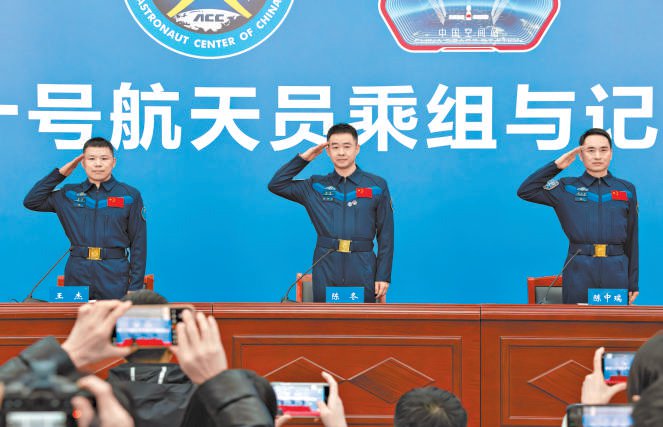
根在河南 志在九天 神二十乘组太空归来后首次公开亮相
He Nan Ri Bao· 2026-01-16 23:27
Core Viewpoint - The Shenzhou 20 crew, consisting of astronauts Chen Dong, Chen Zhongrui, and Wang Jie, successfully completed a 204-day mission in space, showcasing China's advancements in manned spaceflight and the importance of teamwork and training in overcoming challenges [4][6]. Group 1: Mission Accomplishments - Chen Dong has become the astronaut with the most extravehicular activities in China, with a total of six missions, and is the first Chinese astronaut to exceed 400 days in space [4]. - The crew faced a critical situation when a triangular crack was found in the return capsule's window, likely caused by space debris, but they successfully managed the situation with the ground team's support [4][6]. - The Shenzhou 20 mission achieved significant breakthroughs in space science experiments during its 204-day duration [6]. Group 2: Astronaut Insights - Chen Zhongrui emphasized the importance of mental and physical stability during challenging tasks, highlighting the need for thorough preparation and teamwork [6]. - Both astronauts expressed gratitude towards their hometowns and the support from the people, reinforcing their commitment to inspire future generations [5][6]. - The crew's successful return and recovery phase indicate that they are in good health and ready to resume regular training [7].
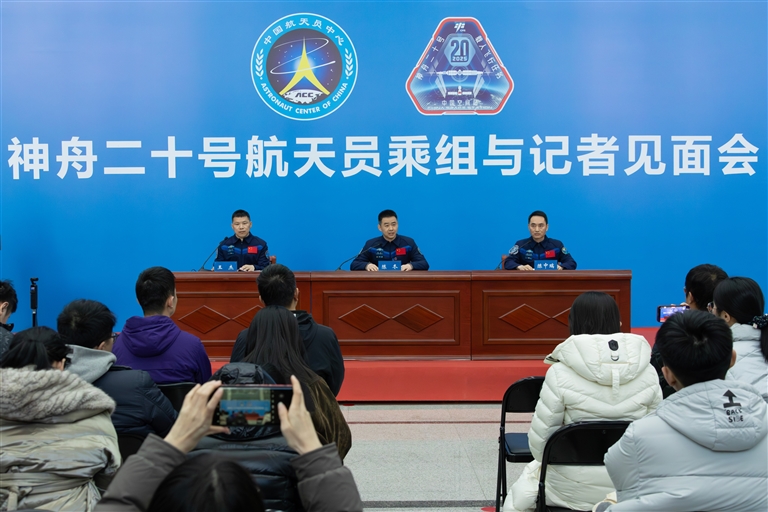
神二十乘组天外归来后首次公开亮相 分享“换船”返回经历与感悟
Xin Hua She· 2026-01-16 10:29
Core Insights - The Shenzhou-20 crew, led by commander Chen Dong, expressed gratitude for public support, emphasizing it as motivation to overcome challenges and complete their mission [1] - The crew shared their experience of dealing with a window crack caused by space debris during their mission, which led to a delayed return to Earth [1] - The successful return of the crew and the subsequent docking of Shenzhou-22 with the space station highlighted the safety and efficiency of China's manned space program [1] Group 1 - Chen Dong became the first Chinese astronaut to exceed 400 days in space, viewing the record as a valuable testament to progress, while also acknowledging that records are meant to be broken [2] - Chen Zhongrui, on his first flight, completed three extravehicular tasks, marking significant milestones in the construction of the space station [2] - Wang Jie, who transitioned from ground support to space operations, encouraged youth to understand that space exploration requires hard work and perseverance [2] Group 2 - Following their return, the Shenzhou-20 crew underwent a series of recovery phases, with their physical and mental health being closely monitored, showing good overall condition [2] - The crew is committed to continuing their tasks with enthusiasm, aiming to fulfill the expectations of the nation and its people [3]
生命、家园、深空与智能…… 今年可能迎来哪些关键性科技突破?
Xin Lang Cai Jing· 2026-01-12 18:00
Group 1: Scientific and Technological Advances - In 2026, significant breakthroughs in gene editing are anticipated, with clinical trials for personalized gene therapies for rare metabolic diseases planned in Philadelphia [8] - A major cancer detection clinical trial involving over 140,000 participants is expected to reveal results in 2026, potentially allowing for the detection of approximately 50 types of cancer through a single blood test [9] - AI is predicted to play a crucial role in the life sciences sector, particularly in biomarker detection, with the potential to move from detection to prediction [9] Group 2: Climate Change and Renewable Energy - The global average temperature is projected to exceed pre-industrial levels by 1.4 degrees Celsius in 2026, continuing a trend of rising temperatures [9] - Renewable energy is expected to surpass traditional energy sources in various sectors, with China leading the transition towards green and low-carbon energy [10] - China plans to add over 20 million kilowatts of wind and solar power capacity in 2026 as part of its commitment to increasing the share of renewable energy [10] Group 3: Space Exploration - 2026 is set to be a busy year for lunar exploration, with China's Chang'e 7 mission targeting the challenging lunar south pole [11] - Multiple crewed space missions are scheduled by China, including the Tianzhou 10 and Shenzhou 22 and 23 missions, marking significant advancements in their space program [11] - The European Space Agency plans to launch the Plato space telescope in late 2026 to monitor over 200,000 stars in search of habitable exoplanets [11] Group 4: AI in Research - AI is transforming research processes, with predictions of significant scientific breakthroughs driven by AI in 2026 [12] - The integration of multiple large language models for complex tasks is expected to become more common, reducing the need for human intervention [12] - Generative AI is leading technological change, with over two-thirds of chief economists anticipating its commercial value to materialize within the next year [12]
在时间卷轴上刻下新坐标
Xin Lang Cai Jing· 2025-12-26 16:59
Group 1 - The "14th Five-Year Plan" period is crucial for the comprehensive construction of a modern socialist country, with the 20th Central Committee's plan outlining the economic and social development blueprint for 2026-2030 [3] - The Central Economic Work Conference emphasizes the need to expand domestic demand as the primary task for the coming year, alongside accelerating the construction of a unified national market and enhancing high-level opening-up [3] - The focus on high-quality development aims to transform the grand vision into reality, with clear direction and path for China's economic growth [3] Group 2 - The commissioning of China's first electromagnetic catapult aircraft carrier, Fujian, marks a significant advancement in naval technology, entering the "three-carrier era" [5] - Fujian has a full-load displacement of over 80,000 tons and is the world's first conventional power electromagnetic catapult aircraft carrier, indicating a shift from near-sea defense to far-sea defense strategy [5] - The establishment of a "one mission, one maintenance, one support" rotation mechanism enhances operational efficiency and supports the People's Navy's strategic transformation [5] Group 3 - The successful emergency response during a space station incident demonstrates China's capabilities in space technology and emergency management, validating the redundancy and flexibility of its space systems [6][7] - The rapid preparation and launch of the Shenzhou 22 spacecraft within 16 days showcases the efficiency and effectiveness of China's space program [6] Group 4 - The official launch of the Hainan Free Trade Port's full island closure operation signifies a major step in China's institutional opening-up strategy, with a special customs supervision model [8] - The "zero tariff" policy has expanded significantly, increasing the number of duty-free items from approximately 1,900 to about 6,600, benefiting enterprises [8] - Hainan is transitioning from a "geographical highland" to an "institutional highland," becoming a crucial hub for domestic and international dual circulation [8] Group 5 - The breakthrough of the AI model DeepSeek represents a transformative moment in China's AI sector, making AI technology accessible across various industries [9] - The synergy between technological advancements and supportive policies has led to the emergence of thousands of innovative applications in finance, healthcare, education, and industry [10] - DeepSeek's impact positions China favorably in the global AI competition landscape, enhancing productivity and innovation across sectors [10]

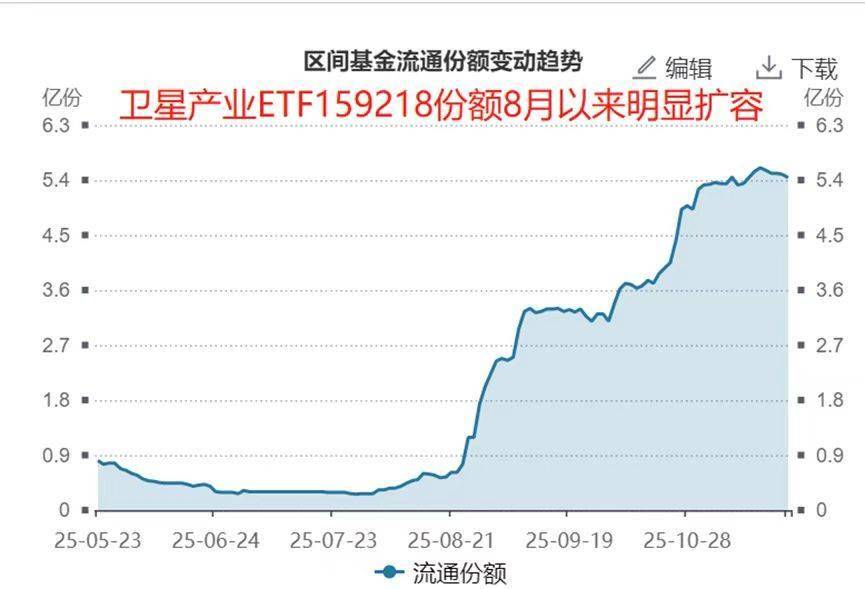
商业航天迎政策与技术双轮驱动,卫星产业ETF(159218)近期获密集增仓
Sou Hu Cai Jing· 2025-11-24 01:44
Core Insights - The satellite industry is experiencing a dual boost from policy and technology, leading to sustained investment interest in related assets [1] - The establishment of a dedicated Commercial Space Administration will streamline regulatory processes, fostering a more efficient environment for commercial space enterprises [2] - The upcoming launch of China's first reusable rocket, ZQ-3, is expected to significantly reduce launch costs and accelerate the commercialization of the space industry [2] - Clear IPO standards linked to the successful launch of reusable rockets will enhance capital inflow and drive technological innovation within the industry [3] - The combination of policy support, technological advancements, and capital facilitation positions the commercial space sector for rapid growth, benefiting investment vehicles like the satellite industry ETF [3] Policy Developments - The National Defense Science and Technology Industry Bureau has established a Commercial Space Administration to improve the regulatory framework for commercial space activities [2] - This regulatory enhancement is anticipated to create a more standardized and efficient development environment for commercial space companies [2] Technological Advancements - The Shenzhou-22 mission is set to launch soon, followed by the inaugural flight of the ZQ-3 reusable rocket [2] - The ability to conduct multiple test launches in a short timeframe will validate the technology of China's first reusable rocket [2] - This technological breakthrough is expected to lower launch costs significantly, facilitating the commercialization of the space industry [2] Capital Market Dynamics - Regulatory authorities are considering the successful orbital insertion of reusable rockets as a criterion for IPO eligibility for commercial rocket companies [3] - This clear capital entry condition is likely to accelerate technological innovation and capital investment in the sector [3] - The commercial rocket segment is expected to see intensified capital market activities as a result of these developments [3]
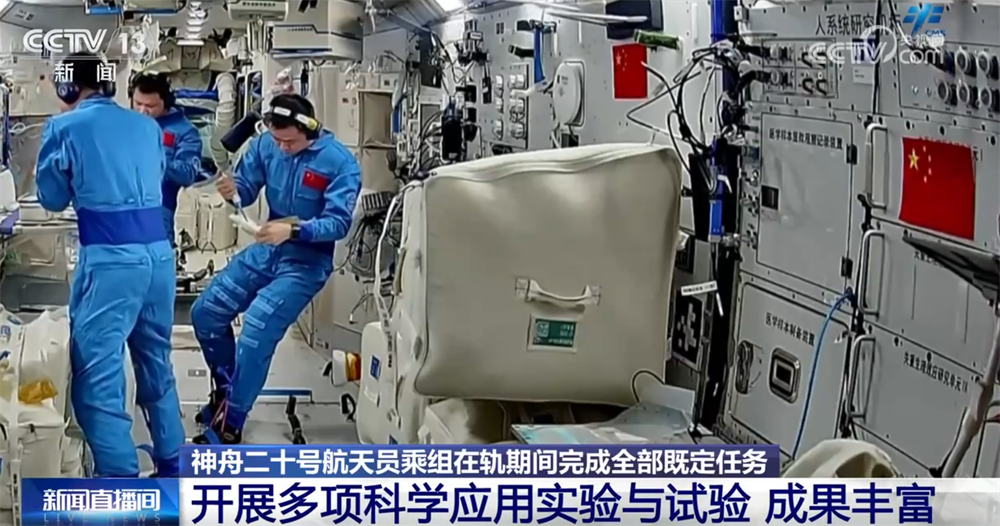
即将收获满满返回地球 神二十乘组“太空出差”期间完成了哪些任务?
Yang Shi Wang· 2025-11-14 02:32
Core Points - The Shenzhou 20 astronaut crew is scheduled to return on November 14 aboard the Shenzhou 21 spacecraft, with all crew members in good condition and preparations underway at the landing site [1] - The Shenzhou 20 mission lasted 203 days, during which the crew completed all planned tasks, achieving significant results in various scientific fields [2][4] Group 1: Mission Achievements - The crew conducted experiments in space life sciences, microgravity fundamental physics, space materials science, aerospace medicine, and new aerospace technologies, yielding phase results [2] - Notable achievements include the successful growth of high-quality protein crystals, which may provide potential targets for cancer treatment, and the heating of tungsten alloy to 3100 degrees Celsius, setting a new record for international space materials science experiments [2] - The crew also discovered charged colloids crystallizing into long-lived metastable structures in microgravity [2] Group 2: Additional Activities - During the mission, the crew took care of zebrafish and a space vegetable garden, contributing to the life atmosphere of the space station and providing valuable experimental data [4] - In July, the Shenzhou 20 received a cargo delivery from the Tianzhou 9 spacecraft, which included supplies for the astronauts and new extravehicular spacesuits, along with valuable data from the evaluation of existing suits [7] - The crew completed four extravehicular activities and seven payload transfer tasks, including the installation of space debris protection devices and external auxiliary equipment, enhancing the efficiency of extravehicular operations [10] Group 3: Delays and Collaboration - The return of the Shenzhou 20 was delayed due to a suspected impact from small space debris, allowing the crew to collaborate with the Shenzhou 21 crew on in-orbit scientific experiments [13]