
美国资产

Search documents
瑞银:抛售美国资产是危险的赌博 把配置完全转移出美国是不可能的
Xin Lang Cai Jing· 2026-01-20 18:52
Group 1 - UBS CEO Sergio Ermotti warns that selling U.S. assets and the dollar is a "dangerous bet" for investors [1] - Ermotti emphasizes that it is impossible to completely shift asset allocation out of the U.S., as it remains the world's strongest economy [1] - The U.S. Treasury bonds faced selling pressure, and the S&P 500 index declined amid rising tensions between President Trump and NATO allies over Greenland [1] Group 2 - UBS, as the world's largest wealth management firm, has nearly $7 trillion in assets and is seeking to expand its wealth management business in the U.S. [2] - The bank's application for a full banking license in the U.S. has received conditional approval [2] - Ermotti states that the U.S. market continues to be a focal point for UBS due to ongoing wealth creation and innovation in the economy [2]

达利欧警告美国可能面临“资本战争”
Hua Er Jie Jian Wen· 2026-01-20 14:37
Core Viewpoint - Ray Dalio, founder of Bridgewater Associates, warns that President Trump's policies may trigger a "capital war," leading countries and investors to reduce their investments in U.S. assets [1] Group 1: Economic Implications - Increasing trade tensions and rising fiscal deficits could undermine confidence in U.S. debt, prompting investors to shift towards hard assets like gold [1] - Dalio suggests that gold should be considered an important hedging tool in the current economic climate [1]
巴克莱:相比美元 格陵兰问题对欧元来说是“更大麻烦”
Xin Lang Cai Jing· 2026-01-20 13:02
Core Viewpoint - Barclays strategists believe that a severe deterioration in relations between the EU and the US, potentially leading to the US's exit from NATO, would pose a greater issue for the euro than for the dollar [1][5]. Group 1: Impact on Euro and Dollar - The potential US exit from NATO is expected to create a negative premium for the euro [2][6]. - The strategists downplay the notion that European investors holding US assets serve as a significant counterbalance to US geopolitical power [3][7]. Group 2: Capital Flows and Investor Behavior - Despite an increase in exposure to US assets since the early 2010s, the eurozone has also received substantial capital inflows from other regions [3][7]. - In a scenario where EU-US relations have completely broken down, it cannot be assumed that Asian investors will maintain their preference for European bonds [3][7]. Group 3: Market Reactions and Currency Sensitivity - There has been no significant "sell-off" of US assets by large holders in response to US tariffs over the past year [4][8]. - The dollar is currently vulnerable to the latest threats from Trump, which may lead to a reversal of the dollar long positions established earlier this year [4][8]. - The Swiss franc is considered the best tool for hedging against internal NATO disputes, while a rising VIX index could negatively impact risk-sensitive currencies such as the Swedish krona, Australian dollar, Latin American currencies, and South African rand [4][8].
周周芝道 - 日债是不是一个问题?
2025-12-08 15:36
Summary of Key Points from Conference Call Industry Overview - The discussion primarily revolves around the **Japanese bond market** and its implications for **global capital markets**. The volatility of Japanese bond yields significantly impacts U.S. assets and the dollar index through carry trade mechanisms [1][2][3]. Core Insights and Arguments - **Japanese Bond Yield Fluctuations**: The long-standing low interest rate policy in Japan has seen its 10-year government bond yield rise from a historical low of around 0.5% post-pandemic, causing global market reactions, particularly in U.S. equities and assets [2][3]. - **"Watanabe-san Investment" Phenomenon**: This term refers to Japanese residents, particularly housewives, investing in overseas assets, especially in the U.S. market. This trend has significant implications for global capital flows, as rising domestic funding costs in Japan could lead to adjustments in these overseas investments [4][5]. - **Inflation and Interest Rate Reversal**: Japan's inflation and interest rates have reversed due to several factors, including global inflation trends, demographic changes, and adjustments in fiscal and monetary policies. This shift has made the previously stable low-inflation environment unsustainable [5][6][7]. - **Impact on U.S. Assets**: Historical data indicates that fluctuations in Japanese bond yields have led to volatility in U.S. equities. For instance, during the third quarter of 2024, rising Japanese yields contributed to a decline in U.S. stock prices [8][9]. - **Central Bank Interventions**: The Bank of Japan typically intervenes during periods of heightened volatility to stabilize markets, suggesting that while fluctuations may occur, a complete market collapse is unlikely [9]. Additional Important Insights - **China's Fiscal and Monetary Policy**: China's approach has shifted towards long-term sustainable development rather than short-term stimulus. Current policies focus on supporting high-end manufacturing through measures like trade-in programs, rather than direct consumer incentives [10][11]. - **Real Estate Market Outlook**: The Chinese real estate market is expected to stabilize at low levels by 2026, with mortgage rates influenced by housing price pressures and income expectations. A decrease in mortgage rates is possible if income expectations improve [14][15]. - **Debt Market Dynamics**: Recent declines in domestic bonds are attributed to financial institution behaviors, with a bearish outlook on long-term bonds. The relationship between real estate sector adjustments and monetary policy will be crucial for future interest rate movements [16]. - **Currency Predictions**: The Chinese yuan is expected to strengthen in the first quarter of the following year but may weaken later due to a potentially strong dollar index. However, exchange rates are not seen as a primary factor influencing domestic monetary policy [17]. This summary encapsulates the critical discussions and insights from the conference call, highlighting the interconnectedness of Japanese bond markets, U.S. assets, and broader economic policies in China.
特朗普着手改造美联储和劳工统计局:美元将成为最大受害者?
Feng Huang Wang· 2025-08-05 01:41
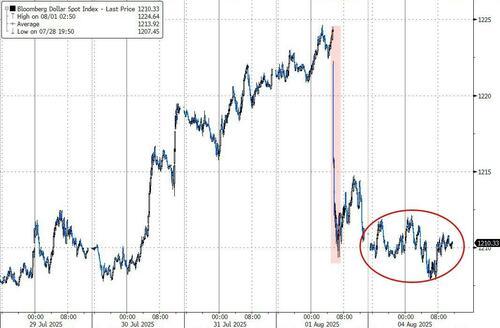
Core Viewpoint - Concerns are rising regarding the credibility of U.S. institutions, which may lead to further selling pressure on the dollar and other U.S. assets [1][6]. Group 1: Economic and Market Implications - The resignation of Fed Governor Kugler, a hawkish figure, may accelerate market expectations for interest rate cuts, with a 94.4% probability of a rate cut in September now priced in by the market [3][5]. - The recent weak non-farm payroll data has prompted traders to increase bets on Fed rate cuts, contributing to a decline in the dollar against all G10 currencies [1][3]. - The ICE Dollar Index fell to a one-week low of 98.58, with the Bloomberg Dollar Index down nearly 8% year-to-date [1]. Group 2: Political Influence on Economic Data - Trump's recent actions, including the firing of the Labor Statistics Bureau head, have raised concerns about the integrity of U.S. economic data, potentially leading to a higher risk premium for U.S. assets [1][6]. - Analysts suggest that the political pressure exerted by Trump on the Fed has undermined its independence, further complicating the market's perception of U.S. economic data reliability [6][8]. - The potential nomination of close Trump associates to key economic positions could negatively impact investor sentiment towards the dollar [6][8]. Group 3: Future Leadership of the Fed - The upcoming nomination for the Fed chair position is seen as a risk event for the market, especially with speculation surrounding potential candidates [8]. - Candidates with prior Fed experience, such as Kevin Warsh, are viewed more favorably compared to those closely associated with Trump, like Kevin Hassett [7][8].

亚洲超级富豪因贸易战快马加鞭减少对美国敞口 甚至全部撤出
news flash· 2025-05-09 07:46
Core Viewpoint - Wealthy families in Asia are significantly reducing their exposure to U.S. assets due to uncertainties stemming from President Trump's tariffs, indicating a potential long-term shift in investment strategies [1] Group 1: Investment Trends - A family office managing assets for Chinese billionaires has completely divested from U.S. assets, reallocating profits back to Asia [1] - A senior executive from one of Europe's largest private banks noted that the scale of recent sell-offs by wealthy clients and institutions is unprecedented in the past 30 years, suggesting a possible long-term trend [1] Group 2: Asset Allocation - An executive from an Asian bank has reduced 60% of U.S. assets from their investment portfolio, citing cash and gold as safer holdings [1]
德意志银行:外资持续抛售美国资产
news flash· 2025-04-29 23:27
Core Viewpoint - Deutsche Bank's latest report highlights concerning trends in U.S. capital flows, indicating that foreign investors are "refusing to buy" U.S. assets despite a recent market recovery [1] Group 1: Capital Flow Trends - The report notes a significant sell-off in ETFs, with investors consistently selling stocks and bonds [1] - Data from EPFR corroborates Deutsche Bank's findings, showing a sudden halt in buying of U.S. equities and an intensified sell-off of U.S. Treasuries [1] Group 2: Investment Strategy Recommendations - Michael Hartnett, Chief Investment Strategist at Bank of America, advises investors to sell during rebounds in U.S. stocks and the dollar until uncertainty is resolved [1] - Bank of America's report indicates that the dollar is in a long-term depreciation trend, and the outflow from U.S. assets is expected to continue [1]


三菱日联:市场对美国资产丧失信心 欧元区债券可能受益
news flash· 2025-04-23 12:14
Core Viewpoint - Investors are losing confidence in U.S. assets, which may benefit Eurozone government bonds [1] Group 1: Market Sentiment - Mitsubishi UFJ Financial Group's global market research head, Harapani, indicates a shift in investor sentiment away from U.S. assets [1] - The performance of German government bonds has consistently outperformed U.S. Treasuries [1] Group 2: Comparative Analysis - The yield spread between French and German government bonds remains relatively stable [1]
