格索雷塞片

Search documents
政策赋能创新药加速跑
Jing Ji Ri Bao· 2026-02-26 21:26
Group 1 - The core issue highlighted is the current burden of innovative drug costs, where basic medical insurance covers 44%, commercial insurance covers 7%, and nearly half is borne by patients themselves [1] - The new policies since 2026 have significantly empowered the innovative drug industry, optimizing the payment system and enhancing drug accessibility [1][2] - The 2025 updated national medical insurance drug list represents the largest expansion of innovative drugs since the inception of the list, adding 114 new drugs while removing 29 [2] Group 2 - The newly added drugs are characterized by filling clinical gaps, superior efficacy, and cost-effectiveness, addressing unmet treatment needs [2] - The first commercial insurance innovative drug list includes 19 drugs, marking a significant step in supporting innovative drugs within a multi-tiered medical insurance system [2][3] - The new policies are expected to reshape the retail drug ecosystem, enhancing the accessibility and efficiency of innovative drugs [4][5] Group 3 - The innovative drug market is anticipated to undergo a restructuring, with deeper integration between innovative drug companies and retail pharmacies [5] - The dual-channel management mechanism for negotiated drugs aims to solve the "last mile" issue in drug accessibility [4][6] - The support from the medical insurance fund has exceeded 460 billion yuan, benefiting 1 billion patients and driving sales of related drugs over 670 billion yuan [7] Group 4 - The current period is seen as a golden era for high-quality development in the innovative drug industry, with increasing support for research and development from the government [8] - The alignment of national medical needs with corporate innovation is crucial for ensuring that innovative results reach patients more quickly and broadly [8][9] - Continuous efforts in basic research and supportive industrial policies are necessary for maintaining a leading position in global pharmaceutical innovation [9]
从“灵魂砍价”到“价值共赢” 医保与创新药的双向奔赴
Zhong Guo Jing Ji Wang· 2026-01-21 09:18
Core Insights - The new national medical insurance drug list and the first commercial insurance innovative drug list will be implemented nationwide starting January 1, 2026, marking the largest expansion of innovative drugs in the history of the medical insurance directory [1] - The adjustment of the medical insurance directory represents a dual benefit for the innovative drug industry in China, with significant changes in the inclusion of innovative drugs and the establishment of a commercial insurance innovative drug directory [1][2] Summary by Sections Innovative Drug Inclusion - A total of 114 new drugs have been added to the national medical insurance drug list, including 111 new products launched within the last five years and 50 Class I new drugs, both of which set historical highs in terms of quantity and proportion [1][2] - The newly included drugs generally possess three common characteristics: they either fill a treatment gap, are superior alternatives, or offer better cost-effectiveness [2] Commercial Insurance Innovative Drug Directory - The first commercial insurance innovative drug directory includes 19 drugs, covering treatments for various conditions such as CAR-T therapies for tumors, rare diseases like Gaucher disease, and Alzheimer's disease, complementing the basic medical insurance [2][3] - The selection mechanism for the commercial insurance directory emphasizes high innovation, significant clinical value, strong irreplaceability, and adaptability to a multi-tiered payment system [3] Payment System and Market Impact - The medical insurance fund has paid over 460 billion yuan for negotiated drugs by the end of October 2025, benefiting 1 billion patients and driving related drug sales exceeding 670 billion yuan [4] - The new dual-directory system aims to clarify the boundaries of basic medical insurance coverage while allowing space for commercial insurance development, thus supporting a multi-tiered payment system [3][4] Innovation Ecosystem - The integration of the commercial insurance innovative drug directory with the national medical insurance drug list is crucial for building a multi-layered medical security system, focusing on high-innovation and clinically significant drugs that exceed basic insurance coverage [5] - The successful inclusion of breakthrough therapies like Alpelisib not only provides hope for patients but also signals strong support for genuine innovation within the pharmaceutical industry [5]
医保商保“双目录”大力支持创新 好药新药加速惠及百姓
Jing Ji Ri Bao· 2026-01-03 02:05
Core Insights - The new National Basic Medical Insurance, Maternity Insurance, and Work Injury Insurance Drug Catalog (2025) and the first Commercial Health Insurance Innovative Drug Catalog (2025) will be implemented nationwide starting January 1, 2026, adding 114 new drugs to the basic insurance catalog and 19 to the commercial insurance catalog [1][2]. Group 1: Drug Catalog Adjustments - The updated basic medical insurance catalog includes 114 new drugs, with significant representation from oncology (36 drugs), chronic diseases (12 drugs), anti-infectives (13 drugs), and rare diseases (10 drugs) [2]. - The total number of drugs in the national medical insurance catalog has increased to 3,253, comprising 1,857 Western medicines and 1,396 traditional Chinese medicines [2]. - The adjustment aims to address clinical treatment gaps and enhance drug accessibility for patients, particularly for previously hard-to-treat conditions like triple-negative breast cancer and pancreatic cancer [2][4]. Group 2: Policy Implementation - A combination of policies will ensure that newly added drugs are available in hospitals by February 2026, including the establishment of temporary green channels for procurement [3]. - Negotiated drugs will not be subject to administrative restrictions such as "one product, two regulations" or overall medical insurance caps, allowing for more flexible access [3]. Group 3: Support for Innovation - Among the new drugs, 50 are classified as first-class innovative drugs, with an overall success rate of 88%, up from 76% in 2024, indicating a shift towards strategic purchasing and value-based reimbursement [4]. - The inclusion of both domestic and foreign innovative products in the catalog reflects a commitment to enhancing drug accessibility and supporting pharmaceutical innovation [4]. Group 4: Commercial Health Insurance - The newly established commercial health insurance innovative drug catalog includes 19 drugs, focusing on high-innovation, clinically valuable treatments that complement the basic medical insurance offerings [7]. - The catalog features advanced therapies such as CAR-T cell treatments and drugs for rare diseases, which are expected to reduce patient financial burdens and enhance market attractiveness for pharmaceutical companies [7][8]. Group 5: Future Directions - The policy signals strong government support for independent innovation and aims to encourage pharmaceutical companies to invest more in original and differentiated research and development [8]. - The National Medical Insurance Administration plans to refine policies and strengthen management to ensure the effective implementation of the drug catalogs, enhancing public access to necessary medications [8].
好药新药加速惠及百姓
Xin Lang Cai Jing· 2026-01-02 22:39
Core Insights - The new National Basic Medical Insurance, Maternity Insurance, and Work Injury Insurance Drug Catalog (2025) and the first Commercial Health Insurance Innovative Drug Catalog (2025) will be implemented nationwide starting January 1, 2026, adding 114 new drugs to the basic insurance catalog and 19 to the commercial insurance catalog [1][6] Group 1: Drug Catalog Adjustments - The adjustment of the National Medical Insurance Drug Catalog adheres to principles of supporting genuine innovation and differentiated innovation, aiming to meet diverse medication needs and enhance accessibility to high-value innovative drugs [1][2] - The updated catalog includes 36 cancer drugs, 12 chronic disease medications, 13 anti-infection drugs, and 10 rare disease treatments, increasing the total number of drugs in the catalog to 3,253 [1][2] - The inclusion of 50 first-class innovative drugs reflects a significant increase in the success rate of new drug approvals, rising from 76% in 2024 to 88% in 2025 [3][4] Group 2: Policy Implementation and Impact - The National Medical Insurance Bureau has adjusted the drug catalog for eight consecutive years, adding a total of 949 new drugs, with expenditures exceeding 460 billion yuan and sales exceeding 600 billion yuan during the negotiation period [2][3] - New policies require medical institutions to include newly added drugs in their procurement lists by the end of February 2026, addressing the issue of drugs being listed but not available in hospitals [2][3] Group 3: Commercial Health Insurance Innovative Drug Catalog - The first Commercial Health Insurance Innovative Drug Catalog includes 19 drugs, primarily high-innovation and clinically valuable treatments, which complement the basic medical insurance offerings [6][7] - The catalog features advanced therapies such as CAR-T cell treatments and bispecific antibodies, targeting rare diseases prevalent in children, thus expanding market opportunities for pharmaceutical companies [6][7] Group 4: Industry Response and Future Outlook - The policy sends a clear signal of government support for independent innovation, encouraging pharmaceutical companies to invest more in original and differentiated research and development [7] - The National Medical Insurance Bureau plans to refine policies and enhance management to ensure the effective implementation of the drug catalogs, ultimately improving the clinical medication experience for insured individuals [7]
医保商保双目录支持“真创新”
Ke Ji Ri Bao· 2025-12-16 00:02
Core Insights - The new National Medical Insurance Drug List and the first Commercial Insurance Innovative Drug List have been officially released, including over a hundred innovative drugs, set to be implemented on January 1 next year [1] Group 1: New Drugs Included in the Medical Insurance List - 98% of the drugs included in the medical insurance list are new drugs approved within the last five years, with 50 of them being first-class new drugs, marking a historical high [2] - A significant portion of the newly added drugs addresses high-demand conditions such as cancer, chronic diseases, and rare diseases, with 36 cancer drugs included, accounting for approximately 30% of the total [2] - The inclusion of innovative drugs is expected to alleviate clinical pain points, particularly for conditions previously lacking effective treatments, such as triple-negative breast cancer and pancreatic cancer [3] Group 2: Coverage and Clinical Value - The new medical insurance directory covers a wide range of diseases, including metabolic diseases and rare diseases, with drugs like KARS-targeted therapies now included [3] - Chronic disease medications, such as the cholesterol-lowering drug Increlex and the dual-target diabetes drug Tirzepatide, have also been added to the list [4] - The approval rate for drugs entering the expert review stage has decreased to 41.48%, with 331 drugs evaluated and only 129 passing the review [5] Group 3: Criteria for Inclusion - The "Four No Changes" principle restricts the inclusion of drugs that do not alter the main components, indications, administration routes, or clinical value, focusing on "true innovative" drugs that fill existing gaps [6] - Several first-class new drugs did not pass the expert review due to insufficient clinical value, despite being new compounds [7] - Experts emphasize the need to avoid homogenized innovation that wastes resources, advocating for genuine innovation that demonstrates real clinical benefits [8] Group 4: Commercial Insurance Innovative Drug List - The first Commercial Insurance Innovative Drug List includes advanced therapies such as CAR-T cell therapy, monoclonal antibodies, and small molecule targeted drugs, with 19 drugs included [10] - To facilitate the implementation of the commercial insurance innovative drug list, the National Medical Insurance Bureau has provided supportive measures, including exemptions from certain monitoring and payment frameworks [11] - The successful implementation of this new system requires careful consideration of actuarial pricing and the establishment of efficient communication platforms between commercial insurance and medical enterprises [11]
医保商保双目录如何影响普通人用药报销
第一财经· 2025-12-12 02:25
Core Viewpoint - The article discusses the recent update of China's National Medical Insurance Drug List, which includes 114 new drugs, highlighting the introduction of a commercial health insurance innovative drug directory alongside the basic insurance list, aiming to enhance patient access to innovative treatments and address gaps in drug coverage [6][13]. Group 1: New Drugs in the National Medical Insurance Directory - A total of 114 new drugs have been added to the directory, covering various treatment areas including 36 for tumors, 12 for chronic diseases, and 10 for rare diseases, with the number of class 1 new drugs increasing from 38 to 50, setting a new historical high [6][7]. - Notable "star drugs" include LuKangsa Tazhu (for tumors), Fluorazirase tablets, and Spilumab (for specific dermatitis), which will benefit a wide range of patients, including those with triple-negative breast cancer and chronic sinusitis [7][8]. Group 2: Financial Impact on Patients - The average price reduction for negotiated drugs has historically been around 60%, with 112 out of 127 drugs successfully negotiated this year, resulting in significant cost savings for patients [9]. - The introduction of Spilumab, priced at around 1,000 yuan per injection, is expected to significantly lower the financial burden on patients, making innovative treatments more accessible [9]. Group 3: Implementation Challenges - There are concerns regarding the "last mile" issue in drug availability at hospitals, as many negotiated drugs are still provided through external pharmacies, and hospitals may hesitate to prescribe these due to cost concerns [10][11]. - The new regulations require that hospitals must not limit the availability of negotiated drugs based on overall budget constraints, ensuring that these drugs are accessible to patients [11]. Group 4: Changes in the Drug Directory - This year, 29 drugs were removed from the directory due to being replaced or not produced, with a total of 467 drugs removed over the past eight years for similar reasons [12]. - A six-month transition period has been established for patients using drugs that are not renewed in the directory, ensuring continuity of care [12]. Group 5: Commercial Health Insurance Innovative Drug Directory - The newly established commercial health insurance innovative drug directory includes 19 drugs, focusing on high-value innovative treatments that cannot be covered by the basic insurance directory [13][15]. - The drugs in this directory are characterized by high innovation, significant clinical value, and the need for diverse payment options, with 50% being class 1 new drugs [15]. Group 6: Benefits for Patients - The commercial health insurance directory aims to provide a curated list of high-quality drugs, reducing the selection burden for insurance companies and potentially lowering costs for patients through reduced premiums or increased reimbursement rates [16]. - The integration of the commercial insurance directory with existing medical insurance systems is being explored to enhance patient experience and access to innovative treatments [16]. Group 7: Future Prospects and Challenges - The implementation of the commercial health insurance innovative drug directory is dependent on market mechanisms, with insurance companies determining the usage and timing of these drugs [19]. - Emphasis on actuarial pricing and collaboration between insurance companies and pharmaceutical firms is crucial for the sustainable rollout of these innovative drugs [19].


贝达药业拖欠益方生物1.8亿元被曝光
Zhong Guo Jing Ying Bao· 2025-07-04 05:14
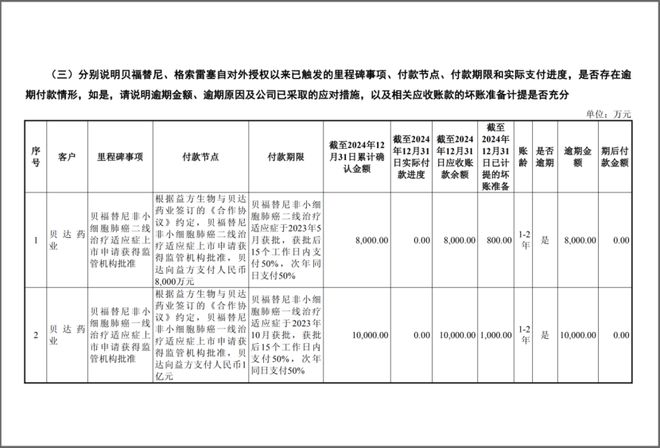
Core Viewpoint - The delayed payment of 180 million yuan by Betta Pharmaceuticals to Yifang Biologics for milestone payments related to the drug Beifuzi has raised concerns about the financial health and operational integrity of both companies [1][2][5]. Company Overview - Yifang Biologics developed Beifuzi, a first-in-class innovative drug for lung cancer, and granted commercial rights to Betta Pharmaceuticals in December 2018 [2][3]. - Betta Pharmaceuticals was supposed to pay a total of 230 million yuan in milestone payments based on the drug's development progress, which includes regulatory approvals for various treatment indications [2][4]. Financial Performance - Yifang Biologics reported zero revenue from 2020 to 2022, but began generating income in 2023, totaling 186 million yuan, primarily from technical authorization and cooperation [4][8]. - As of the end of 2023, Yifang Biologics had accounts receivable of 186 million yuan, with a provision for bad debts of 9.29 million yuan, indicating reliance on Betta Pharmaceuticals for revenue [4][5]. Payment Delays - Betta Pharmaceuticals has delayed payments for two years, with the outstanding amount of 180 million yuan due to its own financial management considerations [5][10]. - The company has acknowledged the overdue payments and stated that it will fulfill its obligations according to the agreement [5][7]. Market Competition - Beifuzi's market entry is hindered by its later approval compared to competitors like Osimertinib and Alectinib, which have annual sales in the range of 3 to 4 billion yuan [8][9]. - Yifang Biologics has reported sales-related income from Beifuzi of approximately 5.53 million yuan in 2023 and 16.38 million yuan in 2024, indicating a significant gap in sales compared to established competitors [8][9]. Financial Health of Betta Pharmaceuticals - As of the end of 2024, Betta Pharmaceuticals had cash reserves of 472 million yuan, down from 752 million yuan at the beginning of the year, reflecting a decline in liquidity [10]. - The company's current ratio has been below 1 for three consecutive years, indicating a potential decline in short-term solvency [10].

益方生物(688382):2024年年报点评:格索雷塞片成功获批上市,期待D-2570更多数据读出
EBSCN· 2025-05-06 08:13
Investment Rating - The report maintains a "Buy" rating for the company, indicating an expected investment return that will outperform the market benchmark by more than 15% over the next 6-12 months [5][12]. Core Insights - The company achieved a revenue of 169 million yuan in 2024, a decrease of 9.02% year-on-year, with a net loss attributable to the parent company of 240 million yuan [1][3]. - The successful approval of Gsorese tablets in November 2024 marks a significant milestone, alongside positive results from the D-2570 Phase II clinical trial for psoriasis [2][3]. - The company is advancing its clinical research with multiple products in various stages, including D-0502 in Phase III trials and D-0120 in Phase II trials [2]. Financial Summary - Revenue projections show a recovery with expected growth rates of 36.80% in 2025 and 35.89% in 2026, reaching 231 million yuan and 314 million yuan respectively [4][8]. - The net profit forecast for 2025 and 2026 has been revised down to -257 million yuan and -223 million yuan, respectively, with a new estimate for 2027 at -46 million yuan [3][4]. - The company’s total assets are projected to decline from 2,162 million yuan in 2023 to 1,438 million yuan by 2027, while total liabilities are expected to increase slightly [9]. Clinical Development Progress - The D-2570 product is being developed for multiple indications, including psoriasis, ulcerative colitis, and Crohn's disease, with promising clinical results indicating significant efficacy compared to existing treatments [2][3]. - The company has two products already authorized for sale and several others in various stages of clinical trials, showcasing a robust pipeline [2]. Market Performance - The current stock price is 22.56 yuan, with a market capitalization of approximately 13.047 billion yuan [5]. - The stock has shown a relative performance increase of 129.75% over the past year, indicating strong market interest [7].
中国生物制药(01177):营收净利双位数增长,创新产品收入突破新高
Changjiang Securities· 2025-04-09 15:26
Investment Rating - The investment rating for the company is "Buy" and is maintained [7]. Core Insights - In 2024, the company achieved a total revenue of 28.87 billion yuan, representing a year-on-year increase of 10.2%. The net profit attributable to shareholders reached 3.50 billion yuan, up 50.1% year-on-year, while the adjusted Non-HKFRS net profit was 3.46 billion yuan, reflecting a 33.5% increase [2][5][8]. - The company has seen robust growth in innovative product revenues, which reached 12.06 billion yuan, a growth of 21.9%, accounting for 41.8% of total revenue. In 2024, six innovative products were approved for market launch, and 28 generic drugs were also approved [8]. - The oncology segment generated revenue of 10.73 billion yuan, up 22.0%, while the liver disease segment saw a decline of 10.1% to 3.44 billion yuan. The respiratory segment grew by 6.2% to 3.15 billion yuan, and the surgical/pain management segment increased by 18.9% to 4.46 billion yuan. However, the cardiovascular segment experienced a significant decline of 21.0% to 2.17 billion yuan [8]. - The company's gross margin for continuing operations improved to 81.5%, up from 81.0% in the previous year, while the selling and administrative expense ratio decreased by 0.1 percentage points, showcasing effective organizational integration and management strategies [8]. - The company is positioned as a benchmark for traditional pharmaceutical companies transitioning to innovation, with a clear inflection point in its fundamentals. The growth in innovative products and optimization of the entire operational chain support its strong long-term value [8]. - Profit forecasts indicate that the net profit attributable to shareholders is expected to be 2.655 billion yuan, 3.144 billion yuan, and 3.725 billion yuan for 2025, 2026, and 2027, respectively, with corresponding EPS of 0.14 yuan, 0.17 yuan, and 0.20 yuan [8].