谷歌云(GCP)

Search documents
高盛闭门会-美股互联网财报季要点-ai担忧云计算再加速-首选metaai颠覆错杀游戏股
Goldman Sachs· 2026-02-13 02:17
Investment Rating - The report indicates a favorable investment rating for Meta, highlighting it as the most attractive stock in terms of risk-reward ratio within the sector [2][6]. Core Insights - The digital advertising and cloud computing sectors are performing strongly, alleviating investor concerns regarding AI capital expenditure returns. Meta shows slight earnings, while Alphabet maintains substantial earnings, but Amazon is expected to incur losses in 2026-2027, prompting a reevaluation of long-term free cash flow valuations [2][3]. - The advertising industry is evolving towards AI and machine learning, with major players like Amazon, Meta, and Alphabet benefiting from this trend. Meta's new growth pillars in AI and its core advertising business leverage AI applications effectively, making it a compelling investment opportunity [2][6]. - Capital intensity among tech companies is expected to peak between 2025 and 2027, but investor skepticism remains regarding the returns on these expenditures. In the next six months, the market will focus more on capacity support, semiconductor industry dynamics, and data center construction [2][6]. Summary by Sections Digital Advertising and Cloud Computing - The digital advertising sector is experiencing robust growth, with search business growing nearly 17% and Meta achieving a mid-20% growth rate. The advertising ecosystem is increasingly driven by AI and machine learning, benefiting only a few large companies [5][6]. - Amazon's strong start in 2026 is overshadowed by unexpected operating profit guidance and capital expenditure intensity, leading to investor concerns about AWS growth compared to Alphabet's cloud services [3][4]. Company Performance and Valuation - Meta is highlighted as having the strongest leverage effect in AI applications within its core advertising business, making it the most attractive investment in the sector [6]. - Amazon's valuation is considered low, trading below 20 times the adjusted earnings per share for 2027, indicating a potential undervaluation [9]. - Google Cloud's (GCP) profit margin increased by 7 percentage points, but it is expected to revert to around 25%. Despite this, GCP has significant growth potential due to a doubling of backlog orders and strong overall market demand [7][8]. Future Outlook - The report anticipates that the growth rate for cloud services will remain around 45% in 2026, although profit margins may experience significant declines. Investor expectations are high regarding the conversion of backlog orders into revenue and capital expenditures into capacity [8]. - The report emphasizes the need for clearer visibility on returns from capital expenditures, as investor confidence remains low despite strong demand in the terminal market [3][4].



摩根士丹利科技谈-Brian-Nowak前瞻META-GOOGL-AMZN-DASH与RDDT互联网公司财报
摩根· 2026-01-28 03:01
Investment Rating - The report does not explicitly state an investment rating for the companies discussed. Core Insights - Meta needs to clarify how to productize its long-term models, particularly in areas like commercial messaging, intelligent agents, diffusion models, meta AI, and wearable devices, to enhance its advertising business and explore new revenue growth points. The market is concerned about its spending structure, but the company's business condition is healthier than a year ago, with greater growth potential [1][4]. - Google's core search business must achieve significant growth beyond expectations (e.g., surpassing 15% to reach 16%-17%) to drive valuation model adjustments and stock price increases. Google Cloud is expected to grow by 50% for the year, but if the search business does not benefit from AI-driven growth, there may be downward adjustments to the 2027 earnings per share (EPS) forecast [1][5][6]. - AWS is projected to grow by 22% year-over-year in Q4, with strong demand and a significant backlog of orders indicating sustainable growth. The deployment of custom Renoir chips by Anthropic is expected to support AWS's growth in the coming quarters [1][8][11]. Summary by Sections Meta - Meta's fourth-quarter performance guidance requires at least a 23% year-over-year growth to meet market expectations. If actual revenue growth exceeds this level, the stock price is likely to rise. The expected capital expenditure for the year is approximately $120 billion, with operational expenditure around $155 billion [4][5]. Google - Google's core search business needs to exceed a growth rate of 15% to positively impact its valuation. The cloud business is expected to grow by around 50%, driven by strong demand and customer coverage, but faces risks related to capacity and the timing of data center operations [5][7]. Amazon - Amazon's retail business, particularly in fresh and perishable categories, has seen growth rates approaching triple digits, which is a positive signal for 2026 and 2027. The AI shopping product Rufus has captured nearly 2% of GMV in North America, and the company is increasing promotional efforts to enhance user engagement and monetization [13][14]. - The implementation of robotic warehouses is projected to save approximately $3-4 billion annually for every 10% of orders processed through these facilities, with a goal of having about 40 robotic warehouses by 2027 [15][16].

谷歌为什么总能做对决策?
3 6 Ke· 2026-01-22 12:32
Core Insights - Google has effectively leveraged its foundational technologies, such as the Transformer architecture and DeepMind's innovations, to establish itself as a leader in AI and cloud computing, transitioning from a perceived follower to the third-largest cloud service provider globally [1][2] - Unlike other tech giants, Google's decision-making process is decentralized, allowing frontline teams to have significant influence, which contrasts with the centralized authority seen in companies like Microsoft and Amazon [3][4] Decision-Making Framework - Google's decision-making framework is characterized by a decentralized network, where any team can propose resource allocation based on compelling technical arguments and market analysis, fostering a culture of intellectual equality [3][4] - The company employs rigorous A/B testing and data analysis for major product decisions, ensuring that even the most celebrated initiatives are subject to continuous evaluation [3][5] - A principle within Google emphasizes that the most persuasive arguments are based on data quality rather than the rank of the individual presenting them, creating a debate environment focused on truth-seeking [4] Long-Term Vision - Google's decision-making is rooted in long-term value rather than short-term gains, exemplified by its acquisition of YouTube for $1.65 billion in 2006, which was initially criticized but later became a significant revenue source [7][8] - The company prioritizes maintaining user trust over immediate revenue, as seen in its advertising strategy, which avoids compromising user privacy for short-term profits [8][10] Innovation Ecosystem - Google recognizes that breakthrough innovations cannot be planned or directed, leading to the establishment of a culture that encourages bottom-up creativity through initiatives like the "20% time" policy [13][14] - The company fosters an environment where ideas can emerge organically, supporting cross-disciplinary collaboration and allowing for the exploration of seemingly unrelated fields [14][15] - Google is willing to terminate projects that do not align with its core technological direction, reallocating resources to more promising initiatives that have the potential to define the future [15][16] Strategic Patience - The company adopts a patient approach to decision-making, allowing for long-term investments in foundational technologies, which may not yield immediate results but are essential for future growth [16][17] - Google's strategic decisions, such as early investments in AI and cloud infrastructure, reflect a commitment to building a robust ecosystem that can thrive in the evolving technological landscape [16][17]
巴菲特看上谷歌什么了?谷歌国内供应商梳理
傅里叶的猫· 2025-11-15 05:43
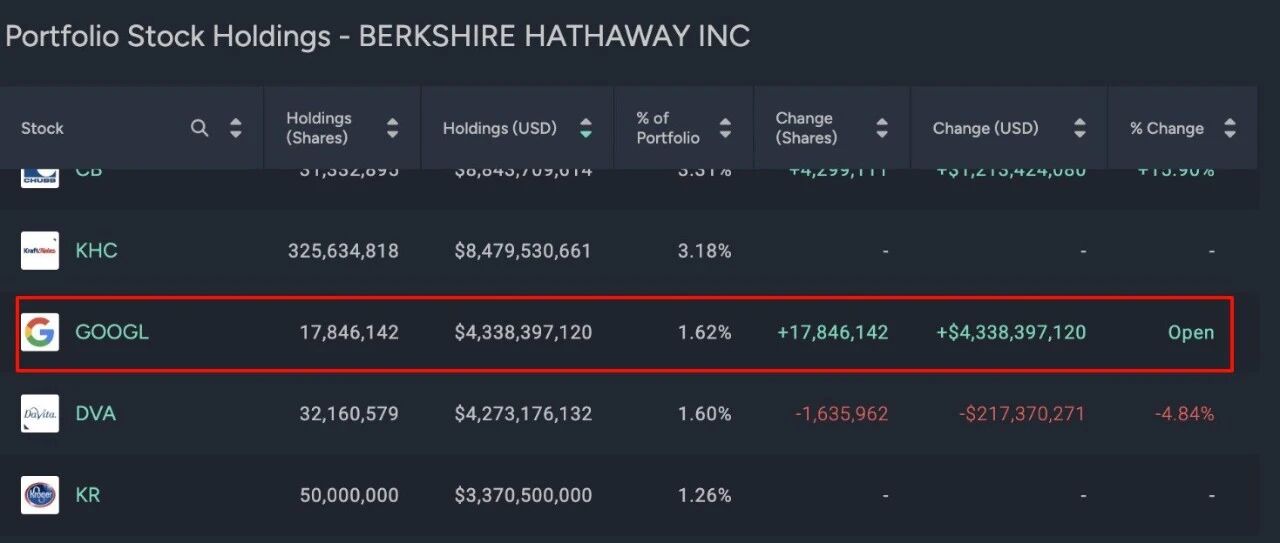
Core Insights - Warren Buffett's Berkshire Hathaway has made a rare investment in Google, increasing its stake by $4.3 billion while reducing holdings in Apple and eliminating DHI [1][2] - Google is investing $40 billion in Texas to build three new data centers, indicating strong confidence in its cash flow and AI capabilities [3][4] Group 1: Google AI Development - Google is one of the few companies with a clear plan to monetize AI, possessing data, proprietary chips, and models, making it a unique player in the AI landscape [4] - The AI-driven search revolution is expected to lead to gradual growth, with Google projecting search revenue growth of approximately 12% and 9% for 2025 and 2026, respectively [7] - Google's search business faces challenges from competitors like OpenAI's GPT series, raising concerns about the retention of commercial queries and long-term revenue [8] Group 2: Cloud Services and Growth Potential - Google Cloud Platform (GCP) is seen as an undervalued asset, with the potential for accelerated growth driven by innovations like the Gemini model and TPU [9] - GCP is projected to grow by approximately 31% to 36% by 2026, with optimistic scenarios suggesting even higher growth if TPU deployment exceeds expectations [10] - The adoption of Gemini has seen significant growth, with 9 million developers utilizing the platform and a notable increase in monthly active users [12] Group 3: Strategic Partnerships - Google has formed significant partnerships, including an $80 billion deal with Anthropic for AI chips, which is expected to generate incremental revenue for Google Cloud [15] - A collaboration with OpenAI allows OpenAI to utilize Google Cloud for model training, diversifying its infrastructure dependencies [15] - The partnership with Oracle enhances access to advanced models like Gemini 2.5, supporting digital transformation across various industries [16] Group 4: Supply Chain and Hardware Developments - Key suppliers for Google include Inveck for liquid cooling solutions and Zhongji Xuchuang for optical modules, both of which are critical for Google's data center operations [18][21] - Google is expected to significantly increase its OCS (Optical Circuit Switch) equipment shipments, with suppliers like Tengjing Technology providing essential optical components [23] - The company is also working with PCB suppliers like SNDL and HDGF to support the production of high-layer PCBs for TPU chips [24]

摩根士丹利:AI四大催化剂重塑明年互联网格局,巨头中最看好亚马逊、Meta、谷歌
Hua Er Jie Jian Wen· 2025-09-17 13:21
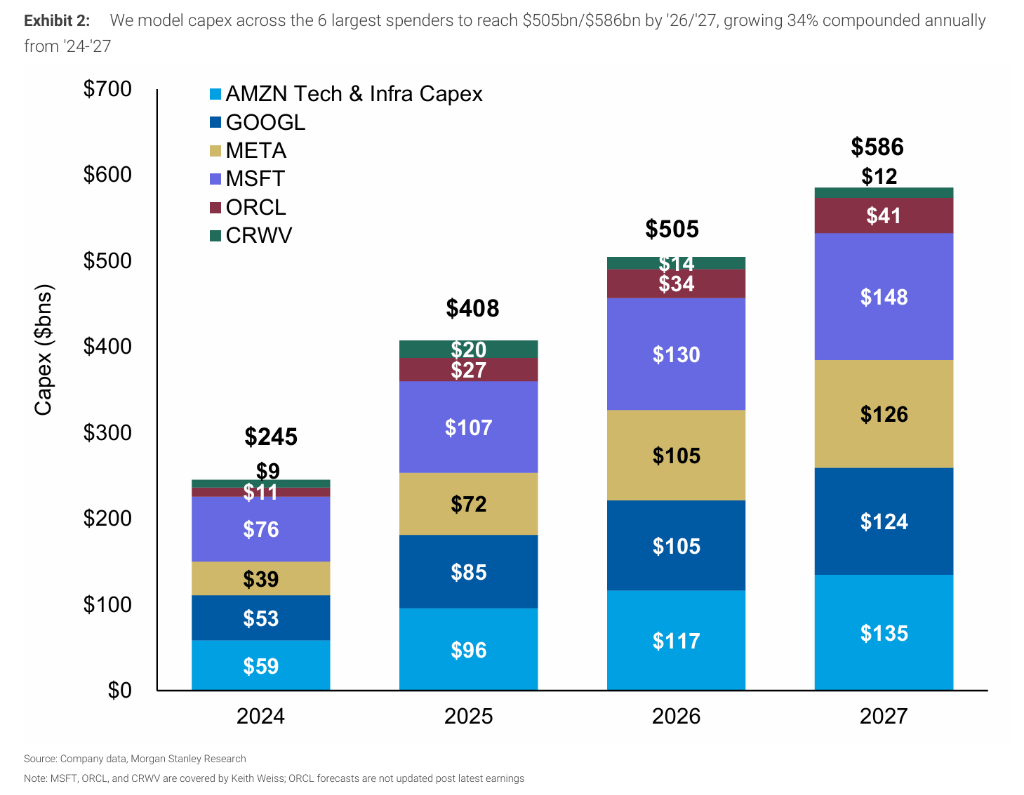
Core Insights - Morgan Stanley identifies four key generative AI (GenAI) catalysts reshaping the internet industry: model advancements, agentic experiences, capital expenditures, and custom chips [1][4]. Group 1: AI Catalysts - Continuous breakthroughs in leading AI models and the rise of agentic AI experiences are driving the industry into a new growth phase, enhancing user experience and digital consumer spending [1][5]. - Capital expenditures by major tech companies are projected to reach approximately $505 billion by 2026 and further increase to $586 billion by 2027, indicating a significant investment in AI technologies [1][4]. - The report anticipates a 34% compound annual growth rate in capital expenditures for six major tech giants from 2024 to 2027, which will impact their free cash flow [4][7]. Group 2: Company Preferences - Morgan Stanley ranks Amazon, Meta, and Google as its top preferences among large tech stocks for the next 12 months, citing their ability to leverage AI catalysts to strengthen market positions and create new revenue streams [3][9]. Group 3: Company-Specific Insights - Amazon is favored with a target price of $300, driven by the acceleration of its AWS business and improving profit margins in North American retail [9][11]. - Meta is rated "overweight" with a target price of $850, focusing on improvements in its core platform, the upcoming Llama model, and new business opportunities like AI search [13]. - Google maintains an "overweight" rating with a target price of $210, emphasizing AI-driven search growth and the potential of its cloud business, particularly through partnerships and innovations in custom chips [15].