
超高清电视

Search documents
江门智能家电“圈粉”全球
Nan Fang Ri Bao Wang Luo Ban· 2026-02-14 07:12
Core Viewpoint - The article highlights the significant growth and export potential of the home appliance industry in Jiangmen, particularly in the context of the upcoming Spring Festival, with a focus on smart appliances and supportive customs policies [1][2]. Group 1: Industry Overview - Jiangmen's home appliance industry chain has a total output value exceeding 60 billion yuan, forming a comprehensive smart home appliance industrial cluster [1]. - By 2025, the total export value of home appliances from Jiangmen is projected to reach 20.78 billion yuan, accounting for 12.3% of the city's total exports [1]. Group 2: Company Performance - The demand for home appliances, particularly air conditioners, is increasing in overseas markets, leading to a surge in orders and market expansion for domestic brands [1]. - Hisense (Guangdong) Air Conditioning Co., Ltd. reports that its fresh air conditioners are particularly favored by overseas customers, achieving a market share of 43.9%, the highest in the industry [1]. Group 3: Customs Support and Policies - Jiangmen Customs, through the Gaosha Customs, is actively promoting tariff reduction policies and providing guidance to home appliance companies to maximize the benefits of origin policies [1]. - The customs authority is also offering dynamic updates on overseas technical standards and warning information to assist Jiangmen's home appliances in achieving better quality and lower costs for global sales [1]. - Gaosha Customs employs efficient customs clearance methods, including "one port access," "direct pick-up at the ship," and "24/7 appointment customs clearance," ensuring zero delays for container movements [2].
“广货行天下”春季行动启动!“惠州制造”“惠州品牌”等你来pick
Sou Hu Cai Jing· 2026-01-16 20:02
Group 1: Overview of "Guanghuo Goes Global" Spring Action - The "Guanghuo Goes Global" Spring Action was launched on January 15, aiming to enhance the exposure and market influence of high-quality Guangdong products through promotional platforms and product showcases [1] - The initiative involves over 6,000 enterprises across various categories, including home appliances, electronics, clothing, food, and automotive, supported by more than 10 major commercial platforms [1] - The campaign aims to drive online sales of high-quality products from Guangdong, marking a significant promotional effort [1] Group 2: Huizhou's Industrial Strength - Huizhou is recognized as a key city in the Guangdong-Hong Kong-Macao Greater Bay Area, with a robust industrial foundation and a focus on modern industrial clusters [2] - The city has been awarded as a national model city for the "Three Products" strategy in consumer goods, showcasing a complete range of consumer goods industries [2] - Huizhou's manufacturing sector has seen significant growth, with brands like TCL and others gaining popularity both domestically and internationally [2] Group 3: Key Industries in Huizhou - The ultra-high-definition television industry in Huizhou accounts for 30% of the province's smart TV production, with major companies like TCL and others leading the market [3] - The automotive electronics sector includes products such as central control screens and HUDs, with companies like Desay SV and Huayang Group being prominent players [5] - Huizhou's new energy battery industry is recognized as one of China's top 100 industrial clusters, with a projected output value exceeding 100 billion yuan by 2024 [7] Group 4: Specialty Products from Huizhou - Huizhou is known as a major production base for women's shoes, with over 6,000 shoe manufacturing enterprises and an expected output of 910 million pairs in 2024 [9] - The guitar industry in Huizhou has developed into a global hub, producing a significant portion of the world's guitars and ukuleles, with an annual output value of 405 million yuan [11] - The city has a strong presence in sports equipment manufacturing, particularly in skateboards and bicycles, with a substantial share of the global market [14]

全球每四块屏幕里,就有一块是“中国造”!
Xin Hua Wang· 2026-01-05 02:38
Core Viewpoint - The rise of China's display industry, particularly in flexible screens and AMOLED technology, signifies a major transformation from reliance on imports to becoming a global leader in innovation and production [2][3][6]. Industry Development - The Chinese display industry has evolved from relying on imports to producing nearly 50% of the global market share, with a projected industry scale of 740 billion yuan by 2024 [6]. - The establishment of the first LCD panel production line in Hefei in 2012 marked a significant turning point, alleviating the dependency on imported screens [3][6]. Technological Advancements - The industry has transitioned from rigid displays to flexible screens, with advancements in AMOLED and Micro LED technologies, showcasing a diverse range of applications from televisions to automotive displays [6][10]. - The integration of AI technology is expected to enhance user interaction with displays, allowing screens to adapt to user habits and predict needs [11]. Supply Chain and Ecosystem - A complete ecosystem for display manufacturing has been established in China, encompassing upstream materials, midstream manufacturing, and downstream applications, enhancing the industry's self-sufficiency [6][7]. - Key players in the supply chain include companies like Rainbow Holdings for glass substrates and companies like BOE, TCL Huaxing, and Visionox in the manufacturing sector [6][7]. Market Presence - BOE has maintained its position as the global leader in display manufacturing, with significant contributions from other companies like TCL Huaxing and Shenzhen Tianma [7]. - The Chengdu region has seen rapid growth in the display industry, with over 120 related enterprises and expected revenue to exceed 100 billion yuan in 2024 [7]. Future Outlook - The Ministry of Industry and Information Technology aims to focus on emerging technologies like Micro LED and micro-displays, promoting the integration of AI with display technologies [11]. - Continuous innovation is essential for the Chinese display industry to maintain its competitive edge in the global market and to expand into new application areas such as smart homes and digital tourism [11].

上海超高清电视加快普及 进一步推广靠体验和内容
Di Yi Cai Jing· 2025-09-19 16:02
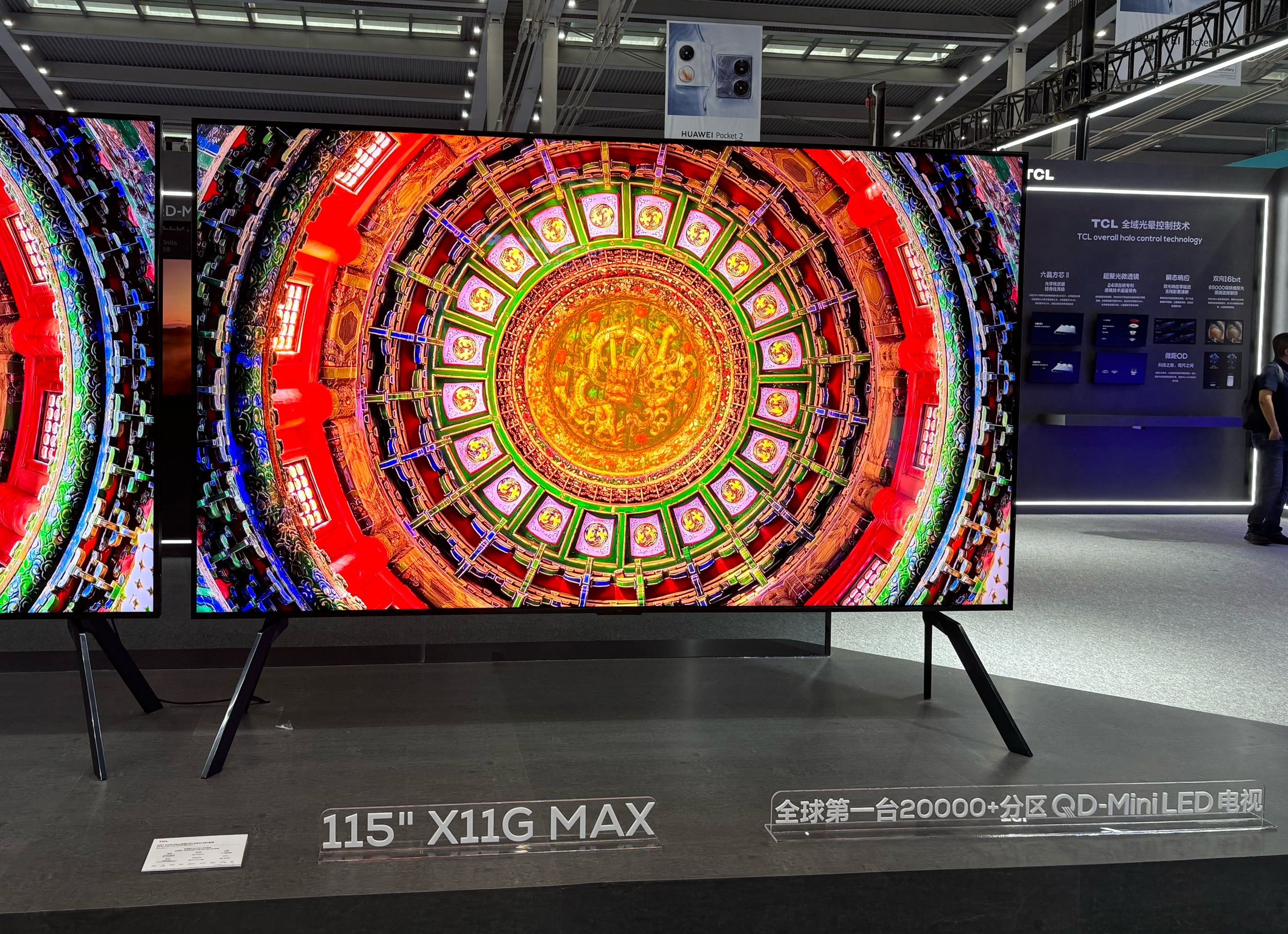
Core Insights - The article highlights the rapid adoption of ultra-high-definition (UHD) televisions in Shanghai, with some manufacturers reporting sales proportions as high as 95% for UHD models [1][2]. Group 1: Market Trends - The penetration rate of UHD televisions is increasing significantly, with TCL reporting a 95% sales share for UHD TVs in Shanghai as of 2025 [1]. - Hisense has sold over 150 million TVs in Shanghai, with all models 55 inches and above being 4K UHD products, indicating a shift towards larger screen sizes and enhanced clarity [2]. - The market is witnessing a transition from "parameter competition" to "experience upgrade," with consumers increasingly valuing immersive experiences over technical specifications [3]. Group 2: Sales Strategies - TCL is collaborating with local telecom operators to promote UHD TVs through bundled offers, such as "4K packages + TV" to stimulate sales [1]. - Hisense suggests enhancing UHD penetration through offline experiences and promotional campaigns that facilitate easy upgrades for consumers [2]. - Pinduoduo reports a double-digit growth in UHD TV sales this year, driven by government subsidies and the popularity of Mini LED technology [3]. Group 3: Consumer Preferences - There is a growing demand for large-screen TVs (75 inches and above) and high-refresh-rate models (120Hz and above), reflecting consumers' desire for better viewing and gaming experiences [3]. - Sales of 98-inch and larger TVs at Suning increased by 70.9% year-on-year, indicating a trend towards larger, smarter, and more diverse television options [3]. - The market is evolving to include various lifestyle applications for TVs, such as leisure, fitness, and outdoor activities, broadening the scope of consumer engagement [3].
上海超高清电视加快普及,进一步推广靠体验和内容
Di Yi Cai Jing· 2025-09-19 15:46
Core Insights - The sales proportion of ultra-high-definition (UHD) televisions has reached 95% for some manufacturers in Shanghai, indicating a significant market penetration that needs to be complemented by the development of UHD content [2][4]. Group 1: Market Trends - In Shanghai, the promotion of UHD televisions is accelerating, with TCL reporting a 95% sales share of UHD TVs in the region as of 2025 [4]. - Hisense has sold over 150 million TVs in Shanghai, with all models 55 inches and above being 4K UHD products, reflecting a trend towards larger screen sizes and diverse display technologies [5]. - The penetration rate of UHD TVs is increasing, with Pinduoduo reporting double-digit growth in UHD TV sales this year, driven by government subsidies and technological advancements [6]. Group 2: Consumer Experience and Engagement - TCL emphasizes the importance of enhancing consumer experience through physical store demonstrations and partnerships with local telecom operators to promote UHD TV sales [4][5]. - Hisense suggests optimizing 4K and 8K content decoding capabilities and collaborating with local operators to pre-install UHD content channels [5]. - The shift in consumer behavior is moving from parameter competition to experience upgrades, with a growing demand for immersive home entertainment solutions [6]. Group 3: Sales Strategies and Policies - TCL has introduced promotional packages like "4K package + TV" in collaboration with Shanghai Telecom to stimulate UHD TV sales [4]. - Hisense advocates for government subsidies for old TV replacements and the inclusion of energy-efficient UHD TVs in government procurement lists to lower upgrade costs [5]. - Retailers like Suning are creating themed experience zones to enhance consumer engagement and showcase the differences between new and old TV products [6].

“对外开放,对内放开” 服务消费激励政策呼之欲出
Sou Hu Cai Jing· 2025-09-07 16:35
Group 1: Service Consumption Policy Support - The Ministry of Commerce plans to introduce several policy measures in September to expand service consumption, utilizing fiscal and financial tools to enhance service supply capacity and stimulate new service consumption growth [1] - The focus will be on increasing high-quality service supply through "opening up externally and internally," with pilot programs in telecommunications, healthcare, and education [1] - New consumption models such as inbound consumption, AI+consumption, and IP+consumption will be promoted, alongside diverse local consumption promotion activities [1] Group 2: Sports Consumption Potential - The State Council has issued an opinion to release sports consumption potential, aiming for the sports industry to exceed 7 trillion yuan by 2030 [2] - The sports industry has shown significant growth, with a total scale of 3.67 trillion yuan in 2023, growing at an annual rate of 10.3% [2] - The opinion outlines 20 measures to enhance sports product supply, stimulate demand, and support the growth of sports enterprises [2][3] Group 3: Challenges in Service Consumption - The service consumption sector faces challenges, including insufficient supply in high-demand areas such as elderly care and childcare, with low enrollment rates compared to OECD averages [5] - The quality of service supply is also a concern, with an oversupply of low-end and homogeneous services, while specialized and personalized services are lacking [6] - Companies in the service sector are experiencing profitability issues, with many emerging consumption areas still exploring viable business models [6] Group 4: Financial and Fiscal Measures - The upcoming policies will leverage fiscal and financial measures to stimulate service consumption, including a 500 billion yuan loan facility for service consumption and elderly care [7] - Financial policies will focus on improving high-quality service supply to create effective demand and unlock consumption growth potential [7] - Fiscal policies can enhance service consumption willingness and capacity by reducing resident burdens and improving supply quality through tax system optimization and increased transfer payments [8]
我国电视迎重要转折!视频、电商平台集体发力
猿大侠· 2025-04-29 04:36
你家的电视机还在"吃灰"吗? 时代在进步,技术过时会被淘汰,设备陈旧就得升级,这是亘古不变的道理,就像我国的视频技术从标清学习、高清追赶,发展到超高清的部分自主核心技术处 于世界先进水平一样,电视产业的发展史,也是每一位电视爱好者的岁月史。 部分地区有线电视、IPTV等设立了超高清点播专区: 此外,京东等电商平台通过"以旧换新"补贴加速了超高清电视入户。 可以说,超高清技术将为视听作品带来主观感受上质的飞跃。 而2025年,我国电视剧行业迎来历史性转折——国家广电总局正式宣布,年底起,全国新拍电视剧、网络剧、纪录片将全面采用超高清(UHD)标准制作,新 闻、综艺等节目超高清占比显著提升。 以后大家家里可能会用上巴掌大的微型机顶盒,打开电视,就能看到更清晰更生动的画面。 同时,国家广播电视总局将2025年定为"超高清发展年"。目标到2027年实现全国50个超高清频道落地,65%的网络新节目普及4K。 本月初,广电更是下发通知,要求IPTV和互联网电视等平台设立超高清专区,共同推进超高清的普及工作。 细心的网友可能发现,爱奇艺、优酷、腾讯、B站、芒果TV、咪咕等6家头部视频平台已开设了超高清专栏,提供无磨皮高画质 ...