适老鞋服

Search documents
八部门发文促银发经济发展 14项举措培育养老服务经营主体
Shang Hai Zheng Quan Bao· 2026-01-13 23:34
Core Viewpoint - The Ministry of Civil Affairs and seven other departments have jointly issued measures to cultivate the elderly care service sector and promote the silver economy, focusing on brand development and technological empowerment [1][2]. Group 1: Policy Measures - The measures include 14 specific initiatives aimed at optimizing the development environment for elderly care services and stimulating operational vitality [1]. - There is a strong emphasis on brand building, with support for brand creation, protection, and promotion to foster well-known brands in the elderly care sector [1]. - The measures aim to enhance market supply and demand matching by optimizing the supply of elderly care services and age-friendly products, encouraging community-supported home care through chain operations [1]. Group 2: Technological Empowerment - The measures advocate for the integration of big data, artificial intelligence, and Beidou technology in health monitoring and personalized services for the elderly [2]. - There is encouragement for the development of elderly care robots and smart devices, with a focus on improving the service experience for older adults [2]. - The initiative aims to transition the elderly care service system from traditional care to a more intelligent and quality-enhanced model, addressing labor shortages and improving service efficiency [2][3]. Group 3: Industry Development Focus - The Ministry of Industry and Information Technology plans to focus on key areas such as elderly care robots, smart footwear, and easy-to-swallow foods, enhancing product development [3]. - There will be a collaborative effort between production and application enterprises to advance core technology and product development in elderly care [3]. - The Ministry of Commerce will work on five key areas, including the development of home care services for the elderly and creating platforms for supply and demand matching in elderly care [3].
八部门出台14项举措促进银发经济发展
Zhong Guo Zheng Quan Bao· 2026-01-13 20:46
Core Insights - The Ministry of Civil Affairs reported that by the end of 2025, there will be 41,700 elderly care institutions in China, employing 722,000 people, with private and public-private institutions making up 71.9% of the total [1] Group 1: Policy Measures - The Ministry of Civil Affairs and eight other departments have issued measures to support the development of the elderly care service industry and the silver economy, focusing on technology empowerment, brand building, supply-demand matching, environmental optimization, and support for resources [1][2] - Specific initiatives include encouraging technological innovation in elderly care services, such as the use of big data, cloud computing, artificial intelligence, and robotics to enhance service efficiency and quality [2][3] Group 2: Financial Support and Market Development - The Ministry of Civil Affairs plans to develop specialized financial support policies to encourage social capital participation and provide diverse financing options tailored to the elderly care industry [1][4] - The Ministry aims to create competitive elderly care service brands and leading enterprises, enhancing accessibility, convenience, and intelligence in elderly care services to meet diverse needs [4] Group 3: Integration and Collaboration - The Ministry of Commerce will focus on integrating elderly care services with home care and domestic services, promoting high-quality development in the home service industry [3] - Efforts will be made to establish a platform for matching supply and demand in elderly care services, creating new consumption scenarios and fostering an open cooperative environment [3]
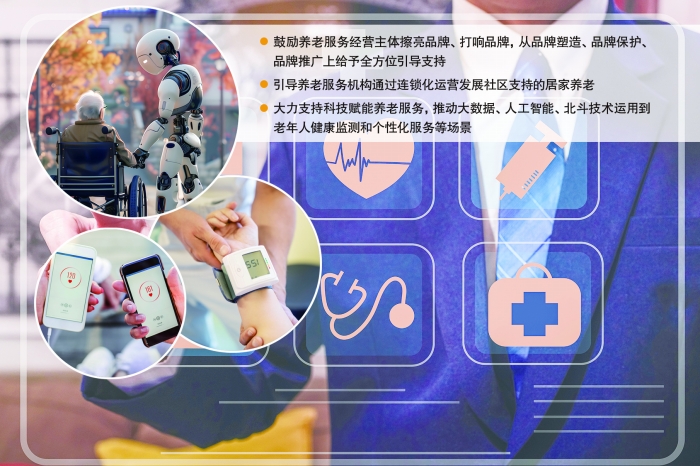
八部门发文促银发经济发展 14项举措培育养老服务经营主体 鼓励养老服务机器人产业发展
Shang Hai Zheng Quan Bao· 2026-01-13 18:34
Core Insights - The Ministry of Civil Affairs and seven other departments have jointly issued measures to cultivate the elderly care service sector and promote the silver economy, focusing on brand development and technological innovation [2][3][4] Group 1: Policy Measures - The measures include 14 specific initiatives aimed at enhancing the operational vitality of elderly care service providers and promoting structural reforms in supply [2] - Emphasis is placed on brand building, with support for brand creation, protection, and promotion to foster well-known brands in the elderly care sector [2] Group 2: Market Optimization - The measures aim to optimize the supply of elderly care services and age-friendly products, encouraging community-based home care through chain operations [3] - Support is provided for e-commerce platforms and large supermarkets to enhance the connection between supply and demand in elderly care services [3] Group 3: Technological Empowerment - The initiative promotes the integration of big data, artificial intelligence, and other technologies into elderly health monitoring and personalized services [3][4] - Development of elderly care robots and smart devices is encouraged, with a focus on improving the service experience for the elderly [3][4] Group 4: Industry Development - The Ministry of Industry and Information Technology will focus on the deep integration of new information technologies with elderly care services, addressing the pain points of elderly living [4] - Key areas for development include elderly care robots, age-friendly clothing, and easy-to-swallow food products [4] Group 5: Business Development - The Ministry of Commerce will focus on five areas, including the development of home care services for the elderly and creating platforms for supply-demand matching in elderly care [5] - Efforts will be made to create new consumption scenarios for elderly care and foster an open cooperative environment [5]


加大养老机器人等研发力度 工信部最新部署
Yang Guang Wang· 2026-01-13 06:42
Core Viewpoint - The Ministry of Civil Affairs emphasizes that technological innovation and supply optimization are essential for addressing labor shortages in the elderly care sector and enhancing service efficiency and quality, supporting the transition from a "traditional care model" to a "smart quality enhancement model" in elderly services [1] Group 1: Strategic Focus Areas - The Ministry of Industry and Information Technology (MIIT) is focusing on the development needs of the silver economy, aiming to enhance product variety, quality, technology, and standards in the elderly care industry [1] - MIIT plans to integrate new generation information technology with elderly services, maintaining a demand-oriented and problem-oriented approach [1] Group 2: Key Initiatives - MIIT will continue to promote high-quality elderly products and services, updating and publishing a directory of excellent cases for age-friendly products and services, and advancing the silver-age certification for elderly products [1] - The ministry will focus on addressing the pain points in elderly living by increasing the R&D of products such as elderly care robots, age-friendly clothing, and easy-to-swallow foods [1] - There will be ongoing optimization of the standard system for elderly products and smart health services, accelerating the implementation of key standards in smart terminals, smart communities, and smart homes [1] - MIIT will deepen the application of the internet and the age-friendly transformation of smart terminals, continuously improving the convenience of life for the elderly, thereby providing strong support for the high-quality development of the silver economy [1]
事关银发经济 八部门联合发布
Shang Hai Zheng Quan Bao· 2026-01-13 05:08
Core Viewpoint - The Ministry of Civil Affairs introduced measures to cultivate the elderly care service sector and promote the silver economy through systematic policy support aimed at enhancing the operational vitality of service providers and advancing structural reforms in supply-side elderly care [1][3]. Group 1: Key Measures - The measures include 14 specific initiatives across five areas, focusing on brand development, market supply-demand matching, technological empowerment, environmental optimization, and increased support for resources [3][4]. - Encouragement for elderly care service providers to enhance brand recognition and protection, providing clear policy pathways for developing well-known brands and leading enterprises in the sector [3]. - Promotion of market-oriented supply-demand matching by optimizing elderly care services and products, facilitating community-based home care through chain operations, and enhancing online and offline service accessibility [3]. Group 2: Technological Empowerment - Strong support for integrating technology into elderly care services, including the use of big data, artificial intelligence, and robotics to improve health monitoring and personalized services for the elderly [3][6]. - Focus on the development and application of humanoid robots and health monitoring devices in various settings such as homes and care institutions, transitioning from mechanical care to precise service delivery [6][7]. Group 3: Environmental Optimization - Creation of a fair competitive environment and establishment of a standard certification system to monitor and evaluate the implementation of standards for silver products and services, while combating illegal activities against the elderly [3][4]. - Improvement of administrative services to attract social investment in elderly care, including the implementation of a unified online service for licenses across regions to reduce operational costs for service providers [4]. Group 4: Market Development - The Ministry of Commerce aims to enhance the supply of quality elderly care services by developing home care services, creating platforms for supply-demand matching, and promoting new consumption scenarios for the elderly [7]. - Plans to accelerate the development of new business models and pilot programs for consumption, while encouraging e-commerce platforms to enrich the supply of elderly-friendly products and services [7].
工信部:持续推动新一代信息技术等与养老服务深度融合
Zheng Quan Shi Bao Wang· 2026-01-13 02:51
Core Viewpoint - The Ministry of Civil Affairs held a press conference to introduce measures aimed at fostering the elderly care service sector and promoting the silver economy, emphasizing the integration of new information technologies with elderly care services [1] Group 1: Key Initiatives - The Ministry of Industry and Information Technology will focus on four main areas to enhance elderly care services: 1. Continuously promote high-quality elderly products and update the directory of excellent aging-friendly products and services [1] 2. Address the pain points in elderly living by increasing the development of products such as care robots, aging-friendly clothing, and easy-to-swallow foods [1] 3. Optimize the standard system for elderly products and smart health care, accelerating the implementation of key standards in smart terminals, smart communities, and smart homes [1] 4. Deepen the application of the internet and the aging-friendly transformation of smart terminals to improve the convenience of life for the elderly, supporting the high-quality development of the silver economy [1]
工信部:加大养老服务机器人、适老鞋服、易吞咽食品等产品研发力度
Xin Lang Cai Jing· 2026-01-13 02:37
Core Viewpoint - The Ministry of Civil Affairs held a press conference to introduce measures aimed at cultivating elderly service operators and promoting the silver economy, emphasizing the integration of new information technologies with elderly services [1] Group 1: Key Initiatives - The Ministry of Industry and Information Technology will focus on four main areas to support the elderly service sector: promoting high-quality elderly products, addressing pain points in elderly living, optimizing standards in elderly products and smart health care, and enhancing internet applications and smart terminal adaptations for the elderly [1] - The first initiative involves the ongoing promotion of quality elderly products and services, including the release of a directory for excellent aging-friendly products and the advancement of silver-age certification for elderly goods [1] - The second initiative targets the development of products that address specific challenges faced by the elderly, such as care robots, age-appropriate clothing, and easy-to-swallow food [1] - The third initiative aims to improve the standard system for elderly products and smart health care, accelerating the implementation of key standards in smart terminals, smart communities, and smart homes [1] - The fourth initiative focuses on deepening the adaptation of internet applications and smart terminals for the elderly, enhancing their convenience of living and supporting the high-quality development of the silver economy [1]
【图解】促消费新政“瞄准”不同年龄人群精准发力
Zhong Guo Jing Ji Wang· 2025-12-04 09:34
Core Viewpoint - The recent implementation plan by six departments, including the Ministry of Industry and Information Technology, aims to enhance the adaptability of consumer goods supply and demand, focusing on the differentiated needs of various age groups [3]. Group 1: Infant and Student Demographics - The focus is on "healthy growth" and "learning efficiency" for infants and students, addressing the need for products that support these key areas [4]. - There are existing issues in the market such as single-function products, inconsistent quality, and safety hazards, prompting support for the development of new eco-friendly materials and the establishment of strict quality standards [5]. - The plan encourages the integration of traditional toys and stationery with smart technology, promoting a safer and more transparent industry [5]. Group 2: Elderly Demographics - The initiative emphasizes the combination of "practical convenience" and "quality of life" for the elderly, addressing challenges such as mobility issues and increased home care needs [6][7]. - There will be a focus on developing products like elderly care robots, suitable clothing, and easy-to-swallow foods, alongside the promotion of internet applications and smart terminal adaptations for the elderly [7][8]. - The plan aims to create a standard system for elderly products and advance the "Silver Age" certification to ensure that elderly consumers can shop with confidence and comfort [9]. Group 3: Young Demographics - The strategy highlights "individual expression" and "fashion leadership" for the young demographic, recognizing their role as the core consumer group in the rising trend of national culture [10][12]. - There will be support for the development of products that combine cultural significance with fashion, fostering original design capabilities [13]. - The initiative encourages the growth of personalized services to meet the diverse and individualized consumption needs of young consumers [15].

晶采观察丨六部门划定三大万亿级消费赛道 带来哪些利好?
Yang Guang Wang· 2025-12-02 01:29
Core Viewpoint - The implementation plan aims to enhance the adaptability of supply and demand in the consumer goods sector to address pain points in consumption [1][2] Group 1: Goals and Targets - The plan sets a target to cultivate three trillion-level consumption sectors and ten hundred-billion-level consumption hotspots by 2027 [2] - The three trillion-level sectors include elderly products, smart connected vehicles, and consumer electronics [2] - The ten hundred-billion-level hotspots focus on specific categories such as baby products, smart wearable devices, cosmetics, fitness equipment, outdoor products, pet food, civilian drones, trendy toys, jewelry, and national trend clothing [2] Group 2: Targeted Consumer Groups - For the young demographic, the plan emphasizes "individual expression" and "fashion leadership," supporting the development of culturally rich and fashionable products like national trend clothing and designer collaborations [2][3] - In addressing the needs of infants and students, the plan promotes the integration of traditional toys and stationery with smart technology, aiming for products that facilitate personalized interaction and learning [3] - For the elderly, the focus is on practical convenience and quality of life, with plans to enhance the development of products like elderly care robots, suitable clothing, and easy-to-swallow foods [3] Group 3: Market Dynamics - The plan anticipates the creation of a new consumption market worth trillions in key sectors by 2027, driven by both "stock optimization" and "incremental creation" [3] - Stock optimization refers to the growing popularity of culturally significant domestic products, while incremental creation involves developing new products and services for emerging demographics and scenarios [3] Group 4: Economic Impact - The multi-faceted approach is expected to significantly enhance the resilience and vitality of the domestic consumer market, providing solid support for the construction of a new development pattern [4] - The goal is to achieve a dynamic balance of supply and demand at a higher level within approximately five years, allowing consumers to enjoy higher quality products and services [4]
三个万亿、十个千亿,促消费新政点名哪些消费热点?
Sou Hu Cai Jing· 2025-11-28 03:49
Core Insights - The article discusses a new consumption policy released by six departments, emphasizing the need for supply to adapt to consumer trends, with a focus on "matching" consumer needs [2][4] - The policy aims to establish three trillion-level consumption sectors and ten hundred-billion-level consumption hotspots by 2027, with a goal of fostering a high-quality development pattern by 2030 [2][5] Group 1: Key Consumption Areas - The three trillion-level consumption sectors include elderly products, smart connected vehicles, and consumer electronics [2][3] - The ten hundred-billion-level consumption hotspots encompass baby products, smart wearable devices, cosmetics, fitness equipment, outdoor goods, pet food and supplies, civilian drones, trendy toys, jewelry, and national fashion apparel [2][3] Group 2: Elderly and Baby Products - The elderly population in China is significant, with 191 million aged 65 and above as of 2020, necessitating the development of elderly-friendly products such as care robots and health monitoring devices [4][5] - The elderly products market is projected to reach 5.4 trillion yuan by 2024, growing at over 7% annually, driven by the demand for various supportive and health-promoting products [5] - The baby products market is expected to reach 565.33 billion yuan in retail sales by 2024, with a focus on quality and safety improvements [5] Group 3: Technological Innovation - The policy encourages the development of products that integrate artificial intelligence, such as smart home devices and educational tools, to enhance consumer experience [6][7] - There is a strong emphasis on personalized consumption, with many of the hundred-billion-level hotspots related to individual interests, such as fitness and outdoor activities [7] Group 4: Market Optimization and Growth - The article highlights the need for optimizing existing consumption patterns and creating new growth opportunities through innovative products that cater to emerging consumer needs [9] - The current consumption landscape in China features over 230 million product varieties, but there are still structural mismatches in supply and demand across various sectors [8]