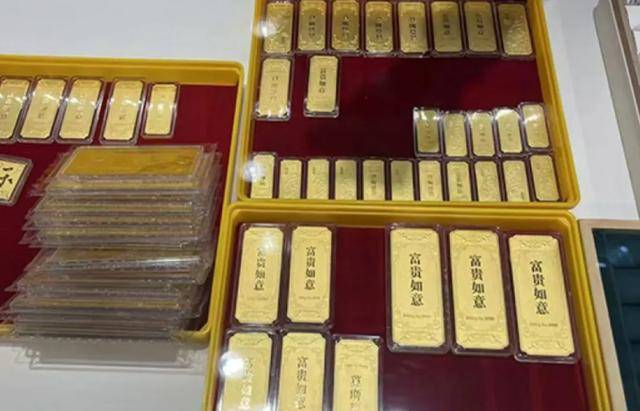
金块

Search documents
中国矿企出海丨中非携手,跨越矿脉
Zhong Guo Ji Jin Bao· 2025-12-28 04:30
Core Viewpoint - The 2025 G20 Summit marks the first time Africa will host, highlighting a new partnership between China and Africa focused on green mining and industrial cooperation, transforming mineral resources from potential conflict sources into catalysts for development [1] Group 1: Transition from Resource Export to Industrial Roots - Africa holds 30% of the world's mineral reserves but has long suffered from the "resource curse," making the transformation of resources into sustainable industrial capabilities crucial [3] - The new global energy transition and industrial chain restructuring present historic opportunities for Africa and raise expectations for Chinese mining companies [3] - The "China Action" under the G20 initiative emphasizes supporting African manufacturing and creating local brands, with Chinese mining companies extending their operations beyond extraction to developing local industrial capabilities [3][4] - Companies like Pengxin Resources are investing in local processing facilities to increase the value of extracted minerals, aligning with African policies that promote resource sovereignty and local processing [3] Group 2: Coexistence and Win-Win Cooperation - Mining investments are capital-intensive and long-term, requiring collaboration to address systemic challenges such as infrastructure and community relations [6] - Chinese mining companies in Africa are adopting a "co-opetition" model, learning from peers and collaborating with traditional Western mining giants to enhance practices in exploration and environmental standards [6] - The "Green Mineral International Trade Cooperation Initiative" promotes multilateral cooperation, paving the way for joint development of large-scale green mining projects [7] Group 3: New Chapters Across Mountains and Seas - The collaboration between Chinese managers and local miners illustrates a shift from resource competition to a focus on empowerment, sharing, and sustainability [9] - The deepening of Chinese mining companies in Africa signifies that true globalization involves deep-rooted partnerships rather than mere expansion [9] - The narrative of China-Africa cooperation is not just about commercial success but also about emotional connections and intertwined destinies, as exemplified by collaborative efforts in mining projects [9][10]
中国矿企出海丨中非携手,跨越矿脉
中国基金报· 2025-12-28 04:14
Core Viewpoint - The article emphasizes the emergence of a new partnership between China and Africa, focusing on green mining and industrial cooperation, as highlighted by the G20 summit in Johannesburg, which aims to transform mineral resources from a source of conflict into a catalyst for development [2]. Group 1: From "Resource Export" to "Industry Rooting" - Africa holds 30% of the world's mineral reserves but has long been trapped in the "resource curse," making the transformation of resources into sustainable industrial capabilities crucial [4]. - The new global energy transition and industrial chain restructuring present historic opportunities for Africa, while also raising expectations for Chinese mining companies [4]. - The "China Action" under the G20 initiative emphasizes supporting African manufacturing and creating local brands, with Chinese mining companies extending their operations beyond extraction to downstream processing [4]. - Examples include Pengxin Resources in South Africa, which is enhancing local processing capabilities, and Congolese mining companies planning local smelting capacities to retain value within Africa [4]. Group 2: "Coexistence" and "Win-Win" - Mining investments are capital-intensive and long-term, requiring collaboration to address systemic challenges such as infrastructure and community relations [7]. - Chinese mining companies in Africa are adopting a "co-opetition" model, learning from peers and collaborating with Western mining giants to enhance practices in exploration and environmental standards [7]. - The "Green Mineral International Trade Cooperation Initiative" promotes multilateral cooperation, paving the way for joint development of large-scale green mining projects [7]. Group 3: New Chapters Across Mountains and Seas - The article illustrates the collaborative efforts between Chinese managers and local miners, highlighting a shift from resource competition to empowerment and sustainability [10]. - The narrative emphasizes that true globalization involves deep-rooted partnerships rather than mere expansion, with the most valuable investments being those that cultivate local capabilities [10]. - The cooperation between China and Africa is portrayed as a significant step towards modernization and addressing global challenges, with a focus on shared futures and community well-being [10].


万联晨会-20251105
Wanlian Securities· 2025-11-05 02:56
Core Insights - The A-share market experienced a contraction, with the Shanghai Composite Index closing down 0.41% at 3960.19 points, and the Shenzhen Component Index down 1.71% [2][8] - The textile manufacturing sector showed stable revenue performance, while the apparel and home textile sectors are still awaiting recovery [4][11] Market Review - On Tuesday, the A-share market saw a decrease in trading volume, with a total turnover of approximately 1.92 trillion RMB and over 3400 stocks declining [2][8] - The banking sector led the gains among industries, while the non-ferrous metals sector faced the largest declines [2][8] - In the Hong Kong market, the Hang Seng Index fell by 0.79% to 25952.4 points, and the Hang Seng Tech Index dropped by 1.76% [2][8] - The U.S. stock indices all closed lower, with the Dow Jones down 0.53%, S&P 500 down 1.17%, and Nasdaq down 2.04% [2][8] Industry Analysis Textile Manufacturing Sector - The textile manufacturing sector achieved revenue of 922.56 billion RMB in the first three quarters of 2025, a year-on-year decrease of 0.17%, with a net profit of 73.41 billion RMB, down 5.65% [12][14] - The sector's overall gross margin and net margin decreased to 18.77% and 8.51%, respectively [12][14] Apparel and Home Textile Sector - The apparel and home textile sector reported revenue of 1112.18 billion RMB, down 4.19% year-on-year, with a net profit of 81.28 billion RMB, down 12.01% [14] - The sector's gross margin increased to 45.57%, but the net margin decreased to 7.28% due to a significant rise in expense ratios [14] Jewelry Sector - The jewelry sector's revenue was 1435.02 billion RMB, a decline of 2.01% year-on-year, with a net profit of 41.04 billion RMB, down 12.28% [14] - The sector's gross margin and net margin were 10.20% and 3.18%, respectively, reflecting a decrease in profitability due to high gold prices affecting demand [14] Investment Recommendations - For the textile manufacturing sector, it is suggested to focus on companies with cost and scale advantages as demand gradually recovers [15] - In the apparel and home textile sector, brands with strong market presence are expected to see performance improvements as demand rebounds [15] - In the jewelry sector, attention should be given to leading companies with strong brand power and innovative product designs, despite short-term pressures from high gold prices [15] Tax Policy Impact on Gold Jewelry Industry - A new tax policy effective from November 1, 2025, exempts certain gold transactions from VAT, which may impact the gold jewelry market [16][17] - The policy differentiates between investment and non-investment uses of gold, potentially increasing costs for downstream retailers [17][18] - The new regulations are expected to enhance market transparency and may lead to increased prices for consumers as retailers adjust to higher tax burdens [18][19]
黄金珠宝行业快评:黄金税收新政落地,分类实施不同方案
Wanlian Securities· 2025-11-04 09:17
Investment Rating - The industry investment rating is "Outperform the Market," indicating an expected relative increase of over 10% in the industry index compared to the market over the next six months [5][8]. Core Insights - The new tax policy for gold, effective from November 1, 2025, to December 31, 2027, introduces different schemes for investment and non-investment uses of gold, aiming to clarify the nature of investment gold and regulate the production chain [1][3]. - The policy exempts value-added tax (VAT) for certain gold transactions, particularly for standard gold traded on exchanges, which is expected to enhance market transparency and reduce illegal trading [2][4]. - The change in VAT deduction rates from 13% to 6% for non-investment gold will increase tax costs for downstream jewelry retailers, potentially leading to higher prices for consumers and impacting sales volumes [3][4]. Summary by Sections Tax Policy Changes - The new policy categorizes gold into investment and non-investment uses, with specific tax implications for each category [3]. - Investment gold will incur VAT upon sale or processing into investment products, while non-investment gold will be exempt from VAT, benefiting cash flow for buyers [2][3]. Market Impact - The new regulations are expected to drive gold trading towards formal exchanges, enhancing market order and transparency [4]. - Increased tax costs for jewelry retailers may lead to price hikes for consumers, affecting demand for gold jewelry [4]. Investment Recommendations - The report suggests focusing on leading gold jewelry companies with membership qualifications and innovative product designs, as they may better navigate the changing tax landscape [4].
黄金新规出台,有商家金条都下架了,你手里的黄金会贬值吗?
Sou Hu Cai Jing· 2025-11-04 09:12
Core Viewpoint - The new tax policy on gold, effective from November 1, represents the largest adjustment since 2002 and 2008, categorizing gold transactions into "investment" and "non-investment" uses, which will significantly impact the gold market and consumer behavior [1][5][11]. Group 1: Tax Policy Changes - The new regulation divides gold into two categories: "investment" (e.g., gold bars, coins) and "non-investment" (e.g., jewelry, industrial gold) [5][7]. - The tax rebate for retailers has decreased from 13% to 6%, increasing tax costs by approximately 7%, which is expected to be passed on to consumers, raising costs by about 60 yuan per gram [7][9]. - The announcement aims to guide gold trading towards more regulated and transparent channels, encouraging transactions through exchanges to benefit from tax exemptions [11][13]. Group 2: Market Reactions - On the first day of the new policy, the Shenzhen gold market saw a significant slowdown, with many retailers halting sales and prices for gold jewelry increasing by 61 yuan per gram to 1259 yuan per gram [3][9]. - The new tax structure is likely to shift trading from informal to formal channels, potentially reducing illegal trading and short-term arbitrage activities [13][18]. - Consumers are advised to consider the implications of the new tax policy on their purchasing decisions, particularly regarding the channels through which they buy gold [9][18]. Group 3: Consumer Impact - Ordinary consumers purchasing gold jewelry will not feel a significant impact from the new tax policy, as retail prices already include taxes [15][16]. - The market restructuring may lead to a preference for purchasing gold through official channels to ensure value retention, as the fluctuations in gold prices remain unpredictable [20].
黄金税收新政实施 买金成本会变吗
Bei Jing Shang Bao· 2025-11-02 15:59
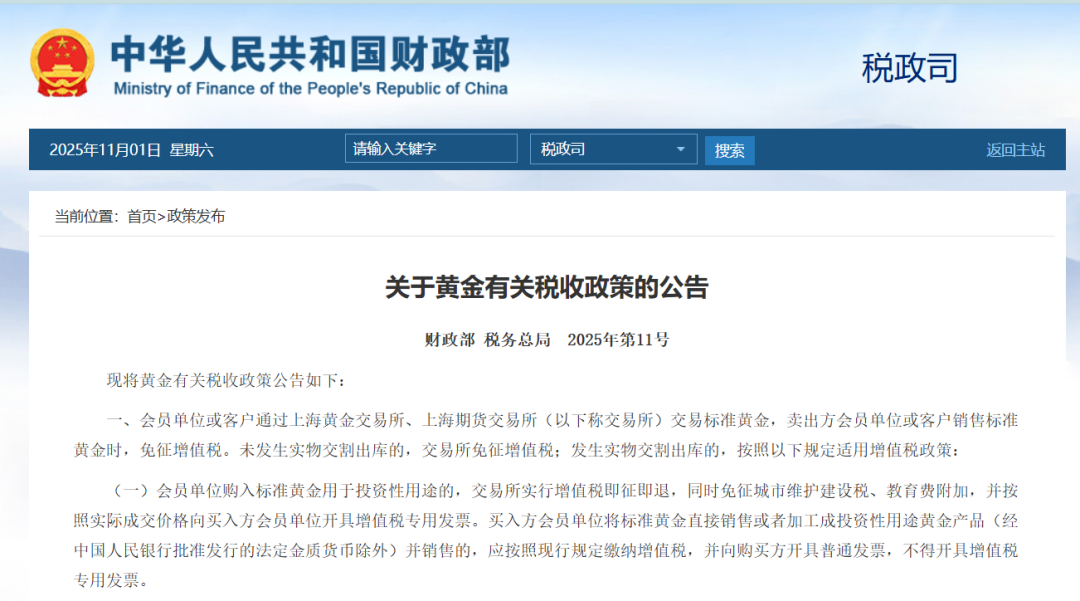
Core Viewpoint - The new tax policy for gold trading, effective from November 1, 2025, aims to enhance the attractiveness of on-exchange trading, promote the standardization and centralization of gold transactions, and improve market transparency and regulatory efficiency [1][5]. Summary by Sections Tax Policy Adjustments - The announcement specifies that members or clients trading standard gold through the Shanghai Gold Exchange and Shanghai Futures Exchange will be exempt from value-added tax (VAT) when selling standard gold [3]. - For physical delivery, transactions will be categorized into "no physical delivery" and "physical delivery," with different tax treatments applied [3][4]. - Investment-use gold purchases will benefit from VAT refunds and exemptions from urban maintenance and education fees, while non-investment-use purchases will be exempt from VAT but will require different invoicing [3][4]. Market Impact - The new policy is expected to strengthen the appeal of on-exchange trading, guide the rational allocation of gold resources, and potentially shift some off-exchange trading to on-exchange, enhancing market transparency [5][6]. - Gold prices have seen significant increases, with spot gold prices reaching $4,002.69 per ounce, up over 52% year-to-date, indicating a favorable environment for the new tax policy [5]. Stakeholder Effects - The policy will impact four main groups: exchange members, institutional investors, ordinary consumers, and downstream businesses in the gold processing and retail sectors [6]. - Institutional investors may shift towards on-exchange trading to benefit from lower tax burdens, while ordinary consumers may become more discerning about purchasing channels to maximize tax advantages [6][7]. Challenges for Small Gold Merchants - Small gold merchants face structural challenges due to the new policy, including cost pressures and compliance requirements, which may lead some to exit the investment gold market [9]. - The traditional profit models of small merchants will undergo significant changes, necessitating a shift towards enhancing product value and brand differentiation to sustain profitability [9].

黄金大消息!两部门重磅发布
Sou Hu Cai Jing· 2025-11-01 12:36
Core Viewpoint - The Ministry of Finance and the State Taxation Administration of China have announced new tax policies regarding gold transactions, which will exempt value-added tax (VAT) for certain transactions involving standard gold, effective from November 1, 2025, to December 31, 2027 [1][25]. Tax Policy Details - Transactions involving standard gold through the Shanghai Gold Exchange and Shanghai Futures Exchange will be exempt from VAT when sold by member units or clients [8][11]. - For physical delivery of standard gold, if member units purchase gold for investment purposes, VAT will be refunded immediately, and they will also be exempt from urban maintenance and construction tax, as well as educational fees [8][11]. - If standard gold is purchased for non-investment purposes, VAT will also be exempt, and a regular invoice will be issued [12][13]. Definitions and Conditions - "Standard gold" is defined as gold that meets specific purity and weight standards, including AU99.99, AU99.95, AU99.9, and AU99.5, with weights of 50 grams, 100 grams, 1 kilogram, 3 kilograms, and 12.5 kilograms [17]. - Investment purposes include direct sales and the production of gold products with a purity of 99.5% or higher [17][18]. - Member units must report any change in the use of standard gold before the change occurs, and they can only apply for a change once within six months of physical delivery [20]. Implementation Timeline - The new tax policies will be implemented starting November 1, 2025, and will remain in effect until December 31, 2027 [25].
周末重磅!黄金有关税收新政发布
Shang Hai Zheng Quan Bao· 2025-11-01 10:06
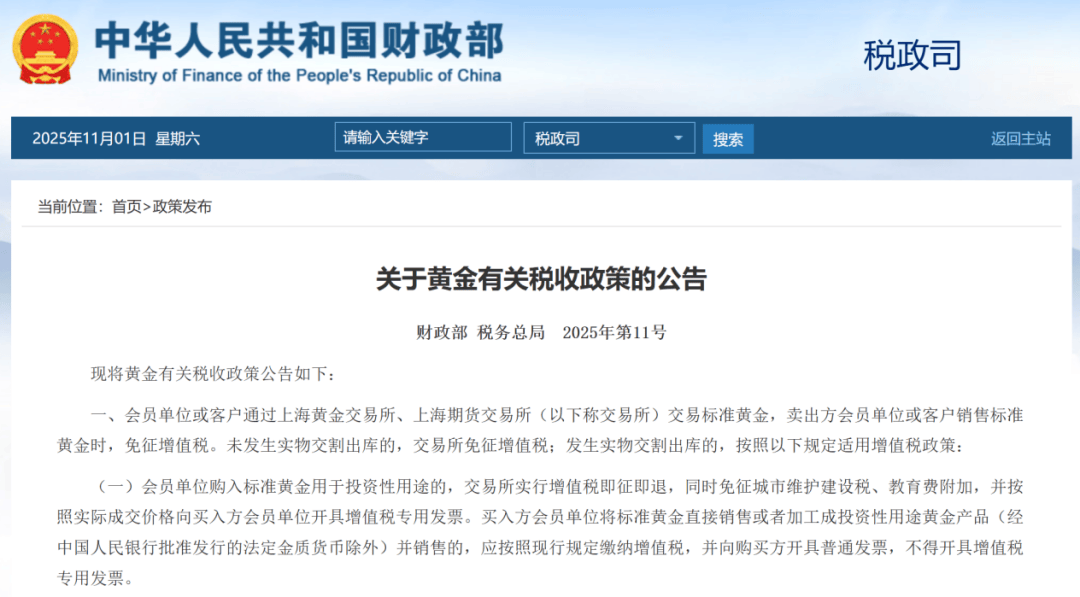
Core Viewpoint - The new tax policy for gold, effective from November 1, 2025, aims to differentiate between investment gold and non-investment gold, promoting a healthier industry ecosystem and addressing previous broad management practices [3][8]. Tax Policy Changes - The announcement specifies that transactions of standard gold through the Shanghai Gold Exchange and Shanghai Futures Exchange will be exempt from value-added tax (VAT) if no physical delivery occurs. If physical delivery occurs, VAT will apply according to regulations [4][6]. - The policy categorizes gold into investment and non-investment uses, with investment uses including direct sales and production of gold bars with a purity of 99.5% or higher [8][9]. Industry Impact - Analysts believe the new policy will help curb excessive speculation in the gold market, reflecting true market demand and enhancing liquidity in the gold spot market [9][12]. - The differentiation between investment and non-investment gold is expected to lower tax burdens for gold jewelry processing and other physical enterprises, potentially encouraging more gold to flow into the real economy [9][12]. Implementation and Compliance - Industry stakeholders are awaiting more detailed implementation guidelines, with some companies already in discussions with the Shanghai Gold Exchange and tax authorities for practical applications of the new policy [10][11]. - The new regulations provide clearer definitions and calculations for invoices and deductions, which may help unify tax and accounting standards across the gold industry [12]. Market Context - As of October 31, 2023, gold prices have surged, with London spot gold and Shanghai gold prices increasing by over 52% and 50%, respectively, since the beginning of the year [12].
黄金税收新政来袭!投资者必看
Sou Hu Cai Jing· 2025-11-01 08:07
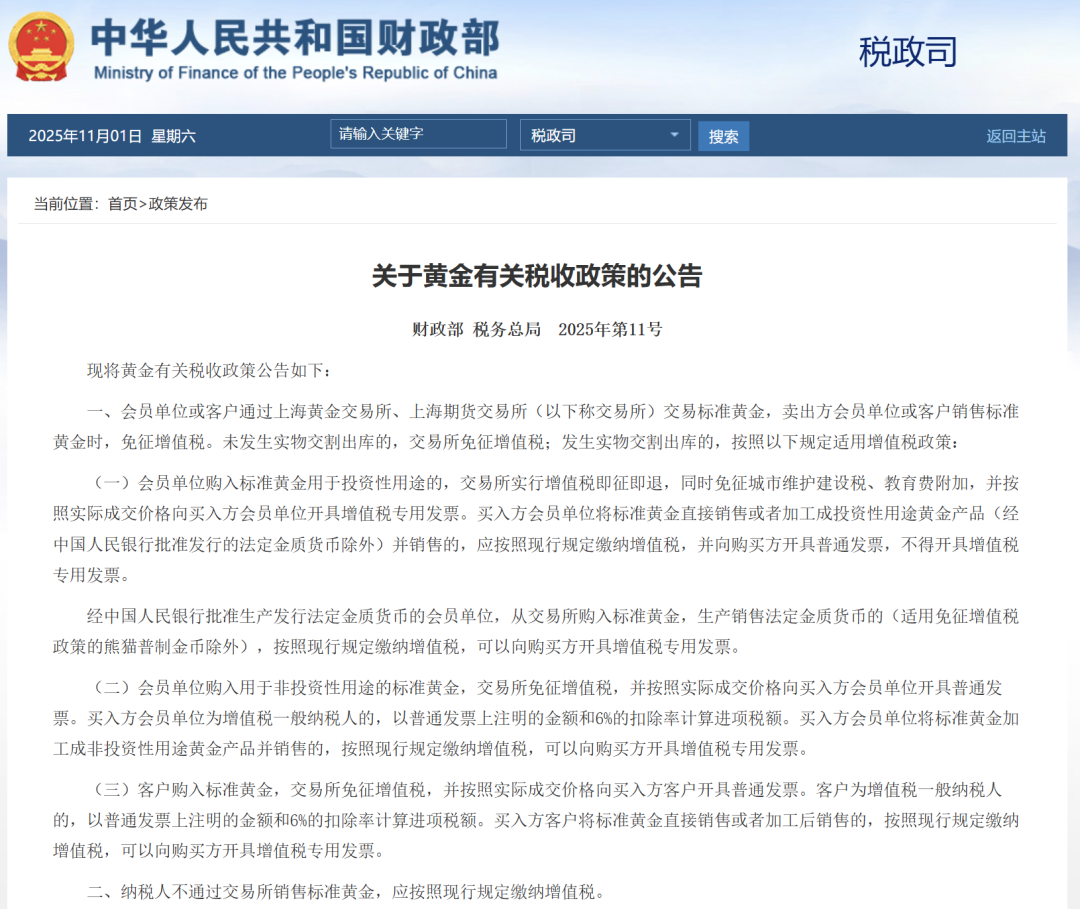
Core Insights - The Ministry of Finance and the State Taxation Administration announced a significant tax policy change regarding gold, effective from November 1, 2025, until December 31, 2027, which will transform the gold market [1] Tax Policy Highlights - **Tax Exemption for Exchange Transactions**: Members or clients trading standard gold through the Shanghai Gold Exchange and Shanghai Futures Exchange will be exempt from value-added tax (VAT) upon selling. Transactions without physical delivery will also be exempt from VAT [1] - **Investment Use Benefits**: Members purchasing standard gold for investment purposes (e.g., processing into gold bars or ingots with a purity of 99.5% or higher) will benefit from immediate VAT refunds and exemptions from urban maintenance and construction tax, as well as educational fees [1] - **Usage Change Reporting Requirement**: If the actual use of standard gold purchased from the exchange changes, members must report and apply for a change within six months, with only one application allowed. Failure to comply will result in the suspension of VAT special invoice issuance [1] - **Severe Penalties for Violations**: Members or clients engaging in fraudulent activities to exploit tax policies, such as obtaining export tax refunds or issuing false VAT invoices, will have their VAT special invoice issuance qualifications suspended starting the month after the penalty decision [1] Market Impact Analysis - The new policy aims to further regulate the tax order in the gold market and promote healthy development of gold trading. Investors are advised to closely monitor policy changes and plan investment strategies accordingly to avoid potential losses due to policy misunderstandings [1]

事关黄金税收,财政部、税务总局最新公告
2 1 Shi Ji Jing Ji Bao Dao· 2025-11-01 02:12
Core Viewpoint - The announcement outlines new tax policies regarding the trading of standard gold through the Shanghai Gold Exchange and Shanghai Futures Exchange, effective from November 1, 2025, to December 31, 2027, which includes exemptions and specific tax treatments for different types of transactions [13]. Tax Policy for Standard Gold Transactions - Members or clients trading standard gold through the exchanges will be exempt from value-added tax (VAT) when selling standard gold, with specific conditions for physical delivery and investment purposes [1][2]. - For members purchasing standard gold for investment purposes, VAT will be collected and refunded immediately, along with exemptions from urban maintenance and education fees [1]. - Non-investment purchases by members will also be exempt from VAT, with ordinary invoices issued [2]. Definitions and Conditions - "Standard gold" is defined as gold that meets specific purity and weight standards, including AU99.99, AU99.95, AU99.9, AU99.5, and weights of 50 grams, 100 grams, 1 kilogram, 3 kilograms, and 12.5 kilograms [6]. - Investment purposes include direct sales and the production of gold products with a purity of 99.5% or higher, while non-investment purposes refer to all other uses [6]. Reporting and Compliance - Members must report any changes in the use of standard gold after physical delivery, with specific procedures for changing from investment to non-investment purposes and vice versa [9][10]. - Failure to report changes or comply with invoicing regulations may result in penalties, including the suspension of VAT refund privileges [12]. Implementation Timeline - The new tax policies will be effective from November 1, 2025, and will replace previous regulations established in 2002 and 2008 [13].