铜ETF

Search documents
一个笔误骗全球一整年!英伟达“50万吨铜”乌龙,推高铜价34%?
Sou Hu Cai Jing· 2026-01-19 15:35
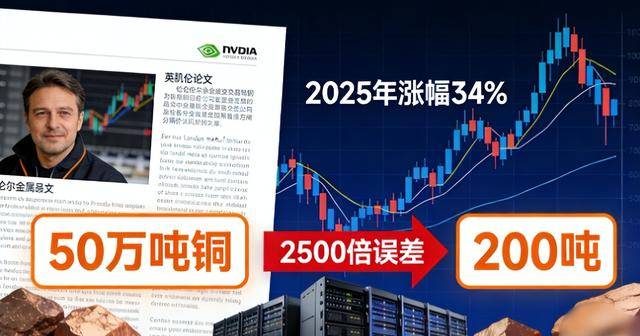
Core Viewpoint - The erroneous data from Nvidia's technical report led to widespread panic about copper shortages due to the anticipated demand from artificial intelligence data centers, despite the actual copper requirement being significantly lower than reported [2][5][8]. Group 1: Nvidia's Report and Its Impact - Nvidia's report mistakenly stated that a 1 GW data center would require 50,000 tons of copper, which is 2,500 times higher than the correct figure of 200 tons [2][7]. - The report's miscalculation was initially accepted without scrutiny, leading analysts and investment banks to predict a significant increase in copper demand due to AI [4][5]. - The narrative surrounding AI's resource consumption gained traction, influencing investor behavior and driving up copper prices throughout the year [6][8]. Group 2: Market Reactions and Price Movements - Following the report, copper prices surged from $8,000 per ton at the beginning of the year to over $11,000 by year-end, marking a significant increase [7]. - The demand for copper was further fueled by trends in electric vehicles and renewable energy, with projections indicating a 60% increase in copper demand for grid upgrades by 2030 [5][8]. - Speculative trading in copper futures increased dramatically, with record inflows into copper ETFs as investors reacted to the perceived shortage [7][8]. Group 3: Correction and Aftermath - In January 2026, Thunder Said Energy published a review clarifying the copper requirement, revealing the original report's error and causing market shock [7][8]. - Despite the correction, the overall market sentiment remained optimistic about copper demand driven by electric vehicles and renewable energy, with Goldman Sachs maintaining its bullish outlook for the future [8].


铜价狂飙逼近1.2万美元!AI数据中心引爆“红色金属”争夺战,供应链已拉响警报
Zhi Tong Cai Jing· 2025-12-15 07:01
Group 1 - The price of copper is approaching $12,000 per ton due to soaring demand for data centers driven by artificial intelligence and supply constraints, with a year-to-date increase of 35% [1] - Copper is essential for powering infrastructure needed for data centers, electric vehicles, and energy transition [1] - A survey predicts a shortage of 124,000 tons of copper this year and 150,000 tons next year, driven by significant investments in grid modernization and expansion [1] Group 2 - Global copper demand is expected to reach 27 million tons this year, with a 2.7% increase projected for 2024, and a 3.7% growth in demand from China [2] - Supply disruptions, including an incident at Freeport-McMoRan's Grasberg mine, have reinforced expectations of tight supply [2] - Copper inventories in major exchanges have increased by 54% this year, reaching 661,021 tons [2] Group 3 - Comex inventory has reached a record high of 405,782 tons, accounting for 61% of total exchange inventory, compared to 20% at the beginning of 2025 [3] - The supply of refined copper is under scrutiny due to ongoing reviews of import tariffs, with a 50% exemption on tariffs effective from August 1 [4]
中国挑战美元霸权!黄金回归:中国正在重建全球货币体系
Sou Hu Cai Jing· 2025-10-31 08:41
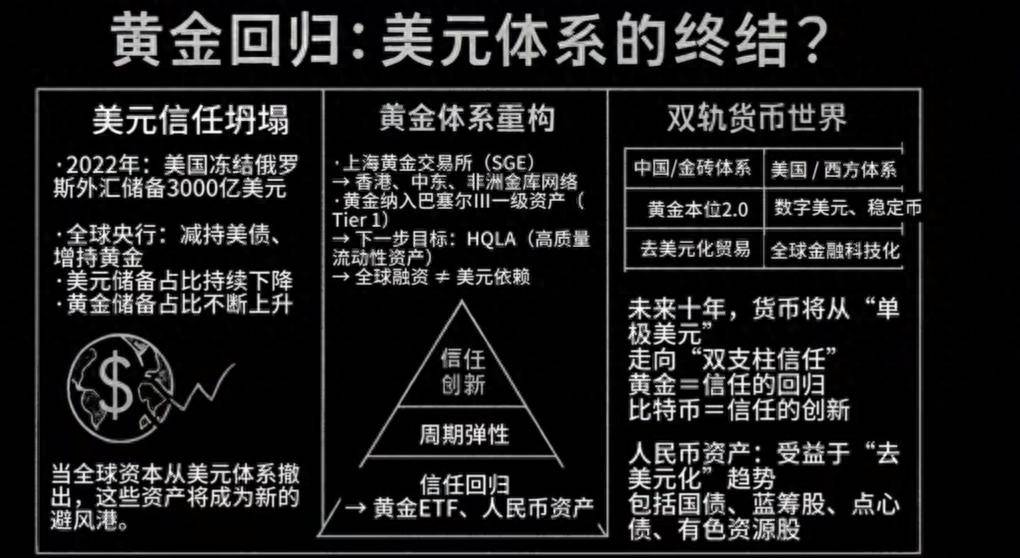
Core Viewpoint - The article discusses the emerging challenge to the US dollar's global dominance, highlighting China's efforts to rebuild a trust system for currency using gold, marking a revolutionary shift in the concept of money [1]. Group 1: Dollar Trust Erosion - For decades, over 70% of global foreign exchange reserves were tied to dollar assets, with countries relying on US Treasury bonds to safeguard their wealth [3]. - The freezing of approximately $300 billion of Russia's foreign reserves by the US in 2022 shattered this trust, signaling that the dollar is not merely an asset but a liability of the US [3]. - This incident prompted central banks worldwide to reduce their holdings of US Treasuries and increase their gold reserves, with China emerging as the largest official gold buyer [3]. Group 2: China's Gold Corridor - China has established a "Gold Corridor" centered around the Shanghai Gold Exchange, which is the largest physical gold market globally, supported by a network of vaults in Hong Kong, the Middle East, and Africa [6]. - This system allows countries holding renminbi to directly exchange it for physical gold, effectively transforming the renminbi into a reserve currency backed by gold [6]. - The initiative aims to create a parallel financial system to the US dollar, bypassing traditional systems like SWIFT and the IMF, with a focus on BRICS nations [6]. Group 3: Future of Gold in Finance - By July 2025, gold will be recognized as a level one asset under Basel III, allowing it to be counted at 100% value on banks' balance sheets, restoring its status as a monetary asset [6]. - Central banks are pushing for gold to be classified as a "high-quality liquid asset," which would enable it to be used for collateral in repurchase financing, fundamentally altering the global financial system [6]. Group 4: Diverging Financial Systems - A clear division is emerging between two financial systems: one led by China and the BRICS, anchored in gold, and the other by the US and the West, based on digital dollars and stablecoins [9]. - This transformation is already impacting asset prices, with central banks and sovereign funds averaging 20% of their reserves in gold or equivalent physical assets, with recommendations to increase this to 30% [9]. - The anticipated increase in gold demand could reach approximately $2 trillion globally, as gold cannot be printed like dollars, suggesting a potential "structural revaluation" of gold prices in the next five years [9]. Group 5: Investment Strategies - Investment strategies are becoming clearer, with recommendations for strategic allocations in gold ETFs, cyclical assets like copper and other metals, and innovative assets such as Bitcoin [9]. - Assets denominated in renminbi, including government bonds, blue-chip stocks, and commodities, are expected to benefit from the trend of de-dollarization, becoming new safe havens as global capital exits the dollar system [9]. Group 6: Trust in Currency - Gold represents a return to "trust," while Bitcoin symbolizes "innovation in trust," together forming the dual pillars of the post-dollar era [11]. - The future may see a diversified currency landscape, with China rebuilding tangible trust through gold and the US maintaining institutional trust through technology [11].
世界货币格局将要变天?美元优势在减少,黄金逐渐成为硬通货
Sou Hu Cai Jing· 2025-10-28 16:29
Core Insights - The global monetary landscape is undergoing a significant transformation, with a shift from a dominant currency structure to a more diversified system, influenced by different camps focusing on varying foundations of monetary trust [1][4][19] Group 1: Dual Monetary Systems - The current financial environment is characterized by a bifurcation in the monetary system, with one side led by China and BRICS nations advocating for a "Gold Standard 2.0," relying on tangible gold, while the other side, led by the U.S. and Western allies, promotes a technology-driven approach with digital dollars and stablecoins [4][8] - This division is not sudden; it has been developing as the U.S. Treasury and Federal Reserve have been quietly repatriating gold from London since November 2024, with New York Commodity Exchange gold inventories increasing from 17.2 million ounces to 34.6 million ounces in just three months [6][8] Group 2: Erosion of Dollar Trust - The dollar's dominance has been challenged, particularly after the U.S. froze approximately $300 billion of Russian foreign reserves in 2022, signaling that the dollar is a political tool rather than a secure asset [8][9][11] - Since 2023, global central banks have shifted towards gold, with countries like China, India, and Turkey significantly increasing their gold purchases, while major holders of U.S. Treasury bonds have begun to reduce their holdings [11][13] Group 3: China's Gold Corridor Strategy - China has established a "Gold Corridor" system, centered around the Shanghai gold market, allowing countries holding renminbi to convert it into gold, enhancing the renminbi's status as a hard currency [13][15] - A new settlement channel has been created to bypass SWIFT and the IMF, enabling BRICS nations to use gold as collateral for loans, which could fundamentally change global financing dynamics [15][17] Group 4: Future of Gold and Currency - The inclusion of gold as a primary asset in Basel III by July 2025 could restore gold's monetary identity, leading to a significant transformation in global financial logic [15][21] - Central banks are currently allocating 20% of their reserves to gold, with suggestions to increase this to 30%, indicating a potential $2 trillion increase in demand for gold, which is expected to undergo a "systemic revaluation" in the next five years [17][21] Group 5: Long-term Trends - The competition between trust mechanisms—China's tangible gold trust versus the U.S.'s rule-based trust—will reshape the global financial landscape, with the dollar's trust foundation eroding and gold regaining prominence [19][21] - As the monetary system diversifies, individuals will need to adapt their asset allocation strategies, with gold ETFs and renminbi-denominated assets emerging as viable options [21]
错过黄金白银暴涨?别慌,铜正在重演10年前的财富神话
Sou Hu Cai Jing· 2025-10-28 07:00
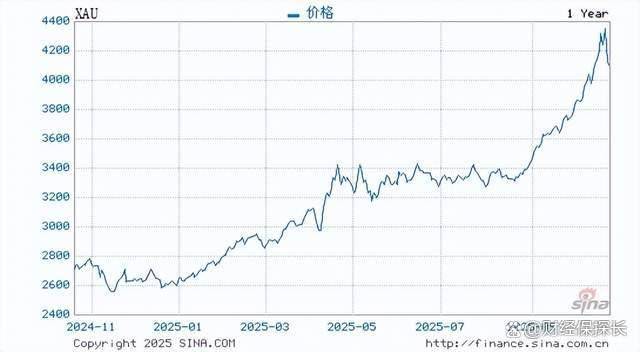
Core Viewpoint - The article suggests that after missing the significant price increases in gold and silver, copper presents a compelling investment opportunity, potentially serving as a "Plan B" for investors [2][14]. Group 1: Market Performance - Gold and silver have seen remarkable price increases this year, with gold rising from $1800 to $4300 and silver from $20 to $53, while copper's performance has been relatively subdued [2][3]. - Historical data shows that during previous commodity supercycles, copper prices have experienced substantial increases, such as a rise from $3000 to nearly $10000 between 2006 and 2008, and from $4500 to $10700 during the pandemic, indicating copper's potential for significant price appreciation [5]. Group 2: Demand and Supply Dynamics - Copper is essential for various industries, including electric vehicles, renewable energy, and AI data centers, with the demand for copper expected to surge due to the ongoing energy transition [9][12]. - The supply of copper is constrained, with the average grade of copper ore from the top ten mines decreasing from 1.2% in 2000 to 0.6% currently, and stricter environmental regulations in major copper-producing countries complicating new mining approvals [13]. Group 3: Investment Strategy - The "gold to copper ratio" has historical significance, with the ratio currently at 5.5, suggesting potential for copper price increases as seen in past trends [12]. - Investors are advised to adopt a cautious approach by gradually entering positions in copper-related investments, such as copper ETFs or stocks of well-known copper mining companies, while being prepared for a longer investment horizon [14].