
铜短缺

Search documents
一个笔误骗全球一整年!英伟达“50万吨铜”乌龙,推高铜价34%?
Sou Hu Cai Jing· 2026-01-19 15:35
Core Viewpoint - The erroneous data from Nvidia's technical report led to widespread panic about copper shortages due to the anticipated demand from artificial intelligence data centers, despite the actual copper requirement being significantly lower than reported [2][5][8]. Group 1: Nvidia's Report and Its Impact - Nvidia's report mistakenly stated that a 1 GW data center would require 50,000 tons of copper, which is 2,500 times higher than the correct figure of 200 tons [2][7]. - The report's miscalculation was initially accepted without scrutiny, leading analysts and investment banks to predict a significant increase in copper demand due to AI [4][5]. - The narrative surrounding AI's resource consumption gained traction, influencing investor behavior and driving up copper prices throughout the year [6][8]. Group 2: Market Reactions and Price Movements - Following the report, copper prices surged from $8,000 per ton at the beginning of the year to over $11,000 by year-end, marking a significant increase [7]. - The demand for copper was further fueled by trends in electric vehicles and renewable energy, with projections indicating a 60% increase in copper demand for grid upgrades by 2030 [5][8]. - Speculative trading in copper futures increased dramatically, with record inflows into copper ETFs as investors reacted to the perceived shortage [7][8]. Group 3: Correction and Aftermath - In January 2026, Thunder Said Energy published a review clarifying the copper requirement, revealing the original report's error and causing market shock [7][8]. - Despite the correction, the overall market sentiment remained optimistic about copper demand driven by electric vehicles and renewable energy, with Goldman Sachs maintaining its bullish outlook for the future [8].



“铜荒”加剧:供应缺口或达1000万吨,AI与国防开支或引爆全球铜争夺战
Jin Shi Shu Ju· 2026-01-08 06:06
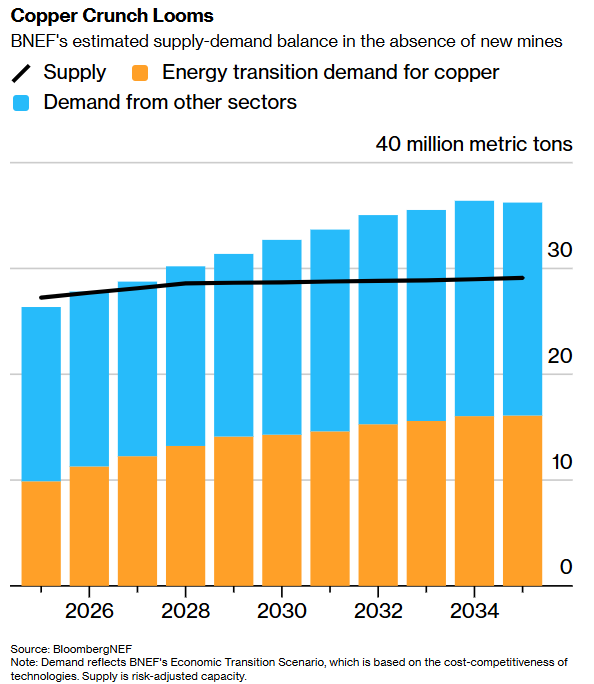
Core Insights - The competition in the artificial intelligence sector and rising defense spending are expected to exacerbate the already evident copper shortage, with producers struggling to expand capacity [1] - A report by S&P Global indicates that global copper demand is projected to increase by 50% by 2040, reaching 42 million tons, driven primarily by energy transition sectors such as electric vehicles and renewable energy [1][2] Group 1: Demand Drivers - The demand for copper from artificial intelligence, data centers, and global defense spending is expected to double, adding approximately 4 million tons of consumption by 2040 [2] - The installation capacity of global data centers is projected to grow nearly fourfold by 2040, significantly increasing copper consumption related to these infrastructures [2] - The potential demand from humanoid robots could reach about 1.6 million tons annually by 2040, accounting for approximately 6% of current consumption [2] Group 2: Supply Challenges - Global copper production is expected to peak at around 33 million tons by 2030, facing challenges such as declining ore grades and obstacles in permitting, financing, and construction of new projects [2] - Even with a significant increase in recycled copper, projected to more than double to 10 million tons, there will still be a supply gap of 10 million tons [2] - The longer development cycles, rising costs, and highly concentrated supply chains further exacerbate supply challenges, making the market increasingly vulnerable to disruptions as demand accelerates [5] Group 3: Market Dynamics - High copper prices are beneficial for the industry, but there is no guarantee that prices will remain at elevated levels [5] - The research received funding from major mining companies and traders, indicating strong industry interest in the findings [5]
铜价狂飙创纪录!关税与AI需求引爆“完美风暴”,明年短缺还将加剧?
Jin Shi Shu Ju· 2025-12-29 08:40
Group 1 - Copper prices are expected to achieve the largest annual increase in over a decade, with prices soaring above $12,000 per ton in December and rising over 30% in 2025, marking the highest annual increase since 2009 [2] - The demand for copper is projected to exceed mineral supply by the 2030s, driven by the transition to renewable energy, electrification of vehicles, and the construction of data centers for artificial intelligence [2] - Aging copper mine productivity is declining, and the high costs and lengthy timelines associated with bringing new mines online are contributing to supply concerns [2] Group 2 - Significant accidents at the world's largest mines since October have raised concerns about shortages, leading to record high copper prices [3] - Major mining companies have lowered production forecasts, and there has been a surge of copper imports into the U.S. as importers rush to acquire metal before potential tariffs [3] - A notable price gap has emerged between London benchmark prices and U.S. Comex copper prices, with traders capitalizing on this difference [3] Group 3 - The current tightness in the copper market is described as regional rather than global, with 85% of LME warehouse copper not qualifying for delivery to U.S. Comex facilities [4] - Despite this, traders are still moving significant amounts of metal to the U.S. due to higher domestic prices, utilizing swaps to manage non-qualifying copper [4] - This situation is expected to persist until 2026, potentially leading to shortages outside the U.S., with copper prices anticipated to remain strong in 2026 [4]
被曝大笔注销LME仓单的摩科瑞上周预测:明年Q1铜将面临严重短缺
Ge Long Hui A P P· 2025-12-04 23:25
Core Viewpoint - Trade companies are competing to ship more copper to the U.S. as President Trump plans to reconsider tariffs on raw copper next year, leading to a surge in copper futures prices and creating an opportunity for traders to import before any tariffs are implemented [1] Group 1: Market Dynamics - Recent weeks have seen an increase in competition among trade companies to transport copper to the U.S. [1] - The surge in New York copper futures prices provides traders with an opportunity to import copper ahead of potential tariffs [1] Group 2: Price Expectations - Kostas Bintas from Mercuria anticipates that copper prices will rise to record levels in the coming weeks due to increased trading momentum [1] - Manufacturers are expected to pay higher prices as exports to the U.S. accelerate and exchange inventories decrease [1] Group 3: Supply Concerns - Bintas warns of a significant issue where other parts of the world may face a severe shortage of cathode copper if current trends continue [1] - Mercuria has reportedly notified plans to withdraw over 40,000 tons of copper from LME's Asian warehouses this week [1]
智媒关注铜价创历史新高
Shang Wu Bu Wang Zhan· 2025-11-01 16:20
Core Insights - Copper prices on the London Metal Exchange reached an all-time high on October 29 due to supply disruptions from major mines in Chile, Africa, and Indonesia, leading to global supply tightness [1] - The Trump administration's tariff policies have resulted in significant copper inventory buildup in the United States [1] - Morgan Stanley predicts the most severe copper shortage in two decades by 2026 [1] - Stable demand from China, along with strong long-term demand from the renewable energy and electric vehicle sectors, is driving copper prices towards their best annual performance since 2017 [1] - As the world's largest copper exporter, Chile's currency has strengthened against the US dollar [1]
矿企巨额交易难解铜短缺之困
Wen Hua Cai Jing· 2025-10-14 11:58
Group 1 - The majority of mining CEOs agree that the world is accelerating towards a copper shortage, with the real challenge being how to respond to this issue [2] - The merger between Anglo American and Teck Resources, valued at $54 billion, appears to address supply concerns, particularly as copper is crucial for the green energy transition [2] - The International Energy Agency (IEA) reported that global copper production was approximately 23 million tons last year, with projections to increase to 24 million tons by the end of the decade, but could fall below 20 million tons by 2035 without new supply sources [2] Group 2 - The IEA predicts that copper demand could approach 33 million tons by 2035, highlighting a significant supply-demand gap that may not be filled by increased recycling of scrap metal [2] - Supply disruptions are a pressing concern, as Freeport-McMoRan announced a production halt at its Grasberg mine in Indonesia, causing a stock price drop of over 15% [2] - Citigroup analysts believe that global copper production growth will be minimal this year, with an expected growth rate of only 1.3% by 2026, significantly lower than the 2.5% average growth rate over the past 25 years [2] Group 3 - Economic theory suggests that price increases typically lead to expanded mining operations, and recent trends indicate that copper prices are nearing last year's 20-year high [3] - However, inflation during the pandemic has accelerated production costs, with capital expenditures required to initiate new supplies in Latin America increasing by 65% since 2020 [3] - Major mining companies have differing views on the actual costs of new projects, with estimates ranging from $23,000 to $30,000 per ton for new copper mines, necessitating significant upfront investments [3] Group 4 - To achieve reasonable returns, large mining companies need copper prices to exceed $12,000 per ton, complicating their willingness to invest in new underground projects due to lengthy approval processes [4] - The merger between Anglo American and Teck Resources is attractive as it allows for the acquisition of additional mining capacity without the risks associated with new mine development [4] - The combined entity expects to add 175,000 tons of copper production by 2030, leveraging synergies from nearby mines [4] Group 5 - There are concerns that post-merger, the combined mining company may not increase production levels compared to their independent operations, as they may prioritize higher-return mines [5] - The exploration budget for mining companies has dropped below 3% of EBITDA for copper operations, down from over 6% in the early 2010s, indicating a decline in new discoveries [5] - Bank of America has raised its copper price forecast for next year to $11,313 per ton, with expectations of reaching $13,500 per ton by 2027, which could incentivize mining companies to resume exploration [5]


摩科瑞:铜短缺可能推动铜价创下历史新高
news flash· 2025-05-21 03:03
Core Viewpoint - Mercuria predicts a significant shortage in copper supply this year, which may lead to record-high copper prices [1] Group 1: Supply Shortage - Mercuria forecasts a shortage of 700,000 tons in copper concentrate and 300,000 tons in refined copper metal for this year [1] - The copper market is described as being in an extremely fragile state, with a high likelihood of entering a shortage phase in the second half of the year [1] Group 2: Price Expectations - Nicholas Snowdon, a prominent copper bull at Mercuria, anticipates that copper prices will reach new highs, stating it is only a matter of time [1] - The current market conditions suggest that the question is not whether a shortage will occur, but when it will happen [1]
能源交易商摩科瑞:预计今年铜精矿短缺70万吨,精炼铜短缺30万吨。
news flash· 2025-05-21 02:04
Core Insights - The energy trader Molybdenum expects a shortage of 700,000 tons of copper concentrate this year and a shortage of 300,000 tons of refined copper [1] Industry Summary - The anticipated shortages in copper concentrate and refined copper indicate potential supply chain challenges within the copper industry, which may impact pricing and availability [1]
矿业公司安托法加斯塔CEO:长期铜短缺将持续,但如果经济疲软,需求驱动因素可能会发生变化。
news flash· 2025-04-08 13:06
Core Viewpoint - The CEO of Antofagasta stated that a long-term copper shortage will persist, but demand drivers may change if the economy weakens [1] Group 1 - The long-term outlook for copper supply indicates a sustained shortage [1] - Economic conditions could alter the demand dynamics for copper [1]