
铝及其制品

Search documents
罗志恒:关税战下的美国——关税收入、实际税率与贸易格局演变
Sou Hu Cai Jing· 2025-10-13 04:55
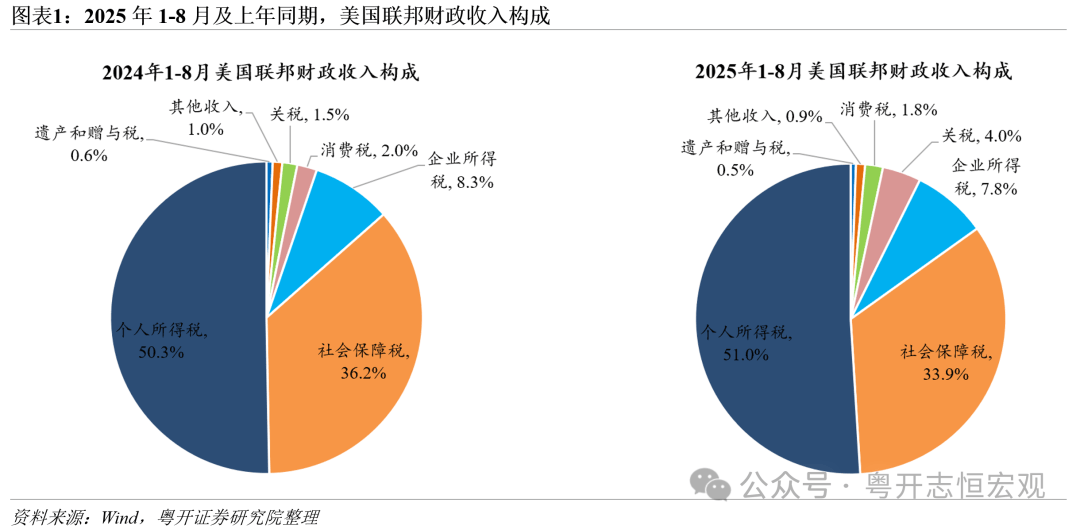
Core Viewpoint - The recent announcement by Trump to impose a 100% tariff on China and export controls on key software is seen as a significant escalation in the US-China trade conflict, which could have profound implications for bilateral trade and the global trade system [1] Group 1: Tariff Revenue and Rates - Since the onset of the trade war, US tariff revenue has surged, becoming the fourth largest source of federal revenue, following individual income tax, social security tax, and corporate income tax [6] - From January to June 2025, the average tariff rate in the US increased from 2.2% to 8.9%, with a notable rise in April due to expanded tariffs on a global scale [8][14] - By August 2025, US tariff revenue reached $144.4 billion, 2.8 times that of the previous year, accounting for 4.0% of federal revenue, an increase of 2.5 percentage points year-on-year [6] Group 2: Tariff Rates by Trade Partner - The actual average tariff rate imposed by the US on China reached 37.4% by June 2025, with significant increases observed for labor-intensive goods and products affected by Section 232 tariffs [24][29] - The average tariff rates for Japan and South Korea were 15.3% and 12.0%, respectively, while rates for the EU, Vietnam, and India ranged between 5% and 10% [24] - The US has seen a decline in its reliance on Chinese imports, with the share of imports from China dropping to 9.4% of total imports, a decrease of 3.4 percentage points year-on-year [28] Group 3: Trade Performance and Deficits - In the first seven months of 2025, US imports grew by 10.7% and exports by 4.8%, but the trade deficit expanded by 21.3% [19] - The US experienced a decline in trade volume with China and Canada, with imports from China down by 18.9% and exports down by 20.2% [19][20] - Despite high tariffs on China, the overall trade deficit with other countries has increased, indicating that the US still relies heavily on imports to meet domestic demand [20] Group 4: Future Tariff Trends - The actual tariff rates are expected to converge with nominal rates as various loopholes and exemptions are closed, leading to an increase in effective tariff rates across different economies [33][34] - Factors such as preemptive imports and exemptions for certain goods have contributed to the current lower effective tariff rates, but these are anticipated to diminish over time [33][35]

关税战下的美国:关税收入、实际税率与贸易格局演变
Yuekai Securities· 2025-10-12 06:54
Revenue and Tax Rate Insights - U.S. tariff revenue surged to $144.4 billion in the first eight months of 2025, 2.8 times higher than the same period last year, making it the fourth largest source of federal revenue at 4.0%[12] - The average tariff rate increased from 2.2% in January to 8.9% in June 2025, reflecting a significant rise driven by higher tariff rates[16] Trade Partner Analysis - The actual average tariff rate on imports from China reached 37.4% in June 2025, up 26.5 percentage points from January, with a peak of 45.6% in May[27] - U.S. imports from China fell by 18.9% and exports by 20.2% in the first seven months of 2025, indicating a significant decline in trade volume[28] Trade Dynamics - U.S. imports grew by 10.7% and exports by 4.8% year-on-year in the first seven months of 2025, while the trade deficit expanded by 21.3%[27] - The U.S. reliance on Chinese imports decreased, with imports from China constituting 9.4% of total U.S. imports, down 3.4 percentage points year-on-year[5] Product-Specific Tariff Changes - Tariff rates on labor-intensive goods, such as toys and shoes, increased significantly, with rates rising by 24.2 and 13.1 percentage points respectively[37] - The "232 tariffs" on steel and aluminum products saw rates increase from 25% to 50%, leading to substantial hikes in actual tariff rates for these categories[38]
美国关税战压顶,欧盟扛不住,冯德莱恩访华前先去日本,事情不简单
Sou Hu Cai Jing· 2025-07-26 10:05
Group 1 - The core issue is the escalating trade tensions between the EU and the US, particularly due to the US imposing significant tariffs on EU goods, which has prompted EU leaders to seek support from allies like Japan [1][3][4] - The US has implemented a series of tariffs, including a 10% basic tariff on most EU exports, a 25% tariff on imported cars and parts, and a 50% tariff on steel and aluminum products, with further threats of a 30% tariff on EU goods starting August 1 [3][4] - The potential impact of these tariffs is severe, with 70% of the €530 billion worth of goods exported from the EU to the US being affected, leading to reduced profit margins and increased prices for EU manufacturers, particularly in the automotive sector [4][6] Group 2 - EU Commission President Ursula von der Leyen's visit to Japan aims to establish a "competitiveness alliance" focused on developing rare earth resources, reducing reliance on China [6][9] - The EU's relationship with China is complex, with recent tensions arising from trade barriers and restrictions on Chinese companies, despite a history of strong economic cooperation [6][7] - The EU is encouraged to recognize mutual interests with China and engage in sincere dialogue to foster cooperation in trade and global governance, which could stabilize and enhance EU-China relations [9]

电解铝观点更新
2025-07-02 15:49
电解铝观点更新 20250702 摘要 2025 年上半年国内原铝表观需求同比增长 4.5%,虽低于去年同期,但 仍超预期,主要受益于流水转化率提升、光伏抢装和抢出口共振,以及 废料供应紧张。 光伏产业对电解铝需求影响复杂,上半年光伏抢装增加原铝需求,但全 年来看,光伏组件对原铝需求同比减少 30 万吨,拖累铝需求增速约 0.7 个百分点。 新能源汽车行业表现强劲,预计全年销量同比增长 30%,汽车用铝增量 同比增加 54 万吨,贡献原铝消费增速约 1.2 个百分点,与去年基本持 平。 受出口退税和关税影响,1-5 月份微断达的铝及其制品累计出口量同比 下降 4.4%,但降幅收窄,全年出口量预计增加 10 万多吨,对全年需求 贡献约 0.5 个百分点。 电力领域投资增长显著,1-5 月新增 220kV 以上线路长度累计同比增长 近 30%,带动铸造业产量同比增长 12%左右,贡献显著。 Q&A 天丰金属公司在过去两年的盈利表现如何? 天丰金属公司在过去两年中,利润增长速率显著提升,分红比例也有所增加, 整体盈利水平保持稳定。这一扩张周期使得公司表现出色,与港股的中国红桥、 A 股的中葡实业、云铝天山等优秀公司 ...