
银河创新成长A

Search documents
基金经理,不能“旱涝保收”了
3 6 Ke· 2025-12-15 04:03
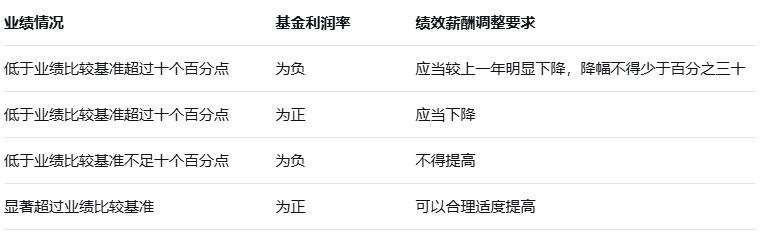
Core Viewpoint - The recent draft guidelines from the China Securities Regulatory Commission (CSRC) propose a performance evaluation mechanism for fund managers, emphasizing a tiered adjustment of performance compensation based on the past three years' performance against benchmarks and fund profitability [1][2]. Performance Evaluation Mechanism - Fund managers' performance compensation can be adjusted in four scenarios: a decrease of no less than 30% if performance is more than 10% below the benchmark with negative profitability, a decrease if performance is more than 10% below the benchmark with positive profitability, no increase if performance is less than 10% below the benchmark with negative profitability, and a reasonable increase if performance significantly exceeds the benchmark with positive profitability [1][2]. Current Fund Performance - Among 20 actively managed billion-level equity funds, 8 funds outperformed their benchmarks by over 10%, while 6 funds underperformed by over 10% as of December 9 [2]. Notable Fund Performances - The top-performing fund, Galaxy Innovation Growth A, managed by Zheng Weishan, achieved an excess return of 49.38% over three years, with a total return of 243% and an annualized return of 20.58% since its management began in May 2019 [4][5]. - Other notable funds include Dachen High Growth A, managed by Liu Xu, with a total return of 417.29% and an annualized return of 17.16% over 10 years, and Xingquan Business Model Preferred A, managed by Qiao Qian, with a total return of 203.42% and an annualized return of 16.11% over 7 years [5][7][8]. Investment Strategies - Zheng Weishan's strategy focuses on heavily investing in technology stocks, maintaining a high concentration in top holdings, while Liu Xu adopts a diversified approach across various sectors, balancing between well-known blue-chip stocks and smaller companies [5][7][9]. - Qiao Qian employs a flexible trading strategy with shorter holding periods and a diversified sector allocation, aiming to balance long-term investment judgments with short-term market fluctuations [9][10]. Implications of New Guidelines - The proposed guidelines aim to address the issue of fund managers' compensation being disconnected from performance, encouraging a stronger link between fund performance and manager remuneration [1][2][10].

近2000只公募基金第三季度合计实现利润1013亿元
Zheng Quan Ri Bao· 2025-10-26 16:15
Group 1 - The core viewpoint of the articles highlights that public funds have shown strong performance in the third quarter, with a total profit of 101.3 billion yuan, driven primarily by investments in technology innovation sectors [1] - Over 1,600 out of nearly 2,000 public funds reported positive profits, with 13 funds exceeding 1 billion yuan in profit, indicating a robust performance across various fund categories [1] - The analysis indicates that fund managers have effectively adjusted strategies, leading to improved competitiveness among small and medium-sized fund companies, with notable net value growth rates for several products [2] Group 2 - The report emphasizes that the market has shifted towards growth-oriented assets, particularly in the hard technology sector, reflecting an increase in investor risk appetite [2] - Specific funds such as Galaxy Innovation Growth A and Yongying Technology Smart A have reported significant profits, with the latter achieving a net value growth rate of 99.74% [2] - Galaxy Innovation Growth A's investment strategy remains focused on innovative technology sectors, particularly the semiconductor industry, with a positive outlook on AI demand and the recovery of the semiconductor cycle [3]
百亿规模偏股型基金:仅剩14只,今年最大涨幅59.99%
Sou Hu Cai Jing· 2025-08-11 15:55
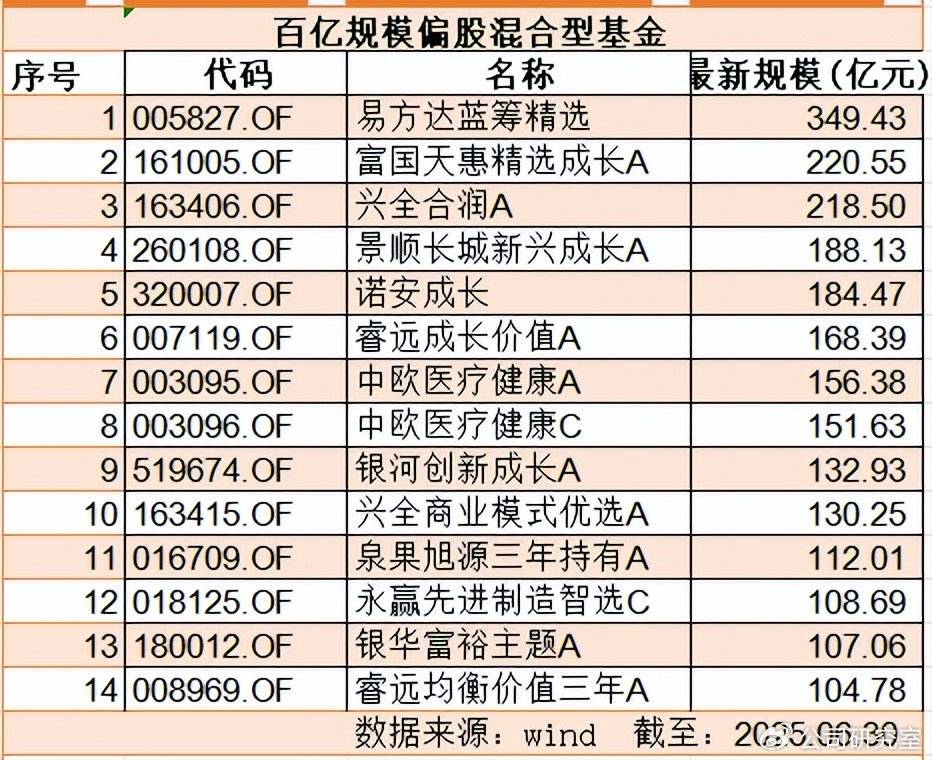
Market Overview - On August 9, the Shanghai Composite Index reached a peak of 3656.85, just 17.55 points shy of the high of 3674.40 from September 24 of the previous year [1] - The market has been characterized by small-cap stocks, with the Micro-cap Index rising by 1.75%, the CSI 2000 by 1.7%, the CSI 1000 by 1.55%, the CSI 500 by 1.08%, and the CSI 300 by 0.43% [1][2] Fund Performance - As of June 30, 2025, only 2 out of 1037 ordinary equity funds remained above 10 billion yuan in size, namely E Fund Consumer Industry at 16.854 billion yuan and Da Cheng Gao Xin A at 12.340 billion yuan [4] - Among 4846 mixed equity funds, only 14 funds exceeded 10 billion yuan, with the largest being E Fund Blue Chip Selection at 34.93 billion yuan [4] - The performance of these large-scale funds has been mixed, with only 4 out of 14 funds achieving returns over 20% year-to-date as of August 8, 2025 [6] Year-to-Date Performance - The top-performing funds year-to-date include: - Yongying Advanced Manufacturing Selection C with a net value growth of 59.99% - Ruiyuan Growth Value A with a growth of 22.04% - China Europe Medical Health A with a growth of 21.81% [6][8] One-Year Performance - Over the past year, the top three funds in terms of net value growth are: - Yongying Advanced Manufacturing Selection C at 163.94% - Galaxy Innovation Growth A at 62.66% - Ruiyuan Growth Value A at 40.79% [9][10] Annualized Returns - Among the 14 large-scale mixed equity funds, 10 have an annualized return exceeding 8%, indicating strong long-term performance [11] - Yongying Advanced Manufacturing Selection C, with a short history of less than 3 years, has an impressive annualized return of 35.96% [11][12] Notable Exceptions - The fund "Quan Guo Xu Yuan San Nian Chi You A" has a current size of 11.2 billion yuan, with year-to-date returns of 12.98% and one-year returns of 31.68%, but an annualized return of -7.18% since inception [12][13]
三年深套阴影难消,基金业绩回暖难阻“解套即赎”
第一财经· 2025-08-08 06:09
Core Viewpoint - The recent recovery in the equity market has led to a significant rebound in the net value of actively managed equity funds, with nearly 90% of these funds showing positive returns over the past year, providing hope for investors who had previously suffered losses [3][5]. Group 1: Fund Performance - As of August 6, 2023, 4304 out of 4349 actively managed equity funds reported positive returns over the past year, representing 99% of the total [5]. - Among these, 40 funds achieved a doubling of their performance, with the top performer, CITIC Construction Investment North Exchange Select Two-Year Open A, showing a return of 212.25% [5]. - Over 70% of funds with over 10 billion in assets achieved returns exceeding 10%, with some funds like China Merchants Advantage Enterprises A and Galaxy Innovation Growth A exceeding 60% [6]. Group 2: Investor Behavior - Investor behavior has shown significant divergence, with three main strategies emerging: some investors choose to redeem their funds upon recovery, others redeem after a significant reduction in losses, and a third group waits until they fully recover their investments [9][10]. - Despite the recovery, there is a notable redemption pressure as many investors opt to cash out when the net asset value approaches their initial investment [10]. - In the second quarter, actively managed equity funds experienced a net redemption of 1,076.04 million units, a 56.43% increase from the previous quarter, indicating a trend of investors withdrawing funds despite improved performance [10][11]. Group 3: Market Sentiment and Trust - The recovery in fund performance has not yet translated into increased investor trust, as many investors remain cautious due to past losses from 2022 to 2024, leading to a prevalent "redeem upon recovery" behavior [11]. - Analysts suggest that the current situation represents a critical period for "cognitive repair" in the market, where fund managers need to enhance their professional capabilities and improve the industry ecosystem to regain investor confidence [11].

大类资产与基金周报:黄金下跌,商品基金跌幅录得-3.58%-20250518
Tai Ping Yang Zheng Quan· 2025-05-18 14:12
- The report provides an overview of the major asset markets, including equities, bonds, commodities, and foreign exchange markets[4][9][10][26][27][32][33][39] - The report highlights the performance of various indices in the A-share market, such as the Shanghai Composite Index, Shenzhen Component Index, and others, with their respective percentage changes[9][11][12][13][15] - The report also covers the performance of the Hong Kong stock market, including the Hang Seng Index and the Hang Seng China Enterprises Index, along with their percentage changes[10][18][19][22] - The report includes the performance of the US stock market, with indices like the Dow Jones Industrial Average, Nasdaq Index, and S&P 500, along with their percentage changes[10][24][25] - The bond market section discusses the yield changes of various government and corporate bonds, including the yield spread between different maturities[26][27][28][29][30][31] - The commodities market section provides the weekly percentage changes of various commodities such as crude oil, gold, copper, aluminum, and others[32][33][34][35][36][37][38] - The foreign exchange market section details the exchange rate changes of major currencies against the Chinese Yuan[39][41][42][43] - The report summarizes the newly established funds for the week, including their types, sizes, and fund managers[44][46] - The report provides an overview of the total number and scale of open-end public funds in China, categorized by different types of funds[47][48][49][50] - The performance of different types of funds over the past week, month, year, and year-to-date is compared, highlighting the best and worst performers[51][52][54][55][56][57][59]