
长江SoC芯片

Search documents
卢伟冰称小米17Ultra涨价;星链一颗卫星异常丨新鲜早科技
2 1 Shi Ji Jing Ji Bao Dao· 2025-12-22 01:56
Group 1: Industry Developments - A Starlink satellite from SpaceX experienced an anomaly, losing contact with the ground and producing debris, which poses a potential threat to other satellites in orbit [2] - The first L3-level autonomous driving license in China was issued to Changan Automobile, marking a significant step towards commercial application of L3 autonomous driving technology [3] - Beijing's humanoid robotics center has open-sourced the XR-1 model, which is the first to pass national standards for embodied intelligence, advancing the domestic embodied intelligence industry [4] - Turing Quantum and Moore Threads have signed a strategic cooperation agreement to develop a hybrid computing architecture that integrates GPU and quantum processors [5] - Chinese robot "Deep Sea Giant Shark 3" won a combat robot competition in Abu Dhabi, showcasing advanced design and capabilities [6] - Researchers at Shanghai Jiao Tong University achieved a breakthrough in optical computing chips, supporting large-scale semantic media generation models [7] Group 2: Corporate News - Xiaomi's president confirmed that the price of the upcoming Xiaomi 17 Ultra smartphone will increase due to rising memory costs, which are expected to continue increasing in the coming years [2] - New Unisplendour Group signed a strategic cooperation agreement with Shanghai Yidian to collaborate on artificial intelligence and intelligent computing [10] - Wallen Technology plans to acquire at least 60% of Liao Jing Electronics, which operates in integrated circuits and electronic components [14] - Tianpu Co. announced the expiration of a tender offer from Zhonghao Xinying for 33.52 million shares, representing 25% of the company's total equity [15] - Lianchuang Electronics is planning a change in control due to a potential transfer of shares by its major shareholder [16] - *ST Dongyi's restructuring plan was approved by the court, allowing the company to focus on its main business while leveraging resources in the computing industry [17]
腾讯研究院AI速递 20251222
腾讯研究院· 2025-12-21 16:01
Group 1: Moore Threads Technology Roadmap - Moore Threads has unveiled its new generation full-featured GPU architecture "Huagang," which boasts a 50% increase in computing density and a 10-fold improvement in energy efficiency, supporting full precision calculations from FP4 to FP64 and capable of supporting over 100,000 card intelligent computing clusters [1] - The company is set to release the "Huashan" AI training and inference integrated chip and the "Lushan" high-performance graphics rendering GPU, with a computing power of 10 EFLOPS for the Wan Card intelligent computing cluster, and the S5000 single card inference sets a new record for domestic GPU performance [1] - The AI computing book MTT AIBOOK, equipped with the "Yangtze River" SoC chip, offers 50 TOPS heterogeneous AI computing power and can locally run large models with up to 30 billion parameters, now available for pre-sale on JD.com [1] Group 2: OpenAI's GPT-5.2-Codex Launch - OpenAI has launched GPT-5.2-Codex, which is considered the most advanced intelligent coding model to date, achieving state-of-the-art performance in SWE-Bench Pro and Terminal-Bench 2.0 benchmark tests [2] - Compared to GPT-5.2, it has improved instruction-following capabilities, long context understanding, and network security features, with better performance in Windows environments and significant improvements in token efficiency at mid-high inference levels [2] - The model is now available to paid ChatGPT users across all Codex platforms, with plans to open access to API users in the coming weeks and provide more lenient access for defensive cybersecurity professionals [2] Group 3: Google's Gemma Models - Google has open-sourced two models from the Gemma 3 family, T5Gemma 2 and FunctionGemma, with T5Gemma 2 being the first multi-modal long-context encoder-decoder model, available in sizes of 270M-270M, 1B-1B, and 4B-4B [3] - FunctionGemma is optimized for function calls, running on just 270 million parameters, suitable for mobile and browser devices, and supports precise structured data output for external API calls, making it ideal for edge AI agent applications [3] - T5Gemma 2 returns to the classic Encoder-Decoder architecture, surpassing similarly sized Gemma 3 models in multi-modal performance, code reasoning, and long context capabilities, while FunctionGemma can be reduced to 135MB for operation through quantization [3] Group 4: NVIDIA's NitroGen Model - NVIDIA has open-sourced the NitroGen foundational model, designed to play over 1,000 games, using game video frames as input to output real controller operation signals, and supports rapid adaptation to new games through post-training [4] - The model is based on the GR00T N1.5 architecture and utilizes 500 million parameters, trained by automatically extracting action labels from 40,000 hours of publicly available game videos, covering various game types including RPGs, platformers, and racing [4] - It can accomplish non-trivial tasks without fine-tuning, achieving a task success rate improvement of up to 52% compared to models trained from scratch, and the dataset, evaluation suite, and model weights have been made open-source [4] Group 5: OpenAI's Codex Agent Skills Support - OpenAI has announced that Codex now fully supports Agent Skills, integrating with industry-standard specifications led by Anthropic, which include markdown commands and optional script resources [5] - It allows for explicit calls (via /skills command or $selection) and implicit calls (automatically matching descriptions based on tasks), with skill storage prioritized from the current working directory to the user's personal directory [5] - Built-in tools like $skill-creator and $skill-installer are provided to automatically generate skill frameworks or install skills from third-party repositories like GitHub, with an official Skill library released by OpenAI [5] Group 6: Luma AI's Ray3 Modify - Luma AI has launched the Ray3 Modify feature, emphasizing a "real person first, AI follows" approach to video production, where actor performances and camera movements serve as the foundational input for AI processing [6] - It supports keyframe control (start and end frames), character reference capabilities, and retains the integrity of performances, allowing the same performance to be placed in different scenes for various content versions without reshooting [6] - Integrated into the Dream Machine platform, it targets film production, advertising creativity, and post-production processes, enabling creators to maintain control without the need for repeated filming [6] Group 7: METR Report on Claude Opus 4.5 - The METR report indicates that Claude Opus 4.5 can sustain coding for approximately 4 hours and 49 minutes, marking the longest time span reported to date, surpassing GPT-5.1-Codex-Max's 2 hours and 53 minutes [9] - The task duration for AI coding agents is showing exponential growth, doubling every 7 months from 2019 to 2024, and expected to double every 4 months from 2024 to 2025, with predictions that AI will complete a full workday's tasks by April 2026 [9] - The industry views long-term memory as the final challenge towards achieving AGI, as current models rely on retrieval tools and context compression, lacking true self-learning and persistent memory capabilities [9] Group 8: Google AI's Success Story - Josh Woodward, the head of Google AI products, has driven the Gemini application’s monthly active users from 350 million in March to 650 million in October, surpassing ChatGPT to top the App Store rankings [10] - At 42 years old and from Oklahoma, he joined Google through an internship in 2009, contributing to Chromebook development, founding the NBU initiative, and leading the expansion of Google Pay, before taking over as Gemini application head in April 2025 [10] - He has promoted the NotebookLM project to break Google's traditional practices by utilizing Discord for community engagement, establishing a "Block" ticketing system to eliminate bureaucratic obstacles, and initiating the "Papercuts" plan to address minor issues, emphasizing the balance between AI innovation and social responsibility [10]


114.28元/股,科创板今年新高!从追赶者到破局者:摩尔线程做对了什么?
Zhong Jin Zai Xian· 2025-11-28 10:24
Core Insights - The article highlights the strong market interest in Moole Technology, which has positioned itself uniquely in the domestic GPU market with its "full-function GPU" strategy, achieving the largest IPO on the Sci-Tech Innovation Board this year with a share price of 114.28 yuan [1][9]. Company Overview - Moole Technology was founded in 2020 by Zhang Jianzhong, a former leader at Nvidia China, with the goal of making full-function GPUs accessible to more users in China [2]. - The company has developed four generations of GPU architecture in less than five years, distinguishing itself from competitors by integrating multiple functionalities such as graphics rendering, AI computing, video processing, and scientific computing into a single chip architecture called MUSA [2][3]. Market Positioning - Moole Technology's full-function GPU is designed to be compatible with the existing global GPU ecosystem, particularly Nvidia's CUDA, which lowers the cost and barriers for users transitioning from Nvidia to Moole's platform [3]. - The company has established a comprehensive product matrix around its four generations of self-developed GPU architecture, focusing on AI computing products, professional graphics acceleration, desktop graphics acceleration, and intelligent SoC products [3]. Industry Trends - The company is strategically positioned to benefit from two major trends: the domestic replacement wave and the explosive demand for AI computing power [4][6]. - The domestic GPU market is experiencing a significant supply-demand mismatch, particularly in the high-end segment, which Moole Technology aims to address with its innovative MUSA architecture [7]. Investment Appeal - The IPO attracted significant attention, with oversubscription rates exceeding 4000 times for online applications and 1572 times for offline applications, indicating strong investor confidence [1][10]. - Following the IPO, Moole Technology's total market capitalization is expected to exceed 53.7 billion yuan, reflecting its potential for growth and valuation in the rapidly expanding GPU market [9][12]. Future Outlook - Moole Technology is positioned as a key player in the domestic GPU sector, with its innovative technology and market strategies aligning with national policies supporting the semiconductor industry [7][13]. - The company is expected to continue growing its revenue and market share, becoming an important investment target in the context of China's digital economy and AI infrastructure development [13].
国产GPU第一股即将打新:发行价114.28元/股,预计募集资金80亿元
Hua Er Jie Jian Wen· 2025-11-20 12:33
Core Viewpoint - Moore Threads, known as the "Chinese version of Nvidia," has set its IPO price and is nearing its listing on the STAR Market, marking a significant milestone for domestic GPU companies [1][4]. Group 1: IPO Details - The company announced an issuance of 70 million shares at a price of 114.28 yuan per share, aiming to raise a total of 8 billion yuan, with a net amount expected to be 7.576 billion yuan after deducting issuance costs [4]. - This IPO is the largest fundraising project in the A-share market this year and will position Moore Threads as the first domestic GPU stock upon listing [4][5]. Group 2: Financial Performance - In the first half of 2025, the company's revenue reached 702 million yuan, surpassing the total revenue of the previous three years combined, with a compound annual growth rate exceeding 208% [4][7]. - The gross profit margin is projected to rise from -70.08% in 2022 to 70.71% in 2024, indicating a significant improvement in market acceptance of its products [7]. Group 3: Technological Advancements - Since its establishment in 2020, Moore Threads has focused on the independent research and development of full-function GPUs, achieving breakthroughs in AI computing acceleration, graphics rendering, and other areas [6]. - The company has successfully mass-produced five chips and completed four GPU architecture iterations, creating a diverse product matrix for various applications [6]. Group 4: Market Position and Future Prospects - The management anticipates achieving consolidated profitability by 2027, with expected orders exceeding 2 billion yuan from clients as of June 30, 2025 [5]. - The company has invested over 4.3 billion yuan in R&D from 2022 to mid-2025, with a workforce comprising over 77% R&D personnel, and holds 514 authorized patents [8].
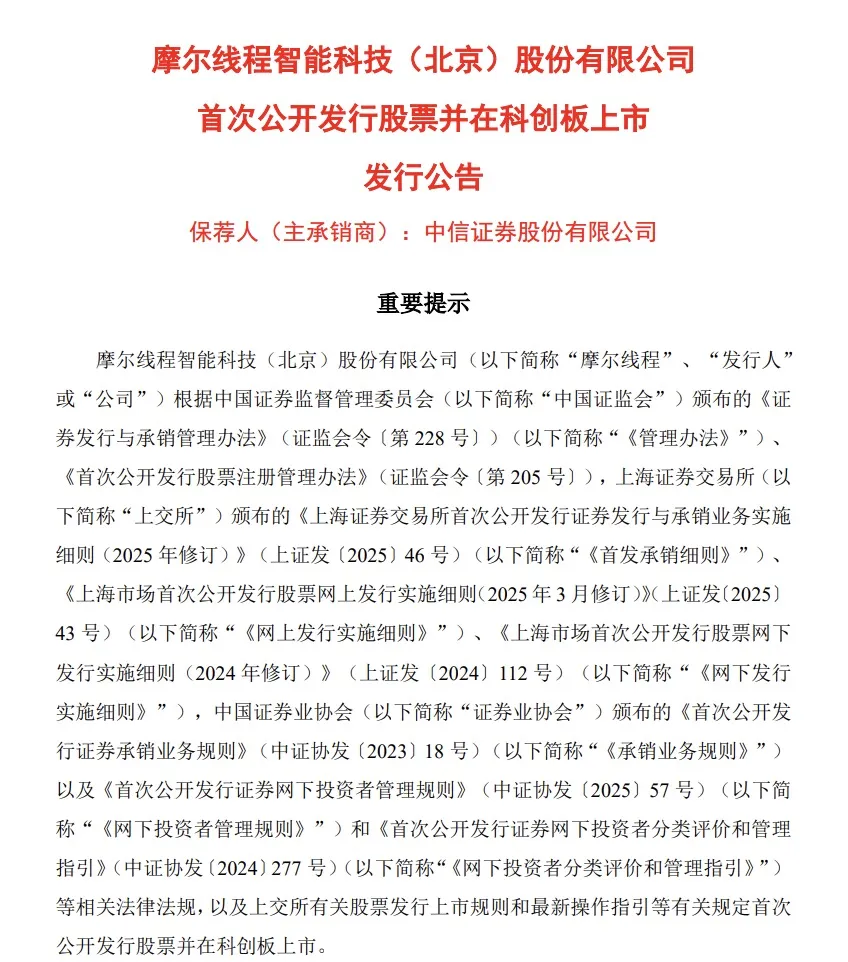
国产GPU第一股来了!摩尔线程科创板IPO注册生效!
Sou Hu Cai Jing· 2025-10-30 16:58
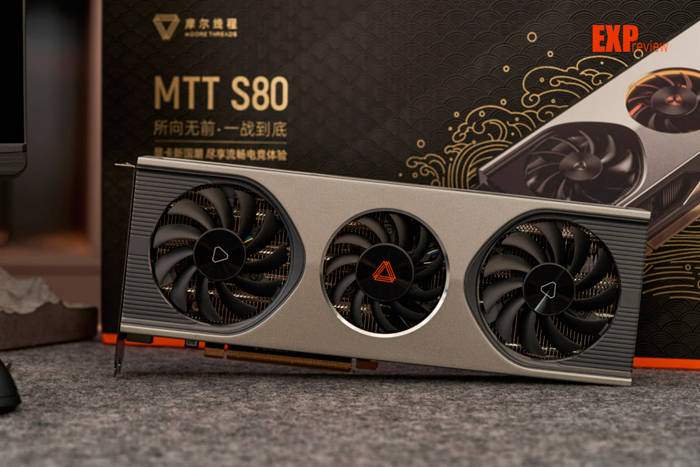
Core Insights - The China Securities Regulatory Commission (CSRC) has approved the initial public offering (IPO) registration of Moore Threads Technology (Beijing) Co., Ltd., marking it as the first domestic GPU company to go public in the A-share market [2] - Moore Threads plans to raise 8 billion yuan for the development of next-generation AI training and inference chips, graphics chips, and AI SoC chips, as well as to supplement working capital [2] - The company has developed four generations of GPUs, with the fourth generation "Pinghu" set to launch in 2024, featuring a maximum frequency of 2GHz and enhanced specifications [2] Financial Performance - Moore Threads reported revenues of approximately 0.46 million yuan in 2022, 1.24 million yuan in 2023, and projected revenues of 4.38 million yuan in 2024, reflecting a compound annual growth rate (CAGR) of 208.44% [3] - For the first half of 2025, the company expects revenues to reach 7.02 million yuan, surpassing the total revenues of the previous three years [3] Product Development - The company has launched its first SoC "Changjiang," which integrates a full-function GPU, CPU, NPU, and VPU, featuring an 8-core CPU with a frequency of 2.65GHz and an INT8 computing power of 50 TOPS [3] - The fourth-generation GPU "Pinghu" includes 8192 shading cores, 512 tensor cores, and supports FP8 precision, with an interconnect speed of 800GB/s and a memory capacity of 80GB [2]
5年估值百亿,英伟达AMD大佬,抢夺“国产GPU第一股”
3 6 Ke· 2025-10-28 10:22
Core Viewpoint - The investment in the startup Moore Threads by Heertai has significantly boosted the company's stock price, with a nearly twofold increase over the year following the investment, highlighting the potential of domestic GPU companies in China [3][25]. Group 1: Investment and Market Performance - Heertai participated in the early investment rounds of Moore Threads, which has now completed its IPO counseling and is expected to become the "first domestic GPU stock" [3][25]. - Moore Threads' stock experienced rapid growth, achieving three consecutive daily limits and prompting a stock price increase of nearly 100% within a year [3]. - The valuation of Moore Threads reached 29.845 billion yuan before its IPO, with 82 shareholders, while Muxi Co. had a valuation of 21.071 billion yuan with 124 shareholders [25]. Group 2: Company Background and Leadership - Moore Threads was founded in June 2020 and quickly became a unicorn, raising tens of billions in its Pre-A round within just a few months [8]. - The founder, Zhang Jianzhong, has a strong background in the GPU industry, having worked at NVIDIA for 14 years, significantly increasing NVIDIA's market share in China [6][7]. - The leadership team of Moore Threads has extensive experience in the GPU sector, with many members previously employed at NVIDIA [12][21]. Group 3: Product Development and Market Strategy - Moore Threads aims to become the "Chinese version of NVIDIA," offering a full range of GPU products for both consumer and enterprise markets [28]. - The company has launched several generations of GPU architecture chips and plans to release its own "CUDA" architecture named "MUSA," which is compatible with NVIDIA's ecosystem [32][36]. - Muxi Co. focuses on AI training and inference, with a product matrix that includes various GPU products for different applications [28]. Group 4: Financial Performance and Projections - Moore Threads reported a compound annual growth rate of 208.44% in revenue from 2022 to 2024, with revenues of 0.46 billion yuan, 1.24 billion yuan, and 4.38 billion yuan respectively [32]. - Muxi Co. expects a revenue increase of 437.36% to 464.23% for the first nine months of the current year and aims to achieve breakeven by 2026 [35]. - Both companies are currently in a high-investment phase, with R&D expense ratios of 310% for Moore Threads and 121% for Muxi Co., indicating they are in a cash-burning stage [39]. Group 5: Market Challenges and Customer Dependency - Both companies face significant challenges in competing with established players like NVIDIA and AMD, with Moore Threads currently holding less than 1% market share in the domestic GPU market [36]. - Moore Threads relies heavily on a few major customers, with the top five contributing 98.29% of its revenue, indicating a high customer concentration risk [37]. - The companies are positioned in a high-demand market for GPUs, particularly in the AI sector, but they must navigate the challenges of high investment and dependency on a limited customer base [39][40].


10月可控核聚变大会召开,谁能受益?| 0928 张博划重点
Hu Xiu· 2025-09-28 14:44
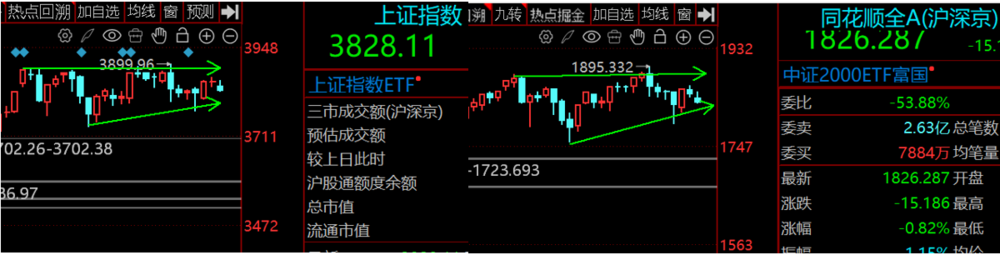
Market Analysis - The market remains cautious ahead of the holiday, with the Shanghai Composite Index at 3828.1 and a significant drop in trading volume, down 53.88% compared to the previous day [1]. Macroeconomic Insights - Economic data shows signs of recovery, indicating potential positive trends in the broader economy [2]. International Trade Dynamics - Trump's recent comments about Japan and South Korea needing to "prepay" for tariff agreements have sparked concerns, with South Korea warning of a potential repeat of the 1997 financial crisis if such measures are enforced [7]. Industry Developments - Moore Threads has successfully passed the IPO approval process, becoming the first domestic GPU company to go public. The company reported a revenue of 702 million yuan in the first half of 2025, surpassing the total revenue of the previous three years, with a compound annual growth rate exceeding 208% [9][10]. - The company's gross margin improved significantly from -70.08% in 2022 to 70.71% in 2024, indicating a strong turnaround [10]. - Moore Threads is in discussions for orders exceeding 2 billion yuan, with a focus on AI computing and graphics acceleration products [11]. Renewable Energy Sector - Daikin Heavy Industries holds an order backlog of 10 billion yuan, benefiting from a surge in offshore wind energy demand in Europe, with expectations of a 50% growth in installation rates from 2025 to 2026 [18][20]. - The European offshore wind market is projected to see a significant increase in demand, with a forecasted installation of 43.1 GW during the 14th Five-Year Plan period [20]. Nuclear Fusion Industry - The Chinese government has introduced supportive policies for the nuclear fusion industry, including the inclusion of fusion projects in major infrastructure initiatives and the establishment of a national venture capital fund [21][23]. - Upcoming international conferences and technology validations in October 2025 will focus on the commercialization pathways for nuclear fusion technology [22]. Robotics Sector - Hongrun Construction is expanding its presence in the robotics field, focusing on humanoid, industrial, and engineering robots, with strategic partnerships to enhance its technological capabilities [35][36]. - The company has made significant advancements in four-legged robot technology and is developing engineering robots to improve efficiency in construction projects [37][38].


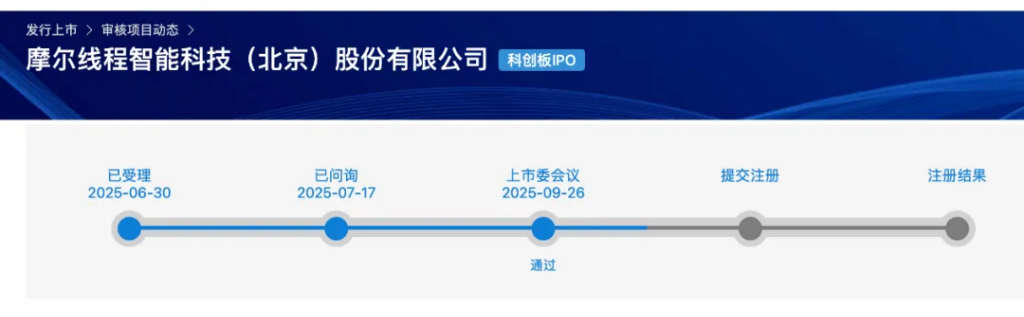
从受理到过会仅用时88天!国产芯片龙头摩尔线程科创板IPO申请获通过
Mei Ri Jing Ji Xin Wen· 2025-09-26 16:17
Core Viewpoint - Moer Technology's IPO application has passed the review by the Shanghai Stock Exchange's Sci-Tech Innovation Board, marking a significant step towards its public listing, with a fundraising target of 8 billion yuan for AI and GPU chip development projects [1][2][3] Company Overview - Moer Technology, established in 2020, is recognized as the "first domestic GPU stock" and focuses on the research, design, and sales of full-function GPU products, being one of the few domestic companies that integrate graphics rendering and AI computing [2] - The company has mass-produced five chips with a cumulative R&D investment exceeding 4.3 billion yuan, targeting applications in large model training, digital twins, consumer electronics, and cloud computing [2] - Moer Technology's market share in its respective segments is currently below 1% as of 2024 [2] IPO Details - The IPO aims to raise 8 billion yuan for projects including the development of next-generation AI training and inference chips, graphics chips, and AI SoC chips, as well as to supplement working capital [2][3] - The IPO application process from acceptance to approval took only 88 days, reflecting the improved efficiency of the Sci-Tech Innovation Board under the "1+6" reform policy [1][3] Financial Performance - Moer Technology reported revenues of 46.09 million yuan in 2022, 124 million yuan in 2023, 438 million yuan in 2024, and 702 million yuan in the first half of 2025, with net losses of 1.84 billion yuan, 1.67 billion yuan, 1.49 billion yuan, and 271 million yuan respectively [4] - As of June 30, 2025, the company had accumulated losses of 1.48 billion yuan [4] Growth Potential - The company has achieved a compound annual growth rate (CAGR) of 208.44% from 2022 to 2024 and anticipates continued revenue growth, with expectations to achieve profitability by 2027 [5]
国产GPU第一股来了!摩尔线程IPO成功过会,半年营收超过往3年!
Hua Er Jie Jian Wen· 2025-09-26 10:38
Core Viewpoint - Moole Technology has successfully passed the IPO application review by the Shanghai Stock Exchange, marking it as the first domestic GPU company to go public [1][3]. Group 1: IPO Details - The company plans to raise 8 billion RMB through its IPO, which is the largest fundraising project in the A-share market this year and the largest IPO in the semiconductor sector [3]. - The funds will primarily be allocated to the research and development of next-generation AI training and inference chips, graphics chips, and AI SoC chips, aiming to strengthen its leading position in high-performance computing [3][5]. Group 2: Financial Performance - Moole Technology's revenue reached 702 million RMB in the first half of 2025, surpassing the total revenue of the previous three years, with a compound annual growth rate exceeding 208% over the last three years [3][4]. - The company's gross margin improved significantly from -70.08% in 2022 to 70.71% in 2024, indicating a substantial increase in market recognition of its products [3][4]. Group 3: Product Development and Market Position - Established in 2020, Moole Technology has invested heavily in R&D, totaling 4.3 billion RMB, with over 75% of its workforce dedicated to this area [4]. - The company has launched four generations of GPUs, covering various application scenarios, and its products are competitive with international standards, with some metrics approaching NVIDIA's RTX 3060 [4][5]. - Moole Technology is the first domestic manufacturer to mass-produce DirectX 12 graphics acceleration, which broadens compatibility with mainstream development toolchains [4]. Group 4: Future Outlook and Challenges - Despite rapid growth, the company faces challenges, including cumulative losses of 1.478 billion RMB as of June 30, 2025, and a market share of less than 1% in its respective segments [6]. - The company plans to continue product development and matrix layout, with the "Yangtze" SoC chip targeting automotive smart cockpits expected to be introduced and mass-produced by 2026 [6]. - The Chinese AI computing GPU market is projected to reach 1,033.34 billion RMB by 2029, with a compound annual growth rate of 56.7% during the period [6].
电子行业周报:科创招股书梳理之摩尔线程篇-20250714
Huaan Securities· 2025-07-14 03:20
Investment Rating - The industry investment rating is "Overweight" [6] Core Insights - The report highlights the launch of four generations of GPU architectures by the company, which includes solutions for AI computing, professional graphics acceleration, desktop graphics acceleration, and intelligent SoC products [1][2][25] - The company aims to provide a comprehensive computing acceleration infrastructure and one-stop solutions globally, focusing on AI computing support for various industries [17][25] - The company has achieved significant revenue growth, with AI computing products projected to contribute 3.36 billion yuan, accounting for 77.63% of total revenue in 2024 [1][2] Summary by Sections Section 1: Company Overview - The company has undergone three development phases, focusing on full-function GPUs to support digital transformation across industries [17] - The company has successfully launched four generations of GPU architectures from 2021 to 2024, with products catering to various market needs [1][28] Section 2: AI Computing Products - The company’s AI computing products are expected to generate significant revenue, with a projected 42.42% of total revenue coming from AI computing clusters in 2024 [1][2] - The company has developed a diverse product line, including AI computing boards and modules, with a focus on high-performance applications [1][2][25] Section 3: Technological Advancements - The company has advanced its manufacturing capabilities, achieving rapid iteration from 12nm to 7nm processes and enhancing its domestic supply chain [2][7] - The company has developed a heterogeneous computing architecture integrating GPU, CPU, NPU, and VPU, leading to the successful production of the "Yangtze" SoC chip [2][32] Section 4: Market Performance - The report provides insights into the performance of the electronic industry, comparing it with the CSI 300 index, indicating a competitive landscape [3][4] - The company has established a strong investor base, having completed six rounds of financing totaling over 4.5 billion yuan, with notable investors including Sequoia China and Tencent [8][9]