
阿维塔新能源汽车

Search documents
重庆:领跑智能网联新能源汽车赛道
Ke Ji Ri Bao· 2026-02-05 06:37
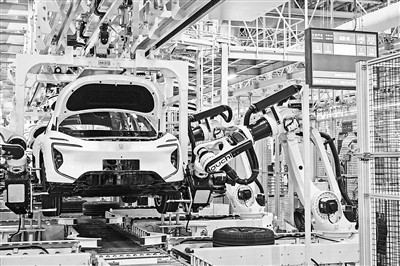
Core Insights - Chongqing is leading the smart connected electric vehicle sector, with a projected annual automobile production of 2.7877 million units by 2025, including 1.2961 million electric vehicles, which is 30 times the production in 2020 [2] - The city is undergoing a significant industrial transformation, shifting from traditional manufacturing to a smart connected ecosystem, thereby accelerating the creation of new high-quality development momentum [2] Innovation Ecosystem - The Chongqing Liangjiang Collaborative Innovation Zone has nurtured nearly 1,000 hard-tech companies and facilitated around 1,500 technology transfer achievements [3] - Companies like Chongqing Zhongke Yaolu Information Technology have developed domestic firsts in 3D glue quality online detection systems, achieving over 20 times growth in five years [3] - Long-term R&D investments by companies such as Changan Automobile exceed 5%, with significant advancements in software and hardware integration [3] Industry Development - Chongqing has established seven national-level enterprise technology centers and three industrial innovation complexes, forming an integrated development pattern of "software + intelligence + hardware" [4] - The region's innovation ecosystem has attracted companies like Beidou Zhili Technology, which has achieved over 3 billion yuan in annual sales and over 12% in R&D investment [4] Industrial Cluster - Chongqing is implementing a world-class smart connected electric vehicle industrial cluster development plan, transitioning from individual efforts to collective action [6] - Changan Automobile reached a milestone of producing its 30 millionth vehicle in just over four years, showcasing the rapid growth of the brand [6] - The city has gathered over 1,200 large-scale component manufacturers, achieving comprehensive coverage of electric vehicle components [6] Supply Chain Optimization - The establishment of a "factory within a factory" model has enhanced supply chain efficiency, with local production and supply capabilities significantly improving response times [8] - Companies like CATL have set up local production facilities within the Seres Super Factory, achieving production adjustments in just 20 minutes [8] - This model has led to a 50% improvement in supply chain collaborative innovation capabilities, streamlining the number of primary suppliers [8] Strategic Vision - Chongqing aims to achieve a local supply rate of 70% for smart connected electric vehicle components by 2027, fostering a deeply integrated industrial ecosystem [7] - The city is leveraging technological innovation and comprehensive chain layout to drive exponential growth in the smart connected electric vehicle industry, aspiring to become a globally influential hub [9]




潮涌“两江”起风帆——重庆两江新区高质量发展新观察
Xin Hua Wang· 2026-01-26 02:20
Core Viewpoint - The establishment of the Chongqing Liangjiang New Area marks a new chapter in development, focusing on integrated development advantages, technological innovation, and high-quality growth for the region [1] Group 1: Innovation and Industry Development - Liangjiang New Area hosts over 2,500 high-tech enterprises and 14,800 technology-based companies, showcasing a highly intelligent and collaborative industrial system [2] - The area has seen the establishment of various innovation platforms, such as Liangjiang Collaborative Innovation Zone and Xiangmiao Data Valley, facilitating the transition of innovative results from laboratories to production lines [2] - The region's innovation ecosystem has led to significant advancements, with companies achieving over 300 invention patents and investing more than 10% of their revenue in R&D annually [4] Group 2: Infrastructure and Logistics - The Guoyuan Port has evolved into a major logistics hub with an annual throughput exceeding 26 million tons, connecting to over 300 ports globally [6] - The integration of various open platforms, such as the China-Europe Railway Express and the Western Land-Sea New Corridor, enhances the region's role as a gateway for international trade [8] - The implementation of innovative regulatory models in the free trade zone has reduced logistics costs significantly, saving approximately 3,000 yuan per container [9] Group 3: Urban Development and Quality of Life - The population of Liangjiang New Area is approximately 3.52 million, with ongoing urban planning aimed at improving public services and living standards [10] - Initiatives such as the expansion of public services and the establishment of a "15-minute high-quality living circle" are enhancing the urban environment and livability [13] - The area is focusing on ecological protection and sustainable development, with efforts to create a harmonious balance between urbanization and nature [13]

潮涌“两江”起风帆 重庆两江新区高质量发展新观察
Xin Hua Wang· 2026-01-26 02:13
Core Insights - The establishment of the Liangjiang New Area in Chongqing marks a new chapter in development, focusing on integrated development advantages and promoting high-quality growth in the region [2] Group 1: Innovation and Industry Development - Liangjiang New Area is home to over 2,500 high-tech enterprises and 14,800 technology-based companies, showcasing a robust innovation ecosystem [3] - The area has seen the establishment of collaborative innovation platforms, such as the Liangjiang Collaborative Innovation Zone and the Zhaomushan Digital Economy Industrial Park, facilitating the transition of innovative results from labs to production lines [3] - Major companies like Changan Automobile and leading tech firms are enhancing their presence, contributing to the region's technological advancements and innovation capabilities [4] Group 2: Infrastructure and Logistics - The Guoyuan Port has evolved significantly, with an annual throughput exceeding 26 million tons, connecting to over 300 ports globally, thus enhancing the region's logistics capabilities [6] - The integration of various open platforms, such as the China (Chongqing) Pilot Free Trade Zone, is creating a more efficient investment and trade environment [7] - Innovations in logistics, such as the new regulatory model for shipping electric vehicles, have reduced port delays and logistics costs significantly [7] Group 3: Urban Development and Quality of Life - The population of Liangjiang New Area is approximately 3.52 million, with ongoing urban planning efforts aimed at improving public services and living conditions [8] - Initiatives like the expansion of public services and the establishment of a "15-minute high-quality living circle" are enhancing the urban living experience [9] - The area is focusing on ecological protection and sustainable urban development, creating a harmonious environment for both residents and businesses [9]
研报掘金丨爱建证券:首予长安汽车“买入”评级,前瞻布局机器人及飞行汽车业务
Ge Long Hui· 2025-12-17 06:36
Core Viewpoint - The automotive industry is experiencing moderate growth, with domestic brands gaining market share due to their early advantages in electric and intelligent technologies, putting pressure on joint venture brands [1] Group 1: Company Strategy - Changan Automobile is set to become the third automotive central enterprise by 2025, accelerating its transformation into a smart low-carbon mobility technology company [1] - The company has established a three-brand matrix for new energy vehicles, covering mainstream, technology, and high-end markets with its brands Qiyuan, Deep Blue, and Avita [1] - Through the "Shangri-La" plan, the company aims to break through key technologies in the three-electric field to create a dedicated platform for new energy vehicles [1] Group 2: Technological Advancements - The "Beidou Tianshu" plan is being implemented to promote the landing of key intelligent solutions in areas such as intelligent driving, cabin technology, and computing architecture [1] - The company has received a conditional approval for L3-level autonomous driving, gradually establishing a leading advantage in intelligence [1] - The first vehicle-mounted component robot was officially launched in Q1 2026, along with the unveiling of a humanoid robot prototype, validating the company's technological and commercialization capabilities in the embodied intelligence sector [1] Group 3: Market Expansion - The "Hainan Baichuan" plan is being executed for global expansion [1] - The company aims to achieve a production and sales scale of 5 million units by 2030 [1] - New model orders and delivery performance for Qiyuan, Deep Blue, and Avita continue to exceed expectations [1]
长安汽车(000625)首次覆盖:新央企向智能低碳出行科技公司转型
Xin Lang Cai Jing· 2025-12-17 00:31
Group 1 - The company is expected to achieve net profits attributable to the parent company of 4.66 billion, 7.32 billion, and 8.67 billion yuan for 2025-2027, corresponding to PE ratios of 24.6, 15.6, and 13.2 times [1] - The automotive industry is experiencing moderate growth, with domestic brands increasing market share due to early advantages in electric intelligence, putting pressure on joint venture brands [1] - The company aims to transform into a smart low-carbon mobility technology company, with plans to produce and sell 5 million vehicles by 2030 [1] Group 2 - The company has been restructured into an independent central enterprise group, which will enhance resource integration, collaboration, and decision-making efficiency, leading to long-term hidden value [2] - The new energy brands are expected to achieve rapid sales growth and improved profitability due to the new vehicle cycle [2] - The company is collaborating with Huawei in the fields of intelligent driving and cockpit technology, and is also planning for humanoid robots and flying cars, which may expand its valuation framework [2] Group 3 - Revenue growth is projected at approximately 5.2%, 8.1%, and 11.9% year-on-year for total revenue from 2025-2027, with vehicle revenue growth at about 5.0%, 8.0%, and 12.0% [2] - The comprehensive gross margin is expected to improve to around 14.2%, 14.8%, and 15.4% from 2025-2027 due to increased sales volume of new energy brands [2] - Key catalysts include the continued strong performance of new model orders and deliveries, the acquisition of L3-level conditional autonomous driving approval, and the launch of the first vehicle-mounted component robot [2]