
雪花全麦白啤

Search documents
计提29亿减值,华润啤酒为跨界“买单”
Guan Cha Zhe Wang· 2026-03-16 12:49
Core Viewpoint - China Resources Beer has issued a profit warning, projecting a net profit decline of approximately 29.6% to 38.6% for the fiscal year 2025, primarily due to goodwill impairment losses related to its acquisition of a majority stake in Jinsha Liquor [1][3] Financial Summary - The company expects a net profit of about 2.92 billion to 3.35 billion RMB for 2025, with a significant goodwill impairment loss estimated between 2.79 billion to 2.97 billion RMB [1] - Excluding the impact of goodwill impairment, the projected net profit would be between 5.71 billion to 6.32 billion RMB, reflecting a year-on-year growth of 20% to 32.8% [1] Strategic Adjustments - The company is undergoing a strategic adjustment in response to pressures from both the beer and liquor industries, particularly following the leadership transition from Hou Xiaohai to Zhao Chunwu and Jin Hanquan [3][20] - The beer industry is facing structural changes, with production declining from a peak of 50.62 million kiloliters in 2013 to 35.56 million kiloliters in 2023, indicating a shift away from volume-driven growth [21] Business Performance - The liquor business, particularly Jinsha Liquor, is experiencing a significant downturn, with revenue dropping by 34% year-on-year to 781 million RMB in the first half of 2025 [25] - The liquor segment accounted for only 5.56% of total revenue in 2024, failing to meet expectations as a "second growth curve" [25] Leadership Changes - Following Hou Xiaohai's resignation, Zhao Chunwu has been appointed as the new chairman, while Jin Hanquan has taken on the role of CEO, marking a new era for the company [17][20] - Zhao Chunwu's extensive experience in sales and regional management is expected to drive the company's strategic initiatives [20] Market Challenges - The company faces challenges from price wars in the retail sector, which threaten established pricing structures [23][24] - The high-end product segment is crucial for future growth, with the company aiming to enhance its own high-end brands while navigating competitive pressures [22][29] Innovation and Development - The company is actively pursuing innovation, including collaborations with other beverage sectors, such as the introduction of a yellow wine-infused beer [29] - A focus on high-end product offerings and tailored marketing strategies is part of the company's response to evolving consumer preferences [30][32]



华润啤酒(0291.HK)2025年业绩预告点评:白酒商誉减值落地 啤酒主业表现优异
Ge Long Hui· 2026-03-12 21:07
Core Viewpoint - China Resources Beer is expected to achieve a net profit of 2.92-3.35 billion yuan in 2025, representing a year-on-year decline of 29.6%-38.6% [1] - The company anticipates a net loss of 2.407-2.837 billion yuan in H2 2025, marking a shift from profit to loss [1] Group 1: Financial Performance - The decline in net profit for 2025 is primarily due to the recognition of goodwill impairment of 2.79-2.97 billion yuan, stemming from the acquisition of a 55.19% stake in Guizhou Jinsha Distillery in January 2023, amid weak demand in the liquor market [1] - Excluding the impact of goodwill impairment, the company expects to achieve an operating net profit of 5.89-6.14 billion yuan in 2025, reflecting a year-on-year growth of 23.8%-29.0% [1] - The anticipated operating net profit for H2 2025 is projected to be 133-383 million yuan, indicating a significant year-on-year increase of 412%-1373% [1] Group 2: Strategic Initiatives - The company is actively embracing new consumption channels, having established strategic partnerships with platforms like Meituan Flash Purchase and Yima Delivery, and plans to launch an exclusive product "Snow Beer Whole Wheat White Beer" in December 2025 [2] - The beer sales are expected to achieve low single-digit growth in 2025, outperforming the industry, with Heineken expected to see double-digit growth [2] - In 2026, the company aims to maintain low single-digit growth in beer sales, focusing on differentiated products such as fruit beer, specialty wheat beer, and tea beer, which are anticipated to support the high-end strategy [2] Group 3: Profit Forecast and Valuation - The company's net profit forecast for 2025 has been revised down to 3.125 billion yuan, a 47% reduction from previous estimates, while the forecasts for 2026 and 2027 remain at 5.968 billion yuan and 6.334 billion yuan respectively [3] - The current stock price corresponds to a PE ratio of 24x for 2025, 13x for 2026, and 12x for 2027 [3] - The company is viewed positively for its clear high-end development strategy and the potential growth of its mid-to-high-end products and liquor business, maintaining a "buy" rating [3]
【光大食饮&海外】华润啤酒(0291.HK):白酒商誉减值落地,啤酒主业表现优异
Xin Lang Cai Jing· 2026-03-12 01:40
Core Viewpoint - The company, China Resources Beer (0291.HK), is expected to face a significant decline in net profit for 2025, primarily due to goodwill impairment related to its white liquor business, while its core beer business remains robust and is expected to grow in the long term [2][4]. Financial Performance - The projected net profit for 2025 is estimated to be between 2.92 billion and 3.35 billion RMB, representing a year-on-year decline of 29.6% to 38.6% [2]. - The second half of 2025 is expected to incur a net loss of 2.407 billion to 2.837 billion RMB, marking a shift from profit to loss [2]. - The company recognized a goodwill impairment of 2.79 billion to 2.97 billion RMB, attributed to the acquisition of a 55.19% stake in Guizhou Jinsha Jiao Liquor and a downturn in white liquor market demand [2][3]. - Excluding the impact of goodwill impairment, the operating net profit for 2025 is projected to be between 5.89 billion and 6.14 billion RMB, indicating a growth of 23.8% to 29.0% year-on-year [2]. Beer Business Outlook - The company anticipates low single-digit growth in beer sales for 2025, outperforming the industry average [3]. - High-end products, particularly Heineken, are expected to see double-digit growth in sales for 2025 [3]. - The company is actively engaging with new consumption channels, forming strategic partnerships with platforms like Meituan and launching exclusive products [3]. - The beer consumption peak season is expected to catalyze sales growth, aided by a recovery in dining channels and positive impacts from events like the World Cup [3]. Future Projections - For 2026, beer sales are expected to continue low single-digit growth, with a focus on differentiated products such as fruit beer and tea beer, which are gaining popularity [3]. - The white liquor business will focus on stabilizing high-end brands and moderately expanding mid-range products, as the industry undergoes consolidation [3]. Valuation and Estimates - The company's net profit forecast for 2025 has been revised down to 3.125 billion RMB, a 47% decrease from previous estimates, while projections for 2026 and 2027 remain at 5.968 billion and 6.334 billion RMB respectively [4]. - The current stock price corresponds to a price-to-earnings ratio of 24x for 2025 and 12x for 2026-2027 [4]. - The company is viewed positively due to its clear high-end development strategy and potential for growth in both beer and white liquor segments [4].
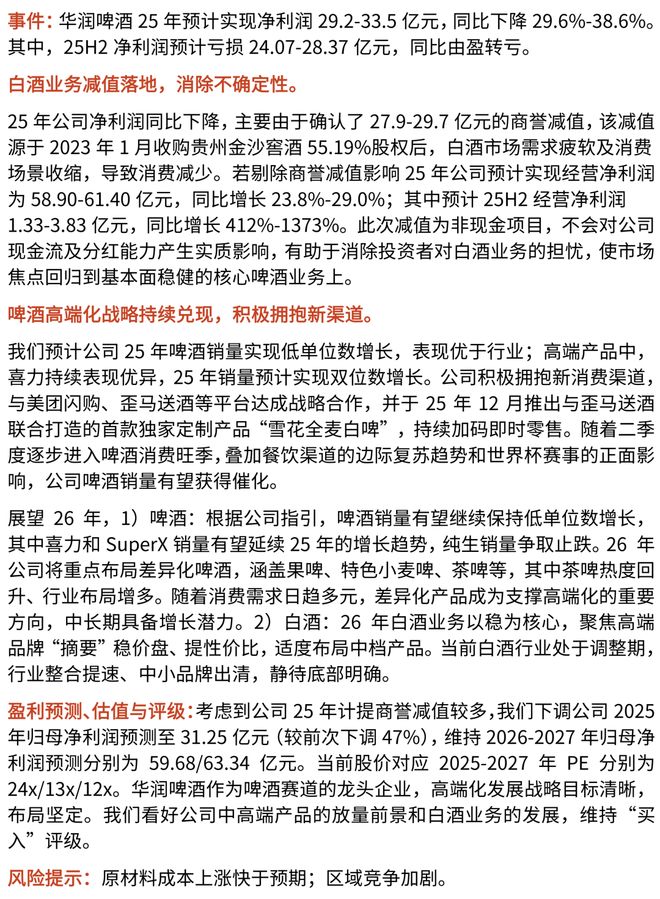
【华润啤酒(0291.HK)】白酒商誉减值落地,啤酒主业表现优异——2025年业绩预告点评(陈彦彤/汪航宇/聂博雅)
光大证券研究· 2026-03-11 23:03
Core Viewpoint - The company is expected to face a significant decline in net profit for 2025, primarily due to goodwill impairment related to its acquisition in the liquor sector, while its core beer business remains stable and shows potential for growth [4][5]. Group 1: Financial Performance - For 2025, the company anticipates a net profit of 2.92-3.35 billion, representing a year-on-year decline of 29.6%-38.6% [4]. - The expected goodwill impairment ranges from 2.79-2.97 billion, attributed to weak demand in the liquor market following the acquisition of a majority stake in Guizhou Jinsha Jiao Liquor [5]. - Excluding the impact of goodwill impairment, the company projects an operating net profit of 5.89-6.14 billion for 2025, reflecting a year-on-year growth of 23.8%-29.0% [5]. Group 2: Beer Business Strategy - The company is expected to achieve low single-digit growth in beer sales for 2025, outperforming the industry average, with premium products like Heineken projected to see double-digit growth [6]. - Strategic partnerships with platforms such as Meituan and Yima for instant retail are being pursued, including the launch of a co-branded product "Snow Beer Whole Wheat White Beer" [6]. - For 2026, the company aims to maintain low single-digit growth in beer sales, focusing on differentiated products such as fruit beer and specialty wheat beer, which are expected to support long-term growth [6]. Group 3: Liquor Business Outlook - The liquor business will focus on stability in 2026, emphasizing high-end brands and maintaining price levels while selectively introducing mid-range products [6]. - The liquor industry is currently undergoing a period of adjustment, with accelerated consolidation and the exit of smaller brands, indicating a wait-and-see approach for clearer market conditions [6].

华润啤酒(00291):——华润啤酒(0291.HK)2025年业绩预告点评:白酒商誉减值落地,啤酒主业表现优异
EBSCN· 2026-03-11 08:06
Investment Rating - The report maintains a "Buy" rating for China Resources Beer [4] Core Views - The company is expected to achieve a net profit of 2.92-3.35 billion CNY in 2025, representing a year-on-year decline of 29.6%-38.6% [1] - The decline in net profit is primarily due to the recognition of goodwill impairment of 2.79-2.97 billion CNY, stemming from the acquisition of a 55.19% stake in Guizhou Jinsha Jiaojiu in January 2023, amid weak market demand for liquor [2] - Excluding the impact of goodwill impairment, the operating net profit for 2025 is projected to be 5.89-6.14 billion CNY, reflecting a year-on-year growth of 23.8%-29.0% [2] Summary by Relevant Sections Financial Performance - The company anticipates a low single-digit growth in beer sales for 2025, outperforming the industry, with double-digit growth expected for high-end products like Heineken [3] - The company is actively engaging with new consumption channels and plans to launch exclusive products in collaboration with platforms like Meituan and Yima [3] - For 2026, beer sales are expected to continue low single-digit growth, with a focus on differentiated beer products [3] Profit Forecast and Valuation - The net profit forecast for 2025 has been revised down to 3.125 billion CNY, a 47% reduction from previous estimates, while forecasts for 2026 and 2027 remain at 5.968 billion CNY and 6.334 billion CNY respectively [4] - The current stock price corresponds to a P/E ratio of 24x for 2025, 13x for 2026, and 12x for 2027 [4] - The company is viewed positively due to its clear high-end development strategy and the potential for growth in both high-end products and the liquor business [4]
华润雪花啤酒总部迁至深圳 中国啤酒行业进入“价值竞争”新阶段
Sou Hu Cai Jing· 2026-01-02 08:43
Core Insights - The relocation of China Resources Snow Beer headquarters to Shenzhen is viewed as a strategic move amid a significant industry adjustment, marking a shift from "scale expansion" to "value competition" in the Chinese beer market [1][10] Industry Overview - The Chinese beer industry has entered a prolonged period of declining production, with national beer output in November 2025 at 1.596 million kiloliters, a year-on-year decrease of 5.8%, indicating the end of the "volume growth" era and a shift towards "price growth" as a survival strategy for market participants [2][4] Company Performance - China Resources Snow Beer reported a slight revenue increase of 0.8% to 23.942 billion yuan in the first half of 2025, with a significant profit growth of 23% to 5.789 billion yuan and a record high gross margin of 48.9%, driven primarily by high-end product sales, which grew over 10% year-on-year [4] - Other companies in the industry, such as Qingdao Beer and Yanjing Beer, also reported revenue growth, with Qingdao Beer achieving 29.37 billion yuan in revenue, a 1.4% increase, and Yanjing Beer’s mid-year report showing a 9.32% increase in revenue from mid-range products [4] Market Dynamics - The relocation of the headquarters to Shenzhen is part of a broader strategy to optimize resources and align with national strategies, while also reflecting a changing market landscape, with the eastern region contributing over 40% of revenue and showing the highest profit growth [6] - The South China market is becoming increasingly competitive for high-end beer consumption, with major players like Budweiser and Qingdao Beer making significant investments in the region [6] Channel Transformation - The beer industry is experiencing a profound transformation in distribution channels, with traditional retail and dining channels growing steadily, while online platforms for instant retail are rapidly expanding, becoming a new engine for reaching younger consumers [7][9] - Companies are leveraging consumer data to drive product development, with China Resources Snow Beer launching an exclusive product in collaboration with Meituan, and other brands like Qingdao Beer and Budweiser enhancing their online presence and delivery efficiency [9]
即时零售流量盛宴,酒业集体“上桌”
Sou Hu Cai Jing· 2025-12-31 07:04
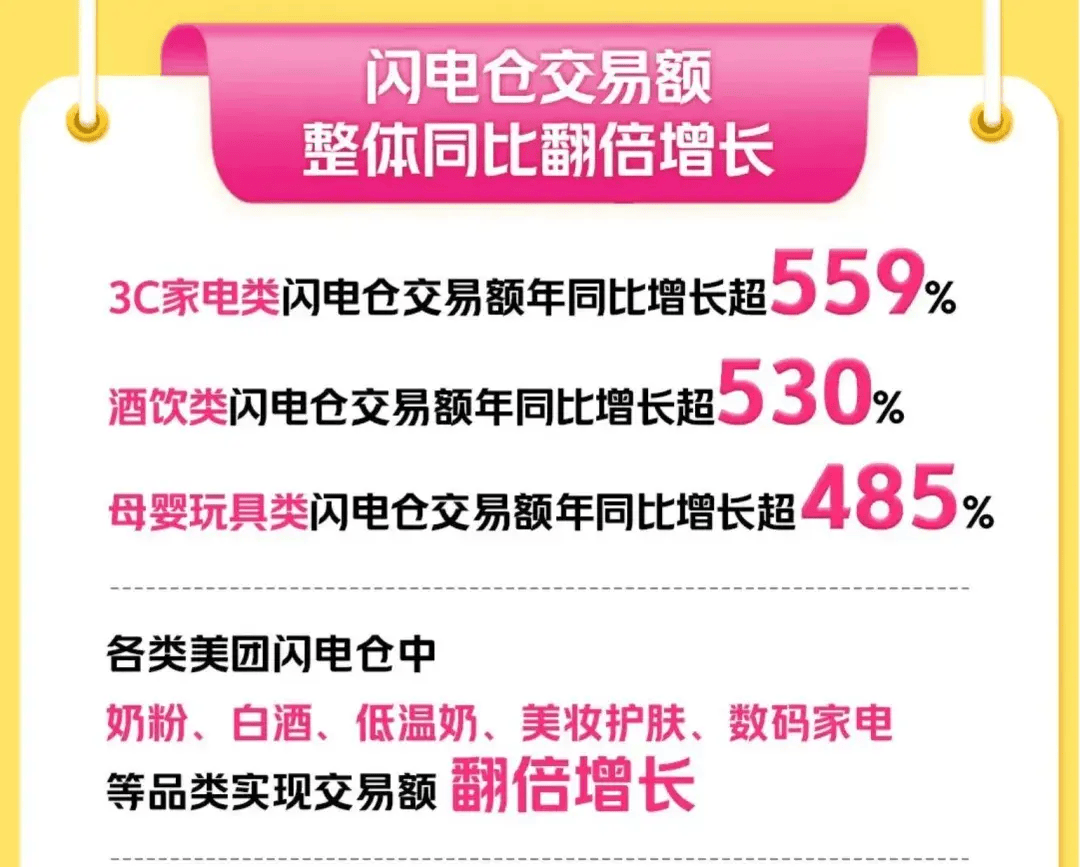
Core Insights - The core theme of the article is the transformative adjustments in the liquor industry by 2025, characterized by a shift towards "instant retail" and a significant evolution in consumer behavior and market dynamics [1] Group 1: Market Trends - The liquor industry's instant retail market is projected to explode in 2025, with an expected market size of 720 billion yuan, up from 360 billion yuan in 2024, indicating a substantial growth trajectory [2] - Major promotional events like 618 and Double 11 have shown remarkable sales growth, with Meituan's flash purchase and Yima's wine delivery achieving over threefold increases in transaction volume [2][4] Group 2: Strategic Shifts - The competition among platforms has intensified, leading to unprecedented strategic focus and resource allocation from both platforms and liquor companies, reshaping consumer habits and the development of instant retail [4][7] - Liquor companies are actively engaging in the instant retail space, with strategies ranging from joining platforms to establishing their own logistics systems, indicating a collective move towards deeper market penetration [7] Group 3: Challenges and Concerns - Despite the growth, the instant retail sector faces challenges such as the imbalance of interests between platforms and merchants, leading to profit erosion for traditional distributors [8][10] - The aggressive discounting strategies employed by platforms during major sales events have disrupted traditional pricing structures, raising concerns about long-term sustainability for smaller retailers [8][10] Group 4: Future Outlook - The liquor industry is expected to transition towards a more rational phase post-2025, focusing on balancing efficiency, quality, and profitability, with trust and authenticity becoming critical for high-end liquor sales [14][16] - Collaborative product creation between platforms and liquor companies is emerging as a new direction, aiming to reduce channel expansion costs while avoiding price wars, thus fostering a win-win scenario [16][17]
美团做起酒外卖,年营收或超60亿
Guan Cha Zhe Wang· 2025-12-25 10:49
Core Insights - The article highlights the rapid growth of Yima Songjiu, a liquor instant retail platform, which is projected to achieve a GMV of over 6 billion yuan in 2023, doubling from 3 billion yuan in 2022 [2][24] - Yima Songjiu has quickly become a leading player in the industry, reflecting the strong demand for instant home delivery of alcoholic beverages [3][28] Company Overview - Established in 2021 as a supplementary project for Meituan's flash purchase service in Huizhou, Yima Songjiu has expanded to over 2,000 warehouses across more than 200 cities, serving nearly 30 million users [3][11] - The platform offers over 800 SKUs, covering major categories such as beer, white liquor, red wine, and foreign liquor, with an average delivery time of 15 minutes [3][4] Competitive Advantages - Yima Songjiu promotes three main advantages: speed, price, and a light-asset model [4] - The platform's self-operated delivery model allows for faster delivery times, achieving a 50% on-time rate within 15 minutes and 95% within 25 minutes, significantly quicker than competitors [4][21] - Pricing strategies include using self-branded products to maintain high margins and leveraging Meituan's subsidies to offer competitive prices on well-known brands [4][5] Market Dynamics - The instant retail sector for alcoholic beverages is still in its early stages, with a projected market size of 100 billion yuan by 2027, indicating a compound annual growth rate of approximately 30% [24][27] - The industry faces challenges such as high delivery costs, low margins, and fluctuating demand, which complicate the balance between operational efficiency and profitability [21][29] Strategic Collaborations - Yima Songjiu has partnered with China Resources Beer to launch exclusive products based on real-time consumer data, showcasing the potential of instant retail platforms to influence product development [9][10] Future Outlook - The article suggests that the next phase of competition in the liquor instant retail market will focus on enhancing customer experience through specialized services and personalized recommendations [22][30] - The industry's growth is expected to be driven by changing consumer habits, particularly among younger generations who favor instant delivery services [27][28]


食品饮料行业周度更新:从中国快消品数据报告,看食品饮料消费结构-20251222
Changjiang Securities· 2025-12-21 23:30
Investment Rating - The industry investment rating is "Positive" and is maintained [9] Core Insights - In the first three quarters of 2025, the Chinese fast-moving consumer goods (FMCG) market exhibited distinct characteristics of "price reduction, volume increase, structural differentiation, and channel reshaping." The overall market average price decreased by 2.4% year-on-year, but the decline has narrowed, indicating price stabilization. Third to fifth-tier cities have become the main drivers of sales recovery, while competition in first and second-tier cities has intensified. Notably, packaged food sales led with a growth rate of 3.4%, although the momentum is slowing due to price sensitivity. Beverages are the only category to experience a decline, significantly impacted by price wars and competition from freshly brewed tea drinks [2][4][27]. Summary by Sections Market Overview - The FMCG market in China is characterized by a "price reduction, volume increase" trend, with a 2.4% year-on-year decline in average prices, which is stabilizing. Sales growth in lower-tier cities contributed approximately 80% to market growth, with a year-on-year increase of 4-6% [17][21][27]. Category Performance - Packaged food sales grew by 3.4% year-on-year, driven by stable demand for core and snack food categories. However, growth momentum is slowing, with quarterly growth rates of 4.6%, 4.2%, and 2.9%. In contrast, the beverage category saw a 1.1% decline in sales, despite a 3.6% increase in volume, primarily due to a 4.6% drop in average prices [21][25][27]. Channel Dynamics - The channel landscape is evolving, with traditional offline channels continuing to shrink. Emerging formats such as warehouse membership stores and snack collection stores are experiencing rapid growth, with increases of approximately 40%, 51%, and 92% respectively. E-commerce channels also showed resilience with a growth rate of about 7% [22][27]. Subsector Performance - The food and beverage sector has seen a mixed performance, with the overall index down 3.66% since the beginning of the year, lagging behind the CSI 300 index. However, subsectors like snack foods, food composites, and soft drinks have shown relative strength in recent weeks [29][35]. Industry Trends - The liquor industry is undergoing strategic adjustments, with major companies like Kweichow Moutai and Wuliangye implementing market reforms. Fast food and coffee brands are leveraging price adjustments and co-branding initiatives to attract consumers. The soft drink sector is focusing on product innovation and brand exposure, while the dairy sector is investing in capacity expansion and governance changes [35][36][37].




啤酒行业更新点评:歪马送酒门店持续扩张,啤酒即时零售进程延续
Changjiang Securities· 2025-12-15 23:30
Investment Rating - The investment rating for the beer industry is "Positive" and is maintained [6]. Core Insights - As of December 12, 2025, Meituan's liquor instant retail platform "Yaimasongjiu" has surpassed 2,000 stores, serving nearly 30 million users, with a transaction volume exceeding 6 billion yuan, entering the top three liquor brands, indicating strong growth momentum [2][4]. - The instant retail platform leverages digitalization to better understand consumer preferences and trends, allowing beer companies that can quickly respond to market demands and create popular products to gain larger market shares in new channels [2][4]. Summary by Sections Industry Overview - The rapid expansion of the instant retail platform has prompted beer companies to increasingly engage in this sector. By early 2025, several beer brands have indicated their plans to enter the instant retail market [4]. - Qingdao Beer, for instance, has been strengthening its layout in instant retail and flash warehouse models, while China Resources Beer has collaborated with "Yaimasongjiu" to launch self-operated products [4]. Market Dynamics - The traditional beer sales channels are primarily focused on dining and distribution, where suppliers have more control. The open nature of instant retail platforms challenges these traditional barriers, presenting opportunities for the beer industry [4]. - Companies that can quickly adapt to market needs and create hit products are expected to thrive in this competitive landscape [4]. Recommended Companies - The report specifically recommends investing in Qingdao Beer, Yanjing Beer, China Resources Beer, and Chongqing Beer due to their strong positioning in the evolving market [2][4].

