
非宽基ETF

Search documents
2025 年资金面回顾及 2026 年展望:资金情绪分化,等待新一轮共振
Xinda Securities· 2026-01-27 08:36
Overview - The funding sentiment has shown a divergence, with a continuous improvement in the funding environment throughout 2025. The net inflow of funds accounted for 6.8% of the free float market value, an increase of 0.3 percentage points compared to 2024. The net inflow of funds (considering half of dividends) accounted for 4.6% of the free float market value, up by 0.6 percentage points from 2024 [4][11][12]. Group 1: 2025 Funding Environment - Various types of funds, including trading funds, high-net-worth investors, insurance funds, and industrial capital, have shown a strong inflow, leading to a robust funding environment [4][12]. - The leverage funds have seen a significant increase in inflow speed, and private equity funds have surged due to improved regulatory policies and increased demand from high-net-worth investors [12][13]. - The scale of company dividends has reached a historical high, and share buybacks have remained at elevated levels, supporting a strong supply-demand balance in the stock market [12][13]. Group 2: 2026 Funding Outlook - The incremental funding for 2026 is expected to remain promising, with potential structural changes. Resident funds are anticipated to have new inflow channels, continuing the trend of "deposit migration" [12][13]. - Long-term funds, including social security funds and enterprise annuities, are expected to provide a "ballast" effect as their equity positions are currently low [12][13]. - Foreign capital is expected to improve its return speed, with an increase in passive allocation funds to Chinese assets anticipated in 2026 [12][13]. Group 3: Monthly Trends - In December 2025, the net inflow of funds accelerated, primarily due to increased net inflow into ETFs and high dividend payouts from listed companies. The number of new accounts also saw a month-on-month increase [21][22]. - In January 2026, the activity of trading funds significantly increased, with a rapid growth in financing balances, while broad-based ETFs experienced substantial net outflows [21][22]. - The net inflow of thematic and industry ETFs, which are favored by resident funds, maintained a positive trend [21][22]. Group 4: Resident and Institutional Funds - In December 2025, the number of new accounts at the Shanghai Stock Exchange reached 2.5967 million, a month-on-month increase of 215,300 accounts [25]. - The financing balance increased by 167.8 billion yuan from January 1 to January 20, 2026, indicating a high level of inflow [21][24]. - The net inflow of private equity funds has also shown a significant increase, with the management scale reaching 70,383.54 billion yuan by November 2025 [24].
写给新老基民:“9·24”一周年之际的复盘与思考
Sou Hu Cai Jing· 2025-09-24 11:16
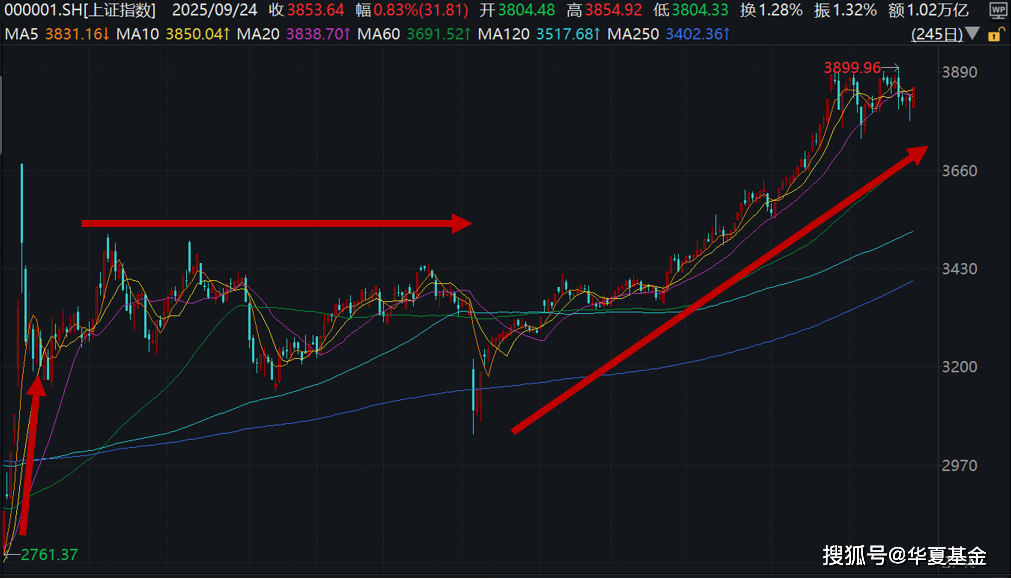
Core Viewpoint - The A-share market has experienced significant changes since September 24, 2024, marking a new cycle characterized by a strong recovery and confidence in the domestic technology sector [1][12]. Market Review - The market can be divided into three phases since September 24, 2024: 1. From September 24 to October 8, 2024, the Shanghai Composite Index surged from around 2700 points to 3674 points, an increase of nearly 1000 points [4]. 2. From October 8, 2024, to April 7, 2025, the market experienced fluctuations, testing investor confidence while hovering above 3000 points [6]. 3. From April 7, 2025, to the present, the market has seen a steady rise of nearly 900 points, moving from 3040 points to nearly 3900 points, indicating a "slow bull" market [6][12]. Market Dynamics - The overall market valuation has shifted from excessive pessimism to reasonable correction, with the technology growth sector gaining optimistic expectations [12]. - The annualized volatility of the Shanghai Composite Index has decreased to 15.9% over the past five years, down 2.8 percentage points from the previous five years, indicating a more stable investment environment [5][12]. Investment Trends - The technology sector has emerged as the strongest driver of the current market rally, with its market capitalization exceeding 25% of the total market [9][12]. - The ChiNext Index and the Science and Technology Innovation 50 Index have both seen significant gains, reflecting the success of the new policies introduced since September 24, 2024 [9][12]. Future Outlook - Historical analysis suggests that the CSI 300 Index could reach around 5500 points, indicating a potential upside of 22% from its current level of approximately 4500 points [18]. - The current dividend yield of the CSI 300 is 2.2%, suggesting a potential increase of 46% based on historical bull market dividend yields [21]. Investor Sentiment - Recent data indicates that while there has been an increase in retail investor activity, it remains below the levels seen during the previous bull market [13][15]. - The market sentiment has shown signs of improvement, but it is still not at the levels experienced during the peak of previous bull markets [13][15].

投资策略周报:行业分化下,市场的配置思路发生变化-20250907
KAIYUAN SECURITIES· 2025-09-07 09:15
Group 1 - The report maintains an optimistic long-term outlook for the index, emphasizing a "bull market mindset" and the potential for upward valuation based on current securities rates [3][12][13] - The market structure is characterized by a "dual-driven" approach, with strong growth in technology sectors and a cyclical recovery led by "anti-involution" trends [3][15] - The report suggests focusing on growth sectors, particularly in a high-risk appetite market, and highlights potential low-position investment opportunities in gaming, media, and the Huawei supply chain [3][12][15] Group 2 - The 2025 mid-year report shows a significant structural recovery, with overall performance being flat but notable improvements in specific sectors [4][17] - The report emphasizes the importance of focusing on high-growth industries, particularly in technology manufacturing, consumer goods, and cyclical sectors [16][19] - It highlights that the current economic environment favors structural recovery over a broad economic rebound, with technology-intensive industries showing rapid growth [18][19] Group 3 - Since June, there has been a rapid expansion of non-broad-based ETFs, with net inflows reaching 227.9 billion yuan, indicating a shift in how retail investors are entering the market [5][21][22] - The report notes that the preference for non-broad-based ETFs suggests a "running into the market" behavior among retail investors, reinforcing the importance of leading stocks [21][22][28] - It emphasizes that selecting industries may become more critical than selecting individual stocks, as the differentiation between sectors is expected to be greater than historical averages [21][28] Group 4 - The report outlines a core investment strategy focusing on technology, military, cyclical recovery, and stable dividends [30][31] - It provides a "4+1" industry allocation strategy, recommending investments in technology growth, cyclical sectors benefiting from PPI improvements, and stable dividend stocks [32][30] - The report identifies structural opportunities in exports and emphasizes the importance of stable dividend and gold investments as part of a balanced portfolio [32][30]