
飞腾CPU

Search documents
中国长城:自主计算产业开拓者,深耕CPU与整机有望受益于信创-20260313
GUOTAI HAITONG SECURITIES· 2026-03-13 00:25
Investment Rating - The report assigns a rating of "Buy" for the company [5]. Core Insights - The company is a pioneer in China's independent computing industry, focusing on CPU and integrated systems, and is expected to benefit from the deepening of the Xinchuang industry and the explosive demand for AI [2][10]. - The company has a stable shareholding structure, with China Electronics being the largest shareholder, holding 39.35% of the shares [10][25]. - The company has made significant contributions to the development of China's independent computing industry, having created several industry firsts [10][24]. Financial Summary - The projected total revenue for 2025-2027 is expected to be 151.80 billion, 170.15 billion, and 188.14 billion yuan, respectively, with a corresponding net profit of -0.56 billion, 1.28 billion, and 2.59 billion yuan [4][18]. - The earnings per share (EPS) for the same period is projected to be -0.02, 0.04, and 0.08 yuan [18]. - The company’s revenue is expected to grow at rates of 10.00%, 15.00%, and 12.00% for its computing industry business from 2025 to 2027 [14][16]. Revenue Breakdown - The computing industry business is projected to generate revenues of 117.72 billion, 135.37 billion, and 151.62 billion yuan from 2025 to 2027, with gross margins of 15.00%, 17.00%, and 17.00% [14][16]. - The system equipment business is expected to see revenues of 25.49 billion, 25.76 billion, and 27.05 billion yuan, with gross margins of 14.00%, 15.00%, and 16.00% [15][16]. - Other business revenues are projected to be 8.59 billion, 9.02 billion, and 9.47 billion yuan, with gross margins of 31.50%, 34.00%, and 36.00% [15][16]. Valuation Analysis - The report uses both PS and PB valuation methods, estimating a reasonable valuation of 740.51 billion yuan and a target price of 22.96 yuan for the company [19][22][23]. - The PS valuation method suggests a valuation based on an average of 11.59 times PS for comparable companies, while the PB valuation method suggests a valuation of 6 times PB [20][22]. Market Position and Strategy - The company is positioned as a key player in the Xinchuang and AI computing sectors, focusing on developing core products and technologies for information security and infrastructure [10][24]. - The company has invested in Feiteng, a leading domestic CPU developer, to enhance its capabilities in high-end chip design and production [10][32][35]. - The company aims to leverage opportunities in the Xinchuang market and solidify its integrated system business [10][14].

中国长城(000066):自主计算产业开拓者,深耕CPU与整机有望受益于信创
GUOTAI HAITONG SECURITIES· 2026-03-12 14:24
Investment Rating - The report assigns a rating of "Buy" for the company [5]. Core Insights - The company is a pioneer in China's independent computing industry, focusing on CPU and integrated systems, and is expected to benefit from the deepening of the Xinchuang industry and the explosion of AI demand, leading to rapid development [2][10]. - The company has a stable shareholding structure, with China Electronics being the largest shareholder, holding 39.35% of the shares as of Q3 2025 [10][26]. - The company has invested in Feiteng, a national team for CPU development, holding 28.03% of its shares, which is crucial for the development of independent and controllable CPUs [10][32]. Financial Summary - Total revenue is projected to be 13,420 million in 2023, increasing to 18,814 million by 2027, with a compound annual growth rate (CAGR) of approximately 10.6% [4][18]. - The net profit attributable to the parent company is expected to improve from -977 million in 2023 to 259 million in 2027, indicating a significant turnaround [4][18]. - Earnings per share (EPS) is forecasted to rise from -0.30 in 2023 to 0.08 in 2027 [4][18]. Revenue and Profit Forecast - The computing industry business is expected to grow at rates of 10.00%, 15.00%, and 12.00% from 2025 to 2027, reaching revenues of 117.72 million, 135.37 million, and 151.62 million respectively [14][16]. - The system equipment business is projected to stabilize and recover, with revenues expected to reach 25.49 million, 25.76 million, and 27.05 million from 2025 to 2027 [15][16]. - Other business revenues are anticipated to grow by 5.00% annually, reaching 8.59 million, 9.02 million, and 9.47 million from 2025 to 2027 [15][16]. Valuation Analysis - The report uses both PS and PB valuation methods, estimating a reasonable valuation of 740.51 billion RMB based on a 6x PB for 2026, corresponding to a target price of 22.96 RMB [19][22][23]. - The average PS valuation for comparable companies is 11.59x for 2026, but the company is given a lower multiple of 5x due to its focus on CPU and integrated systems [20][22]. Market Position and Strategy - The company has been a leader in the independent computing industry for over 40 years, focusing on core areas such as computing and system equipment [24][25]. - The company aims to provide a complete range of independent security products and solutions, leveraging its extensive experience in power supply technology [14][25]. - The company is positioned to capitalize on the growing demand for servers driven by AI and cloud computing, with a focus on enhancing its product offerings and market presence [14][28].
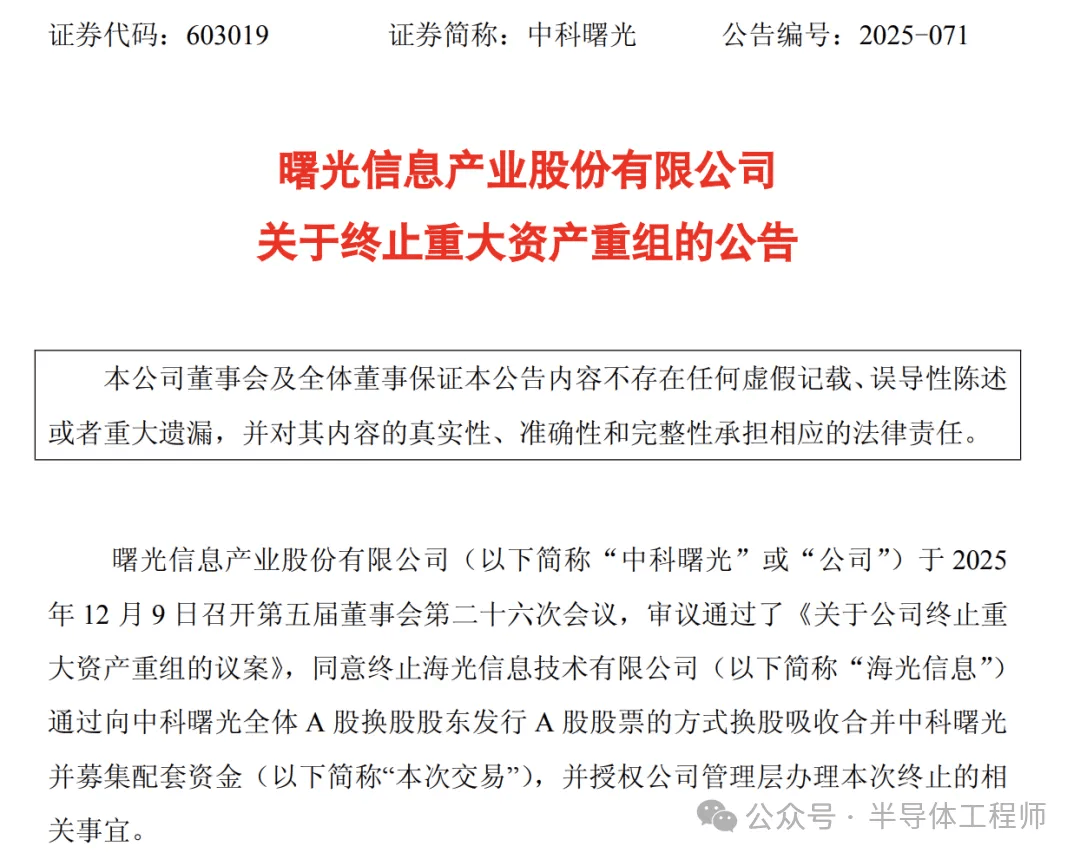
突发!中科曙光与海光信息,重大资产重组终止
Sou Hu Cai Jing· 2025-12-10 04:11
Group 1 - Company Zhongke Shuguang announced the termination of the major asset restructuring involving the absorption of Haiguang Information due to the large transaction scale and changes in market conditions [2] - The decision to terminate the transaction was made after discussions with relevant parties, and it will not have a significant adverse impact on the company's operations and financial status [2] Group 2 - The domestic CPU industry has made significant progress with companies like Loongson, Feiteng, Zhaoxin, and Haiguang launching high-performance products [4] - Loongson has adopted a self-developed instruction set to reduce reliance on foreign technology, while Feiteng has established a presence in the domestic server market due to its performance and low power consumption [4] - Haiguang has collaborated with AMD to enhance its technology, achieving notable compatibility and performance for industries requiring high computing power [4] - Challenges for the domestic CPU sector include incomplete ecosystem development and insufficient software compatibility, which affect user experience and market promotion [4] - Despite challenges, there are opportunities due to strong national policy support and a large domestic market demand, which provide a favorable environment for growth [4] - The domestic CPU industry needs to increase R&D investment, overcome technical bottlenecks, and improve the industrial ecosystem to thrive in the global technology arena [4]


瞭望 | 湘江新区担纲区域创新排头兵
Xin Hua She· 2025-12-01 09:01
Core Viewpoint - Changsha is actively building a competitive technology innovation hub and aims to establish itself as a global R&D center, with Xiangjiang New Area playing a crucial role in this transformation [2] Group 1: Technological Infrastructure - The Xiangjiang New Area is developing a "two cores and one ecosystem" technology system centered around Feiteng CPU and Kunpeng CPU, with the Kirin operating system as the ecological link, targeting the "bottleneck" issues in autonomous secure computing [6] - The National Supercomputing Center in Changsha has achieved the highest performance-to-power ratio globally in the data-intensive application category, with a supercomputing capacity of 200 PFlops and the ability to provide 1000 PFlops of intelligent computing power [3] - The establishment of various innovation platforms, including 37 national-level and 254 provincial-level platforms, is driving the transformation of research outcomes into practical applications [4] Group 2: Industry Development - The new generation of autonomous secure computing industry cluster in Xiangjiang New Area is projected to reach a production value of 201.87 billion yuan in 2024, with over 130 billion yuan expected in the first half of 2025 [7] - The "Zhigu" innovation base, with an investment of 18 billion yuan, focuses on creating a digital economy industry cluster that encompasses the entire industry chain from chips to software and applications [6] Group 3: Talent and Ecosystem Support - The Xiangjiang Science City is enhancing the entrepreneurial ecosystem by establishing a comprehensive incubation base for university students, with 73 projects currently in residence and 22 of them having secured funding totaling 13.69 million yuan [9] - The "Red Maple Plan" has been launched to invest in early-stage, small, and hard technology projects, with over 100 projects selected for investment and a total investment exceeding 30 million yuan [9][10] - The establishment of a technology finance fund matrix, including nine funds with a total subscribed scale of 1.966 billion yuan, supports early-stage project incubation and investment [10]
从“天地一体”到“万物智联” 央企重塑通信产业新格局
Zhong Guo Chan Ye Jing Ji Xin Xi Wang· 2025-09-29 23:44
Core Viewpoint - The launch of satellite communication services by Chinese telecom operators marks a significant advancement in communication technology, enabling direct satellite connectivity for mobile phones and vehicles, which is crucial during emergencies [1][2][5]. Group 1: Satellite Communication Development - China Telecom has pioneered the commercial service of "mobile direct satellite connection," overcoming significant technical challenges to provide this service to consumers [2][4]. - China Unicom has also received a license to operate satellite mobile communication services, further expanding the availability of satellite connectivity across the country [1][5]. - The integration of satellite communication with terrestrial networks is seen as a key feature of the upcoming 6G era, enhancing the resilience and reach of communication services [7][9]. Group 2: Technological Innovations - The introduction of eSIM technology is transforming device connectivity, allowing for more flexible and secure communication solutions across various devices [9][10]. - The proliferation of IoT applications, such as smart water meters and livestock tracking, demonstrates the practical benefits of enhanced connectivity in everyday life [10][12]. - The collaboration between telecom companies and technology providers is driving innovation in communication infrastructure, with a focus on 5G and future 6G technologies [16][20]. Group 3: Economic and Environmental Impact - The shared infrastructure model between China Telecom and China Unicom has resulted in significant cost savings and reduced carbon emissions, showcasing a sustainable approach to network expansion [18][20]. - The development of domestic CPU technology is crucial for supporting the growing demands of AI and other advanced applications, indicating a shift towards self-sufficiency in critical technology sectors [20].




答卷“十四五” 央企惠民生 | 从天地一体到万物智联 央企重塑通信产业新格局
Zhong Guo Zheng Quan Bao· 2025-09-26 00:00
Core Insights - The introduction of satellite communication services by major Chinese telecom operators marks a significant advancement in emergency communication capabilities, particularly during natural disasters [1][3][4] - The integration of 6G technology, eSIM innovations, and IoT applications is driving the development of a more interconnected and intelligent society, enhancing various industries [1][6][7] Group 1: Satellite Communication Services - China Telecom has launched the world's first commercial satellite direct connection service for mobile phones, overcoming significant technical challenges [3] - China Unicom has received a license for satellite mobile communication services and successfully launched four low-orbit satellites, enabling nationwide mobile direct connection services [3][4] - The expansion of satellite communication services is expected to benefit a wider population and empower various industries, particularly in emergency response scenarios [4] Group 2: Technological Innovations - The eSIM technology is revolutionizing device connectivity, enhancing security and user autonomy while facilitating the evolution of device forms [6] - The application of IoT solutions, such as smart water meters and livestock tracking, demonstrates the practical benefits of connected technologies in resource management [6][7] - The ongoing development of 5G-A networks is set to further enhance smart city initiatives and industrial automation, driving digital transformation across sectors [7] Group 3: Infrastructure Development - China has established the world's largest and most advanced information communication network, with over 464 million 5G base stations and 30.53 million gigabit ports [8][9] - Collaborative efforts between major telecom companies have led to the creation of the largest and fastest 5G SA shared network, significantly reducing investment costs and carbon emissions [9] - The focus on domestic CPU development aims to address supply chain challenges and support the growing demand for artificial intelligence applications [10]


从天地一体到万物智联 央企重塑通信产业新格局
Zhong Guo Zheng Quan Bao· 2025-09-25 22:11
Core Viewpoint - The emergence of satellite mobile communication services in China marks a significant advancement in technology, enhancing connectivity and safety during emergencies, and paving the way for a new era of integrated communication systems [1][2][3] Group 1: Satellite Communication Development - China Telecom has launched the world's first commercial satellite direct connection service for mobile phones, overcoming significant technical challenges [2] - China Unicom has received a license for satellite mobile communication services and successfully launched four low-orbit satellites, expanding the availability of satellite services [2][3] - The integration of satellite communication with terrestrial networks is seen as a key feature of the upcoming 6G era, enhancing disaster response capabilities and everyday connectivity [3][4] Group 2: Technological Innovations - The introduction of eSIM technology is revolutionizing device connectivity, allowing for more secure and flexible communication solutions across various devices [4][5] - The proliferation of IoT applications, such as smart water management and livestock tracking, demonstrates the practical benefits of advanced connectivity solutions [5][6] - The development of 5G-A networks is expected to further empower industries, facilitating digital transformation and enhancing user experiences [5][6] Group 3: Infrastructure and Investment - China has established the largest and most advanced information communication network globally, with over 464 million 5G base stations and significant investments in network infrastructure [6][7] - Collaborative efforts between major telecom companies have led to the creation of the world's largest and fastest 5G SA shared network, resulting in substantial cost savings and environmental benefits [6][7] - The focus on domestic CPU development by companies like China Electronics is addressing supply chain challenges and supporting the growth of AI and other advanced technologies [7]