高息股

Search documents
压岁钱理财需分年龄段,攒金攒股等多元规划成趋势丨经济周刊·理财
Guang Zhou Ri Bao· 2026-02-26 16:26
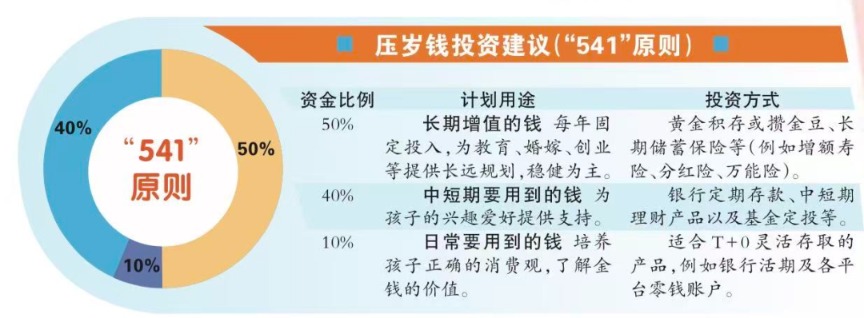
Core Insights - The article discusses the increasing trend among parents to manage their children's New Year's money (lucky money) as a means of financial education, emphasizing the importance of age-appropriate financial planning [1][3]. Age-Based Planning - Financial management of lucky money should be tailored to different growth stages of children, with a focus on the relationship between money and time [3]. - A suggested approach is to divide the lucky money into three parts using the "541 principle": 50% for long-term growth, 40% for foreseeable goals (like education and travel), and 10% for daily expenses [3][4]. - Financial education should be gradual, adapting to children's varying levels of understanding and self-control as they age [3][4]. Specific Age Stages - For children aged 3-6, the focus is on establishing a basic understanding of money, using savings accounts or cash to illustrate wealth accumulation [4]. - For ages 7-12, the emphasis shifts to developing saving habits and low-risk investment practices, allowing children to manage small amounts for daily spending [4]. - For those aged 13 and above, the focus is on fostering independent planning and diversified investment thinking, encouraging the use of low-risk investment options like mutual funds and gold accumulation [4]. Diverse Investment Trends - Parents are increasingly looking to invest lucky money in gold, high-yield stocks, and insurance products, reflecting a shift in financial perspectives among new-generation parents [5]. - The article highlights that many families are now investing in gold as a tangible asset, with some parents purchasing gold beans for their children as a way to teach saving and investment [5]. - The rising interest in capital markets has led some parents to invest in stocks and funds for their children's future education and marriage expenses, focusing on long-term holding strategies [5]. Insurance as a Financial Tool - Financial professionals recommend using long-term savings insurance products for managing lucky money, which can provide stable and continuous growth [6]. - Current market rates for universal life insurance products show guaranteed rates around 1%, with many products offering settlement rates above 2%, and some reaching up to 3.5% [6]. Investment Cautions - The article advises that lucky money management should prioritize stable investments, with common choices including fixed deposits, low-risk financial products, gold, and insurance [8]. - For families considering stock investments, it is suggested to use a dollar-cost averaging approach to mitigate risks associated with market volatility [8].

平安资管黄家乐:港股迎重估机遇 建议“杠铃策略”配置
2 1 Shi Ji Jing Ji Bao Dao· 2025-11-21 04:55
Core Insights - The 2025 Bay Area Wealth Conference highlighted new investment opportunities in the Hong Kong stock market amid China's asset revaluation, with a recommendation for investors to adopt a "barbell strategy" that balances high-dividend stocks for stability and growth stocks for potential returns [1][2]. Group 1: Market Overview - The Hong Kong stock market shows significant valuation advantages, with the Hang Seng Index's dividend yield at 3.04% and a forecasted price-to-earnings ratio of 11.19, lower than major global indices [1]. - The AH share premium index is at a high level, indicating a valuation discount of 20%-30% for Hong Kong stocks compared to A-shares [1]. Group 2: Investment Strategy - The "stable" end of the barbell strategy focuses on high-dividend stocks, which historically perform better during declining interest rates and have low correlation with global indices, thus effectively diversifying risk [1]. - The "growth" end emphasizes the potential of Hong Kong growth stocks, particularly in technology and semiconductors, driven by external factors like the U.S. Federal Reserve's interest rate cuts and easing export restrictions on chips [1][2]. Group 3: Sector Analysis - Key sectors for growth include new consumption, innovative pharmaceuticals, and technological innovation, with AI technology transforming drug development and enhancing efficiency [2]. - The new consumption sector is experiencing a shift in consumer attitudes, leading to the rise of new brands that leverage cultural empowerment and product innovation to capture market share [2]. - The Hang Seng Technology Index has a price-to-earnings growth (PEG) ratio of 0.85, indicating that valuations are below growth rates, suggesting promising growth potential [2]. Group 4: Market Dynamics - There is an increasing enthusiasm from overseas funds for Chinese assets, with an expected influx of over $140 billion if global active funds allocate to Chinese assets [2]. - The momentum of southbound capital inflows into Hong Kong stocks remains strong, particularly in sectors like retail, pharmaceuticals, and media [2][3].
日本,如何走出失去的30年?
大胡子说房· 2025-07-02 12:47
Core Viewpoint - The current economic situation is causing concerns about future income and retirement, similar to Japan's lost decades. The focus should be on effective capital allocation to preserve wealth [1]. Group 1: Japanese Pension System - Japan's pension system has managed to provide substantial payouts despite economic stagnation and an aging population, primarily through investment strategies [2][10]. - The scale of Japan's pension fund is approximately $1.6 trillion, with total returns reaching ¥5.2 trillion since 2001 [2]. - The investment strategy emphasizes long-term orientation and risk management, focusing on stable assets [3][4]. Group 2: Asset Allocation - Japanese pension funds allocate 25% to domestic bonds, 25% to foreign bonds, 25% to domestic stocks, and 25% to foreign stocks, ensuring risk diversification [5][6]. - The strategy includes investing in high-yield domestic stocks, which can outperform the market and provide reliable dividends [7][8]. Group 3: Investment Recommendations - To ensure returns, it is suggested to invest in high-yield domestic stocks and stable, lower-risk assets like savings [11][18]. - The current market conditions indicate a potential bull market for domestic stocks, particularly in the banking sector, which has shown resilience and strong dividend yields [14][17]. - Caution is advised in stock trading, with a recommendation to consider stable funds focused on high-yield stocks rather than direct stock trading [15][17].

日本,如何走出失去的30年?
大胡子说房· 2025-06-21 05:22
Core Viewpoint - The current economic situation is causing concerns about future income and retirement, similar to Japan's lost decades. The key to preserving wealth is effective asset allocation, with a focus on the Japanese pension system as a reference for investment strategies [1][10]. Asset Allocation Insights - Japan's pension system has been able to provide substantial payouts despite economic stagnation and an aging population due to its investment strategies [2][11]. - The Japanese pension fund, valued at approximately $1.6 trillion (around 12 trillion RMB), has generated returns of 5.2 trillion RMB since 2001 [2]. Investment Principles - The Japanese pension fund follows a long-term investment approach, emphasizing risk management while seeking returns [3]. - The fund's asset allocation includes 25% in domestic bonds, 25% in foreign bonds, 25% in domestic stocks, and 25% in foreign stocks, ensuring diversification and risk mitigation [5][6]. High-Yield Stock Strategy - Japanese pension funds focus on high-yield stocks, which can outperform the market significantly, with some yielding up to six times the Nikkei index [8]. - The recommendation for investors is to consider high-yield domestic stocks, particularly in the banking sector, which offers stable dividends of 5-8% annually [15][17]. Stable Asset Investment - In addition to high-yield stocks, it is crucial to invest in lower-risk assets that provide stable returns, especially during market downturns [18]. - The current trend shows a significant inflow of funds into bank stocks, driven by public fund performance benchmarks tied to the CSI 300 index [16][17].