鸿蒙智行问界M9

Search documents
春晚广告位争夺战:四十年国民记忆与商业暗流
凤凰网财经· 2026-02-19 10:54
Core Viewpoint - The evolution of the Spring Festival Gala sponsorship reflects the transformation of China's economy and consumer behavior over the past 40 years, showcasing the shift from material scarcity to technological innovation and brand storytelling [4][5]. Group 1: 1980s to Early 1990s - The Era of Material Scarcity - The transition from a planned economy to a market economy in the 1980s led to a scarcity of goods, making items like watches and bicycles symbols of wealth and status [6][7]. - The first brand to sponsor the Spring Festival Gala was Kambas watches in 1984, which used 3,000 quartz watches as payment, marking the beginning of brand sponsorship in the event [7][9]. - Kambas became a household name, with production reaching 1.26 million units by 1987 and over 2 million by 1991, highlighting the impact of the Gala on brand visibility and market demand [9][10]. Group 2: Mid-1990s to Early 2000s - The Rise of Consumerism - The late 1990s saw a surge in consumer spending, with households moving from basic necessities to larger purchases like televisions and refrigerators [12][14]. - In 1995, Shandong Kongfu Banquet Wine became the first "advertising king" of the Spring Festival Gala, paying 30.79 million yuan, initiating a trend among liquor companies [12][14]. - The sales of Qin Pool Wine skyrocketed from 180 million yuan in 1995 to 950 million yuan in 1996 after winning the sponsorship, demonstrating the immediate impact of Gala advertising [17]. Group 3: 2000s to 2010s - The Era of Brand Awareness - The early 2000s marked a shift towards household appliances as the main consumer focus, with Midea becoming a prominent sponsor, securing 16 sponsorships from 2003 to 2019 [18][20]. - The cost of advertising during the Gala increased significantly, with Midea's sponsorship rising from 6.8 million yuan in 2005 to 57.2 million yuan in 2011, reflecting the growing value of the event [20]. - Brands began to focus on storytelling and emotional connections with consumers, as seen with Haier and Gree, indicating a maturation of brand marketing strategies [21]. Group 4: Mid-2010s to Present - The Digital Economy and Technological Innovation - The rise of internet companies has transformed the Spring Festival Gala into a platform for digital engagement, with WeChat's "red envelope war" in 2015 significantly increasing viewer interaction [24][26]. - The Gala has become a battleground for tech giants, with platforms like Douyin and Kuaishou participating in interactive sponsorships, showcasing the shift towards a two-way communication model [29]. - The introduction of robots and AI technologies in recent Galas reflects China's transition from manufacturing to intelligent manufacturing, highlighting the importance of innovation in the economy [31].



春晚广告位争夺战:四十年国民记忆与商业洪流
Xin Lang Cai Jing· 2026-02-19 07:21
Core Insights - The evolution of the CCTV Spring Festival Gala sponsorship reflects the transformation of Chinese society and economy over the past 40 years, showcasing the changing consumer demands and emerging industries [20][21]. Group 1: 1980s to Early 1990s - The Era of Scarcity - In the 1980s, as China transitioned from a planned economy to a market economy, consumer goods were scarce, leading to a high demand for basic commodities [22]. - The first brand to sponsor the Spring Festival Gala was Kambas watches in 1984, which used 3,000 quartz watches as payment, marking the beginning of brand sponsorship in the gala [22][23]. - Kambas became a household name, with production reaching 1.26 million units in 1987 and over 2 million by 1991, despite the high price of its watches relative to average incomes [23][24]. Group 2: Mid-1990s to Early 2000s - The Rise of Consumerism - The mid-1990s saw a shift in consumer spending from basic goods to electronics, with Shandong Kongfu Banquet Wine becoming the first "advertising king" by paying 30.79 million yuan for sponsorship in 1995 [26]. - The competition among liquor brands for sponsorship reflected the rise of "social consumption," where premium liquor became a status symbol for social gatherings [28]. - After winning the Spring Festival sponsorship, Qin Pool Wine's sales skyrocketed from 180 million yuan in 1995 to 950 million yuan in 1996, demonstrating the immediate impact of gala sponsorship [29]. Group 3: 2000s to Early 2010s - The Home Appliance Boom - The early 2000s marked a shift towards home appliances as the primary consumer focus, with Midea becoming the most frequent sponsor, securing 16 sponsorships from 2003 to 2019 [30]. - The cost of advertising during the gala increased significantly, with Midea's sponsorship fee rising from 6.8 million yuan in 2005 to 57.2 million yuan in 2011, an increase of 840% [30]. - Midea's revenue grew from 17.5 billion yuan in 2003 to over 140 billion yuan in 2014, reflecting the effectiveness of its gala sponsorship strategy [12][30]. Group 4: Mid-2010s to Present - The Digital Economy and Technological Innovation - The rise of internet companies has transformed the Spring Festival Gala into a platform for digital engagement, with WeChat's "red envelope war" in 2015 significantly boosting viewer interaction [15][35]. - The gala's advertising has evolved from one-way promotion to interactive engagement, with platforms like Douyin and Kuaishou participating in sponsorships [16][35]. - The presence of technology companies has increased, with innovations such as AI and robotics showcased during the gala, indicating a shift from traditional advertising to technology-driven marketing [19][37].


春晚40年赞助商变迁史,从康巴丝到机器人见证中国经济跃迁
Sou Hu Cai Jing· 2026-02-18 02:17
Group 1 - The article discusses the evolution of sponsorship in the CCTV Spring Festival Gala over the past 40 years, reflecting changes in Chinese society and consumer behavior [2][3] - The first sponsor, 康巴丝 (Kambas), set a precedent in 1984 by using 3,000 quartz watches as payment, marking the beginning of brand sponsorship in the gala [6][8] - The transition from watches to bicycles as the next major sponsor in 1995 illustrates the shift in consumer goods that represented status during the era of material scarcity [10][12] Group 2 - The late 1990s saw a surge in consumer spending on new household appliances, with 山东孔府宴酒 (Shandong Confucius Banquet Wine) becoming the first "mark king" of the gala in 1995, paying 30.79 million yuan [10][12] - The rapid growth of the liquor industry during this period was fueled by "human consumption," where premium liquor became a social currency [12][14] - The article highlights the consequences of over-reliance on advertising without maintaining product quality, as seen in the case of 秦池酒 (Qin Pool Wine), which faced a significant drop in sales after quality issues emerged [14][15] Group 3 - From the early 2000s, the focus shifted to home appliances, with 美的 (Midea) becoming a prominent sponsor, securing 16 sponsorships from 2003 to 2019 [17][19] - The cost of advertising during the gala increased significantly, with Midea's sponsorship fee rising from 6.8 million yuan in 2005 to 57.2 million yuan in 2011, reflecting the growing viewership [17][19] - The brand storytelling approach adopted by companies like 海尔 (Haier) and 格力 (Gree) during this period indicates a shift towards building emotional connections with consumers [20] Group 4 - The rise of internet companies post-2010 transformed the gala's advertising landscape, with platforms like WeChat leveraging the event for massive user engagement through interactive features like the "red envelope battle" [21][23] - The article notes that the 2015 Spring Festival Gala saw WeChat's user engagement peak, with over 10.1 billion red envelopes sent, showcasing the event's potential as a digital marketing platform [21][23] - The involvement of tech giants in the gala reflects a broader trend of digital economy reshaping traditional advertising methods, with companies like 快手 (Kuaishou) and 抖音 (Douyin) entering the sponsorship arena [25][27] Group 5 - The article concludes by emphasizing the transition from showcasing products to highlighting technological advancements, as seen with the introduction of robots in recent galas [27] - This shift signifies a broader change in China's economic landscape, moving from manufacturing to innovation-driven growth, with a focus on high-tech industries [27] - The future of the Spring Festival Gala sponsorship landscape remains uncertain, raising questions about which industries will dominate the next decade [27]

春晚广告位争夺战:四十年国民记忆与商业暗流
创业邦· 2026-02-17 10:32
Core Viewpoint - The evolution of the Spring Festival Gala sponsorship reflects the changing landscape of China's economy and consumer behavior over the past 40 years, showcasing the transition from material scarcity to technological innovation and brand storytelling [4][24]. Group 1: 1980s to Early 1990s - The 1980s marked a period of material scarcity, where items like watches and radios were symbols of wealth and status, leading to the first brand sponsorship by 康巴丝 (Kangbasi) at the Spring Festival Gala [5][7]. - 康巴丝 sponsored the gala by trading 3,000 quartz watches for advertising, which significantly boosted its brand recognition and sales, reaching an annual production of 1.26 million watches by 1987 [8]. - The sponsorship model evolved, with 中华自行车 (Zhonghua Bicycle) taking over the sponsorship in 1995, reflecting the changing consumer demands and economic conditions [9][14]. Group 2: Mid-1990s to Early 2000s - The mid-1990s saw a surge in consumer spending, with the emergence of "标王" (advertising king) sponsorships, particularly in the liquor industry, exemplified by 山东孔府宴酒 (Shandong Confucius Feast Wine) and 秦池酒 (Qinchijiu) [11][12]. - 秦池酒's sponsorship led to a dramatic increase in sales from 1.8 billion yuan in 1995 to 9.5 billion yuan in 1996, highlighting the impact of gala sponsorship on brand visibility and sales [16]. - The era was characterized by a shift towards consumerism, with brands leveraging the gala to enhance their market presence, although some faced backlash due to quality issues [16]. Group 3: 2000s to Early 2010s - The early 2000s marked the rise of home appliance brands, with 美的 (Midea) becoming a prominent sponsor, securing 11 sponsorships from 2003 to 2014, reflecting the growing importance of brand trust [17][19]. - The cost of advertising skyrocketed, with Midea's sponsorship fee increasing from 6.8 million yuan in 2005 to 57.2 million yuan in 2011, indicating the gala's significant viewership and advertising value [21]. - Brands began to focus on storytelling and emotional connections with consumers, moving beyond mere product promotion to build brand loyalty [23]. Group 4: Mid-2010s to Present - The 2010s saw the rise of internet companies as key players in the advertising space, with platforms like WeChat revolutionizing audience engagement through interactive features like the "red envelope battle" during the gala [25][26]. - The digital transformation of the gala allowed for unprecedented levels of interaction, with WeChat reporting 10.1 billion red envelope transactions on New Year's Eve, significantly enhancing its user base [26]. - The emergence of technology companies in the gala sponsorship landscape reflects a broader shift towards innovation and digital engagement, with brands like Xiaomi and AI robotics showcasing advancements in technology [32].





时报观察丨从春晚合作伙伴看产业“向新”变迁
证券时报· 2026-01-28 00:41
今年春晚将成为机器人企业集体亮相的舞台。 宇树科技近日宣布成为2026年春晚机器人合作伙伴,这是宇树科技第三次与春晚结缘。此外,银河通用 机器人和魔法原子机器人也将亮相马年春晚。 责编:李丹 校对: 高源 版权声明 证券时报各平台所有原创内容,未经书面授权,任何单位及个人不得转载。我社保留追 究相关 行 为主体 法律责任的权利。 早年春晚的合作伙伴,主要是白酒、家电等传统消费类企业。2015年微信通过发红包爆红后,春晚成了 移动互联网产业"流量狂欢"的展示舞台。支付宝、抖音、快手等平台通过春晚红包、互动玩法,让数字 经济完成对生活场景的快速渗透。 随后,"硬科技"企业陆续登场。2024年,小米汽车SU7、鸿蒙智行问界M9等新能源汽车同台亮相,打 破了传统快消品的赞助垄断。今年机器人企业的集体亮相,则意味着具身智能不再是实验室里的概念, 而是开始走进大众生活。 机器人企业近年发展突飞猛进,首先源于核心技术的群体性突破。工信部数据显示,我国持有机器人有 效专利占全球比重达2/3,高精密减速器、高性能伺服电机等关键零部件国产化率稳步提升。春晚舞台 上,机器人能完成扭秧歌、转手绢等复杂动作,能实现环境感知与即时协作, ...

从春晚合作伙伴看产业‘向新’变迁
Xin Lang Cai Jing· 2026-01-27 17:52
Group 1 - The 2026 Spring Festival Gala will feature a collective appearance of robotics companies, marking a significant shift in sponsorship from traditional consumer brands to technology firms [1] - Yushu Technology has been announced as a partner for the Spring Festival Gala for the third time, alongside other robotics companies like Galaxy General Robotics and Magic Atom Robotics [1] - The rapid development of robotics companies is attributed to breakthroughs in core technologies, with China holding two-thirds of the world's effective robot patents and steadily increasing the localization rate of key components [1] Group 2 - The establishment of a complete industrial chain covering upstream components, midstream manufacturing, and downstream applications has provided a fertile ground for the rise of robotics companies in China [2] - The evolution of brands featured in the Spring Festival Gala reflects the strategic shift in national development, moving from home appliance dominance to the emergence of "hard technology" companies under the new production capacity strategy [2] - China's industry is accelerating its transformation towards high-end, intelligent, and green development, with new production capacities reshaping the economic development landscape [2]

金秋车展多元车型满足百姓购车需求
Hai Nan Ri Bao· 2025-09-13 01:28
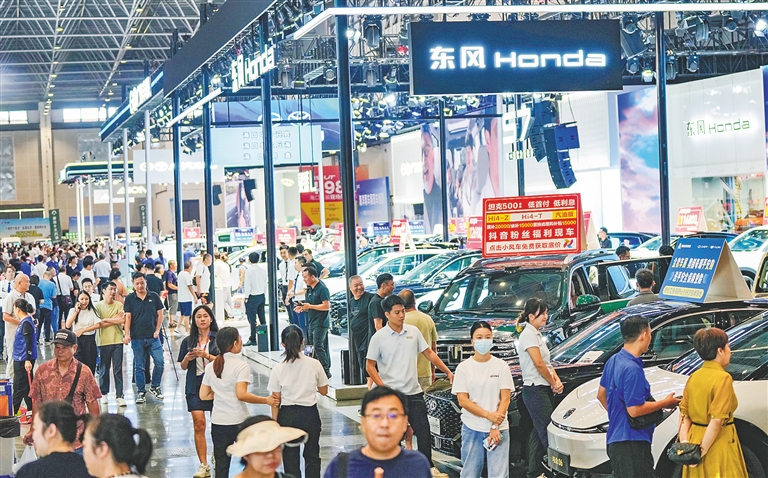
Group 1 - The 2025 Autumn Auto Show attracted nearly 35,000 visitors and generated over 200 million yuan in sales within two days, indicating strong consumer interest in vehicle purchases [3][4] - The event featured significant discounts and promotions from various car manufacturers, with notable offers such as ICAR's 2,000 yuan discount for a 12,000 yuan purchase and BYD's trial drive incentives [4][5] - The demand for new energy vehicles (NEVs) remains robust, with NEVs accounting for 60.7% of new vehicles in Hainan as of August 2025, reflecting a growing trend in the automotive market [5] Group 2 - Many new models showcased at the auto show are designed with family needs in mind, featuring larger seating capacities and amenities such as refrigerators and entertainment systems [6][7] - The introduction of family-oriented vehicles, including six and seven-seater options, highlights a shift in consumer preferences towards more spacious and comfortable cars [6][7] - Advanced features previously found only in luxury vehicles, such as zero-gravity seats and large screens, are now becoming standard in family cars, making them more accessible to average consumers [6][7]